The Effect of Artificial Intelligence–Induced Stress on Employees’ Individual Creativity: Examining the Roles of Stress-Coping Strategies and Management Commitment
Keywords:
artificial intelligence–induced stress, employees’ individual creativity, stress-coping strategies, management commitmentAbstract
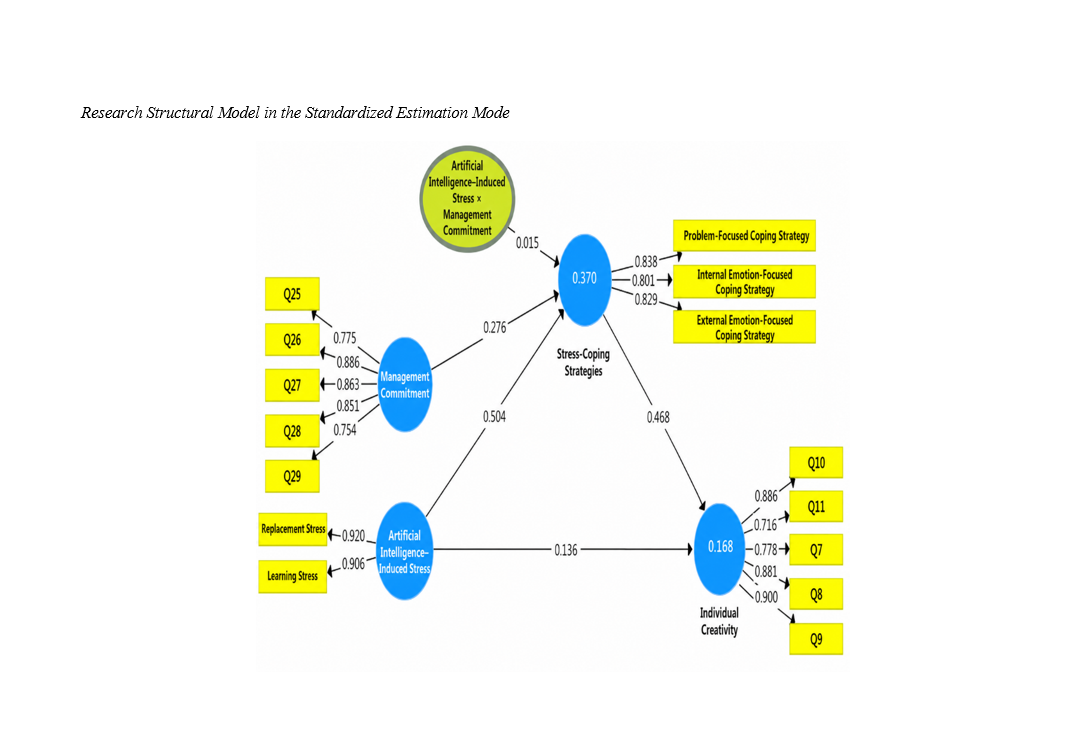
Objective: The present study aimed to investigate the effect of artificial intelligence–induced stress on employees’ individual creativity, considering the mediating role of stress-coping strategies and the moderating role of management commitment.
Methods and Materials: In terms of purpose, this was an applied study, and methodologically, it employed a descriptive survey design. The statistical population comprised all permanent employees of the Yazd City Gas Company between September 2025 and March 2026. Based on Cochran’s formula, 125 employees were selected through simple random sampling. Data were collected using the standardized questionnaire developed by Tong et al. (2025), which assessed artificial intelligence–induced stress, stress-coping strategies, individual creativity, and management commitment. The validity of the instrument was confirmed through confirmatory factor analysis, average variance extracted, and the Fornell–Larcker criterion, while its reliability was verified using Cronbach’s alpha and composite reliability. The data were analyzed using SPSS version 26 and structural equation modeling in SmartPLS version 4.
Findings: The results indicated that artificial intelligence–induced stress had a direct and significant effect on stress-coping strategies, which, in turn, significantly enhanced employees’ individual creativity. The indirect effect of artificial intelligence–induced stress on individual creativity through the mediating variable of stress-coping strategies was also confirmed. However, the direct effect of artificial intelligence–induced stress on individual creativity was not statistically significant. Furthermore, the moderating role of management commitment in the relationship between artificial intelligence–induced stress and stress-coping strategies was not confirmed.
Conclusion: The findings demonstrated that artificial intelligence–induced stress does not necessarily lead directly to a reduction in employee creativity; rather, the manner in which employees manage and cope with this stress determines its creative outcomes. The use of adaptive coping strategies can transform technology-related pressures into opportunities for learning, intrinsic motivation, and creative ideation.
Downloads
References
Benbya, H., Davenport, T. H., & Pachidi, S. (2020). Artificial Intelligence in Organizations: Current State and Future Opportunities. MIS Quarterly Executive, 19(4), 4.
Bostani, T., & Ghorban-Hosseini, M. (2020). The Effect of Job Rotation on Work Engagement with the Mediating Role of Employee Empowerment in Saveh Municipality. Accounting and Management Perspective, 3(24), 108-119.
Dubey, R., Gunasekaran, A., Childe, S., Thanos, P., & Helo, P. (2018). Supplier Relationship Management for Circular Economy: Influence of External Pressures and Top Management Commitment. Management Decision, 57(4), 767-790.
Ebrahimnejad, N. (2021). The Effect of Job Satisfaction and Organizational Commitment on Police Occupational Misconduct. Journal of Police Order and Security, 13(4), 1-26.
Eren, E., Ergulec, F., & Kara, A. (2025). The Mediating Role of Individual Innovativeness in the Relationship between Career Engagement and Artificial Intelligence Anxiety. Education and Information Technologies, 30(18), 26301-26328.
Gao, J. (2021). How Does Artificial Intelligence Influence Employee Creativity? The Mediating Role of Psychological Empowerment. Journal of Business Research, 129, 134-144.
Garriott, P. O., & Nisle, S. (2018). Stress, Coping, and Perceived Academic Goal Progress in First-Generation College Students: The Role of Institutional Supports. Journal of Diversity in Higher Education, 11(4), 436-450.
He, W. (2020). How to Motivate Employees for Sustained Innovation Behavior in the Digital Era? The Role of Psychological Empowerment. Journal of Business Research, 116, 302-312.
Hosseinzadeh Moghadam, H., Jafarzadeh, M., & Maleki, M. (2024). Examining the Relationship between Artificial Intelligence and Human Resource Functions in the Steel Industry. Quarterly Journal of Modern Research Approaches in Management and Accounting, 8(94), 1-16.
Kaya, F., Aydin, F., Schepman, A., Rodway, P., Yetişensoy, O., & Demir Kaya, M. (2022). The Roles of Personality Traits, AI Anxiety, and Demographic Factors in Attitudes toward Artificial Intelligence. International Journal of Human-Computer Interaction, 40(2), 497-514.
Khairy, H. A., Lee, Y. M., & Al-Romeedy, B. S. (2025). Leader STARA Competence and Green Competitiveness in Tourism and Hotel Enterprises: Leveraging Green Creativity and Human Capital. Journal of Hospitality and Tourism Insights, 8(6), 2338-2358.
Kim, B. J., & Lee, J. (2025). The Dark Sides of Artificial Intelligence Implementation: Examining How Corporate Social Responsibility Buffers the Impact of Artificial Intelligence-Induced Job Insecurity on Pro-Environmental Behavior through Meaningfulness of Work. Sustainable Development, 33, 4732-4756. https://doi.org/10.1002/sd.3376
Kim, J. J., Soh, J., Kadkol, S., Solomon, I., Yeh, H., Srivatsa, A. V., & Ajilore, O. (2025). AI Anxiety: A Comprehensive Analysis of Psychological Factors and Interventions. Ai and Ethics, 5(4), 3993-4009. https://doi.org/10.1007/s43681-025-00686-9
Kumar, N., Jin, Y., & Liu, Z. (2024). The Nexus between Servant Leadership and Employee’s Creative Deviance for Creativity inside Learning and Performance Goal-Oriented Organizations. Management Decision, 62(4), 1117-1137.
Li, J., & Huang, J. S. (2020). Dimensions of Artificial Intelligence Anxiety Based on the Integrated Fear Acquisition Theory. Technology in Society, 63, 101410.
Liang, H. (2019). How to Cope with Stress in the Workplace: A Review and Meta-Analysis. Journal of Organizational Behavior, 40(2), 177-195.
Liu, J., & Liu, Y. Z. (2020). Reducing the Harmful Impact of Work Stress on Creativity? Buffering Model of Available Resources. Open Journal of Social Sciences, 8, 62-76. https://doi.org/10.4236/jss.2020.82006
Manosso, L. M., Gasparini, C. R., Réus, G. Z., & Pavlovic, Z. M. (2022). Definitions and Concepts of Stress. Springer.
Mao, Y. (2021). How Does AI Anxiety Affect Employee Creativity? The Mediating Role of Coping Strategies. Journal of Business Research, 134, 1-10.
Miao, S., Komil Ugli Fayzullaev, A., & Dedahanov, A. T. (2020). Management Characteristics as Determinants of Employee Creativity: The Mediating Role of Employee Job Satisfaction. Sustainability, 12(5), 1948.
Nasaj, M., Badi, S., Murtagh, N., & Ding, L. (2025). Collective AI Anxiety and Team Innovative Behaviour: The Role of Coping Strategies. Construction Innovation. https://doi.org/10.1108/CI-08-2024-0222
Neumann, O., Guirguis, K., & Steiner, R. (2024). Exploring Artificial Intelligence Adoption in Public Organizations: A Comparative Case Study. Public Management Review, 26(1), 114-141.
Panda, T., & Swamy, T. N. V. R. L. (2025). Mapping the Evolution of Employee Creativity and Innovation in the Sphere of Business and Management: A Bibliometric Analysis in the Early 21st Century. Cogent Business & Management, 12(1), 2503425.
Rajab Dari, H., Malmir, M., & Khoramin, M. (2021). The Relationship between Ethical Leadership and Employee Creativity: The Moderating Role of Leader-Member Exchange. Ethics in Science and Technology, 16(2), 108-114.
Rezaei, F. (2024). Examining the Effect of Artificial Intelligence on Psychological Well-Being and Stress Reduction: An Analysis of the Impact of New Technology on Improving Mental Health. Cognition, Behavior, Learning, 1(1), 167-181.
Shekari, H., & Hosseini, H. (2020). Investigating the Effect of Jihadi Management on Employees’ Social Undermining with Considering the Mediating Role of Leader-Member Exchange in Youth and Sport Office in Yazd Province. Organizational Behavior Management in Sport Studies, 7(25), 137-148.
Shekari, H., Hosseini, H., & Jalalian, N. (2025). Developing a Model of the Impact of Knowledge Risk Management on Organizational Sustainability Considering the Mediating Role of Employees’ Innovative Behavior. Dynamic Management and Business Analysis, 4(3), 278-295. https://doi.org/10.61838/dmbaj.5815.0403.273
Taheri Lari, M., Rafati, M., & Ajami Khales, A. (2025). The Effect of Artificial Intelligence on Organizational Transformation with the Mediating Role of Individual Creativity, Organizational Innovation, and Knowledge Management. First National Conference on Human Capital Management Challenges in Large-Scale Organizations, Mashhad.
Tong, H., Yu, J., & Shou, M. (2025). Mitigating the Effect of AI Anxiety on Employees’ Creativity: A Social Cognitive Perspective. Journal of Digital Management, 1, 7. https://doi.org/10.1007/s44362-025-00006-5
Wang, X. L., Lei, N., & Hou, Y. Z. (2020). How Does Human Resource Department's Client Relationship Management Affect Sustainable Enterprise Performance in the Context of Artificial Intelligence? International Journal of Technology Management, 84(1), 50-69.
Yazdanmehr, A., Li, Y., & Wang, J. (2023). Employee Responses to Information Security Related Stress: Coping and Violation Intention. Information Systems Journal, 33(3), 598-639.
Yin, M., Jiang, S., & Niu, X. (2024). Can AI Really Help? The Double-Edged Sword Effect of AI Assistant on Employees’ Innovation Behavior. Computers in human Behavior, 150, 107987.
Yohanna, F., & Suleiman, S. I. (2024). The Impact of Artificial Intelligence on Creativity, Innovation and Intellectual Property Rights in Nigeria. Imam Ja'afar Al-Sadiq University Journal of Legal Studies, 4(2), 6. https://doi.org/10.64682/3104-9419.1101
Yuan, L. (2022). Individual Differences in Creativity: A Meta-Analysis. Journal of Creative Behavior, 56(1), 3-20.
Downloads
Additional Files
Publication Timeline
- Submitted
- Revised
- Accepted