An Operational Model for Utilizing Social Media to Enhance the Quality of Public Relations in the Insurance Industry
Keywords:
Social Media, Digital Public Relations, Operational Model, Insurance Industry, Grounded Theory, Quality DevelopmentAbstract
Objective: This study aimed to develop an operational model for the effective utilization of social media to improve the quality of public relations in the insurance industry.
Methods and Materials: The study employed a qualitative research design based on grounded theory. Data were collected through semi-structured interviews with 14 academic experts, executive managers, and professionals with relevant experience in public relations, social media, and the insurance industry. Participants were selected purposively according to their expertise and continued until theoretical saturation was achieved. The interview data were analyzed through open, axial, and selective coding.
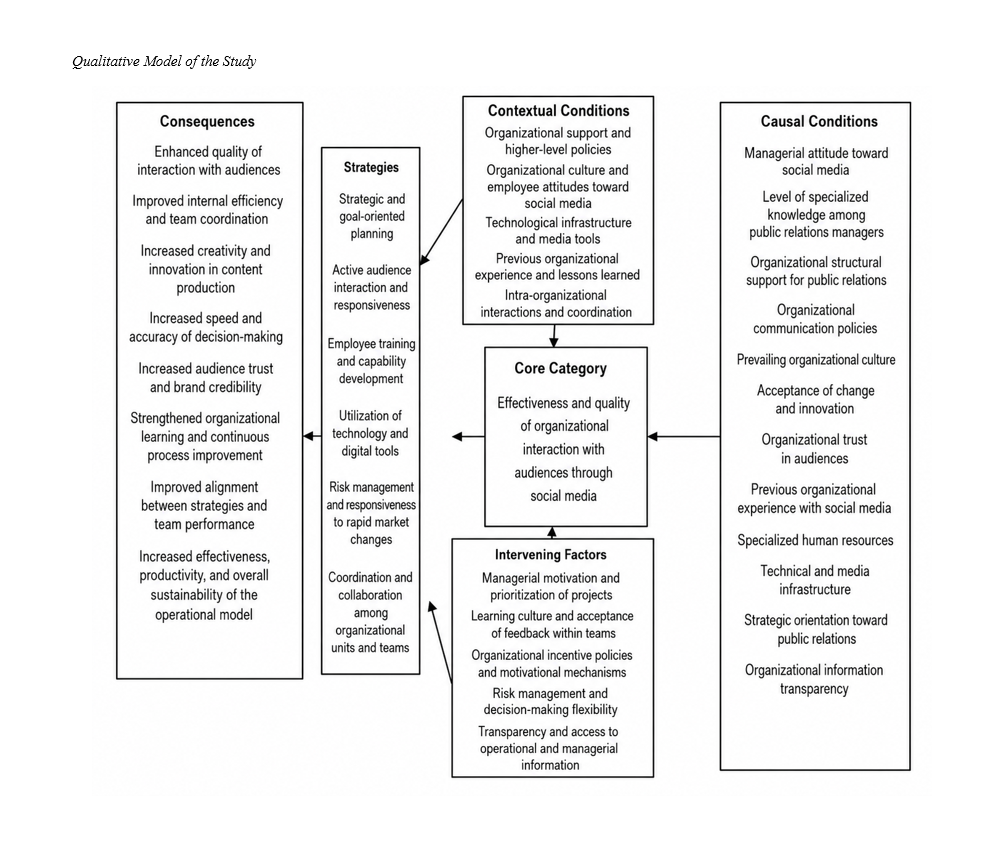
Findings: The analysis indicated that managerial attitudes toward social media, managers’ strategic knowledge and expertise, and organizational structural support constituted the principal causal conditions for effective social media utilization. Transparent communication policies and an open organizational culture provided the contextual foundation required for implementing the model. Specialized human resources, technical infrastructure, managerial motivation and prioritization, acceptance of innovation, and active feedback mechanisms emerged as intervening factors that could either facilitate or constrain implementation. The principal operational strategies included strategic planning, continuous employee training, application of digital technologies, rapid responsiveness to stakeholders, communication-risk management, and coordination among organizational units. The implementation of these strategies was inferred to enhance audience interaction, strengthen public trust and satisfaction, improve internal team efficiency, foster creativity and innovation, accelerate data-driven decision-making, and reinforce organizational reputation and brand image.
Conclusion: The effective use of social media in insurance-industry public relations depends on the coordinated interaction of managerial decisions, organizational structures, workplace culture, skilled human resources, and technological capacities. Systematic implementation of the proposed model can improve the sustainability, effectiveness, responsiveness, and overall quality of public relations practices.
Downloads
References
Ahmad, M. B., Hussain, A., & Ahmad, F. (2022). The Use of Social Media at Workplace and Its Influence on the Productivity of the Employees in the Era of COVID-19. SN Business & Economics, 2(10), 156. https://doi.org/10.1007/s43546-022-00335-x
Al Azzam, A. F. (2024). Examining the Influence of Integrated Marketing Communications on Firm Performance: An Empirical Study. Journal of System and Management Sciences, 14(3), 418-436.
Avani, A., Rashidi, E., & Barmaki, H. (2022). The Effect of Social Media Use on Organizational Communications and Job Performance of Employees: A Case Study of Parsian Insurance Company. Psychological Research in Management, 8(2), 203-219.
Baima, G., Santoro, G., Pellicelli, A., & Mitrega, M. (2022). Testing the Antecedents of Customer Knowledge Sharing on Social Media: A Quantitative Analysis on Italian Consumers. International Marketing Review, 39, 16.
Boyatzis, R. E., Grant, A., Passarelli, A., & Taylor, S. (2019). Desired Outcomes in Coaching: Coaching for "Sticky" Intentional Change Academy of Management Proceedings, Briarcliff Manor, NY.
Cao, X. F., & Yu, L. L. (2019). Exploring the Influence of Excessive Social Media Use at Work: A Three-Dimension Usage Perspective. International Journal of Information Management, 46, 83-92.
Compomori, F., & Casula, M. (2022). How to Frame the Governance Dimension of Social Innovation: Theoretical Considerations and Empirical Evidence. Innovation: The European Journal of Social Science Research, 4. https://doi.org/10.1080/13511610.2022.2036952
Cooke, F. L., Dickmann, M., & Parry, P. (2020). Important Issues in Human Resource Management: Introduction to the 2020 Review Issue. 1, 1-5.
Dailah, H. G., & Naeem, M. (2021). A Social Media Organizational Productivity Model: Insights From Public Health Professionals. Journal of medical Internet research, 23(5), e23792. https://doi.org/10.2196/23792
Dastgerdi, M., Mohammadi, M., Yaghoubi, N. M., & Mahmoudzadeh, M. (2021). Designing an Organizational Coaching Model in Iranian Governmental Organizations Using a Grounded Theory Approach. Journal of Organizational Culture Management, 19, 529-550.
DiGirolamo, J. A., & Tkach, J. T. (2019). An Exploration of Managers and Leaders Using Coaching Skills. Consulting Psychology Journal: Practice and Research, 71(3), 195-218.
Eidi, H., Karimi, J., & Mohammadi Askarabadi, M. (2019). The Effect of Human Resource Meritocracy on Organizational Effectiveness: The Mediating Role of Organizational Innovation. Human Resource Management in Sport, 6(2), 195-205.
Fehrer, J. A., Baker, J. J., & Carroll, C. E. (2022). The Role of Public Relations in Shaping Service Ecosystems for Social Change. Journal of Service Management, 33(4/5), 614-633. https://doi.org/10.1108/JOSM-01-2022-0044
Hosseini, S. F., Batmani, M. A., Vakili, Y., & Naghehchi, M. (2020). Explaining the Role of Dimensions of Social Network Use on Employee Performance with Emphasis on the Mediating Role of Social Capital. Sustainable Human Resource Management, 2(3), 7-26.
Jong, D., Chen, S. C., Ruangkanjanases, A., & Chang, Y. H. (2021). The Impact of Social Media Usage on Work Efficiency: The Perspectives of Media Synchronicity and Gratifications. Frontiers in psychology, 12, 693183. https://doi.org/10.3389/fpsyg.2021.693183
Korzynski, P., Mazurek, G., & Haenlein, M. (2020). Leveraging Employees as Spokespeople in Your HR Strategy: How Company-Related Employee Posts on Social Media Can Help Firms to Attract New Talent. European Management Journal, 38(1), 204-212.
Kretschmer, J., & Winkler, P. (2024). Prospects and Risks of Digitalization in Public Relations Research: Mapping Recurrent Narratives of a Debate in Fragmentation (2010-2022). Journal of Communication Management, 28(2), 193-210. https://doi.org/10.1108/JCOM-02-2023-0020
Liu, M., Kean, W., & Xu, J. (2019). How Will Blockchain Technology Impact Auditing and Accounting: Permissionless versus Permissioned Blockchain. Current Issues in Auditing, 13, 19-29.
Mohammadi, D. (2019). Analysis of Factors Affecting Mobile Acceptance of Electronic Services in the Insurance Industry Using the Fuzzy Analytic Network Process. New Marketing Research, 9(3), 159-178.
Mohammadpour Gharbi, Y., & Hassanzadeh, S. (2022). Examining the Role of Public Relations in Participation and Social Communications in Organizations. 18th National Conference on Psychology, Educational Sciences, and Social Sciences, Babol.
Pargmann, J., Riebenbauer, E., & Flick-Holtsch, D. (2023). Digitalisation in Accounting: A Systematic Literature Review of Activities and Implications for Competences. Empirical Research in Vocational Education and Training, 15, 1. https://doi.org/10.1186/s40461-023-00141-1
Sabai, R. (2023). Examining the Model of the Desirable Administrative System and Its Localization in Private Companies University of Tehran]. Tehran.
Sahiba, Z., & Hassan, S. A. (2025). Analysing the Role of Public Relations in Corporate Social Responsibility. International Journal of Procurement Management, 22(2), 218-237. https://doi.org/10.1504/IJPM.2025.144002
Shoul, A. (2025). The role of public relations in institutional image-making and enhancing the symbolic capital of municipalities Shirvan. https://civilica.com/doc/2370286
Song, Q., Wang, Y., Chen, Y., Benitez, J., & Hu, J. (2019). Impact of the Usage of Social Media in the Workplace on Team and Employee Performance. Information & Management, 56(8), 103160.
Tajpour, M., & Hosseini, E. (2021). Entrepreneurial Intention, and the Performance of Digital Startups: The Mediating Role of Social Media. Journal of Content, Community & Communication, 13, 2456-9011.
Umaru, H. A., Chiakaan, G. J., & Kaigama, K. P. (2025). Public relations and image management of the Nigeria Police Force in Adamawa State. Journal of Social Sciences, Management and Humanities, 6(4), 41-57.
Yaqub, M. Z., & Alsabban, A. (2023). Knowledge Sharing through Social Media Platforms in the Silicon Age. Sustainability, 15, 6765. https://doi.org/10.3390/su15086765
Yuan, B., Li, J., & Zeng, G. (2018). Trapped as a Good Worker: The Influence of Coercive Acquaintance Advertising on Work Outcomes. Cornell Hospitality Quarterly, 59(4), 428-441.
Zhang, X., Ma, L., Xu, B., & Xu, F. (2019). How Social Media Usage Affects Employees' Job Satisfaction and Turnover Intention: An Empirical Study in China. Information & Management, 56, 12.
Zhou, Q., Li, H., & Li, B. (2023). Employee Posts on Personal Social Media: The Mediation Role of Work-Life Conflict on Employee Engagement. Current Psychology, 42, 32338-32354. https://doi.org/10.1007/s12144-022-04218-0
Zhou, R., Luo, Z., Zhong, S., Zhang, X., & Liu, Y. (2022). The Impact of Social Media on Employee Mental Health and Behavior Based on the Context of Intelligence-Driven Digital Data. International journal of environmental research and public health, 19, 16965. https://doi.org/10.3390/ijerph192416965
Downloads
Additional Files
Publication Timeline
- Submitted
- Revised
- Accepted