From Digital Transformation to Responsible Generative AI: Mapping Human-Centered Readiness in Iranian Public Organizations
Keywords:
Digital Transformation, Responsible Generative AI, Human-Centered Readiness, Public Organizations, Survey Study, IranAbstract
Objective: This study aimed to map human-centered readiness for responsible generative artificial intelligence in Iranian public organizations during the transition from digital transformation to AI-supported public administration.
Methods and Materials: This applied quantitative study employed a survey-based descriptive–analytical design and was conducted in 2025. The statistical population consisted of managers, experts, and administrative employees of selected public organizations in Tehran with active information technology, e-government, digital services, or digital transformation units. The sampling frame included public organizations from six functional domains: administrative–regulatory, economic–financial, social–welfare, health–service, educational, and digital-infrastructure sectors. Using multistage stratified cluster sampling, 384 valid responses were collected from managers and supervisors, IT and digital transformation experts, and administrative employees. Data were gathered through a researcher-made questionnaire measuring seven dimensions: technological preparedness, human resource readiness, ethical awareness, algorithmic trust, employee concerns, managerial and organizational support, and human-centered work practices. The validity of the instrument was examined through face and content validity procedures, including expert review, CVR, and CVI assessment. Reliability was evaluated using Cronbach’s alpha. Data were analyzed using SPSS through descriptive statistics, one-sample t-test, Friedman test, independent-samples t-test, and one-way ANOVA.
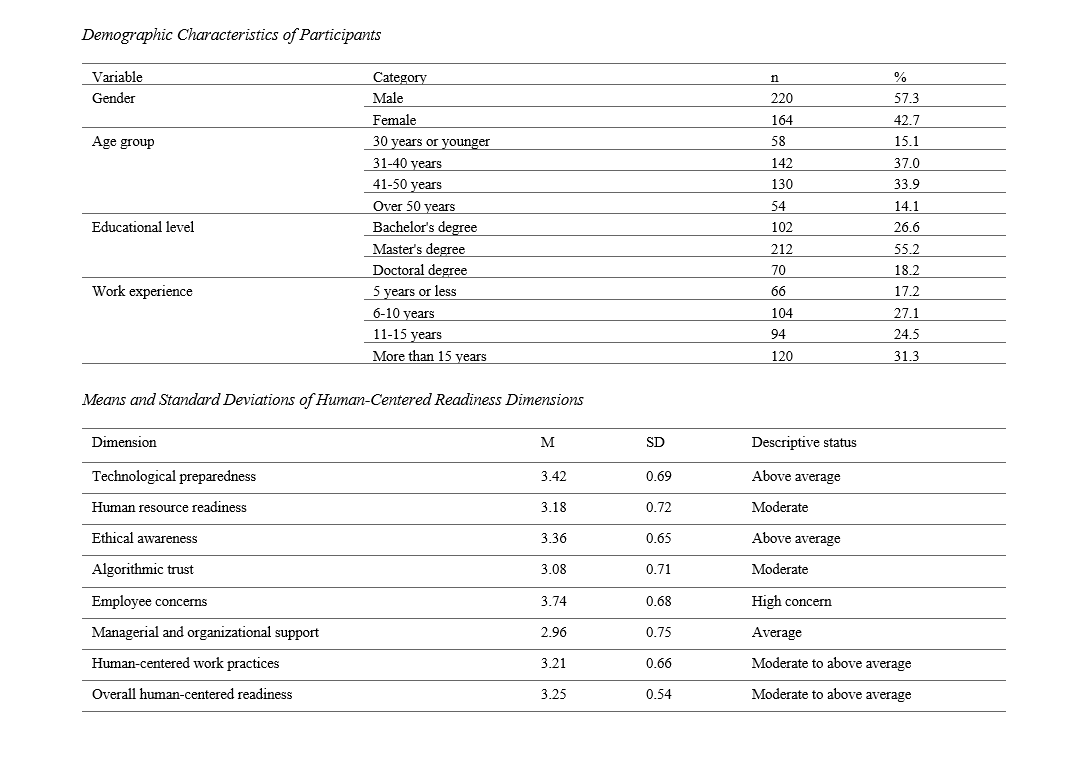
Findings: The results showed that overall human-centered readiness was moderate to above average (M = 3.25, SD = 0.54) and significantly higher than the theoretical midpoint of the scale. Among the dimensions, employee concerns had the highest mean score (M = 3.74), indicating that perceived risks, confidentiality issues, responsibility ambiguity, and job-related concerns were highly salient. Technological preparedness (M = 3.42) and ethical awareness (M = 3.36) were also above average. In contrast, managerial and organizational support had the lowest mean score (M = 2.96) and was not significantly different from the theoretical midpoint, suggesting a weaker level of formal guidance, training, and policy support. Friedman ranking confirmed that employee concerns ranked first, whereas managerial and organizational support ranked last. Significant differences were also observed in overall readiness according to job position and type of organization.
Conclusion: The findings indicate that readiness for responsible generative AI in Iranian public organizations is a multidimensional condition that extends beyond technological infrastructure. Although selected public organizations in Tehran have developed some foundations for digital transformation, responsible generative AI adoption requires stronger managerial support, clearer policies, employee training, ethical guidance, and human-centered governance mechanisms. The study provides a practical readiness map for policymakers and public-sector managers seeking to move from general digital transformation toward responsible, trustworthy, and employee-centered use of generative AI.
Downloads
References
Batool, A., Zowghi, D., & Bano, M. (2025). AI Governance: A Systematic Literature Review. Ai and Ethics, 5, 3265-3279. https://doi.org/10.1007/s43681-024-00653-w
Bright, J., Enock, F. E., Esnaashari, S., Francis, J., Hashem, Y., & Morgan, D. (2025). Generative AI Is Already Widespread in the Public Sector: Evidence from a Survey of UK Public Sector Professionals. Digital Government: Research and Practice, 6(1) 1-14. https://doi.org/10.1145/3700140
Brynjolfsson, E., Li, D., & Raymond, L. (2025). Generative AI at Work. The Quarterly Journal of Economics, 140(2), 889-942. https://doi.org/10.1093/qje/qjae044
Calvino, F., Reijerink, J., & Samek, L. (2025). The Effects of Generative AI on Productivity, Innovation and Entrepreneurship (OECD Artificial Intelligence Papers, Issue.
Cheng, B., Lin, H., & Kong, Y. (2023). Challenge or Hindrance? How and When Organizational Artificial Intelligence Adoption Influences Employee Job Crafting. Journal of Business Research, 164, 113987. https://doi.org/10.1016/j.jbusres.2023.113987
Feuerriegel, S., Hartmann, J., Janiesch, C., & Zschech, P. (2024). Generative AI. Business & Information Systems Engineering, 66(1), 111-126. https://doi.org/10.1007/s12599-023-00834-7
Floridi, L., Cowls, J., Beltrametti, M., Chatila, R., Chazerand, P., Dignum, V., Luetge, C., Madelin, R., Pagallo, U., Rossi, F., Schafer, B., Valcke, P., & Vayena, E. (2018). AI4People—An Ethical Framework for a Good AI Society: Opportunities, Risks, Principles, and Recommendations. Minds and Machines, 28(4), 689-707. https://doi.org/10.1007/s11023-018-9482-5
Janssen, M. (2025). Responsible Governance of Generative AI: Conceptualizing GenAI as Complex Adaptive Systems. Policy and Society, 44(1), 38-51. https://doi.org/10.1093/polsoc/puae040
Jobin, A., Ienca, M., & Vayena, E. (2019). The Global Landscape of AI Ethics Guidelines. Nature Machine Intelligence, 1, 389-399. https://doi.org/10.1038/s42256-019-0088-2
Jöhnk, J., Weißert, M., & Wyrtki, K. (2021). Ready or Not, AI Comes—An Interview Study of Organizational AI Readiness Factors. Business & Information Systems Engineering, 63(1), 5-20. https://doi.org/10.1007/s12599-020-00676-7
Liu, Y., Sheng, F., & Liu, R. (2025). Generative AI Adoption and Employee Outcomes: A Conservation of Resources Perspective on Job Crafting, Career Commitment, and the Moderating Role of Liking of AI. Humanities and Social Sciences Communications, 12, 1376. https://doi.org/10.1057/s41599-025-05656-4
Lokuge, S., Sedera, D., Grover, V., & Xu, D. (2019). Organizational Readiness for Digital Innovation: Development and Empirical Calibration of a Construct. Information & Management, 56(3), 445-461. https://doi.org/10.1016/j.im.2018.09.001
Mergel, I., Edelmann, N., & Haug, N. (2019). Defining Digital Transformation: Results from Expert Interviews. Government Information Quarterly, 36(4), 101385. https://doi.org/10.1016/j.giq.2019.06.002
Mökander, J., Schuett, J., Kirk, H. R., & Floridi, L. (2024). Auditing Large Language Models: A Three-Layered Approach. Ai and Ethics, 4, 1085-1115. https://doi.org/10.1007/s43681-023-00289-2
National Institute of, S., & Technology. (2023). Artificial Intelligence Risk Management Framework (AI RMF 1.0).
Noy, S., & Zhang, W. (2023). Experimental Evidence on the Productivity Effects of Generative Artificial Intelligence. Science, 381(6654), 187-192. https://doi.org/10.1126/science.adh2586
Oecd, & Unesco. (2024). G7 Toolkit for Artificial Intelligence in the Public Sector.
Shneiderman, B. (2020). Human-Centered Artificial Intelligence: Reliable, Safe & Trustworthy. International Journal of Human–Computer Interaction, 36(6), 495-504. https://doi.org/10.1080/10447318.2020.1741118
Verhoef, P. C., Broekhuizen, T., Bart, Y., Bhattacharya, A., Qi Dong, J., Fabian, N., & Haenlein, M. (2021). Digital Transformation: A Multidisciplinary Reflection and Research Agenda. Journal of Business Research, 122, 889-901. https://doi.org/10.1016/j.jbusres.2019.09.022
Vial, G. (2019). Understanding Digital Transformation: A Review and a Research Agenda. The Journal of Strategic Information Systems, 28(2), 118-144. https://doi.org/10.1016/j.jsis.2019.01.003
Weerts, S. (2025). Generative AI in Public Administration in Light of the Regulatory Awakening in the US and EU. Cambridge Forum on AI: Law and Governance, 1, e3. https://doi.org/10.1017/cfl.2024.10
Wirtz, B. W., Weyerer, J. C., & Geyer, C. (2019). Artificial Intelligence and the Public Sector—Applications and Challenges. International Journal of Public Administration, 42(7), 596-615. https://doi.org/10.1080/01900692.2018.1498103
Xu, W. (2019). Toward Human-Centered AI: A Perspective from Human-Computer Interaction. Interactions, 26(4), 42-46.
Downloads
Additional Files
Publication Timeline
- Submitted
- Revised
- Accepted