
Futures Studies of the Key Drivers Influencing Extensible Business Reporting Language (XBRL) in Capital Market Companies
Keywords:
Extensible Business Reporting Language (XBRL), Futures Studies, Scenario Planning, Key Drivers, Capital Market, Financial ReportingAbstract
Objective: This study aimed to identify and analyze the key future drivers influencing the implementation and development of Extensible Business Reporting Language (XBRL) within companies operating in the capital market.
Methods and Materials: This research was exploratory and developmental in terms of its purpose and intended outcomes and employed a qualitative futures-studies approach. In the first phase, thematic analysis was conducted to identify the principal functions and drivers associated with the implementation of XBRL. Data were collected through 12 semi-structured interviews with relevant experts and subsequently coded and categorized into basic, organizing, and global themes. The reliability and acceptability of the identified themes were then assessed using the Delphi technique. Following validation of the thematic structure, scenario planning was employed to develop alternative future perspectives concerning the implementation and expansion of XBRL in capital market companies. Two highly influential and uncertain drivers were selected as the principal axes for constructing the scenario matrix.
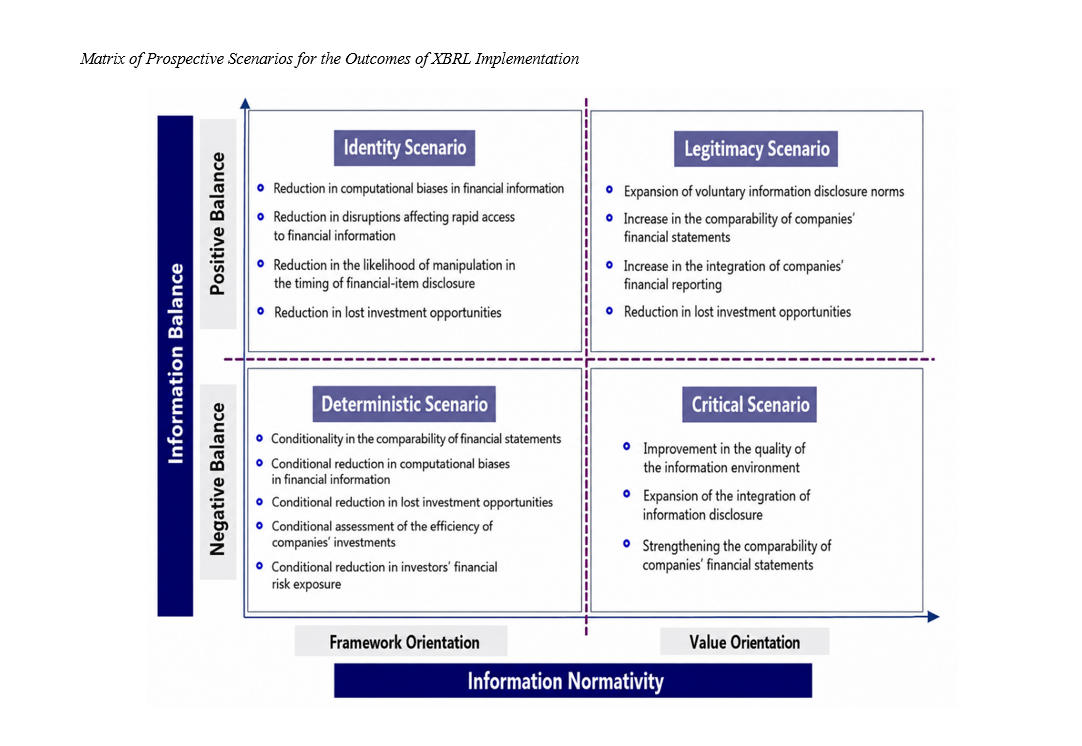
Findings: The thematic analysis initially identified 3 global themes, 6 organizing themes, and 33 basic themes relating to the implementation and future development of XBRL. The Delphi analysis resulted in the elimination of three basic themes, while the remaining themes achieved expert confirmation and were retained in the final framework. In the scenario-planning phase, two drivers—“information symmetry” (E1) and “information normativity” (E2)—were identified as the most decisive dimensions shaping future conditions. The interaction between these two critical drivers generated a four-quadrant scenario matrix representing four distinct prospective configurations for evaluating the future implementation and development of XBRL in capital market companies.
Conclusion: The findings demonstrate that the future effectiveness of XBRL implementation in capital markets depends substantially on improvements in information symmetry and the institutionalization of information norms, and the four developed scenarios can provide a strategic framework for policymakers, regulators, and market participants when planning future digital financial-reporting systems.
Downloads
References
Abdollahi, A., & Monzavi, T. (2011). Identification and Prioritization of Scenarios for Implementing Extensible Business Reporting Language in Iran's Capital Market. Securities Exchange Journal, 4(14), 203-228.
Abhishek, N. (2023). Impact of XBRL Technology on Quality of Financial Data: Mediating Through Various Reporting Aspects in India. In Artificial Intelligence (AI) and Finance (Vol. 488, pp. 36-81). Springer. https://doi.org/10.1007/978-3-031-39158-3_21
Al-Okaily, M. (2024). The Influence of Digital Disclosure Language Adoption on Decrease Financial Information Asymmetry and Increase Its Quality. Information Discovery and Delivery. https://doi.org/10.1108/IDD-03-2024-0045
Al-Okaily, M., Boshnak, H., Alkayed, H., Shehadeh, E., & Alqam, M. (2024). From Traditional to Digital: The Role of XBRL Adoption in Improving Financial Statements Transparency. Global Knowledge, Memory and Communication. https://doi.org/10.1108/GKMC-04-2023-0117
Alghazzawi, R. (2025). The Mediating Role of Regulations in the Effectiveness of XBRL in Emerging Markets: The Case of Jordan. Discover Sustainability, 6(6), 73-93. https://doi.org/10.1007/s43621-025-00800-1
Borgi, H., & Tawiah, V. (2022). Determinants of eXtensible Business Reporting Language Adoption: An Institutional Perspective. International Journal of Accounting & Information Management, 30(3), 352-371. https://doi.org/10.1108/IJAIM-11-2021-0242
Chavoshi, S. K., Nouri, R., & Falatounnejad, F. (2018). Examining the Effect of Extensible Business Reporting Language (XBRL) Implementation on Financial Analysts' Behavior in Iran: A Structural Equation Modeling Approach. Asset Management and Financing, 6(2), 99-120.
Divyashree, M. S., Rahiman, H. U., Kulal, A., & Kulal, M. (2024). The Influence of XBRL Technology on the Quality of Financial Reporting: Exploring Mediating Variables in the Indian Context. The Bottom Line, 37(2), 207-237. https://doi.org/10.1108/BL-04-2023-0108
Fradeani, A. (2022). The Potential Contribution of XBRL. In Non-Financial Disclosure and Integrated Reporting. Springer. https://doi.org/10.1007/978-3-030-90355-8_16
Fülbier, R. U., & Sellhorn, T. (2023). Understanding and Improving the Language of Business: How Accounting and Corporate Reporting Research Can Better Serve Business and Society. Journal of Business Economics, 93(2), 1089-1124. https://doi.org/10.1007/s11573-023-01158-4
Mehrabanpour, M., Rahmani, A., & Mirbalouk, F. (2024). Feasibility of Adopting Extensible Business Reporting Language: The Perspective of Financial Employees in Holding Companies. Financial Accounting Knowledge, 11(1), 31-61.
Mohammadi, J., & Khozin, A. (2017). Examining the Role of Extensible Business Reporting Language (XBRL) Implementation in Improving Financial Reporting Quality, Increasing Financial Information Transparency, and Reducing Information Asymmetry. Accounting and Social Interests, 7(3), 41-60.
Nazemi Ardakani, M., Zare Hosseinabadi, H., & Zare Mehrjerdi, V. (2016). The Effect of Extensible Business Reporting Language on Firm Performance Using the Generalized Method of Moments (GMM). Accounting Reviews, 3(12), 65-82.
Plant, K., Barac, K., & De Jager, H. (2017). Developing Early Career Professional Auditors at Work: What Are the Determinants of Success? Meditari Accountancy Research. https://doi.org/10.1108/MEDAR-03-2017-0119
Sassi, W., Ben Othman, H., & Hussainey, K. (2024). The Determinants of eXtensible Business Reporting Language (XBRL) Adoption: A Cross-Country Study. International Journal of Disclosure and Governance, 21(2), 175-192. https://doi.org/10.1057/s41310-023-00192-6
Scheibelhofer, E. (2023). The Interpretive Interview: An Interview Form Centring on Research Participants' Constructions. International Journal of Qualitative Methods, 4(1), 56-79. https://doi.org/10.1177/16094069231168748
Tawiah, V., & Borgi, H. (2022). Impact of XBRL Adoption on Financial Reporting Quality: A Global Evidence. Accounting Research Journal, 35(6), 815-833. https://doi.org/10.1108/ARJ-01-2022-0002
Wahyudi, S. T., Sari, K., Nabella, R. S., & Zubaidah, D. D. (2022). Improving Bank Efficiency and Reducing Asymmetric Information Through Innovation on Extensible Business Reporting Language. In Modeling Economic Growth in Contemporary Indonesia (pp. 299-317). Emerald Publishing Limited. https://doi.org/10.1108/978-1-80262-431-120221018
Zahmatkesh, Z., Moeinoddin, M., & Nazemi Ardakani, M. (2019). Examining the Effect of Extensible Business Reporting Language on Financial Information Transparency in Companies Listed on the Tehran Stock Exchange. Applied Research in Financial Reporting, 8(1), 147-171.
Downloads
Additional Files
Publication Timeline
- Submitted
- Revised
- Accepted