A Multi-Grounded Model of Organizational Extra-Role Behavior in the Banking Sector: A case of Tejarat Bank
Keywords:
Extra-Role Behavior, Organizational Citizenship Behavior, Multi-Grounded Theory, Organizational Support, Organizational Justice, Leadership, Banking EmployeesAbstract
Objective: This study aimed to develop a contextually grounded model of organizational extra-role behaviors among employees of Tejarat Bank by identifying their individual, group, and organizational antecedents, manifestations, mechanisms, and consequences.
Methods and Materials: This qualitative exploratory study was conducted using the Multi-Grounded Theory approach. The study population consisted of employees working in Tejarat Bank branches in Tehran Province. Participants were selected through purposive theoretical sampling with attention to variation in organizational role, work experience, age, gender, and branch type. The final sample included 25 employees comprising branch managers, specialists, and operational staff. Data were collected through in-depth semi-structured interviews, non-participant field observations, and analysis of organizational documents. Interviews lasted approximately 45–90 minutes and were transcribed verbatim. Data analysis proceeded concurrently with data collection through inductive open coding, conceptual refinement, axial coding, selective coding, constant comparison, memo writing, theoretical grounding, and empirical validation. Trustworthiness was enhanced through triangulation, member checking, negative-case analysis, peer review, and maintenance of an analytical audit trail.
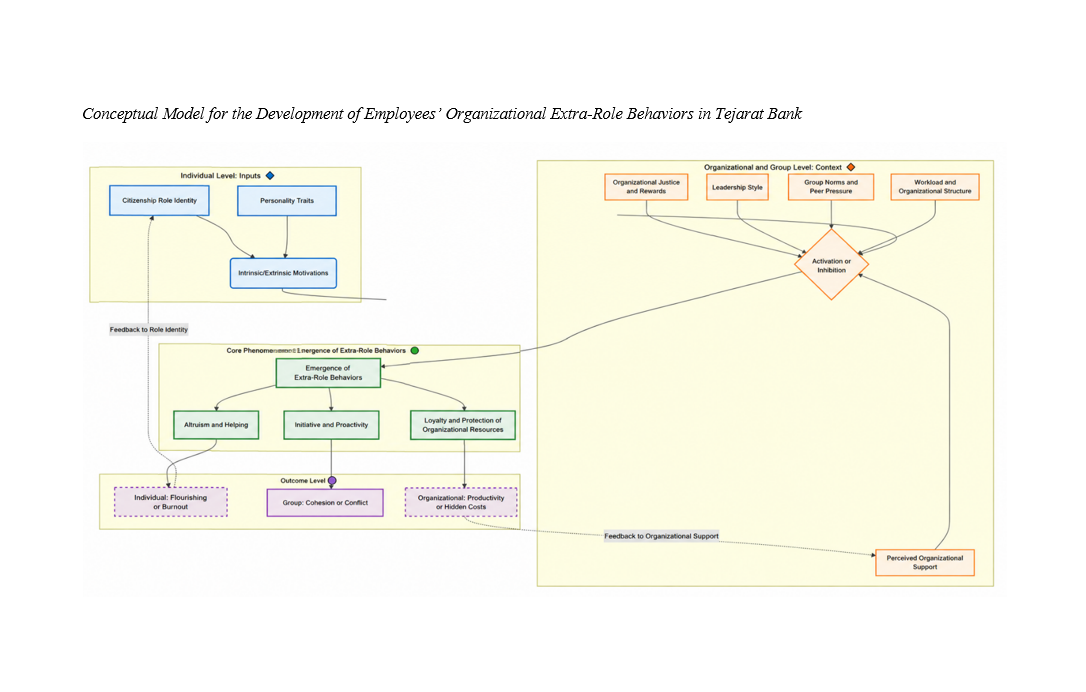
Findings: The analysis generated 210 initial codes that were progressively organized into four major axial categories: employees’ extra-role motivations, organizational and group supportive mechanisms, informal norms and team interactions, and positive and negative consequences of extra-role behavior. The final model indicated that extra-role behavior emerged from interactions among citizenship role identity, intrinsic and extrinsic motivation, facilitative leadership, organizational justice, perceived organizational support, workload, organizational structure, and informal group norms. Extra-role behaviors were manifested through altruism and helping, initiative and proactivity, and loyalty and protection of organizational resources. Supported and balanced extra-role behavior produced individual flourishing, group cohesion, customer-oriented value, and organizational productivity, whereas excessive, unrecognized, or implicitly compulsory behavior generated burnout, work–family conflict, perceived exploitation, psychological withdrawal, and hidden organizational costs.
Conclusion: Organizational extra-role behavior in Tejarat Bank is a dynamic multilevel phenomenon whose sustainability depends on the alignment of individual motivation and role identity with supportive leadership, fair organizational systems, constructive group norms, manageable workload, and appropriate recognition; therefore, developing extra-role behavior requires simultaneously strengthening enabling conditions and preventing the transformation of voluntary citizenship into an excessive or compulsory role burden.
Downloads
References
Aamir, M., Shahid, A. U., Tufail, H. S., & Shahid, J. (2021). Organizational Learning and Innovation and Its Impact on Professional Accountants Organizational Citizenship Behaviour: Evidence From Pakistan. Sustainable Business and Society in Emerging Economies, 3(1), 13-24. https://doi.org/10.26710/sbsee.v3i1.1810
Ali, H. M., Shohib, M. W., & Ibrahim, M. B. (2021). Validating a Model of OCBIP Practices in Indonesian Islamic Higher Education Institutions: A Structural Equation Modeling Approach. IIUM Journal of Educational Studies, 9(2), 64-88. https://doi.org/10.31436/ijes.v9i2.317
Ansori, M. A., & Wulansari, N. A. (2021). The Effect of Perceived Organizational Support and Psychological Capital on OCB: Mediating Role of Engagement. Diponegoro International Journal of Business, 4(2), 69-81. https://doi.org/10.14710/dijb.4.2.2021.69-81
Dewi, M., Hartono, E., & Wibowo, S. N. (2022). The Influence of Leadership and Work Communication on Organizational Citizenship Behavior. IJESS International Journal of Education and Social Science, 3(1), 23-32. https://doi.org/10.56371/ijess.v3i1.72
Giancaspro, M. L., Callea, A., & Manuti, A. (2022). “I Like It Like That”: A Study on the Relationship Between Psychological Capital, Work Engagement and Extra-Role Behavior. Sustainability, 14(4), 2022. https://doi.org/10.3390/su14042022
Ha, T.-S., & Moon, K.-K. (2023). Distributive Justice, Goal Clarity, and Organizational Citizenship Behavior: The Moderating Role of Transactional and Transformational Leadership. Sustainability, 15(9), 7403. https://doi.org/10.3390/su15097403
Hassan, R., Asimiran, S., Basri, R., & Omar, Z. (2021). Organizational Citizenship Behavior of Academic Staff in Malaysian Research Universities. International Journal of Academic Research in Business and Social Sciences, 11(8). https://doi.org/10.6007/ijarbss/v11-i8/10050
Hossain, A., Ahamed, M. M., Hasan, M. R., & Islam, S. A. (2024). Unlocking the Power of Health Safety and Welfare Practices: Exploring the Impact on Organizational Citizenship Behavior in Bangladesh’s Fish Processing Industry. Khulna University Business Review(18). https://doi.org/10.35649/kubr.2023..18.1.1
Ismail, S., Ismail, I. A., Omar, Z., Alias, S. N., & Rami, A. A. M. (2021). School Climate and Its Influence on Organizational Citizenship Behavior: A Theoretical Framework. International Journal of Academic Research in Business and Social Sciences, 11(6). https://doi.org/10.6007/ijarbss/v11-i6/9926
Ismail, S., Omar, Z., Ismail, I. A., Alias, S. N., & Rami, A. A. M. (2021). Item Generation Stage: Teachers’ Organizational Citizenship Behavior. Pertanika Journal of Social Sciences and Humanities, 29(4), 2503-2523. https://doi.org/10.47836/pjssh.29.4.23
Khaliq, A. A., Farooqi, U., Shehzadi, S., & Afzal, H. A. (2023). Going Beyond Job Duties Burdening Employees: A Systematic Review. Multidisciplinary Reviews, 7(1), 2024011. https://doi.org/10.31893/multirev.2024011
Ko, S.-H., Choi, Y., Kim, J.-S., & Kang, H. C. (2023). Employees’ Perceptions of Corporate Social Responsibility and Their Extra-Role Behaviors: A Psychological Mechanism. Sustainability, 15(18), 13394. https://doi.org/10.3390/su151813394
Krishnan, R., Muthusamy, G., Alias, N. E., Romaiha, N. R., & Kanchymalay, K. (2023). Examining the Work Engagement-Organizational Citizenship Behavior Link: The Moderating Role of Employee Personality. Information Management and Business Review, 15(4(SI)I), 219-230. https://doi.org/10.22610/imbr.v15i4(si)i.3596
Li, N., Zhu, J. N., Su, Q., & Xu, Q. (2024). A Daily Exercise Prescription When Work Gets Tough: The Moderating Effect of Work Demands on the Relationship Between Daily Physical Exercise and Next-Day Well-Being and Job Performance. Journal of occupational health psychology, 29(5), 342-358. https://doi.org/10.1037/ocp0000385
Liang, H. L. (2025). The Impact of Compulsory Citizenship Behavior on Employee Complaints: Exploring the Mediating Role of Anger and the Moderating Effect of Leader-Member Exchange. Sage Open, 15(4). https://doi.org/10.1177/21582440251393195
Liu, Z., Chen, C., Cui, H., & Hu, Y. (2023). The Relationship Between Nurses’ Social Network Degree Centrality and Organizational Citizenship Behavior: The Multiple Mediating Effects of Job Satisfaction and Work Engagement. Heliyon, 9(9), e19612. https://doi.org/10.1016/j.heliyon.2023.e19612
Men, C. (2024). Exploring the Nexus: Hierarchy, Identity, and Citizenship Behavior in Prison Organizations. International Journal of Science and Business, 38(1), 188-210. https://doi.org/10.58970/ijsb.2410
Murdiono, J., Diani, R. D., Islami, V., Junaidi, M. N., Nikensari, S. I., & Handaru, A. W. (2023). The Effect of Perceived Organizational Support, Rewards, and Job Satisfaction on Organizational Citizenship Behavior: A Case Study at PT PP (Persero) TBK. International Journal of Integrative Research, 1(12). https://doi.org/10.59890/ijir.v1i12.1093
Nafiudin, N., Andari, A., & Fauzi, R. (2022). Compensation and Job Satisfaction for Organizational Citizenship Behavior (Ocb) Employees of Bank Dki. International Journal of Economy Education and Entrepreneurship (Ije3), 2(2), 403-413. https://doi.org/10.53067/ije3.v2i2.70
Nguyễn, P. N., Giang, T. T., Duong, H. C., & Nguyen, H. H. (2025). Empowering Workplaces: How New Ways of Working Foster Organizational Citizenship Behaviors? Sage Open, 15(4). https://doi.org/10.1177/21582440251393887
Pangastuti, R. L., & Kristanti, D. (2021). Influence Organizational Citizenship Behavior and Work Motivation on Job Performance of PT JNE Kota Kediri. Jurnal Ekonomi dan Bisnis Jagaditha, 8(1), 48-60. https://doi.org/10.22225/jj.8.1.2786.48-60
Phuong, L. P. T., & Ahn, Y. j. (2021). Service Climate and Empowerment for Customer Service Quality Among Vietnamese Employees at Restaurants. Sustainability, 13(3), 1172. https://doi.org/10.3390/su13031172
Pradhan, G. M., & Shrestha, P. (2022). Impact of Human Resource Management Practices on Organizational Citizenship Behavior in Nepalese Financial Institutions. Nepalese Journal of Management Research, 2(1), 12-19. https://doi.org/10.3126/njmgtres.v2i1.48259
Prakoso, B. (2022). Organizational Citizenship Behavior. 204. https://doi.org/10.2991/aebmr.k.220104.027
Putri, N. N. N., Arafah, R., Murti, I. A., & Andleeb, N. (2024). Research Trend on Organizational Citizenship Behavior (OCB) Through Bibliometric Analysis. International Journal of Economics and Management Review, 2(2), 1-14. https://doi.org/10.58765/ijemr.v2i2.201
Rahmaningtyas, W., Suryani, N., Marimin, M., Saeroji, A., & Agustin, A. (2022). Inclusive Leadership, Organizational Justice, Happiness at Work on Extra-Role Behavior With Moderation Organizational Learning. https://doi.org/10.4108/eai.27-7-2021.2316851
Sahil, S., Zadran, H. G., & Nayel, A. N. (2022). The Moderating Role of Internal Locus of Control in the Relationship Between Environmental Management and Organization Citizenship Behavior Towards Environment. Kardan Journal of Economics and Manangement Sciences. https://doi.org/10.31841/kjems.2023.126
Shamsuddin, N., Zin, S. M., Nik Sarina Nik Md, S., & Hamid, R. (2022). Organizational Citizenship Behavior and Emotional Intelligence: A Conceptual Paper. International Journal of Academic Research in Business and Social Sciences, 12(5). https://doi.org/10.6007/ijarbss/v12-i5/13175
Suprayogo, A., & Pandin, M. G. R. (2026). Ten Years Nexus Between Organizational Citizenship Behavior on Employee Performance: A Systematic Literature Review. https://doi.org/10.21203/rs.3.rs-10070297/v1
Surya, I. B. K., Kawiana, I. G. P., Riana, I. G., & Rihayana, I. G. (2021). Determinants of Organizational Citizenship Behavior of Contract Employees. Matrik Jurnal Manajemen Strategi Bisnis Dan Kewirausahaan, 64. https://doi.org/10.24843/matrik:jmbk.2021.v15.i01.p06
Uddin, M. J., Som, H. M., Hashim, R. A., & Rahman, T. (2024). Effect of Leadership Behaviors and Job Satisfaction on Organizational Citizenship Behavior of Private Commercial Banks in Bangladesh: A Conceptual Framework. International Journal of Academic Research in Business and Social Sciences, 14(4). https://doi.org/10.6007/ijarbss/v14-i4/21071
Usman, E., Muthmainnah, M., & Sugianto, S. (2023). The Effect of Job-Relevant Information, Budgetary Participation, Information Asymmetry, and Organizational Citizenship Behavior on SME Performance During Disruption Era. https://doi.org/10.4108/eai.29-10-2022.2334035
Utarini, E. D., & Riyanto, S. (2024). The Influence of Work Environment, Organizational Culture, and Career Path on Organizational Citizenship Behavior. International Journal of Digital Marketing Science, 1(1), 58-73. https://doi.org/10.54099/ijdms.v1i1.843
Zaki, H., Al‐Romeedy, B. S., & Alì, S. G. (2022). Predictors and Outcomes of Women Empowerment in Egyptian Travel Agencies: Perceived Fairness as a Mediator. International Journal of Tourism and Hospitality Management, 5(2), 18-47. https://doi.org/10.21608/ijthm.2022.270109
Downloads
Additional Files
Publication Timeline
- Submitted
- Revised
- Accepted