The Effect of Organizational Culture on the Effectiveness of Employees’ Administrative Performance in Iraqi Sports Federations: The Mediating Role of Job Satisfaction
Keywords:
organizational culture, administrative performance effectiveness, job satisfaction, sports federationsAbstract
Objective: This study aimed to investigate the effect of organizational culture on the effectiveness of employees’ administrative performance in Iraqi sports federations and to determine the mediating role of job satisfaction in this relationship.
Methods and Materials: This applied, quantitative, cross-sectional, descriptive-correlational study was conducted among employees of Iraqi sports federations. A total of 350 valid questionnaires were included in the final analysis. Data were collected using the Denison Organizational Culture Questionnaire, an ACHIEVE-based administrative performance effectiveness questionnaire, and a 25-item Job Descriptive Index-based questionnaire. The instruments were scored on five-point Likert scales. Reliability and construct validity were assessed using Cronbach’s alpha, composite reliability, average variance extracted, and measurement-model evaluation. Data were analyzed using SPSS and SmartPLS. Partial least squares structural equation modeling was employed to examine the measurement and structural models, and bootstrapping was used to test the significance of direct and indirect effects.
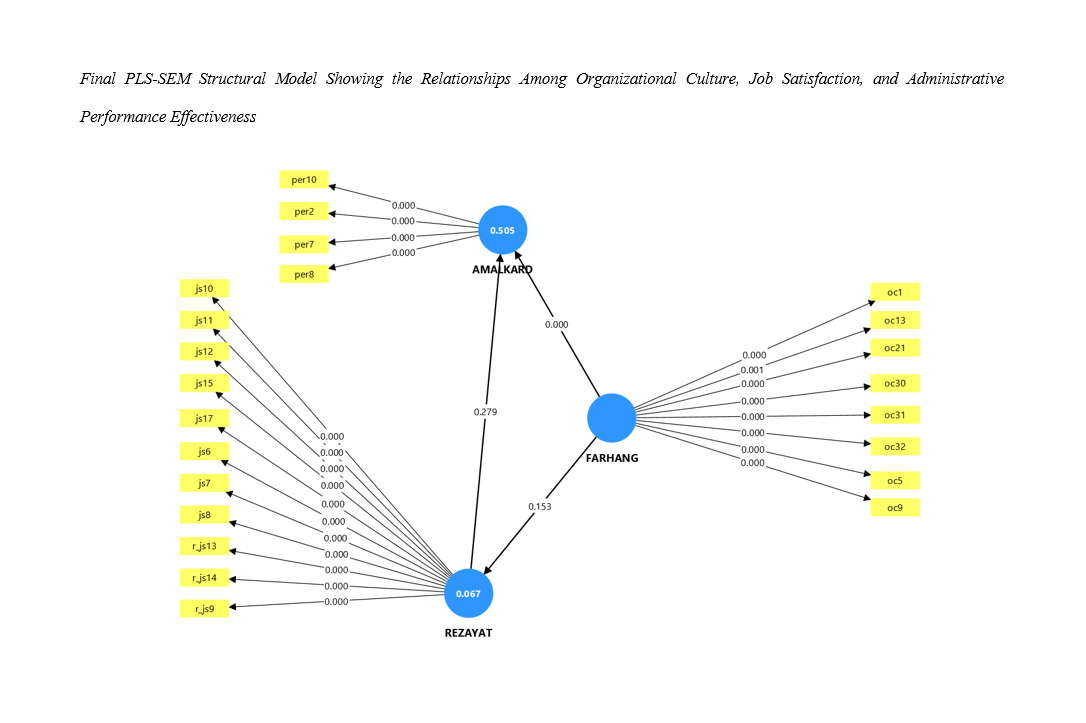
Findings: Organizational culture had a positive and statistically significant effect on administrative performance effectiveness (β = 0.658, p < 0.001). In contrast, the effect of organizational culture on job satisfaction was negative but not statistically significant (β = −0.259, p = 0.153), and the effect of job satisfaction on administrative performance effectiveness was also negative and nonsignificant (β = −0.147, p = 0.279). Accordingly, the mediating role of job satisfaction in the relationship between organizational culture and administrative performance effectiveness was not supported. The structural model explained 50.5% of the variance in administrative performance effectiveness (R² = 0.505), whereas organizational culture explained only 6.7% of the variance in job satisfaction (R² = 0.067).
Conclusion: Organizational culture was identified as a strong direct predictor of administrative performance effectiveness among employees of Iraqi sports federations. However, job satisfaction did not significantly explain or mediate this relationship.
Downloads
References
Abbasi, M., Monazzam, M., Shamsipour, M., & Arab Alibeyk, H. (2021). Individual Job Performance Evaluation Models: A Systematic Review. Occupational Health and Safety Quarterly, 11(4), 630-644. http://jhsw.tums.ac.ir/article-1-6578-fa.html
Abd Sharafat, M., & Jafari, R. (2025). A Review of the Role of Organizational Culture in Organizational Behavior and Performance.
Adinehloo, M., Soheili, B., & Faraji, G. (2021). The Relationship of Knowledge Management and Organizational Culture with Efficient Performance Management in the General Directorate of Sport and Youth of Alborz Province. Knowledge Retrieval and Semantic Systems Quarterly, 8(29), 43-71. https://doi.org/10.22054/jks.2021.58136.1407
Akpa, V. O., Asikhia, O. U., & Nneji, N. E. (2021). Organizational Culture and Organizational Performance: A Review of Literature. International Journal of Advances in Engineering and Management, 3(1), 361-372. https://doi.org/10.35629/5252-0301361372
Amozgar, A. K., & Adel, A. (2025). Prevalence of Job Satisfaction among Bamyan University Lecturers. Journal of Social Sciences - Kabul University, 6(1), 171-180. https://doi.org/10.62810/jss.v6i1.96
Anekwe, K. R., & Igwe, C. P. (2025). The Impact of Organisational Culture on Employee Performance and Productivity in the UK Financial Sector. International Journal of Business Research and Management, 2(3).
Ashayeri, T., Jahanparvar, T., Aghazadeh, P., & Bahri, F. (2023). A Study of the Impact of Organizational Culture on Employee Job Performance in National Organizations. Applied Sociology Studies Quarterly, 154-183. https://civilica.com/doc/1856498/
Azmy, A., & Wiadi, I. (2022). The Effect of Job Satisfaction and Organizational Culture on Employee Performance in Autofinance Business: The Mediating Role of Organizational Commitment. Management, 26(2), 86-119. https://doi.org/10.58691/manment-2023-000B
Bakhtiari Renani, A., Farhadi, Z., Moghbeli, F., & Moghbeli, Z. (2024). Examining the Relationship of Job Satisfaction and Life Satisfaction with Job Performance among Employees of Saipa Company in Golpayegan.
Bina, A., & Mohammadi, E. (2025). Investigating the Relationship between Job Satisfaction and Job Performance of Professors at Bamyan University. Journal of Social Sciences - Kabul University. https://doi.org/10.62810/jss.v3i3.232
Chen, X., Li, S., & Li, M. (2025). A Hybrid Centralized-Decentralized Traffic Control Framework for Unmanned Aerial Vehicles in Urban Low-Altitude Airspace. Communications in Transportation Research, 5(5), 100-195. https://doi.org/10.1016/j.commtr.2025.100195
Cherian, J., Gaikar, V., Paul, R., & Pech, R. (2021). Corporate Culture and Its Impact on Employees' Attitude, Performance, Productivity, and Behavior: An Investigative Analysis from Selected Organizations of the United Arab Emirates. Journal of Open Innovation: Technology, Market, and Complexity, 7(1), 45. https://doi.org/10.3390/joitmc7010045
Cook, D., Mayer, R., & Doy, G. (2024). Crises and the Resilience of the Aviation Industry: A Literature Review of Crises and Airline Responses. Transportation Research Procedia, 75(3), 33-42. https://doi.org/10.1016/j.trpro.2023.12.005
Ertekin, A. B., & Avunduk, Y. (2021). The Relationship between Job Satisfaction and Job Performance: A Study on Sports Industry. Journal of Educational Issues, 7(2), 133-145. https://doi.org/10.5296/jei.v7i2.18949
Ghumiem, S. H., Alawi, N. A., Abd A-A, A. R., & Masaud, K. A. (2023). Corporate Culture and Its Effects on Organizational Performance: Multi-Group Analysis Evidence from Developing Countries. European Journal of Business and Management Research, 8(2), 142-148. https://eu-opensci.org/index.php/ejbmr/article/download/51890/7686
Graham, J. R., Grennan, J., Harvey, C. R., & Rajgopal, S. (2022). Corporate Culture: Evidence from the Field. Journal of Financial Economics, 146(2), 552-593. https://doi.org/10.1016/j.jfineco.2022.07.008
Gyles, D., & Bearman, C. (2025). Co-Constructing Safety: How Air Traffic Controllers Change Goals from Efficiency to Safety. Cognition, Technology & Work, 27, 449-465. https://doi.org/10.1007/s10111-025-00805-w
Humphreys, L., Bigby, C., Iacono, T., & Bould, E. (2022). Patterns of Group Home Culture in Organisations Supporting People with Intellectual Disabilities: A Cross-Sectional Study. Journal of Intellectual & Developmental Disability, 47(3), 252-264. https://doi.org/10.3109/13668250.2021.1954482
Ignjatović, D., Karagiannis, V., Chettakattu, A., Havlik, D., & Neubauer, G. (2024). Crisis Management in the Era of the IoT, Edge Computing, and LLMs. Malmo.
Ispik, A., Yogia, M. A., Zainal, M. S., Wedayanti, M. D., & Purwati, A. A. (2021). The Role of Organizational Culture on Employee Satisfaction and Performance. In (Vol. 525, pp. 269-275). https://doi.org/10.2991/assehr.k.210222.044
Jafarzadeh, V. (2023). Examining the Relationship between Organizational Culture and Human Resource Productivity: A Case Study of Employees of the National Gas Company of Mazandaran Province.
Kabra, G., Ghosh, V., & Mukherjee, R. (2024). Discovering Latent Topics and Trends in Digital Technologies and Disaster Management Research: A Structural Topic Modeling Approach. Engineering Management Journal, 1-17. https://doi.org/10.1080/10429247.2024.2345526
Khazaei, M., Afrasiabi, R., & Hafezian, M. (2022). Interpretive Structural Modeling for Establishing Organizational Culture in the Education Organization Using ISM. A New Approach in Educational Management, 13(4). https://civilica.com/doc/1908003/
Kourd, A., & Mehdinezhad, V. (2024). The Effect of Organizational Culture on Organizational Effectiveness with the Mediation of Organizational Creativity. Iranian Journal of Organizational Psychology, 1(3), 1-8.
Luthans, F., Luthans, B. C., & Luthans, K. W. (2021). Organizational Behavior: An Evidence-Based Approach. IAP. https://doi.org/10.1108/978-1-64802-127-5
Mubarok, T. M. S., Lindayani, L., & Farizah, S. N. (2022). The Relationship between Job Satisfaction and Employee Performance.
Rahimi, A., Sarwari, K.-u.-R., Azad, A., & Waresi, A. (2025). Examining the Relationship between Job Satisfaction and Job Performance among Administrative Employees of Kabul University. Journal of Social Sciences - Kabul University, 8(1), 219-242.
Raziq, O., Khaili, M. E., Nhaila, H., & Khiat, A. (2025). Improving Air Traffic Control by Combining Centralized and Decentralized Solutions. Edelweiss Applied Science and Technology, 9(8), 1122-1138.
Renkhoff, J., Ternus, S., & Guleria, Y. (2025). A Survey on Personalized Conflict Resolution Approaches in Air Traffic Control. Aerospace, 12, 751. https://doi.org/10.3390/aerospace12090751
Reyhaninia, J., & Zardoshtian, S. (2021). The Effect of Organizational Culture on Productivity with the Mediating Role of Creativity and Innovation in Iran's Ministry of Sport and Youth. Sport Management Studies, 13(67), 288-316. https://civilica.com/doc/1425183/
Robbins, S. P., & Judge, T. A. (2023). Organizational Behavior. Pearson Education Limited.
Samur, S. (2021). Examination of Organizational Culture Variables in Sports Organizations: Perspective from Turkey. Journal of Educational Issues, 7(1), 392-412. https://doi.org/10.5296/jei.v7i1.18531
Taylor, F. (2026). Crisis Management for Airports and Airlines. (Vol. 27, pp. 1619-2400).
Tohidtalab, S., & Farani, H. (2021). The Effect of Situational Leadership and Organizational Culture on Employee Job Performance with the Mediating Role of Job Satisfaction in the West Azerbaijan Governorate Payame Noor University, Semnan].
Umasangadji, A. S., Rajak, A., Kamis, R. A., & Arilaha, M. A. (2022). Organizational Culture's Influence on Employees' Performance through Job Satisfaction. Asia Pacific Journal of Management and Education, 5(3), 92-102. https://doi.org/10.32535/apjme.v5i3.1641
Williams, P. (2022). Organisational Culture: Definitions, Distinctions and Functions. In (pp. 5-22). https://doi.org/10.4337/9781788976268.00008
Xie, Q., Xie, X., & Guo, S. (2022). The Factors Influencing Public Satisfaction with Community Services for COVID-19: Evidence from a Highly Educated Community in Beijing. International journal of environmental research and public health, 19(18), 11363. https://doi.org/10.3390/ijerph191811363
Downloads
Additional Files
Publication Timeline
- Submitted
- Revised
- Accepted