Paradigmatic Explanation of the Impact of Business Intelligence on Activity-Based Costing Systems with Emphasis on Cost Drivers under Conditions of Uncertainty: A Qualitative Approach
Keywords:
Business Intelligence, Activity-Based Costing, Cost Drivers, Uncertainty, Grounded Theory, Management Accounting, Predictive Analytics, Organizational ResilienceAbstract
Objective: This study aimed to develop a paradigmatic qualitative model explaining how Business Intelligence (BI) influences Activity-Based Costing (ABC) systems, with particular emphasis on the management of cost drivers under conditions of uncertainty.
Methods and Materials: This qualitative study employed the systematic grounded theory approach of Strauss and Corbin. Participants consisted of 13 academic and professional experts in management accounting, ABC, BI, information systems, financial management, industrial accounting, and related managerial fields who were selected through purposive judgmental sampling, supplemented where necessary by snowball sampling. Data were collected through in-depth semi-structured interviews and continued until theoretical saturation was achieved after the thirteenth interview. All interviews were recorded with participants’ consent, transcribed verbatim, and analyzed using MAXQDA. Data analysis was conducted through open, axial, and selective coding, constant comparison, memo writing, and organization of the emerging categories within the Strauss and Corbin paradigmatic framework. Credibility and trustworthiness were strengthened through member checking, expert review, triangulation of professional perspectives, continuous comparison, and documentation of the analytical process.
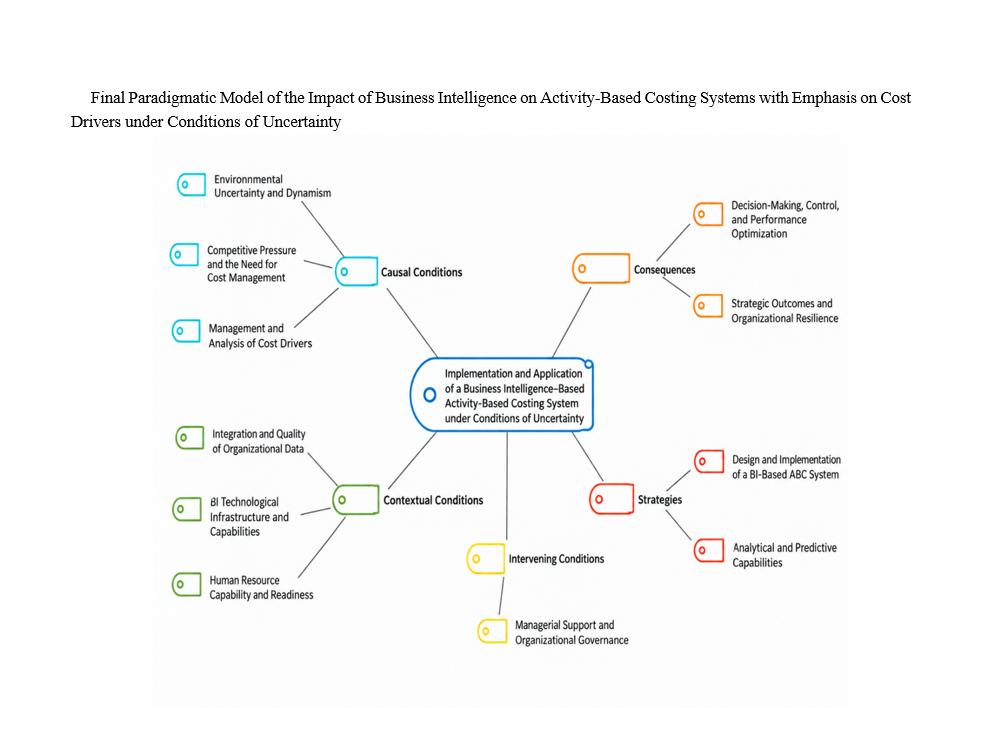
Findings: The analysis yielded five major paradigmatic dimensions comprising 11 axial categories. Environmental uncertainty and dynamism, competitive pressure and the need for cost management, and management and analysis of cost drivers emerged as causal conditions. Integration and quality of organizational data, BI technological infrastructure and capabilities, and human resource capability and readiness formed the contextual conditions. Managerial support and organizational governance constituted the intervening condition. The principal strategies were the design and implementation of a BI-based ABC system and the development of analytical and predictive capabilities. These strategies led to improved decision-making, control and performance optimization, as well as strategic outcomes and organizational resilience. The findings indicate that BI transforms ABC from a largely retrospective costing mechanism into a more dynamic, integrated, predictive, and decision-support-oriented system.
Conclusion: Effective integration of BI with ABC depends on the simultaneous alignment of data quality, technological infrastructure, human capabilities, managerial governance, and predictive analytics, enabling organizations to manage cost drivers more accurately and respond more effectively to uncertainty.
Downloads
References
Abouei Mehrizi, S., & Bozorgi, M. (2025). Business Intelligence (BI) in Firm Performance: The Role of Big Data Analytics and Blockchain Technology. Nur.
Ahmadi, H., Rajabpour, E., Khalili, H., & Hanaei, A. (2025). The Effect of Business Intelligence on Strategic Performance with the Mediating Role of Organizational Innovation: A Study of Startups Located in the Persian Gulf Science and Technology Park. Qaenat.
Chen, B. (2025). Leveraging Advanced AI in Activity-Based Costing (ABC) for Enhanced Cost Management. Journal of Computer, Signal, and System Research, 2(1), 53-62. https://doi.org/10.71222/6b2mrj72
Damis, S., Harun, H., & Arodhiskara, Y. (2025). The Impact of Environmental Uncertainty and Accounting Information Systems on Managerial Performance of Micro, Small, and Medium Enterprises in Parepare City.
Feizizadeh, A., & Hashemi, S. M. (2025). Evaluating the Effectiveness of Activity-Based Costing (ABC) Systems in Organizations. Tehran.
Hao, H., Wang, Y., & Chen, J. (2024). Empowering Scenario Planning with Artificial Intelligence: A Perspective on Building Smart and Resilient Cities. Engineering, 18(5), 67-89. https://doi.org/10.1016/j.eng.2024.06.012
Hasan, R. (2025). The Role of Business Analytics in ESG-Oriented Brand Communication: A Systematic Review of Data-Driven Strategies. ASRC Procedia: Global Perspectives in Science and Scholarship, 1(01), 1096-1127. https://doi.org/10.63125/4mchj778
Ibeh, C. V., Asuzu, O. F., Olorunsogo, T., Elufioye, O. A., Nduubuisi, N. L., & Daraojimba, A. I. (2024). Business Analytics and Decision Science: A Review of Techniques in Strategic Business Decision Making. World Journal of Advanced Research and Reviews, 21(2), 1761-1769. https://doi.org/10.30574/wjarr.2024.21.2.0247
Kitsantas, T., Vazakidis, A., & Stefanou, C. (2026). Integrating Activity Based Costing (ABC) with Enterprise Resource Planning (ERP) for Effective Management: A Literature Review. Technium: Romanian Journal of Applied Sciences and Technology, 2, 160-178. https://doi.org/10.47577/technium.v2i7.1882
Kling, D., Mostad, P., & Tillmar, A. (2025). FamLink2: A Comprehensive Tool for Likelihood Computations in Pedigrees Analyses Involving Linked DNA Markers Accounting for Genotype Uncertainties. Forensic Science International: Genetics, 74(7), 103-150. https://doi.org/10.1016/j.fsigen.2024.103150
Landi, S., Maistri, G., Orsini, L. P., Leardini, C., Malandra, S., & Antonelli, A. (2025). Supporting Managerial Decisions: A Comparison of New Robotic Platforms through Time-Driven Activity-Based Costing within a Value-Based Healthcare Framework. BMC Health Services Research, 25(1), 470-510. https://doi.org/10.1186/s12913-025-12598-9
López-Carbonell, D., Legarra, A., Altarriba, J., Hervás-Rivero, C., Sánchez-Díaz, M., & Varona, L. (2025). Multiple Trait Bayesian Analysis of Partitioned Genetic Trends Accounting for Uncertainty in Genetic Parameters: An Example with the Pirenaica and Rubia Gallega Beef Cattle Breeds. Journal of Animal Breeding and Genetics, 142(4), 454-462. https://doi.org/10.1111/jbg.12918
Mahmoudabadi, A., Salehi, M., & Avazzadeh Fath, F. (2025). Examining the Effect of Applying Modern Technologies (Artificial Intelligence and ERP) on the Process of Implementing Activity-Based Costing Systems. Management Accounting and Auditing Knowledge, 15(60), 279-294.
Masoumi Torkamani, A., & Moghadamnia, E. (2024). Using Time-Driven Activity-Based Costing in the Restaurant Business.
Meyer, M., & Schmidt, M. (2025). Robust Design Heuristics for Product Costing Systems: A Replication and Extension Using an ABC Cost Hierarchy. Journal of Business Economics, 95(2), 197-235. https://doi.org/10.1007/s11573-024-01210-x
Mori, T., Zaharia, O. P., Straßburger, K., Dennis, J. M., Mai, K., & Kabisch, S. (2025). Recognising, Quantifying and Accounting for Classification Uncertainty in Type 2 Diabetes Subtypes. Diabetologia, 68(10), 2139-2150. https://doi.org/10.1007/s00125-025-06486-4
Naderi, M., Nazari, A., Shafaat, A., & Abrishami, S. (2025). Enhancing Accuracy in Construction Overhead Cost Estimation: A Novel Integration of Activity-Based Costing and Building Information Modelling. Smart and Sustainable Built Environment, 14(3), 758-775. https://doi.org/10.1108/SASBE-07-2023-0180
Nourallahzadeh, N., & Kazemi, H. (2025). Using Advanced Artificial Intelligence in Activity-Based Costing (ABC) for Advanced Cost Management. Accounting and Management Perspective, 8(102), 16-26.
Penman, S. (2024). Accounting for Uncertainty. Accounting, Economics, and Law: A Convivium, 14(3), 309-327. https://doi.org/10.1515/ael-2022-0059
Tsai, W. H., Chen, H. C., Chang, S. C., & Chan, K. C. (2024). Revolutionizing Textile Manufacturing: Sustainable and Profitable Production by Integrating Industry 4.0, Activity-Based Costing, and the Theory of Constraints. Processes, 12(11), 23-111. https://doi.org/10.3390/pr12112311
Wang, K. J., & Simarmata, M. T. (2024). Fuzzy Activity-Based Costing: An Investment Evaluation Approach for Management Information System of a Smart Factory. The Engineering Economist, 69(1), 66-86. https://doi.org/10.1080/0013791X.2024.2314673
Woodward, H., Fonseca, E. R., Oxley, T., Rowe, E. C., Vieno, M., Nemitz, E., & ApSimon, H. (2025). Accounting for the Uncertainty in Nitrogen Deposition Estimates in Support of Policy. Environmental research, 27(6), 121-139. https://doi.org/10.1016/j.envres.2025.121519
Downloads
Additional Files
Publication Timeline
- Submitted
- Revised
- Accepted