The Relationship Between Supply Chain Integration and Organizational Productivity: The Mediating Role of Supply Chain Agility in Small and Medium-Sized Food Enterprises in the Industrial Estates of Kerman
Keywords:
Supply Chain Integration, Supply Chain Agility, Organizational Productivity, Small and Medium-Sized Enterprises, Food IndustryAbstract
Objective: This study aimed to examine the relationship between supply chain integration and organizational productivity and to determine the mediating role of supply chain agility among small and medium-sized food enterprises in the industrial estates of Kerman.
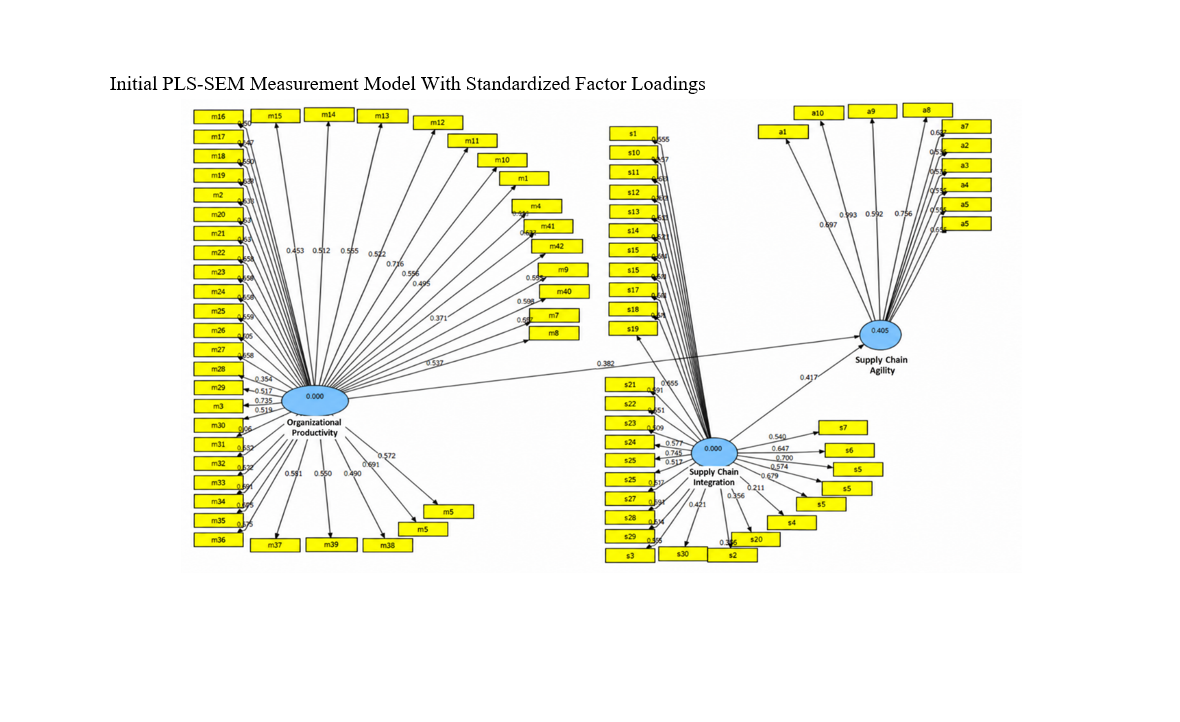
Methods and Materials: This applied, descriptive-correlational study was conducted among employees of small and medium-sized food enterprises located in the industrial estates of Kerman, Iran. The statistical population consisted of 500 employees, from whom 217 participants were selected using proportionate stratified random sampling based on Cochran’s formula. Data were collected using three standardized instruments: a 30-item supply chain integration questionnaire assessing supplier, customer, and internal integration; a 10-item supply chain agility questionnaire assessing market sensing and responsiveness; and a 42-item organizational productivity questionnaire covering organizational culture, environmental conditions, motivation, empowerment, and leadership style. Internal consistency was evaluated using Cronbach’s alpha, while convergent and discriminant validity were assessed through composite reliability, average variance extracted, and the Fornell–Larcker criterion. Data were analyzed using SPSS 19 and SmartPLS 2. Partial least squares structural equation modeling was employed to evaluate the measurement and structural models, with statistical significance set at p < .05.
Findings: The measurement model demonstrated high internal consistency, with Cronbach’s alpha coefficients of .957 for organizational productivity, .941 for supply chain integration, and .933 for supply chain agility, and composite reliability values of .955, .946, and .938, respectively. AVE values ranged from .438 to .467, and the Fornell–Larcker criterion supported discriminant validity. All relevant structural relationships were statistically significant at the 95% confidence level. The model explained 38.7% of the variance in supply chain agility (R² = .387). Effect sizes were moderate (f² = .156 and .295), predictive relevance was positive (Q² = .113), and the overall GOF index was .411. The structural results supported meaningful relationships among supply chain integration, supply chain agility, and organizational productivity, consistent with the proposed mediating role of supply chain agility.
Conclusion: The findings indicate that stronger supply chain integration is associated with greater organizational productivity and that supply chain agility serves as an important mechanism through which integrated supply chain practices can be translated into improved organizational outcomes in food-sector SMEs.
Downloads
References
Ajike, E. O., Adeleke, A. A., Bamidele, A. G., Olubiyi, T. O., Adesuyi, O. O., Ilori, G. E., Ariguzo, V. A., & Binuyo, B. O. (2024). The Moderating Role of Supply Chain Agility on the Relationship Between Strategic Flexibility and Organizational Market Performance in Nigerian Pharmaceutical Industry. PaperASIA, 40(5b), 337-349. https://doi.org/10.59953/paperasia.v40i5b.259
Al-Zabidi, A., Rehman, A. U., & Alkahtani, M. (2021). An approach to assess sustainable supply chain agility for a manufacturing organization. Sustainability, 13(4), 1752. https://doi.org/10.3390/su13041752
Alamsjah, F., & Yunus, E. N. (2022). Achieving Supply Chain 4.0 and the Importance of Agility, Ambidexterity, and Organizational Culture: A Case of Indonesia. Journal of Open Innovation Technology Market and Complexity, 8(2), 83. https://doi.org/10.3390/joitmc8020083
Aldhaheri, R. T., & Ahmad, S. Z. (2023). Factors Affecting Organisations' Supply Chain Agility and Competitive Capability. Business Process Management Journal, 29(2), 505-527. https://doi.org/10.1108/bpmj-11-2022-0579
Alkrait, Y., & Almaktoom, A. (2021). The relationship between supply chain agility and organizational performance in KSA. PalArch's Journal of Archaeology of Egypt/Egyptology, 18(15), 266-271. https://archives.palarch.nl/index.php/jae/article/download/8333/7778/16318
Azad, B. (2020). Examining the Impact of Green Supply Chain Agility on Gaining Competitive Advantage and Organizational Agility in the Industry (Case Study: Active Industrial Units in Ardabil) Moqaddas Ardabili Institute of Higher Education, Department of Management].
Azizi, M., Hanoum, S., Purnomo, J., Shubbak, M., & Gandolfi, F. (2025). Fostering Supply Chain Agility through Transformational Leadership and Organizational Ambidexterity in the Indonesian Automotive Industry. Operations and Supply Chain Management: An International Journal, 18(3), 511-523. https://doi.org/10.31387/oscm0620486
Bavarsad, B., Zare, H., & Fa'ali, R. (2019). The Effect of Information Technology Infrastructure Flexibility and Organizational Learning on Performance with the Mediating Role of Supply Chain Agility Performance in Manufacturing Companies of Khuzestan Province. Quarterly Journal of Innovation Management in Defense Organizations, 1(1), 69-96.
Dubey, R., Bryde, D. J., Foropon, C., Graham, G., Giannakis, M., & Mishra, D. B. (2020). Agility in humanitarian supply chain: an organizational information processing perspective and relational view. Annals of Operations Research, 1-21. https://doi.org/10.1007/s10479-020-03824-0
Ghaedi, M., & Zeraati Foukaliei, P. (2025). Examining the Effect of Sustainable Supply Chain Practices on the Productivity of Small Economic Enterprises with the Mediating Role of Sustainable Supply Chain Dynamic Capabilities. National Conference on Futures Studies, Management, and Sustainable Development, Tehran, Iran.
Hosseini Balaei, S. (2015). Investigating the effect of organizational agility strategies and supply chain agility on organizational performance (Case study: Roshd Food Company) https://elmnet.ir/doc/10784125-26494
Lin, B., & Zhu, Y. (2025). Supply chain configuration and total factor productivity of renewable energy. Renewable and Sustainable Energy Reviews, 209, 115140. https://doi.org/10.1016/j.rser.2024.115140
Malekifar, S., Taghizadeh, S. K., Rahman, S. A., & Khan, S. U. R. (2014). Organizational Culture, IT Competence, and Supply Chain Agility in Small and Medium‐Size Enterprises. Global Business and Organizational Excellence, 33(6), 69-75. https://doi.org/10.1002/joe.21574
Onukwulu, E. C. (2025). Advances in Automation and AI for Enhancing Supply Chain Productivity in Oil and Gas. International Journal of Research and Innovation in Applied Science. https://doi.org/10.51584/ijrias.2024.912057
Patel, B., Samuel, C., & Sharma, S. K. (2017). Evaluation of Agility in Supply Chains: A Case Study of an Indian Manufacturing Organization. Journal of Manufacturing Technology Management, 28(2), 212-231. https://doi.org/10.1108/JMTM-09-2016-0125
Rahman, M. K., Piprani, A. Z., Mohiuddin, S., Nazir, S., & Shah, A. A. (2026). Unraveling the Impact of Organizational Ambidexterity: The Role of Integration and Agility in Enhancing Performance Amidst Supply Chain Disruptions. Global Business and Organizational Excellence. https://doi.org/10.1002/joe.70028
Rehman, A. U., Al-Zabidi, A., AlKahtani, M., Umer, U., & Usmani, Y. S. (2020). Assessment of supply chain agility to foster sustainability: fuzzy-DSS for a Saudi manufacturing organization. Processes, 8(5), 577. https://doi.org/10.3390/pr8050577
Safdari, M., & Rostamzadeh, R. (2018). Examining the Impact of Green Supply Chain Management on Organizational Agility (Case Study: Iran Khodro Tabriz). Value Chain Management Journal, 1(4). https://journals.iau.ir/article_652343.html?lang=en
Vishlaghi, M., Zarei, A., & Feiz, D. (2021). Designing Strategic Agility Model for Sustainable Manufacturing Boom Based on Grounded Theory(Case Study: Automotive Industry). Journal of Improvement Management, 15(2), 127-153. https://doi.org/10.22034/jmi.2021.238717.2292
Yoon, T., 고애란, & Jin, B. (2014). The Role of Market Orientation and Organizational Innovativeness in Enhancing the Supply Chain Agility of Korean Apparel Firms. Journal of the Korean Society of Clothing and Textiles, 38(5), 718-732. https://doi.org/10.5850/jksct.2014.38.5.718
Downloads
Additional Files
Publication Timeline
- Submitted
- Revised
- Accepted