Developing a Model of Organizational Trauma in Iran’s Sports and Youth Departments
Keywords:
Organizational Trauma; Sports and Youth Departments; Mixed Methods; Organizational Resilience; Human Resource Management; Structural Equation ModelingAbstract
Objective: This study aimed to develop and validate a comprehensive model of organizational trauma in Iran’s Sports and Youth Departments.
Methods and Materials: This applied study used a sequential exploratory mixed-methods design. In the qualitative phase, 14 experts in organizational behavior, human resource management, and sports organizations were selected through snowball sampling, and structured open-ended interviews were conducted until theoretical saturation was reached. Qualitative data were analyzed through open, axial, and theoretical coding using MAXQDA 20. The extracted components were used to develop a researcher-made questionnaire whose content validity was examined using CVR and CVI and whose qualitative coding reliability was confirmed through test–retest and inter-coder agreement. In the quantitative phase, 328 managers and deputy managers from Sports and Youth organizations and departments across Iran were selected through convenience sampling from a population of 2,215 individuals. Data were analyzed using SPSS 26 and SmartPLS 4 through reliability and validity assessment, the Friedman test, Pearson correlations, and structural equation modeling.
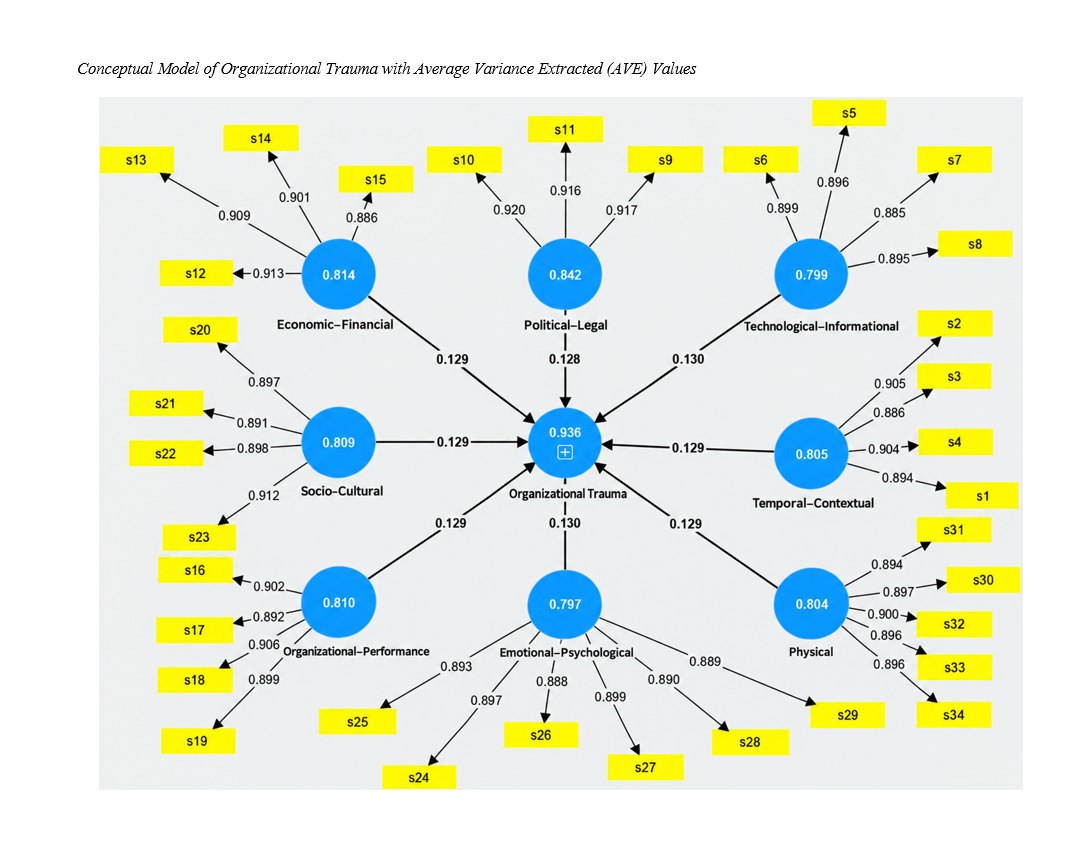
Findings: The qualitative model comprised causal conditions, enabling conditions, contextual factors, strategies, intervening factors, and consequences. Expert validation showed that all dimensions of the conceptual model were significant (p < .001). Friedman tests indicated significant differences in the rankings of all model components (p < .001). Pearson correlations showed strong positive relationships between organizational trauma and all structural dimensions (r = .958–.980, p ≤ .01). Structural modeling demonstrated that socio-cultural, economic–financial, temporal–contextual, organizational–performance, political–legal, emotional–psychological, technological–informational, and physical dimensions all had positive and significant effects on organizational trauma (B = .128–.130, p < .001). Emotional–psychological and technological–informational dimensions showed the highest path coefficients (B = .130).
Conclusion: Organizational trauma in Iran’s Sports and Youth Departments is a multidimensional and systemic phenomenon shaped by interacting managerial, psychological, structural, contextual, technological, cultural, and environmental factors; therefore, its effective management requires integrated organizational interventions focused on leadership, fairness, communication, employee support, resilience, and adaptive organizational systems.
Downloads
References
Amirian, H., Fahimi Nejad, A., Morsal, B., & Siyavashi, M. (2023). Designing the role of ethical leadership on organizational trauma and organizational inertia with the mediating role of social idleness among employees of the Ministry of Sports and Youth. Strategic Studies in Sports and Youth, 22(59), 431-449. https://faslname.msy.gov.ir/article_575.html
Bayati, A., Khodayari, A., & Khalifeh, S. N. (2022). Designing a model of organizational trauma and turnover with the mediating role of organizational mindfulness in employees of the Tehran Municipality Sports Organization. Organizational Behavior Management Studies in Sport, 9(3), 89-98.
Brown, L. L., Pennings, J., Steckel, S., & Van Zyl, M. (2023). The organizational trauma resilience assessment: Methods and psychometric properties. Psychological Trauma: Theory, Research, Practice, and Policy, 15(S2), S446. https://doi.org/10.1037/tra0001184
De Oliveira Camilo, J. A. (2021). Trauma organizacional em tempos de Covid-19: Contribuições para a gestão de pessoas. Revista Administração em Diálogo-RAD, 23(2), 97-107. https://doi.org/10.23925/2178-0080.2021v23i2.49998
Ebrahimi, S., Zahedbabolan, A., Moeinikia, M., & Taghavi, H. (2023). A grounded theory approach to explaining organizational trauma management (OTM) in novice teachers. Journal of Management on Educational Organizations, 12(2), 91-106.
Ebrahimpour Ajirlou, B., & Khaknezhad, A. (2022). Investigating the effect of organizational trauma on job performance mediated by perceived stress of employees in Ardabil province education. New Research Approaches in Management Sciences(35), 17-36.
Elbert, T., Schauer, M., & Neuner, F. (2022). Narrative Exposure Therapy (NET): Reorganizing Memories of Traumatic Stress, Fear, and Violence. In Evidence Based Treatments for Trauma-Related Psychological Disorders: A Practical Guide for Clinicians (pp. 255-280). Springer International Publishing.
Ghafouri, K., Hoveida, R., Rajaeipour, S., & Siadat, S. A. (2022). Identifying the causes of organizational trauma in elementary school teachers. Educational Innovations, 21(3), 69-100.
Hovida, R., Ghafoori, K., Sayadat, S. A., & Ranjai Pour, S. (2021). Identifying the factors causing trauma in organizations based on a synthesis of domestic studies on organizational trauma. Organizational Development of Police, 18(79), 113-138.
Khoshhal, F. (2024). Identifying factors affecting organizational trauma. Proceedings of the Seventh National Conference on Management, Economics, and Islamic Sciences,
Khushhal, F. (2023). Identifying factors affecting organizational trauma. In Proceedings of the 7th National Conference on Management, Economics, and Islamic Sciences,
Kohpar, S. K., Kojouri, D. K., Aghajani, A. H., & Bayekolaei, M. M. (2025). Organizational trauma management in Iranian public organizations: A qualitative exploration with emphasis on cognitive-behavioral interventions. Future of Work and Digital Management Journal, 3(1), 1-18.
Lindsay, P. V. L. (2023). Unmasking the invisible chains: Exploring the interplay of organizational trauma and systemic oppression for sustainable transformation. Organization Development Review, 55(4).
Mahdi, M., Ghafari, H., Mahdinejad, A., & Pour Anjanar, G. (2021). The effect of organizational trauma on the mental health of employees considering the moderating role of psychological resilience. Studies in Industrial and Organizational Psychology, 8(2), 503-521. https://jiops.scu.ac.ir/article_17526.html
Moallemian, L., Haghighi, M., & Razaqi Rostami, A. (2021). Investigating the Causal Relationship Between Organizational Trauma and Organizational Silence with the Mediating Role of Managers' Emotional Intelligence (Case Study: Bank Mellat Companies). Quarterly Journal of Ethical Research, 11(4). https://en.civilica.com/doc/1880928/
Moezinejad, R., Tavousi, S. S., Darbandi, A., & Shahifar, E. (2023). Investigating the relationship between organizational trauma and organizational cynicism considering the moderating role of managers' emotional intelligence. Proceedings of the Fifth National Conference on Organizational Research and Management,
Moradi, A. (2023). Organizational health versus organizational trauma: A confrontation of concepts. Management Sciences Research, 16, 55-66.
Rahmani, E., & Ghanbari, S. (2022). The Role of Toxic Leadership in Creating Organizational Trauma with the Mediation of Hypocritical Behavior. Research in Educational Systems, 16(58), 20-34. https://www.jiera.ir/article_167788.html
Rahmani, I., & Ghanbari, S. (2024). The effect of toxic leadership on the creation of organizational trauma with the mediating role of organizational cynicism among middle and high school teachers. Psychological Achievements, 31(1), 231-252.
Rhone, C. C. (2021). Organizational resilience during times of trauma. In Role of leadership in facilitating healing and renewal in times of organizational trauma and change (pp. 170-185). IGI Global. https://doi.org/10.4018/978-1-7998-7016-6.ch009
Rostamzadeh, F., Moslemzadeh, R., & Farrokhi, S. (2025). Examining the Relationship of Organizational Inertia and Organizational Trauma with Social Undermining and Organizational Entropy among Elementary School Principals in District 1 of Urmia. Journal of New Achievements in Humanities Studies, 8(83), 25-39.
Shahbakhsh, Z., & Nasti Zai, N. (2023). The effect of organizational trauma on social burnout with the mediating roles of grief and suppressed envy. Religion, Spirituality, and Management, 10(19), 233-260. https://rsm.rihu.ac.ir/article_2185.html
Williams, S. D., & Williams, J. (2020). Posttraumatic Stress in Organizations: Types, Antecedents, and Consequences. Business and Society Review, 125(1), 23-40. https://doi.org/10.1111/basr.12192
Downloads
Additional Files
Publication Timeline
- Submitted
- Revised
- Accepted