An Analysis of the Impact of Cultural Knowledge on the Job Success of Managers in the General Department of Sports and Youth of Kerman Province
DOI:
https://doi.org/10.61838/kman.ijimob.3182Keywords:
Cultural knowledge, sports managers, job success, coachesAbstract
Objective: The primary aim of this study is to analyze the impact of cultural knowledge on the job success of sports managers.
Methodology: The research is descriptive-correlational in nature. The statistical population included all managers of the General Department of Sports and Youth of Kerman Province (385 individuals) in 2022, with a sample size of 223 individuals (41 women and 182 men), selected using a random sampling method. The research instrument was a researcher-developed questionnaire, with a Cronbach's alpha reliability coefficient of 0.89.
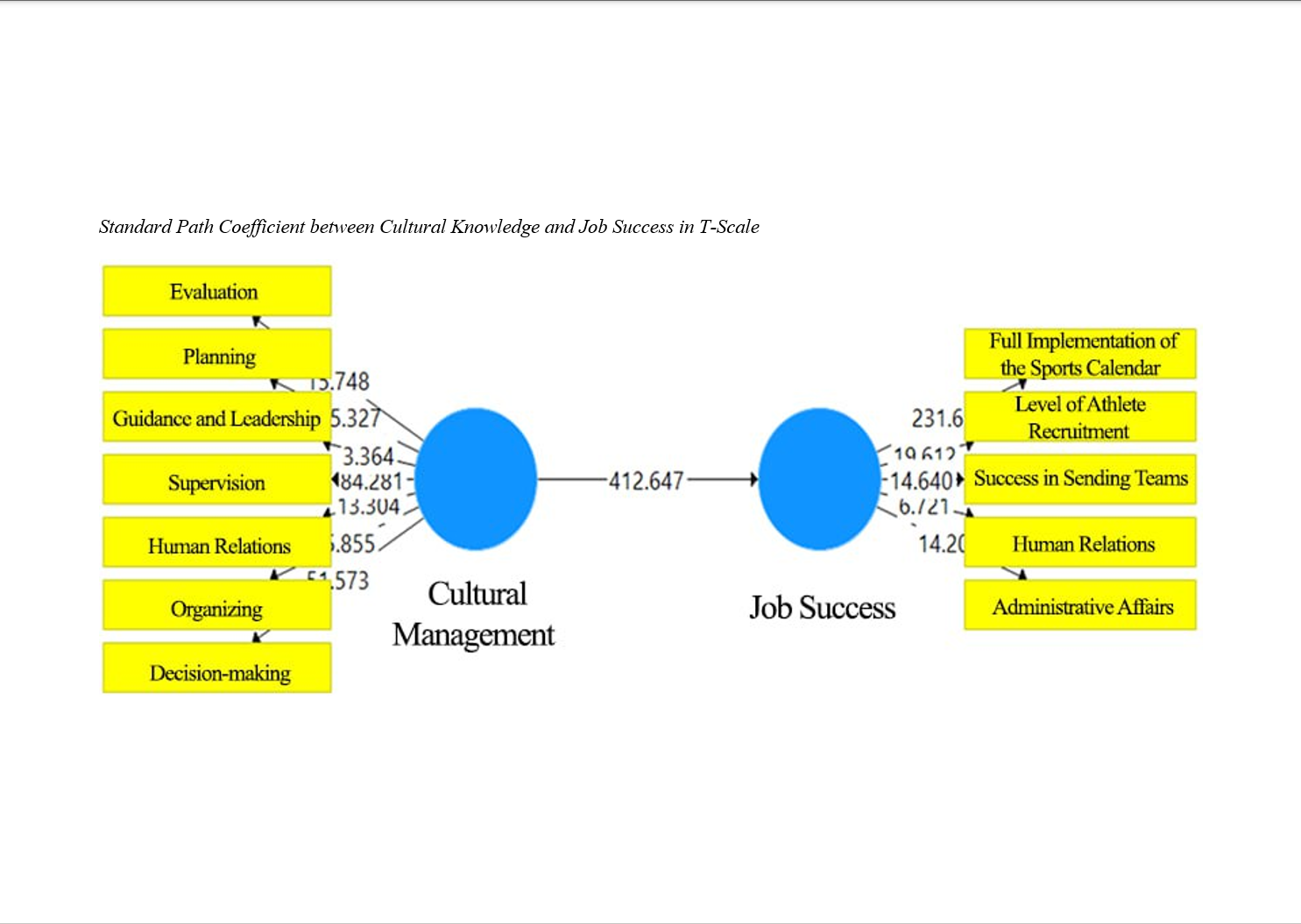
Findings: The results indicated that all components of cultural knowledge had a positive and significant relationship with the job success of managers. The highest correlation was between supervision and control with job success (0.918), while the lowest correlation was between guidance and leadership with job success (0.352). Additionally, stepwise regression showed that all seven components could contribute to prediction, explaining 96.2% of the variance in the job success variable. Structural equation modeling also revealed a path coefficient of 0.975 and a t-value index of 412.62 between the two variables of cultural knowledge and job success.
Conclusion: It appears that managers must have sufficient knowledge and awareness of the details of sports programs and their implementation. They should make accurate and low-error decisions in their job performance, and their planning should align with the organization's objectives, aiming for its growth and development.
Downloads
References
Abniki, A., Naghshbandi, S., & Bagherian, M. (2021). Relationships of personality treaties and change management with mediator’s role of strategic thinking on sport facility managers. Journal of Organizational Behavioral Management in Sport Studies, 8(1), 119-133. https://doi.org/10.30473/fmss.2021.55966.2217
Arzeh, M. K., & Seyedameri, M. M. (2012). Knowledge Management and Communicational Skills of Managers of Physical Education Organization (Iran). Journal of Sport Management Review, 4(13), 49-64. https://www.sportrc.ir/article_129044.html?lang=fa
Asadi, N., Sajadi, S. N., Goudarzi, M., & Moradi, A. (2015). Determining the Competencies of Sports Event Managers. Sport Management, 7(25), 159-174. https://doi.org/10.22059/jsm.2015.55156
Beigi, H. H., & Madavani, A. N. (2019). Identification and Prioritization of Managers Competency Criteria in Places and Sports Spaces. Human Resource Management in Sport Journal, 7(1), 81-97. https://doi.org/10.22044/shm.2020.7121.1764
Ebrahimi, E. (2019). Presenting a Framework to Identify Competencies of Sport Managers based on a Multi-Criteria Decision-Making Model. Human Resource Management in Sport Journal, 7(1), 1-17. https://doi.org/10.22044/shm.2020.8414.1988
Erkins, L., Shilbury, D., & O’Boyle, I. (2018). Leadership in governance: Exploring collective board leadership in sport governance systems. International Journal of Sport Management and Review, 21(3), 221-231. https://doi.org/10.1016/j.smr.2017.07.007
Ghorbani, M. H., Goodarzi, F. M., & Jafarloo, H. R. S. (2020). Role of Employer Branding in Individual and Organizational Performance of Human Resources in Selected Iran Sports Federations. Human Resource Management in Sport Journal, 7(2), 405-420. https://doi.org/10.22044/shm.2020.8702.2037
Huang, S. Y., Lee, S. C., & Lee, Y. S. (2021). Why can green social responsibility drive agricultural technology manufacturing company to do good things? A novel adoption model of environmental strategy. Agronomy, 11(8), 1673. https://doi.org/10.3390/agronomy11081673
Karimzadeh, M. S., Naderinasab, M., Taheri, M., & Biniyas, S. A. (2024). Identification and Analysis of Factors Influencing the Development of Sports in the Islamic Republic of Iran's Army Using Foresight Methodology (Focusing on Health and Lifestyle). International Journal of Sport Studies for Health, 1-11. https://journals.kmanpub.com/index.php/Intjssh/article/view/2634
Keshavarz, L., Bahmanzadeh, M., & Keshavarz, M. M. (2019). The Analysis of Factors Affecting at the Behavior of Sports Managers in the Success of Iran's Sports Team in 2022 Asian Games. Journal of Organizational Behavioral Management in Sport Studies, 6(2), 25-40. https://doi.org/10.30473/fmss.2019.45625.1933
Khoram, M. H., Omidi, A. R., & Safari, S. (2020). Effect of Talent Management on Innovative Performance through Resilience (Case Study: General Department of Sports and Youth of Fars Province). Human Resource Management in Sports, 8(1), 183-203. https://doi.org/10.22044/SHM.2022.11096.2382
Monkaresi, S., Safania, A. M., & Ghasemi, H. (2015). Identification of Iran Athletics Challenges in Olympic Medalist Sports. Strategic Studies on Youth and Sports, 4(27), 159-178. https://faslname.msy.gov.ir/article_42.html?lang=fa
Naderian Jahormi, M., Derishi, M., Mostefezian, S., & Rahbari, S. (2018). Comparison of the quality of life of physically active and inactive citizens (case study: sports facilities of Isfahan Municipality). Journal of Sports Management and Movement Behavior, 12(24), 215-228. https://msb.journals.umz.ac.ir/article_1301.html
Naderian Jahormi, M., & Jabri, S. (2012). Effective factors in the social status of physical education teachers from the perspective of middle school students in Isfahan city. Research in Sports Management, 1(4), 105-121. https://qrsm.atu.ac.ir/article_574.html?lang=en
Nalbant, K. G., & Aydın, S. (2022). Literature review on the relationship between Artificial Intelligence Technologies with Digital Sports Marketing and Sports Management. Indonesian Journal of Sport Management, 2(2), 135-143. https://doi.org/10.31949/ijsm.v2i2.2876
Penczynski, S. P. (2016). Strategic thinking: The influence of the game. Journal of Economic Behavior and Organization, 128, 72-84. https://doi.org/10.1016/j.jebo.2016.05.006
Pourkiani, M., Hamidi, M., Goodarzi, M., & Khabiri, M. (2017). Analyzing the role of championship and professional sport on sport development. Sport Management Review, 9(42), 55-72. https://doi.org/10.22089/smrj.2017.454.1143
Rahmani, N., Naderi Nasab, M., Taheri, M., & Biniaz, S. A. (2024). Exploring the Future of the Sports Industry Through an Economic Lens in 2031. International Journal of Innovation Management and Organizational Behavior (IJIMOB), 4(1), 170-179. https://doi.org/10.61838/kman.ijimob.4.1.20
Rowe, K., Karg, A., & Sherry, E. (2019). Community-oriented practice: Examining corporate social responsibility and development activities in professional sport. Sport Management Review, 22(3), 363-378. https://doi.org/10.1016/j.smr.2018.05.001
Sahebkaran, M. A., Ramzaninejad, R., Reihani, M., & Darabi, M. (2022). Identification, Prioritization, and Weighting of Evaluation’s Indicators of Volleyball Coaches in Iran Premier League using Analytic Hierarchy Process (AHP). Journal of Sport Management and Development, 11(2), 27-46. https://doi.org/10.22124/jsmd.2021.18437.2484
Shabani, J. S., & Mostafavi, R. (2022). Designing a model of factors affecting on 35 years of Success and authority of the Iranian men's national sitting volleyball team in international arenas. Journal of Sport Management and Development, 11(1), 24-47. https://doi.org/10.22124/jsmd.2022.5802
Shirvani, T., & Zohrehvandian, K. (2021). Relationship between Sports Coach Professional Ethics and Self-Efficacy with respect to Mediating Role of Competence. Human Resource Management in Sport Journal, 8(2), 359-377. https://shm.shahroodut.ac.ir/article_2231_b50800aa9f7f37f028e357576d6eda31.pdf
Shokriamlashi, S., Elahi, A., & Akbariyazdi, H. (2020). A Model for Iranian Sport Coaching Career Path Management: Findings of a Qualitative Research Work. Human Resource Management in Sport Journal, 8(1), 183-203. https://doi.org/10.22044/shm.2021.9828.2238
Vecchiato, R. (2019). Scenario planning, cognition, and strategic investment decisions in a turbulent environment. Long Range Planning, 52(5), 101865. https://doi.org/10.1016/j.lrp.2019.01.002
Zardoshtian, S., & Bahrami, M. (2022). Effect of Kinship on Organizational Performance with Mediating Role of Human Resource Management in Ministry of Sports and Youth. Human Resource Management in Sport Journal, 9(1), 213-266. https://doi.org/10.22044/SHM.2022.11305.2400
Downloads
Additional Files
Publication Timeline
- Submitted
- Revised
- Accepted
Issue
Section
License
Copyright (c) 2024 Hamzeh Salari Kiskani, Mohammad Hassan Solhjoo, Hossein Zareian (Author)

This work is licensed under a Creative Commons Attribution-NonCommercial 4.0 International License.