The Effects of Work Meaningfulness and Autonomy on Radically Innovative Behavior: A Neural Network Approach
DOI:
https://doi.org/10.61838/kman.ijimob.5271Keywords:
Radically Innovative Behavior, Work Meaningfulness, Job AutonomyAbstract
Objective: The primary objective of this study was to utilize an advanced artificial neural network approach to investigate the complex, non-linear predictive effects of work meaningfulness and job autonomy on radically innovative behavior among professional employees.
Methods and Materials: A quantitative, cross-sectional design was employed, utilizing a purposive sample of Polish professionals operating within the high-technology, engineering, and manufacturing sectors. Data were gathered using adapted, standardized psychometric instruments measured on a five-point Likert scale, with all measures demonstrating robust internal reliability (Cronbach’s ). To accurately model intricate, non-linear behavioral relationships without relying on restrictive parametric assumptions, the data were analyzed using a Multilayer Perceptron artificial neural network. The dataset was systematically partitioned into training ( ), testing ( ), and holdout ( ) subsets to rigorously validate the computational model’s predictive accuracy and isolate predictor strength via sensitivity analysis.
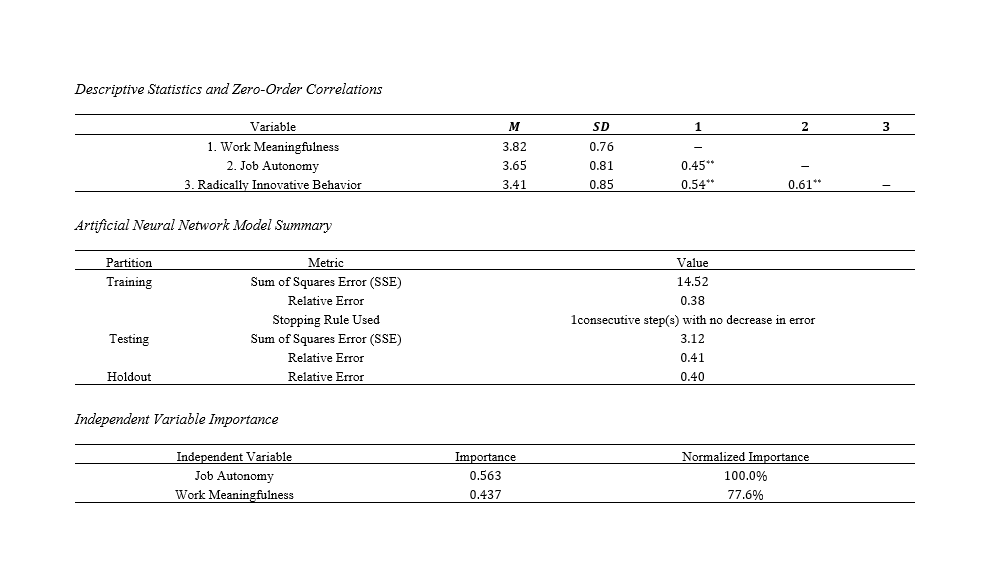
Findings: The descriptive analysis confirmed that the sample ( ) reported significant positive correlations among all variables ( ). The artificial neural network demonstrated excellent model fit and explanatory power, successfully accounting for approximately of the total variance in radically innovative behavior ( ). The normalized sensitivity analysis revealed that job autonomy is the paramount predictor of radical innovation, yielding an absolute importance of and a normalized importance of . Work meaningfulness emerged as a highly critical secondary predictor, demonstrating an absolute importance of and a normalized importance of .
Conclusion: Structural job autonomy is the absolute foundational prerequisite for enabling radically innovative behavior, while the cultivation of work meaningfulness provides the indispensable psychological drive and intrinsic resilience required to sustain these complex, paradigm-shifting efforts.
Downloads
References
Aslani, F., Ayat, M., Goharimehr, S., & Mohammadi, M. (2025). The effect of meaning in life on job performance with the mediating role of extrinsic and intrinsic motivation in employees of Isfahan Urban Railway Organization. Quarterly Journal of Work Psychology, 4(1), 9-20. https://doi.org/10.30473/jpsy.2025.75139.1096
Chakravorty, A., Kumar, V., Singh, P., & Baburaj, S. (2024). Does Work Meaningfulness Hold the Key? Exploring the Power of Meaningful Work in Attenuating Burnout. Global Knowledge Memory and Communication. https://doi.org/10.1108/gkmc-08-2023-0274
Chan, W. C. H. (2024). Applying Logotherapy in teaching meaning in life in professional training and social work education. The British Journal of Social Work, 54(1), 77-94. https://doi.org/10.1093/bjsw/bcad181
Fu, M., & Huang, J.-H. (2024). Job Crafting and Teachers' Organizational Citizenship Behavior in Chinese Colleges: The Mediating Role of Meaningful Work. Journal of Ecohumanism, 3(7), 2231-2239. https://doi.org/10.62754/joe.v3i7.4375
Hewitt, A., Bo, D., & Rosin, A. (2024). Decent Work, Meaningful Education or Potential Exploitation? The Role of Universities in Ensuring the Quality of Academic Internships in Australia, Finland and France. International Journal of Comparative Labour Law and Industrial Relations, 40(Issue 4), 495-530. https://doi.org/10.54648/ijcl2024019
Karkhaneh, F., Yusofund, H. R., & Dehqan, H. (2024). Sociological Investigation of the Consequences of Socio-Economic Inequality on Education and Training in the Western Provinces of the Country (Ilam, Kurdistan and Kermanshah) A Qualitative Study. Sociology of Education, 10(1), 224-235. https://doi.org/10.22034/ijes.2023.560565.1404
Kinanti, N. (2024). Hubungan Antara Work Meaningfulness Dengan Organizational Citizenship Behavior Pada Karyawan PT. X Kota Gresik. Journal of Education Humaniora and Social Sciences (Jehss), 7(1), 155-167. https://doi.org/10.34007/jehss.v7i1.2274
Kutaladze, I., & Butsashvili, B. (2024). The Role of Organizational Cynicism in the Relationship Between Organizational Support, Perceived Meaningfulness of Work and Organizational Commitment. GPJ, 1. https://doi.org/10.60131/gpj.1.2024.8551
Lee, S. I., & Han, S. h. (2024). Knowledge Sharing as a Cornerstone for Sustainability: The Dual Mediating Roles of Job Engagement and Meaningful Work. European Journal of Training and Development. https://doi.org/10.1108/ejtd-08-2024-0125
Mosquera, P., Tigre, F. B., & Alegre, M. (2024). Overcoming Organizational Politics and Unlocking Meaningful Work Through Ethical Leadership. International Journal of Ethics and Systems. https://doi.org/10.1108/ijoes-04-2024-0108
Mulyana, O. P., Izzati, U. A., Jihan, J. C., Nucahyanie, Y. D., Budiani, M. S., Puspitadewi, N. W. S., Novianti, D. C., & Dinar Ester Marturia Oktaviana, S. (2024). Understanding What Makes Teaching Meaningful: a Systematic Literature Review of Antecedents and Determinants of Meaningful Work in Education. Ijorer International Journal of Recent Educational Research, 5(6), 1542-1557. https://doi.org/10.46245/ijorer.v5i6.719
Nguyen, T. M., Mikolajczak, M., Wang, W., Le, H. T., & Roskam, I. (2025). Work–Family Conflict and Enrichment, Family Routines and Rituals Meaning, and Parental Burnout in UK and Vietnamese Families. Journal of marital and family therapy, 51(3). https://doi.org/10.1111/jmft.70056
Poxon, L. (2024). An Antidote to the Pathologizing of Grief: Applying the Power–Threat–Meaning Framework. Ethical Human Psychology and Psychiatry, 26(1), 74-81. https://doi.org/10.1891/ehpp-2023-0016
Rifai, A., Muchlis, M., & Susanto, B. F. (2024). Building Meaningful Work Through Inclusive Leadership: The Role of Psychological Safety. Icobuss, 974-987. https://doi.org/10.24034/icobuss.v4i1.581
Rostad, I. S., & Langvik, E. (2025). “It's the workload, not the pictures that keep me up at night.” Experi ences of Norwegian police prosecutors working with child abuse cases. International Journal of Law, Crime and Justice, 80. https://doi.org/10.1016/j.ijlcj.2024.100723
Rurkkhum, S., & Detnakarin, S. (2024). Employee Withdrawal Behavior During Forced Remote Work: The Roles of Perceived Organizational Support and Meaningful Work. International Journal of Organization Theory and Behavior, 27(3), 281-297. https://doi.org/10.1108/ijotb-01-2023-0023
Westover, J. (2025). Finding Purpose at Work: How Leaders Can Help Their Team Discover Meaning. HCLReview, 17(2). https://doi.org/10.70175/hclreview.2020.17.2.6
Widodo, T., Wening, N., Nakuloadi, H., Rustiana, E., & Saifuddiin, M. R. (2025). Work Engagement in Generation Z Employees: Organizational Commitment, Perceived Organizational Support and Work Meaningfulness. JLSDGR, 5(2), e02610. https://doi.org/10.47172/2965-730x.sdgsreview.v5.n02.pe02610
Zanabazar, A., Dugersuren, A., & Maligar, B. (2024). The Impact of Meaningful Work on Employee Engagement: The Case of Mongolian Kindergarten Teachers. Advances in Social Sciences Research Journal, 11(2), 520-531. https://doi.org/10.14738/assrj.112.16438
Zhang, Y., Tan, C., & Wang, N. (2023). How Does Supervisor Developmental Feedback Make Employees Sense the Meaning of Work? Asia Pacific Journal of Human Resources, 62(1). https://doi.org/10.1111/1744-7941.12376
Downloads
Additional Files
Publication Timeline
- Submitted
- Revised
- Accepted