Unsupervised Learning of Organizational Learning Patterns: The Roles of Knowledge Sharing and Cognitive Flexibility
DOI:
https://doi.org/10.61838/kman.ijimob.5275Keywords:
Organizational Learning, Knowledge Sharing, Cognitive Flexibility, Unsupervised Machine LearningAbstract
Objective: The objective of this study was to autonomously identify latent patterns of organizational learning among corporate professionals and examine the differentiating roles of knowledge sharing and cognitive flexibility within these profiles.
Methods and Materials: A descriptive, quantitative cross-sectional design was employed, collecting data from a sample of corporate professionals in Egypt via a validated, self-administered online questionnaire. The analytical framework utilized unsupervised machine learning, specifically Principal Component Analysis for dimensionality reduction and K-means clustering to extract distinct learning profiles. Subsequently, Multivariate Analysis of Variance (MANOVA) and Tukey’s post-hoc tests were conducted to evaluate how knowledge sharing and cognitive flexibility differed across the autonomously generated clusters.
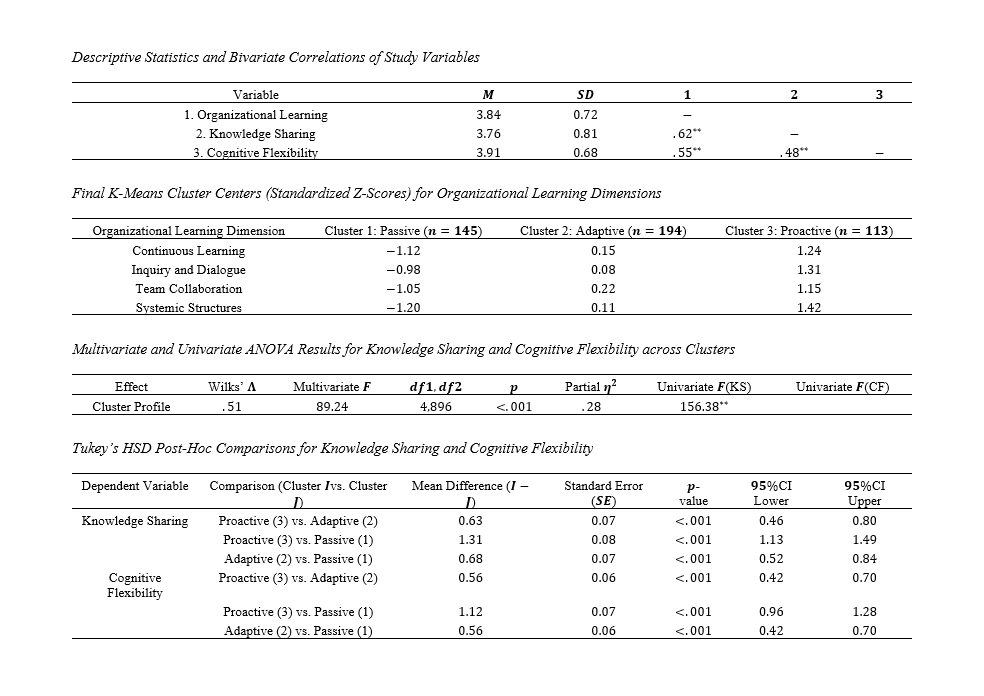
Findings: The K-means clustering algorithm identified an optimal three-cluster solution ( ): a Passive Learning Profile ( , ), an Adaptive Learning Profile ( , ), and a Proactive Learning Profile ( , ). The MANOVA results revealed a highly significant omnibus effect across the clusters, Wilks’ , . Univariate and post-hoc analyses demonstrated that individuals in the Proactive Learning Profile exhibited significantly higher levels of knowledge sharing ( ) and cognitive flexibility ( ) compared to those in the Adaptive Profile ( and , respectively; ) and the Passive Profile ( and , respectively; ).
Conclusion: Fostering a highly proactive and generative organizational learning environment fundamentally depends on deliberately cultivating both interpersonal knowledge exchange networks and individual cognitive adaptability.
Downloads
References
Abubakr, K., & Kalifa, W. (2025). The Impact of Sustainability Knowledge Sharing on Service Innovation in Libyan Banks: The Mediating Role of Intellectual Capital and Organizational Learning. Sustainability. https://doi.org/10.3390/su17083545
Alves, J. L., Nadae, J. d., & Carvalho, M. M. d. (2022). Knowledge management enablers and barriers: exploring the moderating effect of communication barriers. International Journal of Managing Projects in Business, 15(7), 1091-1122. https://doi.org/10.1108/IJMPB-02-2022-0047
Antunes, H. d. J. G., & Pinheiro, P. G. (2020). Linking knowledge management, organizational learning and memory. Journal of Innovation & Knowledge, 5(2), 140-149. https://doi.org/10.1016/j.jik.2019.04.002
Bahari, B., & Taheri Rouzbahani, M. (2023). Designing an electronic human resources management model based on knowledge creation in knowledge-based companies. Journal of value creating in Business Management, 3(1), 106-121. https://doi.org/10.22034/jvcbm.2023.392785.1082
Balweh, K., Saghafi, F., Mousakhani, M., Tajfar, A. H., & Mohaghar, A. (2022). A Framework for Knowledge Management for Open Innovation with Meta-synthesis Method. Journal of Technology Development Management, 9(4), 45-74. https://doi.org/10.22104/jtdm.2022.5123.2859
Castaneda, D. I., & Rojas, C. A. R. (2024). Organizational Conditions Associated with the Sharing of Tacit and Explicit Knowledge in the Financial Sector in Colombia. Knowledge Management & E-Learning, 16(3), 547-564. https://doi.org/10.34105/j.kmel.2024.16.025
Hoang, T. N., & Le, P. B. (2025). The influence of transformational leadership on knowledge sharing of teachers: the roles of knowledge-centered culture and perceived organizational support. The Learning Organization: An International Journal, 32(2), 328-349. https://doi.org/10.1108/TLO-08-2023-0144
Kim, E. J., & Park, S. (2020). Transformational leadership, knowledge sharing, organizational climate and learning: an empirical study. Leadership & Organization Development Journal, 41(6), 761-775. https://doi.org/10.1108/LODJ-12-2018-0455
Kim, S. L. (2021). Supervisor Knowledge Sharing and Employee Knowledge Sharing: The Moderating Roles of Learning Goal Orientation and Affective Organizational Commitment. Sustainability, 13(8), 4176. https://doi.org/10.3390/su13084176
Li, X., Qiang, Q., Huang, L., & Huang, C. (2023). How knowledge sharing affects business model innovation: an empirical study from the perspective of ambidextrous organizational learning. Sustainability, 14(10), 6157. https://doi.org/10.3390/su14106157
Marsick, V. J., & Watkins, K. E. (2023). Informal and incidental learning in the workplace: Enhancing knowledge sharing for organizational effectiveness. Journal of Workplace Learning, 35(4), 235-251. https://doi.org/10.1108/JWL-10-2022-0107
Meher, J. R., & Mishra, R. K. (2022). Examining the role of knowledge sharing on employee performance with a mediating effect of organizational learning. VINE Journal of Information and Knowledge Management Systems, 52(2), 205-223. https://doi.org/10.1108/VJIKMS-04-2020-0056
Meher, J. R., Nayak, L., Mishra, R. K., & Patel, G. (2024). Impact of organizational learning culture on organizational effectiveness: a serial mediation analysis with knowledge sharing and employee competencies. VINE Journal of Information and Knowledge Management Systems, 54(2), 324-338. https://doi.org/10.1108/VJIKMS-10-2021-0230
Mohammadi Moghaddam, Y., Valiasl, J., & Abedi, M. (2017). Investigating the Impact of Knowledge Sharing on the Organizational Learning Process with an Emphasis on Technology and Social Interaction (Case Study: Oil Industry Pension Fund). Human Resource Management in the Oil Industry, 7(28), 147-171. https://iieshrm.ir/article-1-59-en.html
Moiri, M., Nami, K., Rahmani, M., & aBEDINI, M. (2022). Identifying the components of improving the electronic professional learning environment of managers. Educational Development of Judishapur, 13(3), 554-566. https://doi.org/10.22118/edc.2023.382155.2243
Rafiei Zadeh, A. (2024). Investigating the relationship between organizational forgetting and knowledge sharing with organizational learning in primary schools in Sirik County. Third International Conference on Management, Education, and Research in Education,
Salimi, M., & Mousavi, Z. (2019). The Relationship Between Professional Ethics with Organizational Learning and Purposeful Forgetting: The Mediating Role of Knowledge Sharing. Ethics in Science and Technology, 14(2), 74-82. https://ethicsjournal.ir/browse.php?a_id=1450&sid=1&slc_lang=en
Sorakraikitikul, M., & Siengthai, S. (2014). Organizational learning culture and workplace spirituality. Is knowledge-sharing behaviour a missing link? Learning Organization, 21(3), 175-192. https://doi.org/10.1108/TLO-08-2011-0046
Takhsha, M., Barahimi, N., Adelpanah, A., & Salehzadeh, R. (2020). The effect of workplace ostracism on knowledge sharing: the mediating role of organization-based self-esteem and organizational silence. Journal of Workplace Learning, 32(6), 417-435. https://doi.org/10.1108/JWL-07-2019-0088
Zhang, Y., & Zheng, J. (2021). Entrepreneurial Leadership and Employee Learning: The Role of Knowledge Sharing and Organizational Support. Journal of Business Research, 125, 225-238.
Downloads
Additional Files
Publication Timeline
- Submitted
- Revised
- Accepted