Strategic Foresight Capability, Dynamic Capabilities, Organizational Resilience, Innovation Speed, and Firm Performance: Testing a Structural Equation Model
DOI:
https://doi.org/10.61838/kman.ijimob.5452Keywords:
Strategic foresight capability, dynamic capabilities, organizational resilience, innovation speed, firm performanceAbstract
Objective: The purpose of this study was to examine the direct and indirect relationships among strategic foresight capability, dynamic capabilities, organizational resilience, innovation speed, and firm performance through a comprehensive structural equation model among organizations operating in Canada.
Methods and Materials: This study employed a quantitative, cross-sectional design using structural equation modeling (SEM). The research population consisted of managers, executives, innovation specialists, and strategic planning professionals employed in medium-sized and large organizations across Canada. Using a stratified random sampling approach, data were collected from 542 participants representing manufacturing, technology, financial services, healthcare, logistics, and professional service sectors. Data were gathered using standardized instruments measuring strategic foresight capability, dynamic capabilities, organizational resilience, innovation speed, and firm performance. The psychometric properties of the instruments were evaluated through confirmatory factor analysis, composite reliability, and convergent validity assessments. Data analysis was conducted using SPSS 29 and AMOS 29. The measurement and structural models were assessed using maximum likelihood estimation, bootstrap procedures, and multiple model-fit indices, including χ²/df, CFI, TLI, IFI, GFI, RMSEA, and SRMR.
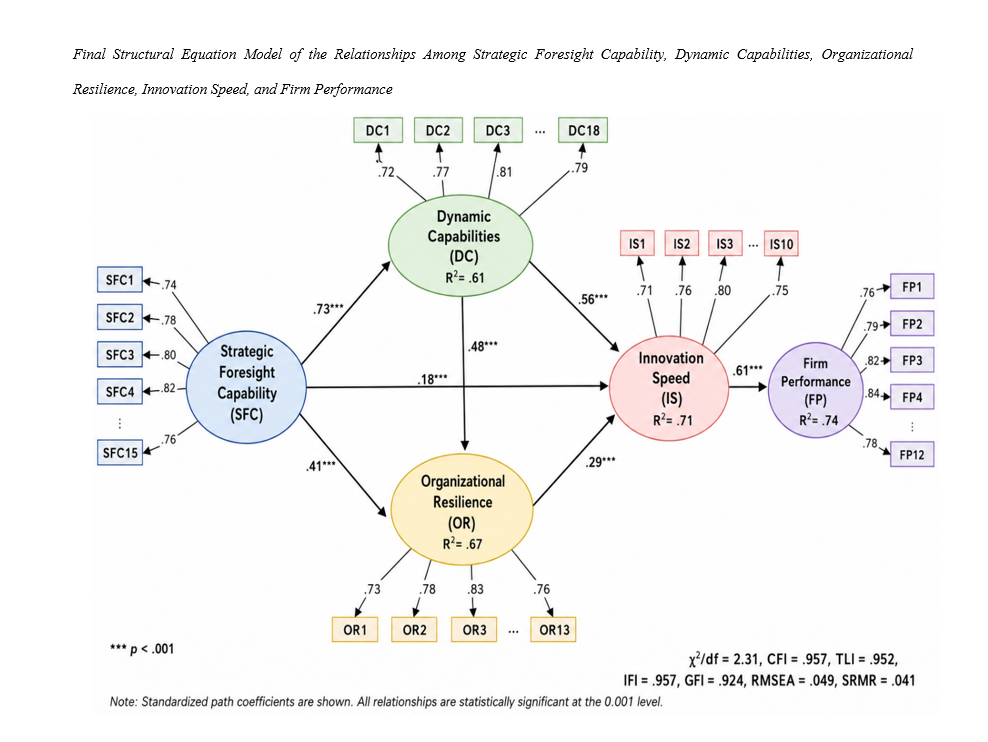
Findings: The measurement model demonstrated excellent fit to the data (χ²/df = 2.31, CFI = .957, TLI = .952, IFI = .957, GFI = .924, RMSEA = .049, SRMR = .041). Structural equation modeling revealed that strategic foresight capability positively influenced dynamic capabilities (β = .73, p < .001), organizational resilience (β = .41, p < .001), and firm performance (β = .18, p < .001). Dynamic capabilities significantly affected organizational resilience (β = .48, p < .001) and innovation speed (β = .56, p < .001). Organizational resilience exerted a positive effect on innovation speed (β = .29, p < .001), while innovation speed emerged as the strongest predictor of firm performance (β = .61, p < .001). The model explained 61% of the variance in dynamic capabilities, 67% of the variance in organizational resilience, 71% of the variance in innovation speed, and 74% of the variance in firm performance. Bootstrap analyses further confirmed significant indirect effects, indicating that dynamic capabilities, organizational resilience, and innovation speed jointly mediated the relationship between strategic foresight capability and firm performance.
Conclusion: The findings demonstrate that strategic foresight capability serves as a foundational organizational capability that enhances firm performance through the development of dynamic capabilities, organizational resilience, and innovation speed. Organizations that systematically anticipate future developments, adapt resources effectively, maintain resilience under uncertainty, and accelerate innovation processes are more likely to achieve superior performance outcomes. The study contributes to strategic management literature by providing empirical evidence for an integrated capability-based model of organizational success in dynamic and uncertain environments.
Downloads
References
AbuShanab, R. (2024). Advancing Economic Recovery With Artificial Intelligence, Quantum Computing Technologies, and Strategic Management in Small Businesses. Jaigs, 5(1), 327-338. https://doi.org/10.60087/jaigs.v5i1.201
Adigwe, C. S. (2024). Transformational Leadership: A Comparative Exploration of the Leadership Prowess of Jeff Bezos and Steve Jobs. Asian Journal of Economics Business and Accounting, 24(3), 68-89. https://doi.org/10.9734/ajeba/2024/v24i31242
Alakaş, E. Ö., Bölük, A. A., & Karadoğan, D. (2025). Resilient Logistics in Strategic Management: Going Beyond Low Cost and Sustainability. Business Strategy & Development, 8(3). https://doi.org/10.1002/bsd2.70197
Alhajahjeh, D. A., & Alkshali, S. J. (2023). The Impact of Strategic Foresight on Crisis Management Effectiveness at Greater Amman Municipality. International Journal of Academic Research in Business and Social Sciences, 13(6). https://doi.org/10.6007/ijarbss/v13-i6/17194
Alqam, H. S., Razzak, M. R., Al-Busaidi, A. S., & Al‐Riyami, S. (2024). Conceptualizing Digital Readiness, Strategic Foresight, and Strategic Flexibility as Drivers of Digitalization and Performance of Small and Medium Enterprises. Joiv International Journal on Informatics Visualization, 8(2), 938. https://doi.org/10.62527/joiv.8.2.2230
Bassey, D. N., Uwa, K. L., & Okurebia, S. (2023). Strategic Agility and Organizational Performance in Selected Manufacturing Firms in South-South Nigeria. International Journal of Business and Management Review, 11(11), 72-96. https://doi.org/10.37745/ijbmr.2013/vol11n117295
Cooper, M. (2024). Navigating Complexity: Insights Into Strategic Procurement Practices in Global Supply Chains. https://doi.org/10.20944/preprints202407.0590.v1
Duin, P. v. d., Trott, P., & Marzi, G. (2024). Tomorrow Is Already Here: Exploring How Corporate Foresight Can Contribute to Ambidexterity. Strategic Change, 33(3), 187-200. https://doi.org/10.1002/jsc.2574
Elamin, M. O. I. (2024). Leadership Dynamics in the Modern Era: A Comparative Study of Transformative and Controversial Leaders. International Journal of Religion, 5(5), 379-392. https://doi.org/10.61707/jesf6626
Gerlich, M. (2024). Empirical Insights Into the Contemporary 360 Management Framework (360MF). Open Journal of Business and Management, 12(03), 1488-1515. https://doi.org/10.4236/ojbm.2024.123081
Hu, C., & Ahmed Razman Bin Abdul, L. (2024). Reflections on the Construction of Strategic Performance Management System in Chinese Manufacturing Enterprises. Modern Management Science & Engineering, 6(1), p45. https://doi.org/10.22158/mmse.v6n1p45
Husni, F. X. (2025). Thriving Through Adversity: A Survival Learning Framework for Entrepreneurial Transformation During the COVID-19 Crisis in Indonesia. Sage Open, 15(3). https://doi.org/10.1177/21582440251370428
Ilmola‐Sheppard, L., & White, P. (2024). Extreme Uncertainty Requires Extreme Resilience: Identifying the Features of Resilience in Complex Social Systems Faced With Deep Uncertainty. FUTURES & FORESIGHT SCIENCE, 6(3). https://doi.org/10.1002/ffo2.179
Laakkonen, A., Heiskanen, A., Näyhä, A., Toppinen, A., & Hurmekoski, E. (2025). Foresight‐Related Dynamic Capabilities in Finnish Forest‐Based Bioeconomy SMEs. FUTURES & FORESIGHT SCIENCE, 7(1). https://doi.org/10.1002/ffo2.70007
Manalu, V. G., & Adzimatinur, F. (2024). How Digital Transformation Can Affect Product Innovation Performance Msmes: Evidence From West Java. Jurnal Aplikasi Manajemen, 22(1). https://doi.org/10.21776/ub.jam.2024.022.01.19
Mohammadi, R. (2023). The Role of Strategic Foresight on Dynamic Capabilities. International Journal of Innovation in Management Economics and Social Sciences, 3(1), 40-45. https://doi.org/10.52547/ijimes.3.1.40
Nguyen, H., Mohanty, S., & Ho, J. Y. (2025). Strategic Foresight in the Digital Transformation Era: Roadmapping Inspired by Design Thinking. FUTURES & FORESIGHT SCIENCE, 7(3). https://doi.org/10.1002/ffo2.70029
Ooi, S. K., & Memon, K. R. (2025). Responsible Innovation, Circular Economy and Organisational Resilience: Investigating Multiple Pathways Towards Sustainability Performance. Business Strategy and the Environment, 34(7), 8966-8982. https://doi.org/10.1002/bse.70057
Purwanto, J., Nasution, R. A., & Anggoro, Y. (2023). A Literature Review and Conceptual Framework on Corporate Strategic Foresight – What Value Created as a Source of Competitive Advantage in the Automotive Industry. Jurnal Manajemen Indonesia, 23(2), 221-240. https://doi.org/10.25124/jmi.v23i2.5631
Rafee, N. F. M., Hamid, N. A., Ahmad, M. F., & Ahmad, A. N. A. (2023). Technology Foresight Capabilities for Survival of Micro Business During Post Covid-19. International Journal of Industrial Management, 17(2), 90-98. https://doi.org/10.15282/ijim.17.2.2023.9457
Rand, A. (2024). Shaping Cultural Evolution: The Role of Craft Excellence, Design Intelligence, and Acceleration. Design Management Review, 35(1), 6-10. https://doi.org/10.1111/drev.12377
Razzak, M. R., Al‐Riyami, S., & Palalić, R. (2022). Organizational Meta Capabilities in the Digital Transformation Era. Foresight and Sti Governance, 16(4), 24-31. https://doi.org/10.17323/2500-2597.2022.4.24.31
Sakellariou, E., & Vecchiato, R. (2022). Foresight, Sensemaking, and New Product Development: Constructing Meanings for the Future. Technological Forecasting and Social Change, 184, 121945. https://doi.org/10.1016/j.techfore.2022.121945
Santos, E. C. S. (2026). Automated Technology Foresight for Urban Innovation Ecosystems: A Machine Learning Approach to Real‐Time Startup Detection and Technology Trend Mapping in a Mid‐Sized City. FUTURES & FORESIGHT SCIENCE, 8(1). https://doi.org/10.1002/ffo2.70026
Steiber, A., & Teece, D. J. (2026). The Dynamic Capabilities of Chinese Companies: Leadership in an Age of Disruptive Innovation. California Management Review, 68(2), 141-154. https://doi.org/10.1177/00081256251412827
YahiaMarzouk, Y., & Jin, J. (2022). Impact of Environmental Scanning on Organizational Resilience and Competitive Advantage: A Study of Egyptian SMEs. Continuity & Resilience Review, 4(2), 192-223. https://doi.org/10.1108/crr-10-2021-0037
Downloads
Additional Files
Publication Timeline
- Submitted
- Revised
- Accepted