Forecasting Organizational Innovation Performance Through Long Short-Term Memory (LSTM) Networks and Strategic Capability Indicators
DOI:
https://doi.org/10.61838/kman.ijimob.5463Keywords:
Organizational Innovation Performance, Long Short-Term Memory Network, LSTM, Strategic Capabilities, Deep Learning, Innovation ForecastingAbstract
Objective: The objective of this study was to forecast organizational innovation performance using Long Short-Term Memory (LSTM) networks based on strategic capability indicators and to evaluate the predictive contribution of key organizational capabilities to future innovation outcomes.
Methods and Materials: This quantitative longitudinal predictive study was conducted among 312 organizations operating across multiple industries in Canada, including manufacturing, information technology, healthcare, financial services, telecommunications, and professional services. Data were collected from 1,248 senior managers and executives using standardized instruments measuring strategic flexibility, technological capability, organizational learning capability, knowledge management capability, market sensing capability, innovation capability, absorptive capacity, resource integration capability, and leadership capability. In addition, longitudinal organizational performance records covering five consecutive years were obtained from organizational databases and annual reports. Data preprocessing procedures included normalization, outlier treatment, and temporal sequence generation. The dataset was divided into training (70%), validation (15%), and testing (15%) subsets. Organizational innovation performance was forecasted using a Long Short-Term Memory neural network. Comparative analyses were conducted using Linear Regression, Support Vector Regression, Random Forest, XGBoost, and Multilayer Perceptron models. Model performance was evaluated using Root Mean Squared Error (RMSE), Mean Absolute Error (MAE), Mean Absolute Percentage Error (MAPE), and the coefficient of determination (R²). SHapley Additive exPlanations (SHAP) analysis was employed to determine predictor importance.
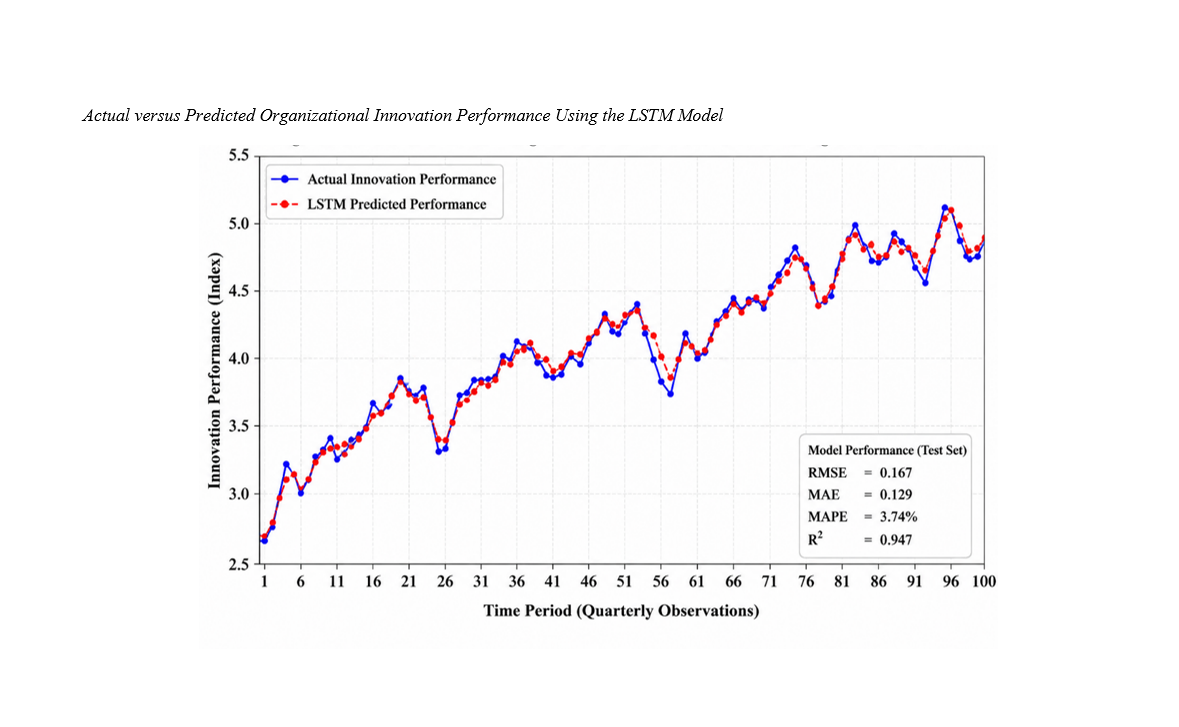
Findings: The results revealed significant positive correlations between all strategic capability indicators and organizational innovation performance (p < .01). Technological capability demonstrated the strongest association with innovation performance (r = .77), followed by organizational learning capability (r = .74) and knowledge management capability (r = .71). Comparative model evaluation indicated that the LSTM network outperformed all alternative forecasting approaches, achieving the lowest prediction errors (RMSE = 0.167, MAE = 0.129, MAPE = 3.74%) and the highest explanatory power (R² = 0.947). SHAP analysis identified technological capability, organizational learning capability, and knowledge management capability as the most influential predictors of future innovation performance. Furthermore, the LSTM model maintained strong predictive accuracy across all industrial sectors, with R² values ranging from 0.932 to 0.958, demonstrating robust cross-sector generalizability.
Conclusion: The findings demonstrate that organizational innovation performance can be forecasted with high accuracy through LSTM-based deep learning models utilizing strategic capability indicators. Technological capability, organizational learning, and knowledge management emerged as the most critical determinants of future innovation outcomes. The superior performance of the LSTM model highlights the importance of capturing temporal and nonlinear relationships within organizational data and suggests that artificial intelligence-driven forecasting systems can provide valuable support for strategic planning, innovation management, and long-term organizational decision-making.
Downloads
References
Amankona, D., Yi, K., Tackie, E. A., Tweneboa Kodua, L., & Odai, L. A. (2025). Responsible digital innovation and innovation performance in Ghana’s high-tech industry: The mediating roles of digital organizational culture and strategy, and the moderating role of digital literacy. Sage Open, 15(2), 21582440251341256.
Ardabili, F. S., Verbenko, G., & Cajnko, P. (2025). The effects of organizational agility on organizational performance: the mediating role of ambidexterity. Journal on Innovation and Sustainability Risus, 16(2), 114-123. https://doi.org/10.23925/2179-3565.2025v16i2p114-123
Duah, E., Pakmoni, L., & Appiah-Kubi, E. (2025). Green human resource management and organizational efficiency among local assemblies: role of process innovation and knowledge sharing. Journal of Organizational Effectiveness: People and Performance, 12(1), 168-190. https://doi.org/10.1108/JOEPP-11-2023-0511
Iman, N. (2025). Balancing Order and Entropy: The Role of Innovation and Organizational Disorder in Performance Across Startups and Banking. International Journal of Innovation Science. https://doi.org/10.1108/ijis-03-2025-0142
Kassa, B. Y., & Worku, E. K. (2025). The Impact of Artificial Intelligence on Organizational Performance: The Mediating Role of Employee Productivity. Journal of Open Innovation: Technology, Market, and Complexity, 11, 100474. https://doi.org/10.1016/j.joitmc.2025.100474
Lusha, E. (2025). Organizational productivity and employee performance in the era of digital technological innovation. Interdisciplinary Journal of Research and Development, 12(3), 102-102. https://doi.org/10.56345/ijrdv12n312
Mukhaini, S. A. A., Uraimi, S. M. A., & Farsi, T. S. A. (2025). The Effect of Leadership Style on Organizational Performance in Oman. International Journal of Research and Innovation in Social Science, IX(I), 911-930. https://doi.org/10.47772/ijriss.2025.9010075
Nkgowe, S. T., Qu, L., & Odai, L. A. (2025). The interplay between digital organizational culture, ESG performance, and corporate reputation in shaping innovation capacity. Business Process Management Journal(ahead-of-print). https://doi.org/10.1108/BPMJ-01-2025-0040
Rahman, M. A., & Saba, N. A. (2025). Driving Sustainable Business Performance through Green HRM: Examining the Mediating Roles of Green Technology Innovation and Green Organizational Culture. Golden Ratio of Human Resource Management, 5(2), 501-516. https://doi.org/10.52970/grhrm.v5i2.1326
Shahzad, M. A., Chen, S., Wang, X., Li, Z., & Iqbal, T. (2025). Impact of GHRM and Innovation Capabilities on Organizational Performance: The Role of Digital Transformation and Green Leadership. Journal of Manufacturing Technology Management, 1-28. https://doi.org/10.1108/jmtm-11-2024-0639
Wang, S., & Zhang, H. (2025). Enhancing SMEs sustainable innovation and performance through digital transformation: Insights from strategic technology, organizational dynamics, and environmental adaptation. Socio-Economic Planning Sciences, 98, 102124. https://doi.org/10.1016/j.seps.2024.102124
Wang, Y., Zhu, L., & Jin, X. (2024). The effect of a high-performance work system on organizational innovation performance: The mediating effect of employees' intrinsic motivation and the moderating effect of person-organization fit. Systems, 12(7), 230. https://doi.org/10.3390/systems12070230
Wongmahesak, K., Wongsuwan, N., Akkaya, B., & Palazzo, M. (2024). Impact of Knowledge Management Process on Organizational Performance: The Mediating Role of Technological Innovation. Knowledge and Process Management, 32(1), 54-64. https://doi.org/10.1002/kpm.1795
Xu, M., Zhang, Y., Sun, H., Tang, Y., & Li, J. (2024). How Digital Transformation Enhances Corporate Innovation Performance: The Mediating Roles of Big Data Capabilities and Organizational Agility. Heliyon. https://doi.org/10.1016/j.heliyon.2024.e34905
Yu, J., & Xiang, K. (2024). Transformational Leadership, Organizational Resilience, and Team Innovation Performance: A Model for Testing Moderation and Mediation Effects. Behavioral Sciences, 15(1), 10. https://doi.org/10.3390/bs15010010
Zarei, M. (2024). The Impact of High-Performance Work Systems on Promoting Organizational Creativity and Innovation Mediated by Knowledge Sharing (Case Study: A Military Organization). Journal of Marine Science Education, 11(4), 13-29.
Zhang, J., Zia, U., Shehzad, M. U., & Sherani. (2025). Tacit knowledge management process, product innovation and organizational performance: exploring the role of affective trust and task efficiency. Business Process Management Journal, 31(1), 267-297. https://doi.org/10.1108/BPMJ-11-2023-0873
Downloads
Additional Files
Publication Timeline
- Submitted
- Revised
- Accepted