Predicting Employee Voice Behavior Based on Ethical Leadership and Organizational Justice: The Mediating Role of Psychological Safety
Keywords:
Employee Voice Behavior, Ethical Leadership, Organizational Justice, Psychological Safety, Structural Equation Modeling, CanadaAbstract
Objective: This study aimed to predict employee voice behavior based on ethical leadership and organizational justice and to examine the mediating role of psychological safety among employees working in Canada.
Methods and Materials: This cross-sectional correlational study was conducted in 2026 among employees working in public and private organizations in Canada. A total of 326 employees were included in the final analysis. Data were collected using the Ethical Leadership Scale, Colquitt’s Organizational Justice Scale, Edmondson’s Psychological Safety Scale, and the Employee Voice Behavior Scale. Data analysis was performed using IBM SPSS Statistics and AMOS. Pearson correlation analysis, confirmatory factor analysis, and structural equation modeling were used to examine the proposed relationships. The mediating effects were tested using a bootstrap procedure with 5,000 resamples and bias-corrected 95% confidence intervals.
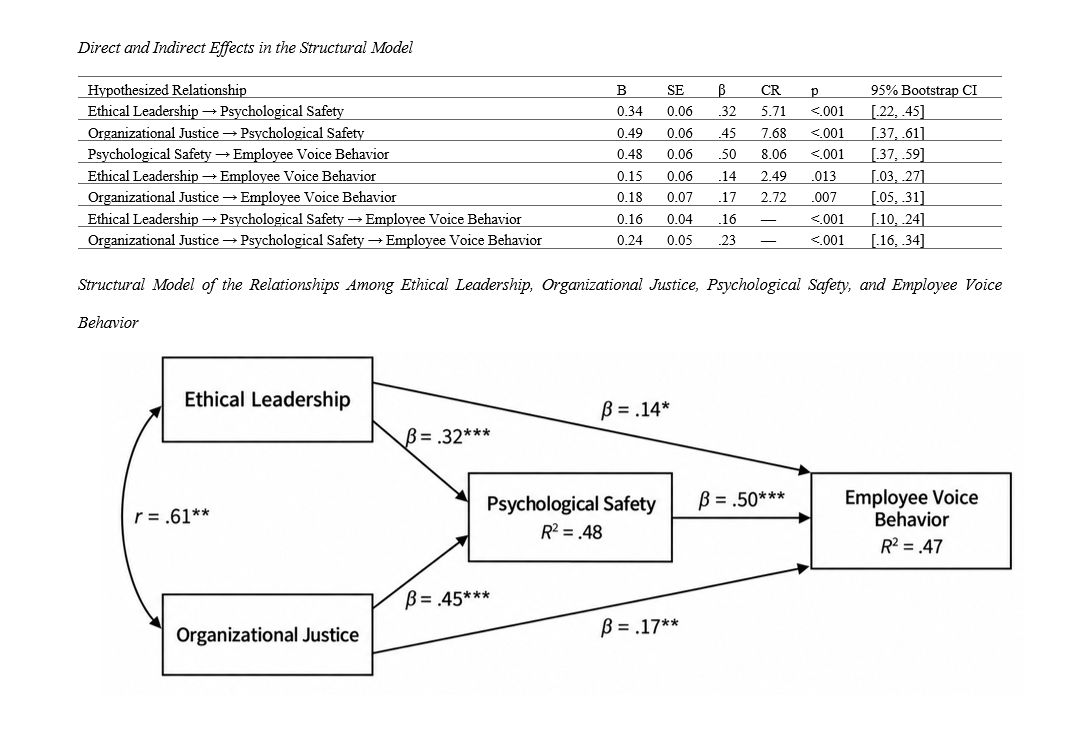
Findings: Ethical leadership significantly predicted psychological safety (β = .32, p < .001) and employee voice behavior (β = .14, p = .013). Organizational justice also significantly predicted psychological safety (β = .45, p < .001) and employee voice behavior (β = .17, p = .007). Psychological safety significantly predicted employee voice behavior (β = .50, p < .001). The indirect effect of ethical leadership on employee voice behavior through psychological safety was significant (β = .16, 95% CI [.10, .24], p < .001), as was the indirect effect of organizational justice through psychological safety (β = .23, 95% CI [.16, .34], p < .001). The structural model showed acceptable fit, χ²/df = 2.20, CFI = .93, TLI = .92, IFI = .93, RMSEA = .061, and SRMR = .055.
Conclusion: Ethical leadership and organizational justice contribute to greater employee voice behavior both directly and indirectly by strengthening psychological safety, indicating that employees are more likely to speak up constructively when they experience ethical supervision, fair organizational treatment, and a safe interpersonal climate.
Downloads
References
Abdelrahman, M. M., Nashwan, A. J., & El-boudy, D. F. (2025). Nurse Managers’ Toxic Leadership: Its Relation to Nurses’ Internal and External Intentions to Whistleblowing. Journal of nursing management, 2025(1). https://doi.org/10.1155/jonm/1734502
Aboobaker, N., & Zakkariya, K. A. (2023). Nurturing the Soul at Work: Unveiling the Impact of Spiritual Leadership, Interpersonal Justice and Voice Behavior on Employee Intention to Stay. International Journal of Ethics and Systems, 40(3), 539-560. https://doi.org/10.1108/ijoes-01-2023-0013
Ballout, S., & Hamadeh, S. (2026). From Resilience to Resistance: Rethinking Faculty Well‐Being as a Moral and Political Problem in Nursing Education—Toward a Humane Ethics of Academic Care. Nursing Inquiry, 33(2). https://doi.org/10.1111/nin.70092
Beil‐Hildebrand, M. B., Kundt, F. S., Kutschar, P., & Birkholz, L. (2024). What Keeps You Up at Night? Moral Distress in Nurse Leaders in the USA, Germany, Austria and Switzerland. Leadership in Health Services, 37(3), 377-393. https://doi.org/10.1108/lhs-09-2023-0075
Bhatnagar, A., & Aggarwal, G. (2022). Impact of Inclusive Leadership on Variables Affecting Employee Performance: A Review of Empirical Papers. International Journal of Research in Human Resource Management, 4(1), 13-24. https://doi.org/10.33545/26633213.2022.v4.i1a.83
Boutwell, K. R., & Smith, T. D. (2023). A Hierarchy of Learning Needs for Revolutionizing Inclusive Organizational Practices. Advances in Developing Human Resources, 25(3), 189-204. https://doi.org/10.1177/15234223231176107
Budreikaitė, J., Rapuano, V., & Raišienė, A. G. (2024). State of Play in the Implementation of the Principles of Inclusive Leadership in Fintech Companies in Lithuania. Merits, 4(4), 400-413. https://doi.org/10.3390/merits4040028
Burhan, Q.-u.-A., Khan, M. A., & Malik, M. F. (2023). “Ethical Leadership: A Dual Path Model for Fostering Ethical Voice Through Relational Identification, Psychological Safety, Organizational Identification and Psychological Ownership”. RAUSP Management Journal, 58(4), 341-362. https://doi.org/10.1108/rausp-01-2023-0008
Campbell, Y. (2025). The Ethical Responsibility of Psychological Safety: Leadership at the Intersection of Safety Culture. Healthcare Management Forum, 39(1), 66-69. https://doi.org/10.1177/08404704251348817
Clarke, E., Näswall, K., Masselot, A., & Malinen, S. (2024). Feeling Safe to Speak Up: Leaders Improving Employee Wellbeing Through Psychological Safety. Economic and Industrial Democracy, 46(1), 152-176. https://doi.org/10.1177/0143831x231226303
Daniel, M. (2023). The Effect of Abusive Supervision Climate on B2B Sales Performance: A Moderated Mediation Model. American Journal of Management, 23(3). https://doi.org/10.33423/ajm.v23i3.6359
Elhihi, E. A., Aljarary, K. L., Alahmadi, M., Adam, J. B., Almwualllad, O. A., Hawsawei, M. S., & Ibrahim, I. A. (2025). The Mediating Role of Moral Courage in the Relationship Between Ethical Leadership and Error Reporting Behavior Among Nurses in Saudi Arabia: A Structural Equation Modeling Approach. BMC Nursing, 24(1). https://doi.org/10.1186/s12912-025-03043-7
George, C. E. (2022). What Do We Owe Health Workers Earning Low Wages Who Are at Risk of Harm? The Ama Journal of Ethic, 24(9), E830-838. https://doi.org/10.1001/amajethics.2022.830
Ibrahim, I. A., Doddanavar, I., Abdelrahim, S. M., & Mennat Allah, G. A. Z. (2025). The Role of Ethical Leadership in Promoting Internal Whistleblowing Among Nurses: A Dual-Mediation Model Analysis of Psychological Safety and Reporting Attitudes. International journal of nursing sciences, 12(5), 431-437. https://doi.org/10.1016/j.ijnss.2025.08.004
Ip, E., Srivastava, R., Lentz, L., Jasinoski, S. C., & Andérson, G. S. (2025). Antecedents of Workplace Psychological Safety in Public Safety and Frontline Healthcare: A Scoping Review. International journal of environmental research and public health, 22(6), 820. https://doi.org/10.3390/ijerph22060820
Kim, H. S. (2024). Silence in the Workplace: What Do We Know From Research? European Journal of Training and Development, 48(10), 56-83. https://doi.org/10.1108/ejtd-06-2024-0077
Knippenberg, D. v., & Dwertmann, D. J. G. (2022). Interacting Elements of Leadership: Key to Integration but Looking for Integrative Theory. Journal of Management, 48(6), 1695-1723. https://doi.org/10.1177/01492063211073069
Kumah, A. (2025). Adverse Event Reporting and Patient Safety: The Role of a Just Culture. Frontiers in Health Services, 5. https://doi.org/10.3389/frhs.2025.1581516
Mohase, K., Donald, F. M., & Israel, N. (2025). Inclusive Leadership, Psychological Safety, and Employee Voice in Remote and Hybrid Work Employees. South African Journal of Psychology, 55(3), 432-446. https://doi.org/10.1177/00812463251365484
Montgomery, A., Lainidi, O., Johnson, J., Creese, J., Bååthe, F., Băban, A., Bhattacharjee, A., Carter, M., Dellve, L., Doherty, E., Jendeby, M. K., Morgan, K., Srivastava, M., Thompson, N., Tyssen, R., & Vohra, V. (2022). Employee Silence in Health Care: Charting New Avenues for Leadership and Management. Health Care Management Review, 48(1), 52-60. https://doi.org/10.1097/hmr.0000000000000349
Pincus, J. D. (2025). Team Emergent States as Emotional Needs. Small Group Research, 56(6), 987-1023. https://doi.org/10.1177/10464964251317474
Qi, L., Xu, Y., & Liu, B. (2023). Does Justice Matter in Voice? Inclusive Leadership and Employee Voice: The Moderating Role of Organizational Justice Perception. Frontiers in psychology, 14. https://doi.org/10.3389/fpsyg.2023.1313922
Sasaki, N., Inoue, A., Asaoka, H., Sekiya, Y., Nishi, D., Tsutsumi, A., & Imamura, K. (2022). The Survey Measure of Psychological Safety and Its Association With Mental Health and Job Performance: A Validation Study and Cross-Sectional Analysis. International journal of environmental research and public health, 19(16), 9879. https://doi.org/10.3390/ijerph19169879
Shafaei, A., & Nejati, M. (2023). Creating Meaningful Work for Employees: The Role of Inclusive Leadership. Human Resource Development Quarterly, 35(2), 189-211. https://doi.org/10.1002/hrdq.21512
She, J., Zhang, R., Li, Y., Mei, Y., & Li, H. (2023). Effect of Ethical Leadership on Nurses’ Organizational Silence: The Mediating Role of Organizational Justice. Journal of nursing management, 2023, 1-10. https://doi.org/10.1155/2023/9929435
Walker, J. (2025). Trauma, Power, and Psychological Safety: Understanding the Mental Health Impact of Workplace Bullying. Healthcare, 13(23), 3084. https://doi.org/10.3390/healthcare13233084
Wang, X., Wen, X., & Gou, L. (2024). Exploring the Relationship Between Ethical Leadership and Nurses’ Moral Courage in China: The Mediating Effect of Psychological Empowerment. Journal of nursing management, 2024(1). https://doi.org/10.1155/2024/6664191
Worthington, R. L., Elmore, B. D., Dissassa, D.-T., & Pasha, A. M. (2026). From Principles to Practice: Ethical Leadership in a Time of Threat. Journal of Diversity in Higher Education. https://doi.org/10.1037/dhe0000717
Downloads
Additional Files
Publication Timeline
- Submitted
- Revised
- Accepted