The Impact of Business Environmental Changes on the Adoption of a Strategic Pivot: A Case Study of Zar Industrial Group
Keywords:
Business Environment, Strategic Pivot, Environmental Change, Business-Model Redesign, Digital Transformation, Organizational Learning, Zar Industrial GroupAbstract
Objective: This study aimed to examine the impact of business environmental changes on strategic pivot adoption in Zar Industrial Group and develop a conceptual model of this process.
Methods and Materials: This applied qualitative study used a grounded theory design. The study population consisted of Zar Industrial Group managers and university professors with expertise in strategic management and organizational change. Participants were selected purposively based on their knowledge and professional experience. Data were collected through semi-structured interviews with managers of the holding company and its food-industry subsidiaries, together with academic experts. Interviews continued until theoretical saturation, resulting in a final sample of 12 participants. Interview transcripts were systematically coded, compared, and categorized to identify the principal dimensions and mechanisms associated with strategic pivot adoption.
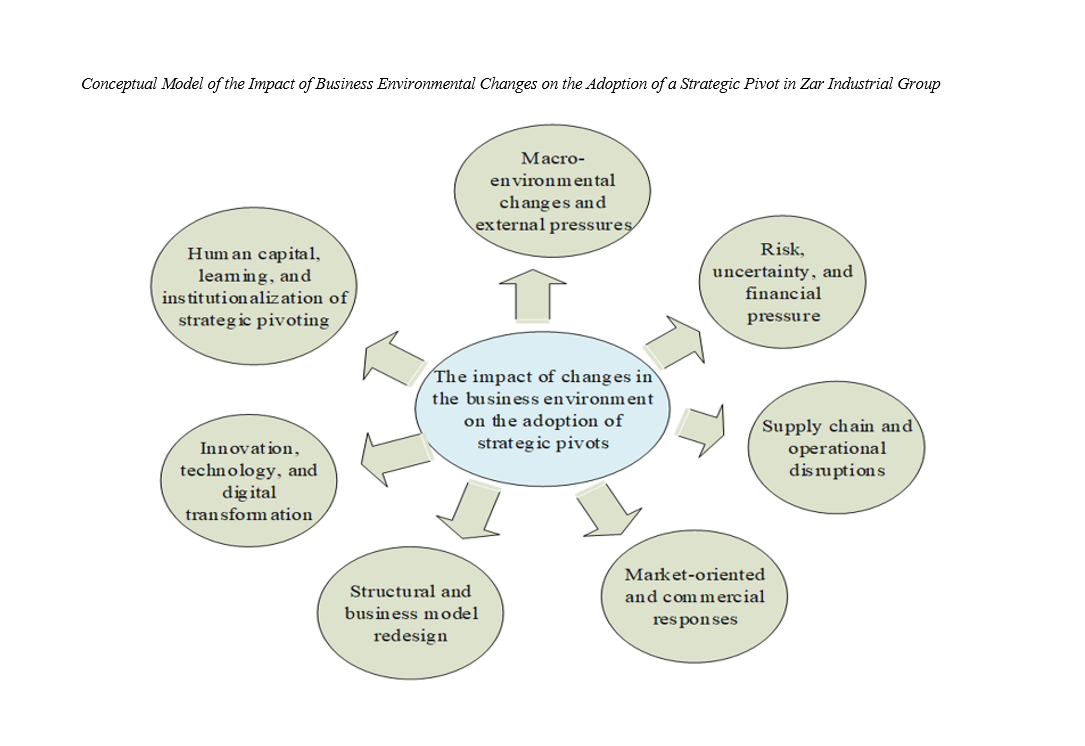
Findings: The analysis produced seven main categories and 41 related concepts. The categories included macro-environmental changes and external pressures; risk, uncertainty, and financial pressure; supply-chain and operational disruptions; market-oriented and commercial responses; structural and business-model redesign; innovation, technology, and digital transformation; and human capital, organizational learning, and institutionalization of the strategic pivot. Environmental turbulence generated financial, operational, and market pressures that stimulated coordinated strategic responses. These responses involved market reorientation, business-model redesign, technological innovation, digital transformation, and capability development. Human capital and organizational learning played a central role in sustaining and institutionalizing the strategic pivot.
Conclusion: Strategic pivot adoption in Zar Industrial Group represents a multidimensional organizational response to environmental uncertainty rather than an isolated managerial decision. Successful pivots require alignment among market responses, structural transformation, technological innovation, operational resilience, and organizational learning. The proposed conceptual model can help managers recognize environmental signals, coordinate adaptive actions, and strengthen organizational resilience and long-term competitiveness.
Downloads
References
Autor, D., Dorn, D., Katz, L. F., Patterson, C., & Van Reenen, J. (2020). The Fall of the Labor Share and the Rise of Superstar Firms. The Quarterly Journal of Economics, 135(2), 645-709. https://doi.org/10.1093/qje/qjaa004
Bajwa, S. S., Wang, X., Duc, A. N., & Abrahamsson, P. (2016). How Do Software Startups Pivot? Empirical Results from a Multiple Case Study. In A. Maglyas & A. L. Lamprecht (Eds.), Software Business (pp. 169-176). https://doi.org/10.1007/978-3-319-40515-5_14
Blank, S., & Eckhardt, J. T. (2024). The Lean Startup as an Actionable Theory of Entrepreneurship. Journal of Management, 50(8), 3012-3034. https://doi.org/10.1177/01492063231168095
Burnell, D., Stevenson, R., & Fisher, G. (2023). Early-Stage Business Model Experimentation and Pivoting. Journal of Business Venturing, 38(4), 106314. https://doi.org/10.1016/j.jbusvent.2023.106314
Han, Y., Pan, C., & Jin, F. (2023). Does the Improvement of the Business Environment Improve the Innovation Efficiency of Enterprises? Evidence from the Listed Companies in China. Sustainability, 15(14), 11424. https://doi.org/10.3390/su151411424
Kirtley, J., & O'Mahony, S. (2020). What Is a Pivot? Explaining When and How Entrepreneurial Firms Decide to Make Strategic Change and Pivot. Strategic management journal, 1-34. https://doi.org/10.1002/smj.3131
Köseoğlu, M. A. (2025). Leveraging Entrepreneurship for Environmental Sustainability: A Machine Learning Approach to SDG Achievement. Business Strategy and the Environment, 34(7), 7980-8000. https://doi.org/10.1002/bse.70011
Lai, J., Ke, J., Lin, S., Zhang, P., & Zhang, Q. (2024). Business Environment Optimization and Labor Income Share of Enterprises: Evidence from China. Research in International Business and Finance, 71, 102491. https://doi.org/10.1016/j.ribaf.2024.102491
Özdemirkol, M. (2025). Business Ethics Within the Framework of Ethical Responsibility Implied by Environmental Protection Principles: Responsibility to Nature. Turkish Journal of Business Ethics, 18(1), 35-52. https://doi.org/10.12711/tjbe/m403
Ramazani Borukhani, N., Vardi, S. S., Mehrara, A., & Diri, E. (2025). Investigating the Impact of Individual, Environmental, Organizational, and Cultural Factors on Enhancing Human Resource Productivity in Public Banks of Mazandaran Province. Dynamic Management and Business Analysis Quarterly, 2(4), 200-211. https://doi.org/10.61838/dmbaj.2.4.13
Ries, E. (2011). The Lean Startup: How Constant Innovation Creates Radically Successful Businesses. Penguin Group.
Romero Martínez, M., Carmona Ibáñez, P., & Martínez Vargas, J. (2025). Predicting Business Failure with the XGBoost Algorithm: The Role of Environmental Risk. Sustainability, 17, 4948. https://doi.org/10.3390/su17114948
Sanasi, S. (2023). Entrepreneurial Experimentation in Business Model Dynamics: Current Understanding and Future Opportunities. International Entrepreneurship and Management Journal, 19(2), 805-836. https://doi.org/10.1007/s11365-023-00836-7
Singh, R. K., Mishra, R., & He, Q. (2025). Sustainable Supply Chain and Environmental Collaboration in the Supply Chain Management: Agenda for Future Research and Implications. Business Strategy and the Environment, 34(5), 5487-5513. https://doi.org/10.1002/bse.4136
Snihur, Y., & Clarysse, B. (2022). Sowing the Seeds of Failure: Organizational Identity Dynamics in New Venture Pivoting. Journal of Business Venturing, 37(1), 106164. https://doi.org/10.1016/j.jbusvent.2021.106164
Downloads
Additional Files
Publication Timeline
- Submitted
- Revised
- Accepted