The Effect of Affect Arousal on the Consolidation of Motor Memory in Adolescents: Investigating the Role of Rest Intervals
DOI:
https://doi.org/10.61838/kman.jayps.2001Keywords:
Off-line Practice, Positive Affect, Negative Affect, AdolescentsAbstract
Objective: The purpose of this study was to investigate the effect of affect arousal on the consolidation of motor memory in adolescents: investigating the role of rest intervals.
Methods and Materials: The research employed a semi-experimental, applied design. The statistical population included semi-skilled male adolescent basketball players from clubs in Kurdistan province. A total of sixty participants, aged 14 to 16, were purposively selected based on inclusion criteria and randomly assigned to one of five groups: control, immediate positive Affect arousal, immediate negative Affect arousal, delayed positive Affect arousal, and delayed negative Affect arousal. Participants in each group performed 100 basketball free throws, with two-minute rest intervals after every twenty throws. Immediately following their final practice session, participants in the Affect arousal groups were shown a ten-minute film clip designed to evoke either positive or negative Affects. The Affect arousal stimuli were administered immediately or after a delay, according to the group assignment. Subsequently, participants completed a memory recall test, with ten free throws performed at two intervals: fifteen minutes and forty-eight hours’ post-acquisition.
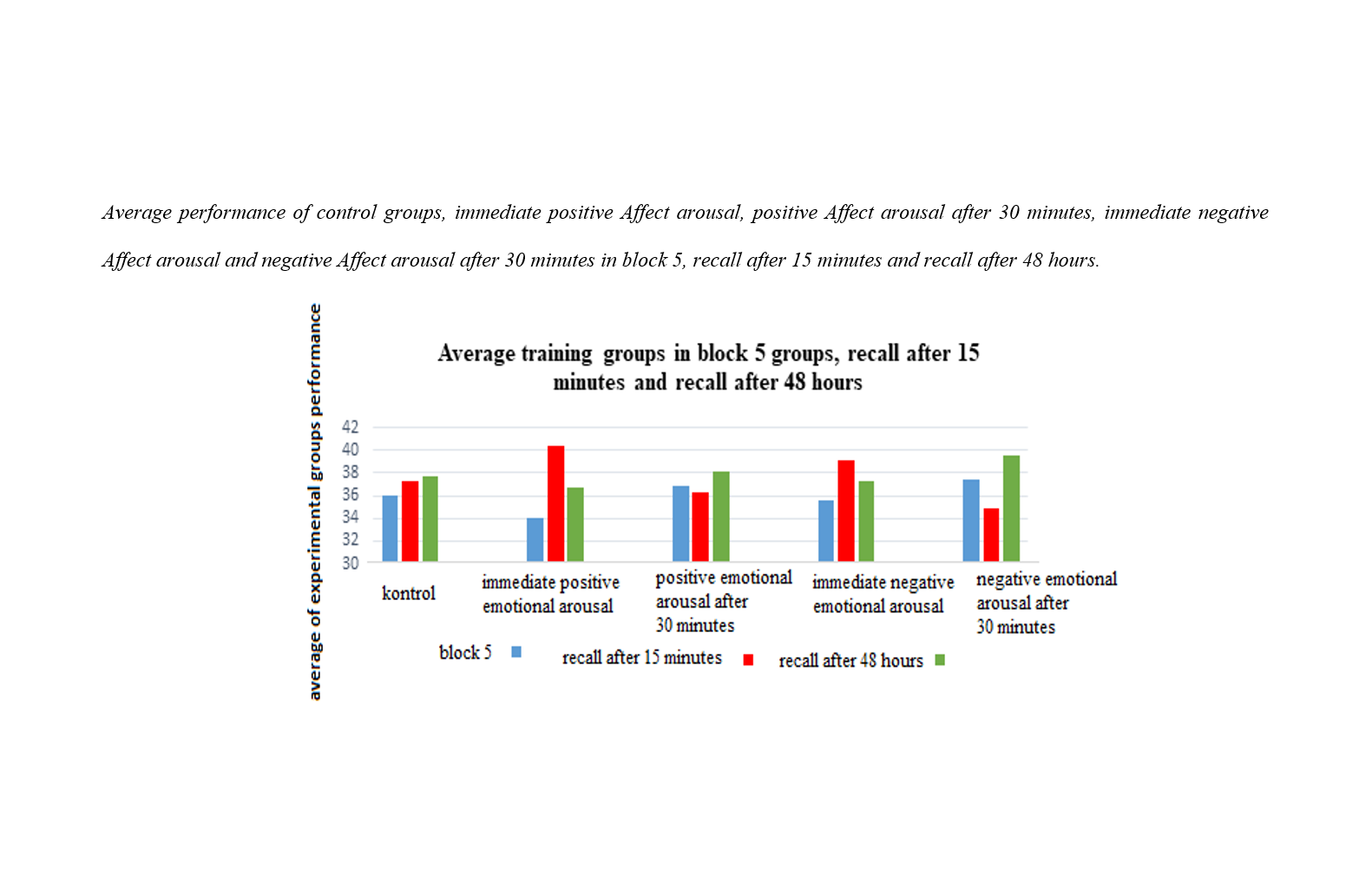
Findings: The results of a repeated measures analysis of variance indicated that the mean scores in the fifth practice block were significantly higher than those in the first practice block (p=0.001). A significant interaction effect was observed between evaluation time (fifteen minutes and forty-eight hours’ post-acquisition) and group type (p=0.042). In the immediate Affect arousal groups (both positive and negative), participants scored higher on the memory recall test fifteen minutes’ post-acquisition compared to forty-eight hours’ post-acquisition. In contrast, in the delayed Affect arousal groups (both positive and negative), participants performed better in the memory recall test forty-eight hours’ post-acquisition compared to fifteen minutes’ post-acquisition.
Conclusion: The long-term effects of positive and negative Affect arousal increase over time, and the effects of positive and negative Affects decrease in individual performance after fifteen minutes.
Downloads
References
Baker, K. B., & Kim, J. J. (2002). Effects of stress and hippocampal NMDA receptor antagonism on recognition memory in rats. Learning & Memory, 9(2), 58-65. https://doi.org/10.1101/lm.46102
Bolte, A., Goschke, T., & Kuhl, J. (2003). Affect and intuition: Effects of positive and negative mood on implicit judgments of semantic coherence. Psychological Science, 14, 416-421. https://doi.org/10.1111/1467-9280.01456
Cahill, L., Haier, R. J., Fallon, J., Alkire, M. T., Tang, C., Keator, D., & McGaugh, J. L. (1996). Amygdala activity at encoding correlated with long-term, free recall of Affect information. Proceedings of the National Academy of Sciences, 93(15), 8016-8021. https://doi.org/10.1073/pnas.93.15.8016
Cornelisse, S., Van Stegeren, A. H., & Joels, M. (2011). Implications of psychosocial stress on memory formation in a typical male versus female student sample. Psychoneuroendocrinology, 36(4), 569-578. https://doi.org/10.1016/j.psyneuen.2010.09.002
Gray, J. R. (2001). Affect modulation of cognitive control: Approach-withdrawal states double-dissociate spatial from verbal two-back task performance. Journal of Experimental Psychology: General, 130(3), 436-452. https://doi.org/10.1037/0096-3445.130.3.436
Judde, S., & Rickard, N. (2010). The effect of post-learning presentation of music on longterm word-list retention. Neurobiology of learning and memory, 94(1), 13-20. https://doi.org/10.1016/j.nlm.2010.03.002
Kensinger, E. A., & Corkin, S. (2003). Memory enhancement for Affect words: Are Affect words more vividly remembered than neutral words? Memory & Cognition, 31(8), 1169-1180. https://doi.org/10.3758/BF03195800
Kensinger, E. A., & Ford, J. H. (2020). Retrieval of Affect events from memory. Annual review of psychology, 71, 251-272. https://doi.org/10.1146/annurev-psych-010419-051123
Kim, J. H., Daie, K., & Li, N. (2024). A Combinatorial Neural Code for Long-Term Motor Memory. https://doi.org/10.1101/2024.06.05.597627
Kim, T., & Wright, D. L. (2021). Exposure to Sleep, Rest, or Exercise Impacts Skill Memory Consolidation but so Too Can a Challenging Practice Schedule. Eneuro, 8(5). https://doi.org/10.1523/ENEURO.0198-21.2021
McEwen, B. S., & Sapolsky, R. M. (1995). Stress and cognitive function. Current opinion in neurobiology, 5(2), 205-216. https://doi.org/10.1016/0959-4388(95)80028-X
McGaugh, J. L. (2005). Affect arousal and enhanced amygdala activity: new evidence for the old perseveration-consolidation hypothesis. Learning & Memory, 12(2), 77-79. https://doi.org/10.1101/lm.93405
McGaugh, J. L. (2018). Affect arousal regulation of memory consolidation. Current Opinion in Behavioral Sciences, 19, 55-60. https://doi.org/10.1016/j.cobeha.2017.10.003
Mednick, S., Nakayama, K., & Stickgold, R. (2003). Sleep-dependent learning: a nap is as good as a night. Nature Neuroscience, 6(7), 697-698. https://doi.org/10.1038/nn1078
Nielson, K. A., Yee, D., & Erickson, K. I. (2005). Memory enhancement by a semantically unrelated Affect arousal source induced after learning. Neurobiology of learning and memory, 84(1), 49-56. https://doi.org/10.1016/j.nlm.2005.04.001
Rasch, B., Büchel, C., Gais, S., & Born, J. (2007). Odor cues during slow-wave sleep prompt declarative memory consolidation. Science, 315(5817), 1426-1429. https://doi.org/10.1126/science.1138581
Stee, W., & Peigneux, P. (2023). Does Motor Memory Reactivation through Practice and Post-Learning Sleep Modulate Consolidation? Clocks & Sleep, 5(1), 72-84. https://doi.org/10.3390/clockssleep5010008
Stoica, D., & Barbu, D. (2025). Analysis of Effects of Specific Football Training on the Development of Motor Skills in Juniors Aged 12-13 Years Old. Bulletin of the Transilvania University of Brasov. Series IX: Sciences of Human Kinetics, 101-108. https://doi.org/10.31926/but.shk.2025.18.67.1.12
Storbeck, J. (2012). Performance costs when Affect tunes inappropriate cognitive abilities: Implications for mental resources and behavior. Journal of Experimental Psychology: General, 141(3), 411-416. https://doi.org/10.1037/a0026322
Suhartini, B., Ambardini, R. L., Sutapa, P., & Sumaryanti, S. (2024). Development of a Motor Physical Activity Game Model to Improve Self-Control and Memory of Children with Visual Impairment in Special Schools (SLB). 6th Yogyakarta International Seminar on Health, Physical Education and Sport Science (YISHPESS 2023),
Tomlin, K. B., Johnson, B. P., & Westlake, K. P. (2024). Age-Related Differences in Motor Skill Transfer With Brief Memory Reactivation. Brain Sciences, 14(1), 65. https://doi.org/10.3390/brainsci14010065
Tremblay, S., Lepage, J. F., Latulipe-Loiselle, A., Fregni, F., Pascual-Leone, A., & Théoret, H. (2014). The uncertain outcome of prefrontal tDCS. Brain Stimulation, 7(6), 773-783. https://doi.org/10.1016/j.brs.2014.10.003
Vytal, K., Cornwell, B., Letkiewicz, A., Arkin, N., & Grillon, C. (2013). The complex interaction between anxiety and cognition: Insight from spatial and verbal working memory. Frontiers in human neuroscience, 7, 93. https://doi.org/10.3389/fnhum.2013.00093
Walker, M. P., Brakefield, T., Allan Hobson, J., & Stickgold, R. (2003). Dissociable stages of human memory consolidation and reconsolidation. Nature, 425(6958), 616-620. https://doi.org/10.1038/nature01930
Wang, B., & Bukuan, S. (2015). Timing matters: Negative Affect elicited 5 min but not 30 min or 45 min after learning enhances consolidation of internal-monitoring source memory. Acta Psychologica, 157, 56-64. https://doi.org/10.1016/j.actpsy.2015.02.006
Wang, B., & Sun, B. (2017). Post-encoding Affect arousal enhances consolidation of item memory, but not reality-monitoring source memory. The Quarterly Journal of Experimental Psychology, 70(3), 461-472. https://doi.org/10.1080/17470218.2015.1134604
Xie, T., Ma, H., Wang, L., & Du, Y. (2024). Can enactment and motor imagery improve working memory for instructions in children with autism spectrum disorder and children with intellectual disability? Journal of Autism and Developmental Disorders, 54(1), 131-142. https://doi.org/10.1007/s10803-022-05780-z
Xing, Y., & Wu, X. (2025). Effects of Motor Skills and Physical Activity Interventions on Motor Development in Children with Autism Spectrum Disorder: A Systematic Review. Healthcare, 13(5), 489. https://pubmed.ncbi.nlm.nih.gov/40077051/
Yun, J.-E., Im, C.-H., & Park, J.-H. (2025). Effects of Repetitive Practice on Motor Learning and Adaptability in Foot Position Control for Cerebellar Ataxia. International Journal of Rehabilitation Research. https://doi.org/10.1097/mrr.0000000000000670
Zhang, J., Lam, S. P., Ho, C. K. W., Li, A. M., Tsoh, J., Mok, V., & Wing, Y. K. (2008). Diagnosis of REM sleep behavior disorder by video-polysomnographic study: is one night enough? Sleep, 31(8), 1179-1185. https://pubmed.ncbi.nlm.nih.gov/18714790/
Zlotnik, G., & Vansintjan, A. (2019). Memory: An extended definition. Frontiers in psychology, 10, 2523. https://doi.org/10.3389/fpsyg.2019.02523
Downloads
Additional Files
Publication Timeline
- Submitted
- Revised
- Accepted