“Parental Meta-Emotion as a Mediator Between Perfectionism and Self-Handicapping in Adolescents”
“Parental Meta-Emotion, Perfectionism and Self-Handicapping in Adolescents”
DOI:
https://doi.org/10.61838/kman.jayps.6.5.1Keywords:
Parental meta-emotion, perfectionism, self-handicappingAbstract
Objective: This study was conducted to investigate the parental meta-emotion as a mediator between perfectionism and self-handicapping in adolescents of high school students in Zahedan City, Iran.
Methods and Materials: The statistical population of this study consisted of all high school students in Zahedan in the academic year 2023-2024 and one of their parents (180 participants), of whom 180 adolescents (91 girls, 89 boys) were selected as the research sample by multi–stage cluster sampling. Participating parents answered the Kehoe (2006) Parents’ Meta-Emotion Philosophy Questionnaire, and their children answered two scales, Frost's (1990) Multi-dimensional Perfectionism, and Jones and Rhodewalt's (1982) Self–Handicapping Scale. The data were analyzed using Pearson's correlation coefficient in SPSS–2 and path analysis through Smart PLS–4 software.
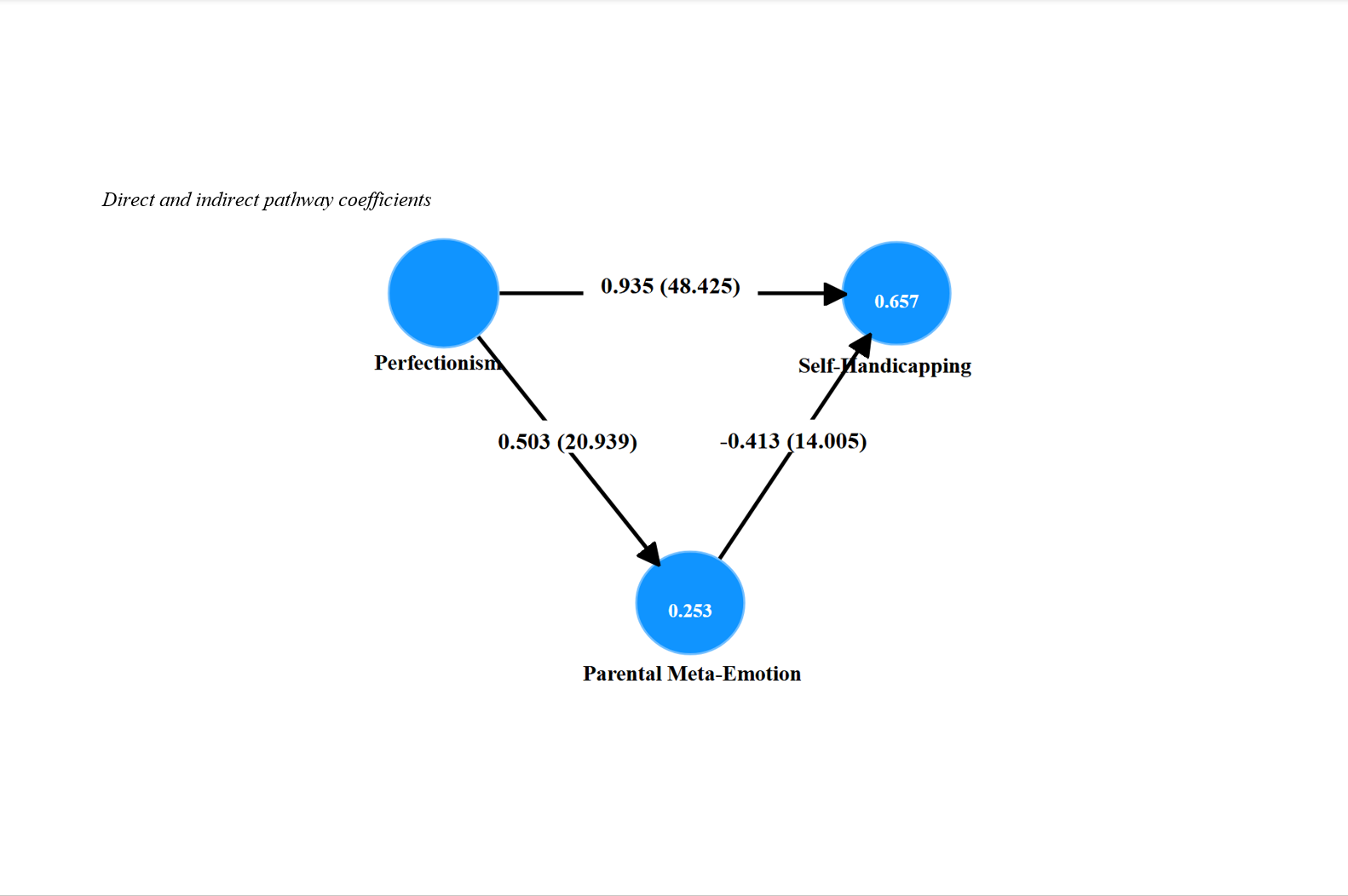
Findings: The findings indicated that parental meta–emotion displayed a significant positive correlation with perfectionism (r= .30, p< .01) and a significant negative correlation with self-handicapping (r= -.14, p< .05). A substantial positive relationship existed between perfectionism and self–handicapping (r= .46, p< .01). The results indicated that parental meta–emotion had a significant effect on self–handicapping (Beta= -.413, t= 14.00, p= .0001). Perfectionism had a significant positive effect on parental meta–emotion (Beta= .503, t= 20.94, p= .0001). Perfectionism had a significant positive effect on self–handicapping (Beta= .728, t= 48.43, p= .0001). The indirect effect of perfectionism via the parental meta–emotion on self–handicapping (Beta= -.208, t= 12.10, p= .0001) was significant. The results indicated that parental meta-emotion significantly negatively affected self-handicapping, whereas perfectionism had a significant positive direct effect on both parental meta-emotion and self–handicapping. The findings further revealed that parental meta-emotion played a significant mediating role in the relationship between perfectionism and self–handicapping in adolescents.
Conclusion: According to the results, it is concluded that parental meta-emotion is a significant mediator between perfectionism and self–handicapping in adolescents, and accordingly, it is recommended to adopt appropriate plans to regulate parental meta–emotion in adolescents.
Downloads
References
Abdollahi, M., & Foroughi pordanjani, B. (2023). The Mediating Role of Personality Traits in the Relationship between Parenting Styles and Academic Self-Handicapping. Journal of Psychology New Ideas, 18(22). http://jnip.ir/article-1-990-en.html
American Psychological Association. (2023). APA Dictionary of Psychology: self-handicapping. https://dictionary.apa.org/self-handicapping
Ashrafzade, T., & Sheikhalizadeh, S. (2023). Causal Explanation of Girls Perfectionism Based on the Dark Traits of Personality, Contingent Self-Worth and Academic Self-Efficacy. Women's Studies Sociological and Psychological, 21(2), 151-178. https://doi:10.22051/jwsps.2023.41294.2664
Bien, K., Wagner, J., & Brandt, N. D. (2025). Who tends to be a perfectionistic adolescent? Distinguishing perfectionism from excellencism and investigating the links with the Big Five and self‐esteem. British Journal of Psychology, 116(1), 108–130. https://doi.org/10.1111/bjop.12739
Brás, M., Antunes, J., Reis, A., & Carmo, C. (2024). Perfectionism and Emotion Regulation in the Study of Suicidal Ideation in Portuguese Young Adults. Behavioral Sciences, 14(9), 846. https://doi.org/10.3390/bs14090846
Chang, K., Seo, J., Kim, M., Song, H., & Kim, M.S. (2025). Psychological Mechanism Contributing to Academic Burnout and Depression in College Students: Focus on Evaluation Concern Perfectionism, Academic Procrastination, Fear of Failure, and Self-Handicapping. The Journal of Learner-Centered Curriculum and Instruction, 25(2), 807-824. https://doi:10.22251/jlcci.2025.25.2.807
Chęć, M., Konieczny, K., Michałowska, S., & Rachubińska, K. (2025). Exploring the Dimensions of Perfectionism in Adolescence: A Multi-Method Study on Mental Health and CBT-Based Psychoeducation. Brain sciences, 15(1), 91. https://doi.org/10.3390/brainsci15010091
Dastgahi, N., & Farrokhnia, Y. (2023). The Relationship between Emotional Regulation and Perfectionism Ii Students. Journal of Psychology New Ideas, 16(20). http://jnip.ir/article-1-930-fa.html
Frost, R. O., Marten, P., Lahart, C., & Rosenblate, R. (1990). The dimensions of perfectionism. Cognitive Therapy and Research, 14(5), 449-468. https://doi:10.1007/BF01172967
Gaudreau, P., Schellenberg, B. J. I., & Quesnel, M. (2023). From theory to research: Interpretational guidelines, statistical guidance, and a shiny app for the model of excellencism and perfectionism. European Journal of Personality, 38, 839–860. https://doi.org/10.1177/08902070231221478
Ghaffarzadeh, N., Azari, R.S., Abdollahpour M.A., & Moheb, N. (2023). Academic Self-handicapping Based on Metacognitive Beliefs and Perfectionism Regarding the Mediating Role of Goal Orientation. Middle Eastern Journal of Disability Studies, 13, 11, 1-9. https://10.30514/ICSS.24.2.43
Ghosh, O., & Raj, M. S. S. (2025). The Vital Role of Emotions in Health Decision-Making. In Behavioral Economics and Neuroeconomics of Health and Healthcare (pp. 299-332). IGI Global. https://doi:10.4018/979-8-3693-6055-2.ch013
Gil, T. C., Obando, D., García-Martín, M. B., & Sandoval-Reyes, J. (2023). Perfectionism, Academic Stress, Rumination and Worry: A Predictive Model for Anxiety and Depressive Symptoms in University Students from Colombia. Emerging Adulthood, 11(5), 1091-1105. https://doi.org/10.1177/21676968231188759
Gottman, J. M., Katz, L. F., & Hooven, C. (1996). Parental meta-emotion philosophy and the emotional life of families: Theoretical models and preliminary data. Journal of Family Psychology, 10(3), 243–268. https://doi.org/10.1037/0893-3200.10.3.243
Hummel, J., Cludius, B., Woud, L.M., Holdenrieder, J., Mende, N., Huber, V., Limburg, K., & Takano, K. (2023). The causal relationship between perfectionism and negative affect: Two experimental studies. Personality and Individual Differences, 200, 111895. https://doi.org/10.1016/j.paid.2022.111895
Jannesari, Z. (2025). Predicting Parental Stress in Mothers of Children with Behavioral Problems Based on Perfectionism Mediated by Psychological Flexibility. International Journal of New Findings in Health and Educational Sciences (IJHES), 3(1), 11–18. https://doi.org/10.63053/ijhes.108
Jones, E. E., & Rhodewalt, F. (1982). The Self-handicapping Scale. Available from F. Rhodewalt, Department of Psychology, University of Utah, Salt Lake City, UT. https://www.scirp.org/reference/referencespapers?referenceid=379408
Kang, W., & Gong, C. (2024) Exploring potential mediating mechanisms between maladaptive perfectionism and athlete burnout based on multi-theory perspectives. Frontiers in Psychology, 15, 1416281. https://doi:10.3389/fpsyg.2024.1416281
Karami, S., & Seydi, M. S. (2022). The explanation of the causal model of parental meta-emotional philosophy based on emotional self-awareness, differentiation and existential anxiety. Applied Research in Consulting, 5(3), 1-17. https://www.jarci.ir/article_704641.html
Kavyani, M., Nejati, M., & Farsi, A. (2023). Predicting Exercise Addiction Based on Stress, Perfectionism, and Self-handicapping in Athletic Students. Sport Psychology Studies, 12(43), 73-96. https://doi:10.22089/spsyj.2021.9198.1997
Kehoe, E.C. (2006). Parents’ meta-emotion philosophy, emotional intelligence and relationship to adolescent emotional intelligence. Swinburne. Thesis. https://doi.org/10.25916/sut.26294803.v1
Khodadadi, E., Zarshenas, H., Ahmadi, S., Aghchi, A., & Keneshloo, R. (2024). Investigating the Effect of Parenting Type on Self-esteem and Perfectionism with the Mediating Role of Character Strengths on Adolescents with Anxiety Disorders. International Journal of Health Studies, 10(1), 8-16. https://doi:10.22100/ijhs.v10i1.1081
Manav, A.N., & Temel, Z. (2024). Self-handicapping in adults: relationship with perfectionism, self-critical rumination and meta-cognitive believes. Journal of Personality, 73(2), 411-442. https://doi.org/10.36315/2024inpact123
Menon, S., Aiswarya, V.R., & Rajan, S.K. (2024). Parental Expectations and Fear of Negative Evaluation among Indian Emerging Adults: The Mediating Role of Maladaptive Perfectionism. Indian Journal of Psychological Medicine, 20, 1–9. https://doi:10.1177/02537176241252949
Merchant, E. (2024) Parental Meta-Emotion Philosophy: A Review of the Past Decade of Research. Psychology, 15, 364-376. https://doi:10.4236/psych.2024.153022
Molaei Moghbeli, A., Kazemi, Y., & Davarpanah, A. (2023). Effectiveness of problem solving skill training with storytelling approach on student s academic self-disability. Journal of Educational Psychology Studies, 19(48), 168-152. https://doi:10.22111/jeps.2022.7311
Nguyen, H., & Morris, E. M. J. (2024). The role of clinical perfectionism and psychological flexibility in distress and wellbeing. Clinical Psychologist, 28(3), 207–220. https://doi.org/10.1080/13284207.2024.2362440
Parsai, A., & Foladchang, M. (2010). Validity and reliability study of the parents' hyperemotional perspective scale in Iran. First National Student Conference on Social Factors Affecting Health, Tehran. https://civilica.com/doc/95106
Qian, M., Jin, R., Lu, C., & Zhao, M. (2024). Parental emotional support, self-efficacy, and mental health problems among adolescents in Hong Kong: a moderated mediation approach. Frontiers in Psychiatry, 15, 1458275. https://doi:10.3389/fpsyt.2024.1458275
Raemen, L., Claes, L., Buelens, T., Vankerckhoven, L., Van Oudenhove, L., & Luyckx, K. (2023). Personal identity, somatic symptoms, and symptom-related thoughts, feelings, and behaviors in adolescence: Examining between- and within-person associations and the role of depressive symptoms. Journal of Youth and Adolescence, 52, 1933–49. https://doi:10.1007/s10964-023-01811-9
Sabbaghi Renani, S., Shafiei, L., & Bagheri Dastjerdi, F. (2023). The role of hyper-excitement and psychological distress in predicting suicidal ideation in girls with a history of running away from home. The 21st National Conference of Psychology, Educational and Social Sciences, Babol. https://civilica.com/doc/1905255
Soleimani, E., & Pakravan, H. (2024). Validation and Standardization of College Academic Perfectionism Scale. Research in School and Virtual Learning, 12(1), 59-68. https://doi:10.30473/ETL.2024.70182.4133
Soper, D.S. (2024). A-priori Sample Size Calculator for Structural Equation Models [Software]. Available from https://www.danielsoper.com/statcalc
Wang, W. (2016). Self-Handicapping. In: Zeigler-Hill, V., Shackelford, T. (eds) Encyclopedia of Personality and Individual Differences. Springer, Cham. https://doi.org/10.1007/978-3-319-28099-8_1175-1
Wang, L., Wang, Z., Shi, Y., Yang, X., & Tang, Y. (2024). Parenting behavior profiles and adolescents’ self-handicapping: an analysis from the perspective of self-determination theory. Current Psychology, 43, 29833–29847. https://doi.org/10.1007/s12144-024-06613-1
World Health Organization. (2023). "Health and Well-Being". https://www.who.int/
Xiong, Z., Liu, C., Song, M., & Ma, X. (2024). The Relationship between Maladaptive Perfectionism and Anxiety in First-Year Undergraduate Students: A Moderated Mediation Model. Behavioral Sciences, 14(8), 628. https://doi.org/10.3390/bs14080628
Yosefi, N., Azmodeh, M., Vahedi, S., & Livarjani, S. (2023). The effectiveness of storytelling on aggression, anxiety and social fear in children with obsessive-compulsive disorder. Journal of Modern Psychological Researches, 18(71), 295-303. https://doi:10.22034/jmpr.2023.16928
Downloads
Additional Files
Publication Timeline
- Submitted
- Revised
- Accepted
Issue
Section
License
Copyright (c) 2025 Shokoufeh Kheyrdoust (Author); Bahman Kord Tamini (Corresponding Author)

This work is licensed under a Creative Commons Attribution-NonCommercial 4.0 International License.