Examining the Relationship Between Mindfulness and Emotion Regulation With Rumination in Anxious Students
DOI:
https://doi.org/10.61838/kman.jayps.6.5.3Keywords:
mindfulness, emotion regulation, rumination, anxiety, university studentsAbstract
Objective: The objective of this study was to investigate the relationship between mindfulness and emotion regulation with rumination in university students experiencing anxiety.
Methods and Materials: This descriptive-correlational study was conducted among students at Islamic Azad University, Lahijan Branch, during the 2023–2024 academic year. From a total population of approximately 9,000 students, a sample of 368 was selected using convenience sampling based on scores from the Beck Anxiety Inventory. The instruments utilized in the study included the Beck Anxiety Inventory (Beck et al., 1988), the Five Facet Mindfulness Questionnaire (Baer et al., 2006), the Emotion Regulation Questionnaire (Gross & John, 2003), and the Ruminative Responses Scale (Nolen-Hoeksema & Morrow, 1991). Descriptive statistics (mean, standard deviation, frequency, and percentage) were used for demographic data, while Pearson correlation coefficient and stepwise multiple regression were employed to analyze relationships and predictability among variables. All analyses were performed using SPSS software.
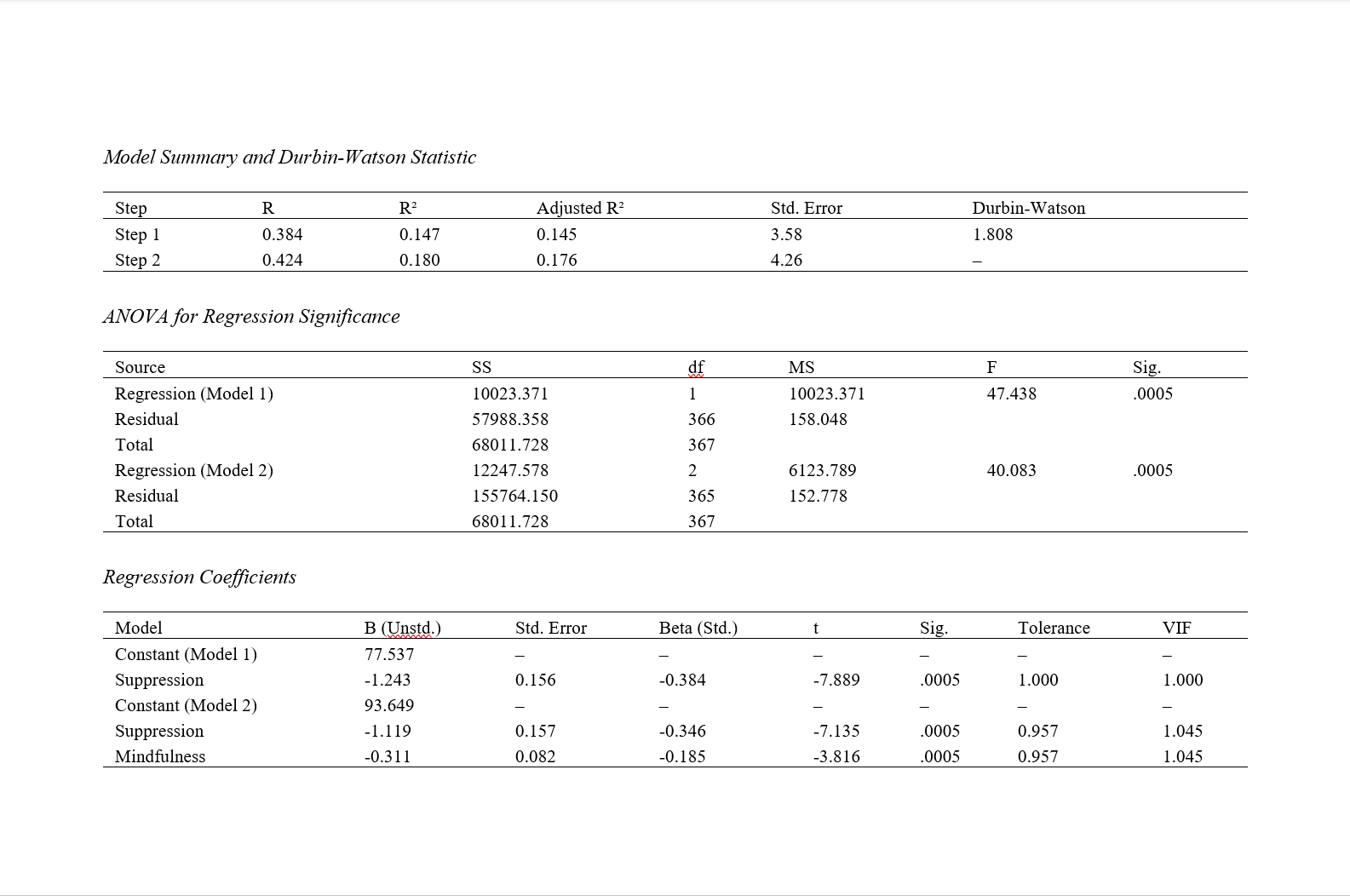
Findings: The results indicated significant negative correlations between mindfulness and rumination (r = -0.256, p < .01), emotion suppression and rumination (r = -0.384, p < .01), and emotion reappraisal and rumination (r = -0.374, p < .01). Stepwise regression analysis revealed that emotion suppression and mindfulness together explained 17.6% of the variance in rumination (adjusted R² = 0.176). Emotion suppression emerged as the strongest predictor of rumination, indicating that higher levels of suppression were associated with increased rumination among anxious students.
Conclusion: Emotion suppression, in particular, plays a crucial role in predicting rumination, suggesting that interventions aimed at improving adaptive emotion regulation and enhancing mindfulness may be effective in reducing maladaptive cognitive patterns such as rumination in anxious university populations.
Downloads
References
Ahmadvand, Z., Heydarinasab, L., & Shairi, M. R. (2013). An investigation of the validity and reliability of psychometric characteristics of five facet mindfulness questionnaire in Iranian non-clinical samples. Journal of Behavioral Sciences, 7(3), 222-238. https://www.behavsci.ir/article_67834_99ef981d5a4e2669dcc867c24cf45769.pdf
Bagheri Khorasgan, M. (2024). Investigating the relationship between mindfulness, rumination and executive functions. National Conference on Applied Psychology and Human Development, Tehran,
Brozovich, F. A., Goldin, P., Lee, I., Jazaieri, H. A. U. H. R. G., & Gross, J. J. (2015). The effect of rumination and reappraisal on social anxiety symptoms during cognitive‐behavioral therapy for social anxiety disorder. Journal of Clinical Psychology, 71(3), 208-218. https://doi.org/10.1002/jclp.22132
Cao, L., Meng, F., Zhou, H., & Zhang, X. (2023). The Relationship Between Mindfulness and Anxiety in Uyghur High School Students: The Mediating Role of Rumination. Am J Med Public Health, 4(2), 1040. https://www.remedypublications.com/open-access/the-relationship-between-mindfulness-and-anxiety-in-uyghur-high-school-9740.pdf
Constantin, K., & English, M. M. D. (2018). Anxiety, depression, and procrastination among students: rumination plays a larger mediating role than worry. Journal of Rational-Emotive & Cognitive-Behavior Therapy, 36(1), 15-27. https://doi.org/10.1007/s10942-017-0271-5
Dargahi, Z., Mahmoudi Tabar, M., Dinarvand, R., Ali Mohammadi, A., Shams, F., & Sadeghi, M. (2022). The effectiveness of schema therapy on emotional regulation, worry and anxiety of female students of Shahid Chamran University of AhvazJO - Medical Journal of Mashhad University of Medical Sciences. 64(6), 3102-3115. https://journals.mums.ac.ir/article_22380.html
Davodi, Z., Qomashi, S., Tamannaifar, M., & Alizadeh, H. (2020). the relationship between mindfulness and cognitive emotion regulation strategies with anger ruminations in perpetrators of violent crimes. police medicine, 9(3), 149-156. https://sid.ir/paper/964985/fa
Gross, J. J. (2015). Emotion regulation: Current status and future prospects. Psychological Inquiry, 26(1), 1-26. https://doi.org/10.1080/1047840X.2014.940781
Jafarpour, H., Akbari, B., Shakernia, I., & Asadi Mojreh, S. (2021). Comparison of the Effectiveness of Emotion Regulation Training and Mindfulness Training on the Reduction Rumination in the Mothers of Children with Mild Intellectual Disability. J Child Ment Health, 7(4), 76-94. https://doi.org/10.52547/jcmh.7.4.6
Jandaghi, F., & Gholami Andrati, K. (2019). Reducing Anxiety and Improving Students' Public Speaking Ability. Second International Conference on the Development and Promotion of Humanities in Society, Tehran,
Jankowski, T., & Bak, W. (2019). Mindfulness as a mediator of the relationship between trait anxiety, attentional control and cognitive failures. A multi model inference approach. Personality and individual differences, 142, 62-71. https://doi.org/10.1016/j.paid.2019.01.034
Ji, L. (2024). Childhood emotional abuse and depression among Chinese adolescent sample: A mediating and moderating dual role model of rumination and resilience. Child abuse & neglect, 149, 106607. https://doi.org/10.1016/j.chiabu.2023.106607
Kobylińska, D., & Kusev, P. (2019). Flexible Emotion Regulation: How Situational Demands and Individual Differences Influence the Effectiveness of Regulatory Strategies. Frontiers in psychology, 10, 72. https://doi.org/10.3389/fpsyg.2019.00072
Kord, B., & Mohammadi, M. (2019). Predicting of Students' Anxiety on the basis of Emotional Regulation Difficulties and Negative Automatic Thoughts. Educ Strategy Med Sci, 12(1), 130-134. https://edcbmj.ir/article-1-1945-fa.html
Kraft, J. D., Grant, D. M., White, E. J., Taylor, D. L., & Frosio, K. E. (2021). Cognitive mechanisms influence the relationship between social anxiety and depression among college students. Journal of American College Health, 69(3), 245-251. https://doi.org/10.1080/07448481.2019.1661844
Li, P., Mao, L., Hu, M., Lu, Z., Yuan, X., Zhang, Y., & Hu, Z. (2022). Mindfulness on Rumination in Patients with Depressive Disorder: A Systematic Review and Meta-Analysis of Randomized Controlled Trials. Int J Environ Res Public Health, 19(23), 16101. https://doi.org/10.3390/ijerph192316101
Miri, L. S., Davari, R., & Dartaj, F. (2021). Presenting a Causal Model of Emotional Regulation Based on Beliefs and Spiritual Intelligence by mediating role of Worry in Tehran Students. Islamic Life Style, 143-155. https://www.islamiilife.com/article_188550_99291a7fa193a53e858a9174ea400e2e.pdf
Nasiri Karbasdehi, Z., Fakhri, M., & Ghanadzadegan, H. (2024). Comparing the Effectiveness of Mindfulness and Positive Psychology Training on Reappraisal and Suppression in Students with Generalized Anxiety Disorder Symptoms. Journal of Assessment and Research in Applied Counseling (JARAC), 6(1). https://journals.kmanpub.com/index.php/jarac/article/view/1716
Nolen-Hoeksema, S., Wisco, B. E., & Lyubomirsky, S. (2008). Rethinking rumination. Perspectives on Psychological Science, 3(5), 400-424. https://doi.org/10.1111/j.1745-6924.2008.00088.x
Ogińska-Bulik, N., & Michalska, P. (2020). The Relationship Between Emotional Processing Deficits and Posttraumatic Stress Disorder Symptoms Among Breast Cancer Patients: The Mediating Role of Rumination. Journal of Clinical Psychology in Medical Settings, 27(1), 11-21. https://doi.org/10.1007/s10880-019-09606-6
Omidi, A., Ahmadi, V., & valizadeh, r. (2024). Comparison of the effectiveness of emotion regulation training with cognitive therapy based on mindfulness on perceived stress and self-compassion in patients with irritable bowel syndrome. medical journal of mashhad university of medical sciences, 66(6). https://doi.org/10.22038/mjms.2023.70085.4163
Potek, R. (2012). Mindfulness as a school-based prevention program and its effect on adolescent stress, anxiety and emotion regulation degree=Ph.D NEWYORK UNIVERSITY]. https://eric.ed.gov/?id=ED537610
Prosen, S., & Jendričko, T. (2019). A Pilot Study of Emotion Regulation Strategies in a Psychodrama Group of Psychiatric Patients. Journal of Creativity in Mental Health, 14(1), 2-9. https://doi.org/10.1080/15401383.2018.1486260
Reardon, T., Harvey, K., & Creswell, C. (2020). Seeking and accessing professional support for child anxiety in a community sample. Eur Child Adolesc Psychiatry, 29(5), 649-664. https://doi.org/10.1007/s00787-019-01388-4
Rezaei, F., & Rezakhani, S. (2019). the role of cognitive emotion regulation strategies and coping styles in prediction of rumination in women (who referred to health houses of district 14 in tehran). Knowledge & Research in Applied Psychology, 20(2), 90-99. https://sid.ir/paper/163572/fa
Schwartz, C., Lou Barican, J., Yung, D., Zheng, Y., & Waddell, C. (2019). Six decades of preventing and treating childhood anxiety disorders: a systematic review and meta-analysis to inform policy and practice. Evid Based Ment Health, 22(3), 103-110. https://doi.org/10.1136/ebmental-2019-300096
Seah, T. S., Aurora, P., & Coifman, K. G. (2020). Emotion Differentiation as a Protective Factor Against the Behavioral Consequences of Rumination: A Conceptual Replication and Extension in the Context of Social Anxiety. Behavior therapy, 51(1), 135-148. https://doi.org/10.1016/j.beth.2019.05.011
Tabatabaei, S. S., & Mohammadzadeh, F. (2019). Investigating the relationship between mindfulness, rumination, and early schemas among ninth grade female students in Birjand. The third international conference of psychology, counseling and educational sciences,
Wang, H., & Sun, H. (2024). The Mediating Role of Rumination in the Relationship Between Insomnia and Non-Suicidal Self-Injury of College Students. Frontiers in psychology, 15. https://doi.org/10.3389/fpsyg.2024.1504890
Zafari, S. A. U., & Khademi Ashkzari, M. (2020). The structural model of the role of cognitive emotion regulation strategies, mindfulness and perfectionism in predicting emotional problems in students. Journal of Psychological Science, 19(87), 321-328. https://doi.org/10.29252/psychosci.19.87.321
Zikopoulou, O., Rapee, R. M., & Simos, G. A. (2021). Randomized Controlled Trial of a Cognitive Behavior Therapy Program for Children with Clinical Anxiety Symptoms. Psychiatry Int, 2, 211-223. https://doi.org/10.3390/psychiatryint2020016
Downloads
Additional Files
Publication Timeline
- Submitted
- Revised
- Accepted
Issue
Section
License
Copyright (c) 2025 Reyhaneh Arian (Author); Marzieh Masjoudi (Corresponding Author)

This work is licensed under a Creative Commons Attribution-NonCommercial 4.0 International License.