Effectiveness of Compassion Focused Therapy on Self-blaming and Depressive Symptoms of Depressed Bullied Adolescents
DOI:
https://doi.org/10.61838/kman.jayps.6.5.5Keywords:
Compassion, Focused , depressedAbstract
Objective: The objective of this study was to evaluate the effectiveness of Compassion-Focused Therapy (CFT) in reducing self-blame and depressive symptoms in adolescents who have been bullied.
Methods and Materials: A randomized controlled trial (RCT) design was employed with 30 adolescents from Tehran, randomly assigned to either an intervention group receiving CFT or a control group. The intervention group underwent eight CFT sessions aimed at reducing self-blame and depressive symptoms, while the control group received no intervention. Self-blame and depressive symptoms were measured at three time points: pre-test, post-test, and follow-up (five months post-intervention). Data were analyzed using descriptive statistics, repeated measures ANOVA, and Bonferroni post-hoc tests in SPSS-26.
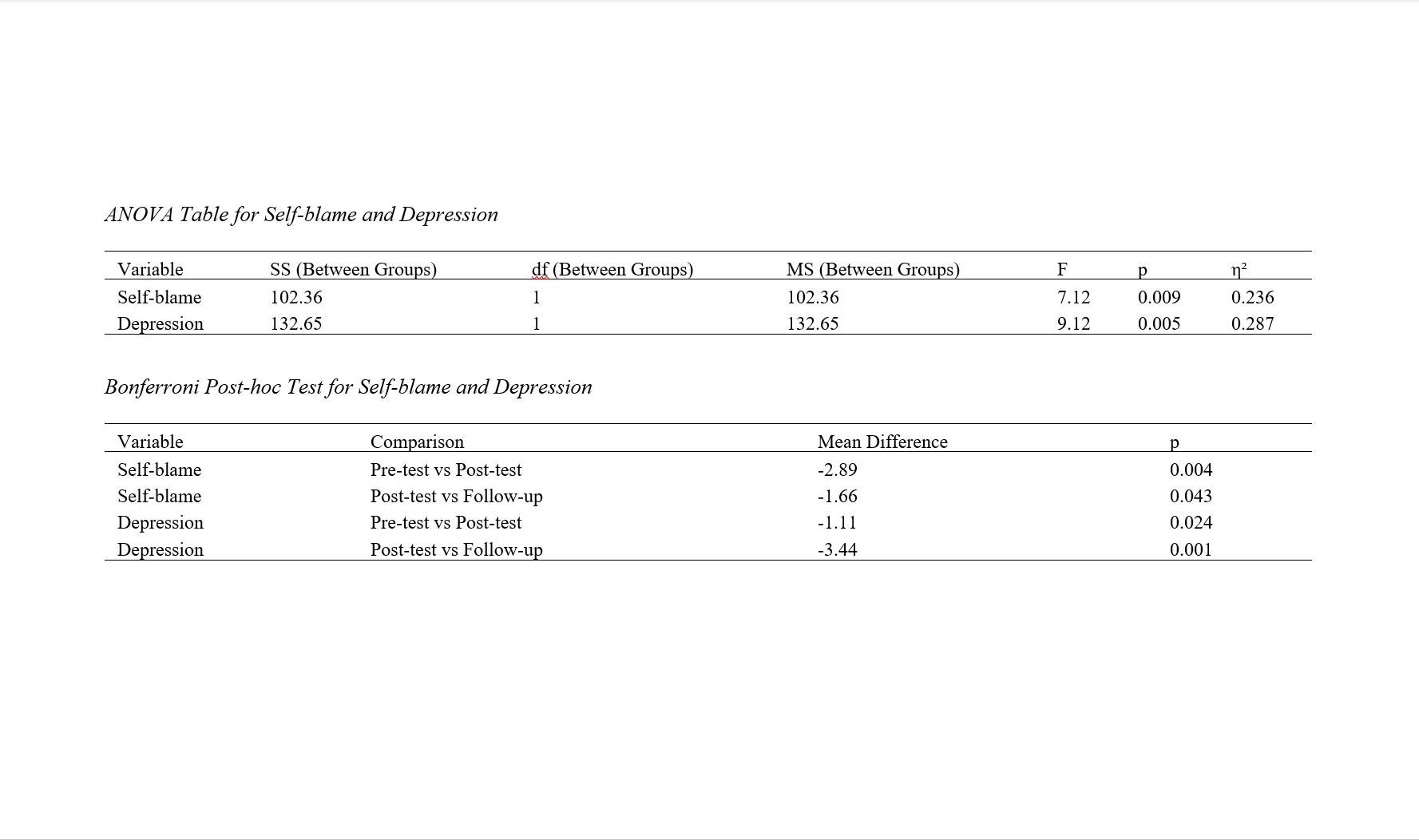
Findings: The results revealed significant reductions in both self-blame and depressive symptoms in the intervention group. The analysis indicated that the intervention group had significantly lower self-blame (F = 7.12, p = 0.009) and depressive symptoms (F = 9.12, p = 0.005) compared to the control group, with moderate to large effect sizes (η² = 0.236 for self-blame, η² = 0.287 for depression). Post-hoc comparisons confirmed significant differences between the pre-test and post-test, and between the post-test and follow-up for both self-blame and depression, suggesting sustained benefits of the therapy.
Conclusion: This study demonstrates that Compassion-Focused Therapy (CFT) is an effective intervention for reducing self-blame and depressive symptoms in adolescents who have experienced bullying. These results support the utility of CFT in fostering self-compassion and improving emotional regulation in this vulnerable population, contributing to improved mental health outcomes.
Downloads
References
Ahmadabadi, M. S., Zabihi, M., Khodarahmi, A., & Ahmadabadi, A. B. (2024). Mediating Role of Self-Criticism in the Relationship Between Fear of Negative Evaluation and Self-Compassion With Social Anxiety in Yazd Medical Students. Journal Of Shahid Sadoughi University Of Medical Sciences. https://doi.org/10.18502/ssu.v32i8.16856
Bruk, A., Scholl, S. G., & Bless, H. (2022). You and I both: Self-compassion reduces self-other differences in evaluation of showing vulnerability. Personality and Social Psychology Bulletin, 48(7), 1054-1067. https://doi.org/10.1177/01461672211031080
Chwyl, C., Chen, P., & Zaki, J. (2021). Beliefs about self-compassion: Implications for coping and self-improvement. Personality and Social Psychology Bulletin, 47(9), 1327-1342. https://doi.org/10.1177/0146167220965303
Fatollahzadeh, S., Kianimoghadam, A. S., Bahri, R., Khesali, M., Aghaei, Z. P. S., & Arani, A. M. (2023). The Effectiveness of Compassion-Focused Therapy on Resilience, Shame, Internal Self-criticism, and Quality of Life of Patients with Vitiligo. Iranian journal of psychiatry and behavioral sciences, 17(4).
Geng, J., Wang, J., Wang, Y., Wang, X., Lei, L., & Wang, P. (2022). Relationship Between Cyberbullying Victimization and Non-Suicidal Self-Injury: Roles of Basic Psychological Needs Satisfaction and Self-Compassion. Social Science Computer Review, 41(4), 1276-1295. https://doi.org/10.1177/08944393221074602
Huangfu, H., Li, L., & Shuai, W. (2024). Mediating Effects of Self-Esteem and Self-Compassion on the Relationship Between Body Dissatisfaction and Depression Among Adolescents With Polycystic Ovary Syndrome. Frontiers in Public Health, 12. https://doi.org/10.3389/fpubh.2024.1420532
Jiang, Y., Ren, Y., Liu, T., & You, J. (2020). Rejection Sensitivity and Adolescent Non‐suicidal Self‐injury: Mediation Through Depressive Symptoms and Moderation by Fear of Self‐compassion. Psychology and Psychotherapy Theory Research and Practice, 94(S2), 481-496. https://doi.org/10.1111/papt.12293
Karimi, E., Mohammadi, N., & Rahimi, C. (2020). Effectiveness of Self Compassion Group Training on Self Criticism and Cognitive Behavioral Avoidance in Depressed Adolescents. Journal of Clinical Psychology, 11(4), 23-32. https://doi.org/10.22075/jcp.2020.18969.1752
Kauser, S., Keyte, R., Regan, A., Nash, E. F., Fitch, G., Mantzios, M., & Egan, H. (2022). Exploring Associations Between Self-Compassion, Self-Criticism, Mental Health, and Quality of Life in Adults with Cystic Fibrosis: Informing Future Interventions. Journal of Clinical Psychology in Medical Settings, 29(2), 332-343. https://doi.org/10.1007/s10880-021-09831-y
Pullmer, R., Chung, J., Samson, L., Balanji, S., & Zaitsoff, S. (2019). A systematic review of the relation between self-compassion and depressive symptoms in adolescents. Journal of adolescence, 74, 210-220. https://doi.org/10.1016/j.adolescence.2019.06.006
Rahimi, F., & Asghari, A. (2024). Comparing the Effectiveness of Metacognitive Therapy and Compassion-Based Therapy on Emotional Suppression and Self-Disclosure in Adolescents with Depression. Journal of Modern Psychological Researches, 18(72), 135-143. https://psychologyj.tabrizu.ac.ir/article_17344.html
Ren, Y., Zhang, S., Huang, C., Zhang, J., Jiang, T., & Fang, Y. (2024). Perceived Parental Rearing Styles and Depression in Chinese Adolescents: The Mediating Role of Self-Compassion. Frontiers in Psychiatry, 15. https://doi.org/10.3389/fpsyt.2024.1417355
Salakhpour, Z. (2023). Comparison of the effectiveness of hope therapy and compassion-based therapy on risk-taking behaviors, psychological symptoms, and self-criticism in child and adolescent laborers in Ahvaz Doctoral Dissertation]. Counseling Psychology, Faculty of Science and Research, Islamic Azad University, Ahvaz Branch.
Vidal, J., Ciudad-Fernández, V., Navarrete, J., Soler, J., Schmidt, C., Molinari, G., & Cebolla, A. (2024). From Self-Criticism to Self-Compassion: Exploring the Mediating Role of Two Emotion Dysregulation Variables in Their Relationship to Depressive Symptoms. Current Psychology. https://doi.org/10.1007/s12144-024-06325-6
Xu, X., Li, Y., Liu, S., & Wang, W. (2024). Longitudinal Relationships Between Bullying Victimization and Dual Social Behaviors: The Roles of Self-Compassion and Trauma-Related Shame. Psychology research and behavior management, Volume 17, 1463-1475. https://doi.org/10.2147/prbm.s450013
Yaghoubi, S., Birashk, B., Aghebati, A., & Ashouri, A. (2021). Mediating role of external shame and self-compassion in the relationship between peer victimization and depression in adolescents. Iranian Journal of Psychiatry and Clinical Psychology, 27(1), 16-31. https://doi.org/10.32598/ijpcp.27.1.3288.1
Downloads
Additional Files
Publication Timeline
- Submitted
- Revised
- Accepted
Issue
Section
License
Copyright (c) 2025 Samane Bemani (Author); Amin Barazandeh (Corresponding Author); Mahboube Khajavi, Nasim Samadifard, Leila Esmaeilzadeh (Author)

This work is licensed under a Creative Commons Attribution-NonCommercial 4.0 International License.