Prediction of Wisdom Based on Spiritual Intelligence and Mindfulness in University Students
DOI:
https://doi.org/10.61838/kman.jayps.6.6.4Keywords:
Wisdom, Spiritual Intelligence, Mindfulness, University StudentsAbstract
Objective: Given the importance of cultivating wisdom as a combination of deep knowledge, critical thinking, and self-awareness for academic success and professional life among university students, this study aimed to examine the predictive roles of spiritual intelligence and mindfulness in fostering wisdom.
Methods: This study employed a descriptive-correlational design and was conducted as a field study during the 2022–2023 academic year. The statistical population included all students at universities in Tehran. A sample of 150 students (87 women and 63 men), aged between 20 and 40 years, was selected using convenience sampling. The instruments used in the study were King’s Spiritual Intelligence Questionnaire (2008), the Five Facet Mindfulness Questionnaire by Baer et al. (2006), and Ardelt’s Wisdom Scale (2003). After checking the assumptions, data were analyzed using multiple regression analysis in SPSS-26 software.
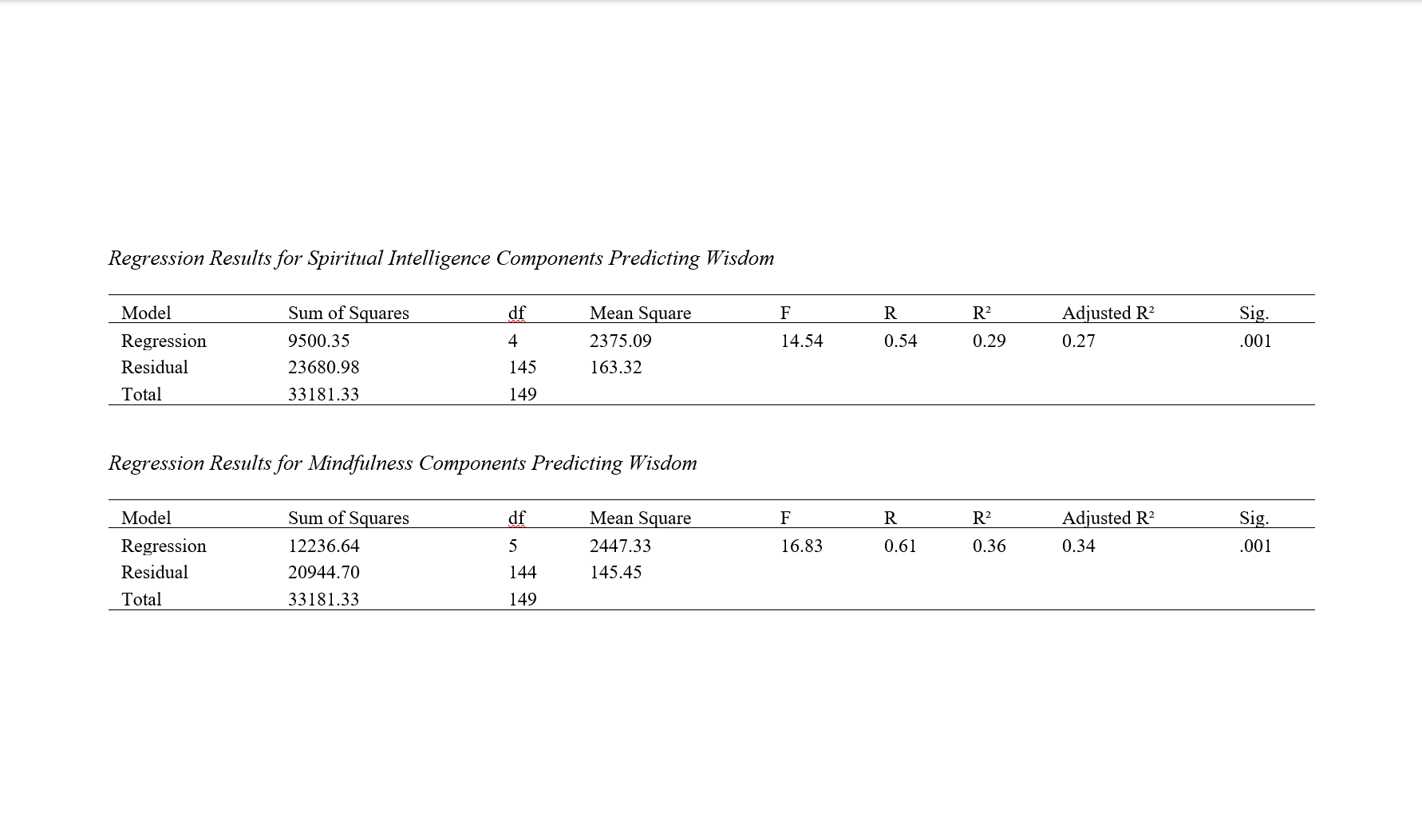
Findings: The results indicated that the components of "meaning production" (β = 0.44) and "transcendental awareness" (β = 0.17) from spiritual intelligence, as well as the components of "describing" (β = 0.28) and "acting with awareness" (β = 0.38) from mindfulness, significantly predicted wisdom (p < 0.001). The spiritual intelligence model explained 29% (27% adjusted) of the variance in wisdom, while the mindfulness model accounted for 36% (34% adjusted) of the variance.
Conclusion: The findings suggest that enhancing spiritual intelligence—particularly the components of meaning production and transcendental awareness—and mindfulness—especially the components of describing and acting with awareness—can contribute to the development of wisdom in students. These results underscore the importance of integrated educational programs in university settings to strengthen these psychological capacities.
Downloads
References
Alnuaimi, A. S. M., Yousefi, Z., Aayedi, A. E. Z., & Golparvar, M. (2024). Prediction of Wisdom Based on Executive Function, Attachment Style, and Personality Traits. Journal of Adolescent and Youth Psychological Studies (JAYPS), 5(4), 1-10. https://journals.kmanpub.com/index.php/jayps/article/view/2283
Amram, Y. (2022). The intelligence of spiritual intelligence: Making the case. Religions, 13(12), 1140. https://doi.org/10.3390/rel13121140
Andrei, O. (2023). Enhancing religious education through emotional and spiritual intelligence. HTS Teologiese Studies/Theological Studies, 79(1), a8376. https://doi.org/10.4102/hts.v79i1.8376
Ardelt, M. (2019). Wisdom and well-being. Annual review of psychology, 70, 327-350. https://doi.org/10.1146/annurev-psych-010418-103406
Ardelt, M. (2025). Wisdom predicts emotional intelligence and wise reasoning. The Journal of Positive Psychology, 20(1), 123-135. https://doi.org/10.1080/17439760.2024.2322448
Bangen, K. J., Meeks, T. W., & Jeste, D. V. (2019). Defining and assessing wisdom: A review of the literature. The American Journal of Geriatric Psychiatry, 21(12), 1254-1266. https://doi.org/10.1016/j.jagp.2019.07.015
Brown, K. W., Creswell, J. D., & Ryan, R. M. (2022). Handbook of mindfulness: Theory, research, and practice. Guilford Press. https://www.researchgate.net/publication/259867686_Handbook_of_mindfulness_Theory_research_and_practice
Garland, E. L., Farb, N. A., Goldin, P. R., & Fredrickson, B. L. (2021). Mindfulness broadens awareness and builds meaning. Psychological Inquiry, 32(2), 124-129. https://doi.org/10.1080/1047840X.2021.1935621
Gharibi, H. R., Basharat, M. A., & Mansouri, J. (2021). Predicting levels of mindfulness based on dimensions of self-oriented, other-oriented, and socially-oriented perfectionism. Applied Psychological Research, 12(1), 167-178. https://japr.ut.ac.ir/article_81194.html?lang=en
Glück, J. (2018). Measuring wisdom: Existing approaches and new developments. The Journals of Gerontology: Series B, 73(8), 1393-1403. https://doi.org/10.1093/geronb/gbx140
Grossmann, I. (2017). Wisdom in context. Perspectives on Psychological Science, 12(2), 233-257. https://doi.org/10.1177/1745691616672066
Grossmann, I., Weststrate, N. M., Ardelt, M., Brienza, J. P., Dong, M., Ferrari, M., & Vervaeke, J. (2020). The science of wisdom in a polarized world: Knowns and unknowns. Psychological Inquiry, 31(2), 103-133. https://doi.org/10.1080/1047840X.2020.1750917
Kabat-Zinn, J. (2019). Full catastrophe living: Using the wisdom of your body and mind to face stress, pain, and illness. Bantam.
King, D. B., & DeCicco, T. L. (2019). A viable model and self-report measure of spiritual intelligence. International Journal of Transpersonal Studies, 28(1), 68-85. https://doi.org/10.24972/ijts.2009.28.1.68
Mostafavi, N. (2022). Comparative evaluation of wisdom intelligence with spiritual intelligence and its relationship with education. Journal of Philosophical Investigations, 16(40), 111-126. https://doi.org/10.22034/jpiut.2022.52384.3292
Pamungkas, J., & Manaf, A. (2023). A systematic review and meta-analysis group contrasts: Learning model based on local cultural wisdom and student learning outcomes. International Journal of Instruction, 16(2), 53-70. https://doi.org/10.29333/iji.2023.1624a
Soleimani, E., Pakandish, S., Mohammadi Fakhr, A., & Salm Abadi, M. (2022). Predicting the resilience of students during the COVID-19 pandemic based on components of spiritual and social intelligence. Research in Religion and Health, 8(Special Issue), 10-22. https://journals.sbmu.ac.ir/jrrh/article/view/34794
Vago, D. R., & Silbersweig, D. A. (2012). Self-awareness, self-regulation, and self-transcendence (S-ART): A framework for understanding the neurobiological mechanisms of mindfulness. Frontiers in human neuroscience, 6, 296. https://doi.org/10.3389/fnhum.2012.00296
Vaughan, F. (2022). What is spiritual intelligence? Journal of Humanistic Psychology, 62(2), 313-329. https://doi.org/10.1177/00221678211020761
Verhaeghen, P. (2020). The examined life is wise living: The relationship between mindfulness, wisdom, and the moral foundations. Journal of Adult Development, 27(4), 305-322. https://doi.org/10.1007/s10804-020-09362-1
Vieten, C., Scammell, S., Pilato, R., Ammondson, I., Pargament, K. I., & Lukoff, D. (2023). Spiritual and religious competencies in psychology: A cultural humility approach. American psychologist, 78(3), 356-370. https://doi.org/10.1037/amp0001093
Downloads
Additional Files
Publication Timeline
- Submitted
- Revised
- Accepted
Issue
Section
License
Copyright (c) 2025 Arya Kadkhoda (Author); Mahboubeh Farshad (Corresponding Author); Soroush Shahbeik (Author)

This work is licensed under a Creative Commons Attribution-NonCommercial 4.0 International License.