The Effect of a Comprehensive Intervention Program Based on the World Health Organization’s Functional Assessment Outcomes on Communication Skills and Behavioral Problems in Adolescents with Intellectual Disabilities
DOI:
https://doi.org/10.61838/kman.jayps.4188Keywords:
World Health Organization functional assessment, communication skills, behavioral problems, intellectual disabilitiesAbstract
Objective: The present study was conducted with the aim of determining the effectiveness of a comprehensive intervention program based on the World Health Organization’s functional assessment outcomes on the communication skills and behavioral problems of adolescents with intellectual disabilities.
Methods and Materials: The research method was quasi-experimental with a pretest–posttest design and a control group. The statistical population consisted of all male adolescents with mild intellectual disabilities in Gilan Province during the 2020–2021 academic year. The sample included 30 adolescents with mild intellectual disabilities residing in small group homes for individuals with intellectual disabilities under the supervision of the Welfare Organization. They were selected through convenience sampling and randomly assigned to experimental and control groups. Participants in both groups completed the pretest before the intervention. The experimental group then participated in a comprehensive intervention program based on the World Health Organization’s functional assessment outcomes for 17 sessions, each lasting 90 minutes, while the control group remained on a waiting list and did not receive any intervention until the posttest. Afterward, the posttest was administered to both groups. The data collection instruments included Barton’s Communication Skills Questionnaire (1990) and Rutter’s Parent-Report Behavioral Problems Questionnaire (1975). Data analysis was conducted using univariate and multivariate analysis of covariance (ANCOVA) with SPSS version 22.
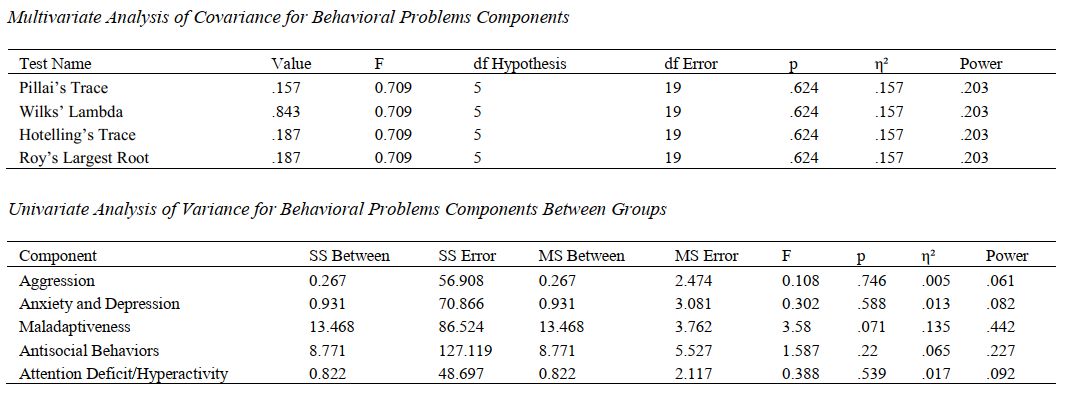
Findings: The findings indicated that the intervention program did not result in significant improvements in any components of communication skills or behavioral problems (P > .05).
Conclusion: Based on the findings, it can be concluded that achieving the desired effects on communication skills and behavioral problems may require longer-term intervention sessions, which is recommended for investigation in future research.
Downloads
References
Aggarwal, G. (2022). Social communication disorder outside intellectual disability? A review and classification approach to receptive and expressive communication in intellectual disability. Wireless Personal Communications, 127(4), 2841-2858. https://doi.org/10.1007/s11277-022-09899-1
Ahmad, W., Arun, P., Nazli, N., Ratnam, V., Mehta, S., & Raina, D. (2022). Understanding of Behavioral Problems Among Young Persons with Intellectual Disability: A Self-Report. Journal of Neurosciences in Rural Practice, 13(2), 295-300. https://doi.org/10.1055/s-0042-1743213
Arjamandnia, A., Mahaki, F., & Omidi Khankehdani, M. (2020). Designing a cognitive flexibility training program and examining its impact on reducing behavioral problems in adolescents with intellectual disabilities. Journal of Exceptional Children, 20(2), 89-100. https://joec.ir/article-1-1111-fa.html
Bekkari, H., Benmakhlouf, Y., Nourouti, N. G., Barakat, A., & Mechita, M. B. (2024). Study of Clinical Characteristics of Intellectual Disability in Morocco. Innovations in Clinical Neuroscience, 21(7-9), 10. https://pmc.ncbi.nlm.nih.gov/articles/PMC11424067/
Borland, R. L., Cameron, L. A., Tonge, B. J., & Gray, K. M. (2021). Effects of physical activity on behaviour and emotional problems, mental health and psychosocial well-being in children and adolescents with intellectual disability: A systematic review. Journal of Applied Research in Intellectual Disabilities, 35(2), 399-420. https://doi.org/10.1111/jar.12961
Brooker, K. S., De Greef, R., Trollor, J. N., Franklin, C. S., & Weise, J. (2024). Intellectual disability healthcare in Australia: Progress, challenges, and future directions. Journal of Policy and Practice in Intellectual Disabilities, 21(1), e12497. https://doi.org/10.1111/jppi.12497
Cartledge, G., & Milburn, J. F. (1995). Teaching social skills to children and youth: Innovative approaches. Allyn and Bacon. https://archive.org/details/teachingsocialsk0000unse_o0y8
Chow, J. C. (2018). Comorbid language and behavior problems: development, frameworks, and intervention. School Psychology Quarterly, 33, 356-360. https://doi.org/10.1037/spq0000270
Diken, O. (2019). Describing and comparing pragmatic language skills of Turkish students with typical development and inclusive education students with mild intellectual disability. International Journal of Progressive Education, 15, 157-166. https://doi.org/10.29329/ijpe.2019.189.11
Georgoula, E., & Koustriava, E. (2024). Enhancing Social-Communication and behavior skills in adolescents with intellectual disabilities through computerized cognitive training. International Journal of Instruction, 17(4), 421-440. https://doi.org/10.29333/iji.2024.17424a
Güler, H. A., Orpay, A. N., Kılınç, K., Yılmaz, Ç., & Türkoğlu, S. (2024). The differential diagnostic utility of the social communication questionnaire in mild intellectual disability and autism spectrum disorder: a case control study. International Journal of Developmental Disabilities, 70(7), 1297-1304. https://doi.org/10.1080/20473869.2024.2392973
Hagan, L., & Thompson, H. (2014). It's good to talk: developing the communication skills of an adult with an intellectual disability through augmentative and alternative communication. British Journal of Learning Disabilities, 42(1), 66-73. https://doi.org/10.1111/bld.12041
Hastings, R. P. (2016). Do children with intellectual and developmental disabilities have a negative impact on other family members? The case for rejecting a negative narrative. International Review of Research in Developmental Disabilities, 50, 165-194. https://doi.org/10.1016/bs.irrdd.2016.05.002
Hernández Hernández, S., Marín Quinto, S., Guillén Martín, V. M., & Mumbardó-Adam, C. (2025). Assessing Pragmatic Skills in People with Intellectual Disabilities. Behavioral Sciences, 15(3), 281. https://doi.org/10.3390/bs15030281
Hickey, E., & Cotts, K. G. (2024). Intellectual disability. Care of Adults with Chronic Childhood Conditions: A Practical Guide. https://doi.org/10.1007/978-3-031-54281-7_33
Hofmann, V., & Muller, C. M. (2022). Challenging behaviour in students with intellectual disabilities: the role of individual and classmates' communication skills. Journal of Intellectual Disability Research, 66, 353-367. https://doi.org/10.1111/jir.12922
Hosseinkhanzadeh, A. A. (2015). Teaching Social Skills to Children and Adolescents. Rooshd-e Farhang.
Hunter-Geboy, C. (1995). Life planning education: A youth development program. Advocates for Youth. https://www.advocatesforyouth.org/wp-content/uploads/storage/advfy/documents/lpe.pdf
Javdan, M., & Morovati, Z. (2020). The Impact of Storytelling on Improving Social Problems, Aggressive Behaviors, and Law-Breaking Behaviors of Primary School Children. Iranian Evolutionary Educational Psychology, 2(2), 81-88. https://doi.org/10.29252/ieepj.2.2.81
Karbalai Ismail, H., Anvari, Q., Jorabi, N., & Khajeh Hosein, H. (2006). Investigating the effectiveness of life skills training on changing attitudes, its application in daily life, and social participation leading to personal and social independence of adolescents with disabilities. Welfare Organization of Iran.
Lee, K., Cascella, M., & Marwaha, R. (2022). Intellectual Disability. StatPearls [Internet]. https://doi.org/10.35361/KJID.24.3.9
Marrus, N., & Hall, L. (2017). Intellectual disability and language disorder. Child and Adolescent Psychiatric Clinics of North America, 26(3), 539. https://doi.org/10.1016/j.chc.2017.03.001
Matson, J. L. (2024). Handbook of psychopathology in intellectual disability: Research, practice, and policy. Springer Nature. https://doi.org/10.1007/978-3-031-66902-6
Mirza Amiri, A., Sajadi, F., & Yazdani Pour, M. (2020). The effectiveness of life skills training on behavioral problems of students with mild intellectual disabilities in primary school in Isfahan. New Advances in Psychology, Educational Sciences, and Teaching, 3(33), 66-76. https://civilica.com/doc/1501062/
Onnis, L., Truzzi, A., & Ma, X. (2018). Language development and disorders: possible genes and environment interactions. Research in Developmental Disabilities, 82, 132-146. https://doi.org/10.1016/j.ridd.2018.06.015
Rahmani Boldaji, A., & Nazamzadeh Azhieh, A. (2018). Examining the impact of Montessori method training on learning mathematical concepts and improving communication skills in students with intellectual disabilities. Exceptional Education, 2(151), 51-60. https://ensani.ir/fa/article/392844/
Rizvandi, P., & Imam Jomeh, M. (2023). Examining the impact of cooperative learning on the social development and communication skills of female middle school students in Kermanshah. Curriculum Development, 1(1), 123-133. https://www.sid.ir/FileServer/SF/6251394H0471
Rutter, M. (1967). A children's behaviour questionnaire for completion by teachers: Preliminary findings. Child Psychology & Psychiatry & Allied Disciplines, 8(1), 1-11. https://doi.org/10.1111/j.1469-7610.1967.tb02175.x
Schalock, R. L., Luckasson, R., & Tassé, M. J. (2021). An overview of intellectual disability: Definition, diagnosis, classification, and systems of supports. American Journal on Intellectual and Developmental Disabilities, 126(6), 439-442. https://doi.org/10.1352/1944-7558-126.6.439
Schuppener, S., & Bock, B. M. (2024). Intellectual disability and accessible communication. Handbook of Accessible Communication. https://doi.org/10.57088/978-3-7929-9120-6_11
Sechoaro, E. J., Scrooby, B., & Koen, D. P. (2014). The effects of rehabilitation on intellectually-disabled people - a systematic review. Health Sa Gesondheid, 19(1), 1-9. https://doi.org/10.4102/hsag.v19i1.693
Tassé, M. J., Schalock, R. L., Balboni, G., Bersani Jr, H., Borthwick-Duffy, S. A., Spreat, S., & Zhang, D. (2012). The construct of adaptive behavior: Its conceptualization, measurement, and use in the field of intellectual disability. American Journal on Intellectual and Developmental Disabilities, 117(4), 291-303. https://doi.org/10.1352/1944-7558-117.4.291
UNICEF. (2019). Basic Life Skills Course Student Book. https://www.unicef.org/azerbaijan/reports/basic-life-skills-course-student-book
Varzadar, F., Ranjabari Pour, T., & Rezabakhsh, H. (2019). Predicting life satisfaction based on spiritual well-being and communication skills in parents of children with disabilities. Growth of Psychology, 8(10), 150-143. https://frooyesh.ir/article-1-1459-fa.html
Vatankhah, M., & Bakhtiarpour, S. (2025). The effectiveness of the child-centered solution-focused skills training method on life and communication skills of children with intellectual disabilities. Quarterly Journal of Psychology of Exceptional Individuals, 13(15), 25-32. https://jpe.atu.ac.ir/article_16431.html
Wolan-Nieroda, A., Wojnarska, A., Mańko, G., Kiper, A., Guzik, A., & Maciejczak, A. (2023). Assessment of rehabilitation effects in children with mild intellectual disability. Scientific reports, 13(1), 15541. https://doi.org/10.1038/s41598-023-42280-1
Wood, S., & Standen, P. (2021). Is speech and language therapy effective at improving the communication of adults with intellectual disabilities?: A systematic review. International Journal of Language & Communication Disorders, 56(2), 435-450. https://doi.org/10.1111/1460-6984.12601
World Health Organisation. (2019). Definition: Intellectual disability. http://www.euro.who.int/en/health-topics/noncommunicable-diseases/mental-health/news/news/2010/15/childrens-right-to-family-life/definition-intellectual-disability
Yousefi Khaneh Bargh, H., & Zeynali, A. (2024). The role of child temperament and maternal attachment and parenting styles in predicting behavioral problems in 3-5 year-old children with working mothers. Quarterly Journal of Child Mental Health, 11(1), 61-47. https://doi.org/10.61186/jcmh.11.1.5
Zeynizadeh, S., Pirzadeh, A., & Tabrizian, S. (2020). Communication skills and its related factors in Ardabil Alavi Hospital nurses and staff. International Journal of Community Medicine and Public Health, 7(2), 416-419. https://doi.org/10.18203/2394-6040.ijcmph20200407
Zheng, S., LeWinn, K., Ceja, T., Hanna-Attisha, M., O'Connell, L., & Bishop, S. (2021). Adaptive Behavior as an Alternative Outcome to Intelligence Quotient in Studies of Children at Risk: A Study of Preschool-Aged Children in Flint, MI, USA. Frontiers in psychology, 12, 692330. https://doi.org/10.3389/fpsyg.2021.692330
Downloads
Additional Files
Publication Timeline
- Submitted
- Revised
- Accepted
Issue
Section
License
Copyright (c) 2025 Shahla Akbari (Author); Abbas Ali Hosseinkhanzadeh (Corresponding Author); Bahman Akbari (Author)

This work is licensed under a Creative Commons Attribution-NonCommercial 4.0 International License.