Developing a Model of Tendency Toward Risky Behavior Based on Self-Differentiation and Cognitive Flexibility with the Mediating Role of Self-Control in Adolescents
DOI:
https://doi.org/10.61838/kman.jayps.4203Keywords:
Self-differentiation, Cognitive flexibility, Self-control, AdolescentsAbstract
Objective: The objective of this study was to develop a structural model of the tendency toward risky behavior in adolescents based on self-differentiation and cognitive flexibility, with the mediating role of self-control.
Methods and Materials: This descriptive-correlational research was conducted using structural equation modeling (SEM). The statistical population included adolescents aged 13 to 16 in Jahrom City during the 2023–2024 academic year. A total of 312 adolescents (158 girls and 154 boys) were selected through multistage cluster sampling. The research instruments included the Risk-Taking Scale, the Self-Control Scale (Tangney et al.), the Self-Differentiation Questionnaire (Skowron & Dendy), and the Cognitive Flexibility Inventory (Martin & Rubin). Data analysis was carried out using AMOS software to evaluate model fit and estimate path coefficients.
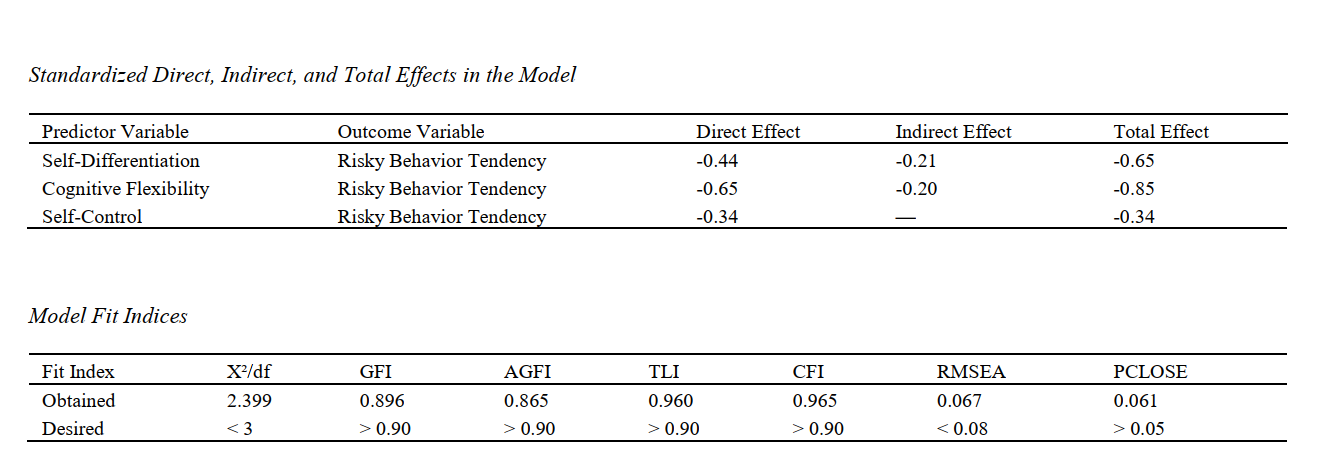
Findings: The structural model demonstrated acceptable fit indices (χ²/df = 2.39, CFI = 0.965, TLI = 0.960, RMSEA = 0.067). Cognitive flexibility showed the strongest total negative effect on risky behavior (β = –0.85), including a direct effect of β = –0.65 and an indirect effect of β = –0.20 through self-control. Self-differentiation had a significant total negative effect (β = –0.65), with a direct effect of β = –0.44 and an indirect effect of β = –0.21 via self-control. Self-control itself had a direct negative effect on risky behavior (β = –0.34). All path coefficients were statistically significant at p < 0.01, confirming both direct and mediated relationships among the constructs.
Conclusion: The findings indicate that adolescents with higher levels of self-differentiation and cognitive flexibility are less likely to engage in risky behaviors, partly due to increased self-control. These insights emphasize the importance of designing prevention programs that enhance self-regulation, flexible thinking, and identity coherence to reduce adolescent risk-taking tendencies.
Downloads
References
Abbasnejad-Bandari, Z. (2022). The relationship between internet addiction and sleep quality: The role of self-control and loneliness Master's thesis, Faculty of Psychology, Kharazmi University]. https://www.google.com/url?sa=t&source=web&rct=j&opi=89978449&url=https://pe.khu.ac.ir/find-66.28863.68047.fa.html&ved=2ahUKEwjnkMSHhaaOAxWIg_0HHaHAJXgQFnoECBcQAQ&usg=AOvVaw3YhINYpOEwzK0Kuij0rIlt
Ahmadi, M., & colleagues. (2022). The role of self-control in reducing risky behaviors in adolescents. Iranian Journal of Clinical Psychology, 9(2), 34-42.
Aloi, M., Riccelli, C., Piterà, F., Notaro, M., Curcio, V., Pullia, L., & De Fazio, P. (2022). Impaired metacognitive differentiation, high difficulty in controlling impulses and non-acceptance of emotions are associated with the severity of gambling disorder. Journal of Gambling Studies, 38, 1-11. https://doi.org/10.1007/s10899-022-10145-9
Ayano, G., Yohannes, K., & Abraha, M. (2020). Epidemiology of attention-deficit/hyperactivity disorder (ADHD) in children and adolescents in Africa: A systematic review and meta-analysis. Annals of General Psychiatry, 19(1), 21-31. https://doi.org/10.1186/s12991-020-00274-4
Baumeister, R. F., & Vohs, K. D. (2020). Strength model of self-control revisited. Current Directions in Psychological Science, 29(2), 139-145. https://doi.org/10.1177/0963721419892706
Bi-Ahmadi, H., & colleagues. (2021). The role of self-control in preventing risky behaviors in adolescents. Quarterly Journal of Educational Psychology, 7(3), 25-34.
Dabiri, S. (2022). The role of self-control, emotions, and self-compassion in predicting addiction readiness. Scientific Journal of Addiction Research, 16(65), 311-332. https://doi.org/10.52547/etiadpajohi.16.65.311
Darvishi, M., Taghinajad, N., & Amir Fakhrayi, A. (2023). The effectiveness of self-differentiation training on empathy and self-control in students of divorced parents with tendencies toward risky behaviors. Quarterly Journal of New Psychological Research, 18(70), 74-83. https://www.google.com/url?sa=t&source=web&rct=j&opi=89978449&url=https://psychologyj.tabrizu.ac.ir/article_16519.html&ved=2ahUKEwjQz_PBhaaOAxWkgf0HHVWaFcgQFnoECCIQAQ&usg=AOvVaw2YfUNVlsdi-wiRkMHFEZ0d
Dezhkam, N., Zarbagh, M., & Khaneh-Kashi, A. (2023). The relationship between addiction tendencies, distress tolerance issues, self-differentiation, and emotional regulation mediated by resilience in students. Journal of Shahrekord University of Medical Sciences, 25(2), 76-82. https://doi.org/10.34172/jsums.2023.760
Duckworth, A. L., Milkman, K. L., & Laibson, D. (2020). Beyond willpower: Strategies for reducing failures of self-control. Psychological Science in the Public Interest, 21(3), 102-129. https://doi.org/10.1177/1529100618821893
Duckworth, A. L., Taxer, J. L., Eskreis-Winkler, L., Galla, B. M., & Gross, J. J. (2019). Self-control and academic achievement. Annual review of psychology, 70, 373-399. https://doi.org/10.1146/annurev-psych-010418-103230
Ghasemi, A., & colleagues. (2023). Self-control and its impact on emotional regulation in adolescents. Journal of Behavioral Sciences, 9(2), 41-50.
Ghorbani, F., Porafkand, B., Heydari, A., Alamerdani, S. S., & Heydari-Rad, H. (2016). The relationship between emotional regulation and locus of control with cognitive self-control in substance-dependent individuals. Clinical Psychology and Personality Studies, 3(2), 13-25. https://cpap.shahed.ac.ir/article_2818.html?lang=fa
Gorji, R. (2023). Prevention of social harm and risky behaviors in schools. Quarterly Journal of Innovative Ideas in Psychology, 16-20. https://jnip.ir/browse.php?a_id=941&sid=1&slc_lang=fa
Hanife, E. A. (2018). The relationship between pre-service teachers' cognitive flexibility and interpersonal problem solving skills. Eurasian Journal of Educational Research, 18(77), 105-128. https://doi.org/10.14689/ejer.2018.77.6
Hohl, K., & Dolcos, S. (2024). Measuring cognitive flexibility: A brief review of neuropsychological, self-report, and neuroscientific approaches. Frontiers in human neuroscience, 18, 1331960. https://doi.org/10.3389/fnhum.2024.1331960
Hosein-Sarani, S. Z. (2021). A causal model of cognitive flexibility and addiction to social networks: The mediating role of self-control, mental vitality, and cognitive empathy Master's thesis, Payame Noor University, Shiraz Unit].
Hosseini, S., & colleagues. (2021). Investigating the effect of self-control on risky behaviors in students. Quarterly Journal of Educational Psychology, 8(4), 19-27.
Johnson, R., & Smith, T. (2020). Adolescent development and risk-taking behaviors. Developmental Psychology Review, 15(3), 123-139.
Kazemi, H., Hedayati-Charmehini, S., Habibollahi, A., & Bayat Nasab, A. (2023). Examining the relationship between identity dimensions and self-control with risky behaviors in high school male adolescents.
Kumar, S. (2021). Understanding high-risk behaviors in youth. International Journal of Behavioral Health, 10(2), 88-97. https://doi.org/10.1007/s11469-021-00532-4
Li, Y., Zhang, W., & Chen, X. (2020). Risk behaviors and adolescent health: Global perspectives. Journal of Youth Studies, 22(4), 456-472. https://doi.org/10.1080/13676261.2019.1654687
Lindner, P., Carlbring, P., Flodman, E., Hebert, A., Poysti, S., Hagkvist, F., & Andersson, G. (2016). Does cognitive flexibility predict treatment gains in Internet-delivered psychological treatment of social anxiety disorder, depression, or tinnitus? Peerj, 4, e1934. https://doi.org/10.7717/peerj.1934
Liu, L., Wang, N., & Tian, L. (2019). The parent-adolescent relationship and risk-taking behaviors among Chinese adolescents: The moderating role of self-control. Frontiers in psychology, 10, 1372. https://doi.org/10.3389/fpsyg.2019.01372
Mischel, W., Shoda, Y., & Rodriguez, M. L. (2023). Delay of gratification in children: A longitudinal perspective. Developmental Psychology, 59(4), 567-578. https://doi.org/10.1037/dev0001345
Mofrad, N., Jadidi, M., & Golestani-Pour, M. (2023). Explaining the structural model of treatment motivation based on addiction memory, craving for consumption with self-control as a mediator in individuals seeking recovery. Psychological Studies of Adolescents and Young Adults, 4(2), 97-112. https://www.google.com/url?sa=t&source=web&rct=j&opi=89978449&url=https://mjms.mums.ac.ir/article_23214.html&ved=2ahUKEwjtsvPthqaOAxXs9bsIHS5GIrgQFnoECBwQAQ&usg=AOvVaw0t9J6XTLVdDTyC0tS1uAzc
Moghanloo, M., & Koliwand, Z. (2018). Comparing self-differentiation and cognitive self-control in successful recovering addicts and individuals with substance dependence. Addiction Research, 12(46), 102-120. https://www.google.com/url?sa=t&source=web&rct=j&opi=89978449&url=https://ensani.ir/fa/article/383358/
Mohammadi-Hosseini-Asl, F., Sakin-Azari, R., Abdol Tajadini, P., & Aghdasi, A. (2022). Predicting risky behaviors based on the satisfaction of psychological basic needs, cognitive emotional regulation, and attachment styles with the mediating role of mental vitality in female adolescents. Journal of Cognitive Psychology and Psychiatry, 9(2), 117-130. https://doi.org/10.32598/shenakht.9.2.117
Mohammadi, S., & colleagues. (2024). The relationship between self-control and the reduction of risky behaviors in youth. Quarterly Journal of Applied Psychology, 10(4), 12-19.
Nikrosh, N. (2021). The relationship between religious teachings, self-control, cognitive flexibility, and substance abuse tendencies among students of Islamic Azad University in Bandar Abbas Master's thesis, Faculty of Humanities, Islamic Azad University, Bandar Abbas Unit].
Peterson, K., Brown, L., & Taylor, J. (2019). Prevalence of self-harm and substance use among adolescents. Public Health Reports, 134(5), 567-575. https://doi.org/10.1177/0033354919864731
Poursaeed Isfahani, M., Sharifi, H., & Akrami, N. (2021). Predicting risky behavior based on self-differentiation and interpersonal problems in female students. Journal of Developmental Psychology, 60(3), 55-64. https://www.google.com/url?sa=t&source=web&rct=j&opi=89978449&url=https://frooyesh.ir/article-1-2529-fa.html&ved=2ahUKEwix14Kph6aOAxW46wIHHUmTN4QQFnoECBcQAQ&usg=AOvVaw0Hw15L6cGDVJOWF93Zr3bl
Prado, V. F., Janickova, H., Al-Onaizi, M. A., & Prado, M. A. (2017). Cholinergic circuits in cognitive flexibility. Neuroscience, 345, 130-141. https://doi.org/10.1016/j.neuroscience.2016.09.013
Rezai, N., Qamari, M., Bazazian, S., & Baba Khani, V. (2020). Investigating the role of cognitive flexibility and personality traits in predicting risky driving behavior. Safety Promotion and Injury Prevention, 8(3), 149-153. https://www.google.com/url?sa=t&source=web&rct=j&opi=89978449&url=https://www.sid.ir/paper/961984/fa&ved=2ahUKEwjBqfm2h6aOAxVu3AIHHfcHONsQFnoECCMQAQ&usg=AOvVaw3PSm688LGThhBNKj3t_apQ
Shahi, H., Sadqi Afjeh, Z., & Moradi-Abbasabadi, F. (2020). The relationship between attachment styles and self-control with risky behaviors in female high school students in Tehran. Advances in New Behavioral Sciences, 5(45), 12-24. https://www.google.com/url?sa=t&source=web&rct=j&opi=89978449&url=https://ijndibs.com/article-1-451-fa.html&ved=2ahUKEwimqpDOh6aOAxX1xAIHHWkHBRkQFnoECBgQAQ&usg=AOvVaw10cJytjyUwj40uaLiRRTtB
Tangney, J. P., Baumeister, R. F., & Boone, A. L. (2021). High self-control predicts good adjustment, less pathology, better grades, and interpersonal success. Journal of personality, 89(5), 981-996. https://doi.org/10.1111/jopy.12625
Torkman, S., & Lotfi-Kashani, F. (2022). The relationship between self-differentiation and communication beliefs in the perception of stress among couples, and the mediating role of emotional regulation. Quarterly Journal of Innovative Ideas in Psychology, 12(16), 1-14. https://www.google.com/url?sa=t&source=web&rct=j&opi=89978449&url=https://jnip.ir/article-1-701-fa.html&ved=2ahUKEwjty47ah6aOAxWiRP4FHa6GMvMQFnoECBgQAQ&usg=AOvVaw24cSTL3LPqEQR9OyfGX1jO
Willems, Y. E., Boesen, N., & Li, S. (2022). Self-control and adolescent risk-taking: A meta-analysis. Journal of youth and adolescence, 51(6), 1043-1059. https://doi.org/10.1007/s10964-022-01576-8
Zinn, J. O. (2019). The meaning of risk-taking - key concepts and dimensions. Journal of Risk Research, 22(1), 1-15. https://doi.org/10.1080/13669877.2017.1351465
Zsido, A. N., Arato, N., Lang, A., Labadi, B., Stecina, D., & Bandi, S. A. (2021). The role of maladaptive cognitive emotion regulation strategies and social anxiety in problematic smartphone and social media use. Personality and individual differences, 173, 110647. https://doi.org/10.1016/j.paid.2020.110647
Downloads
Additional Files
Publication Timeline
- Submitted
- Revised
- Accepted
Issue
Section
License
Copyright (c) 2025 Mansureh Asadi (Author); Maryam Kouroshnia (Corresponding Author); Maryam Zarnaghash, Majid Barzegar (Author)

This work is licensed under a Creative Commons Attribution-NonCommercial 4.0 International License.