Effectiveness of Cognitive Behavioral Therapy on Sleep Quality and Quantity in Adolescents with Depressive Symptoms
DOI:
https://doi.org/10.61838/kman.jayps.4268Keywords:
Cognitive Behavioral Therapy, Sleep Quality, Sleep Quantity, Adolescents, Depression, Psychological Intervention.Abstract
ABSTRACT
Objective: This study aimed to evaluate the effectiveness of cognitive behavioral therapy (CBT) on improving the quantity and quality of sleep in adolescents with depressive symptoms.
Methods and Materials: The study employed a quasi-experimental pre-test–post-test design with a control group. The statistical population consisted of 4,137 middle and high school students in Khalkhal, Iran, during the 2024–2025 academic year. A total of 40 adolescents showing symptoms of depression were selected using convenience sampling and randomly assigned to an experimental group (n = 20) and a control group (n = 20). The intervention consisted of eight 70-minute CBT sessions delivered weekly. Data were collected using the Pittsburgh Sleep Quality Index (PSQI) and the Beck Depression Inventory (BDI), and analyzed using one-way analysis of covariance (ANCOVA).
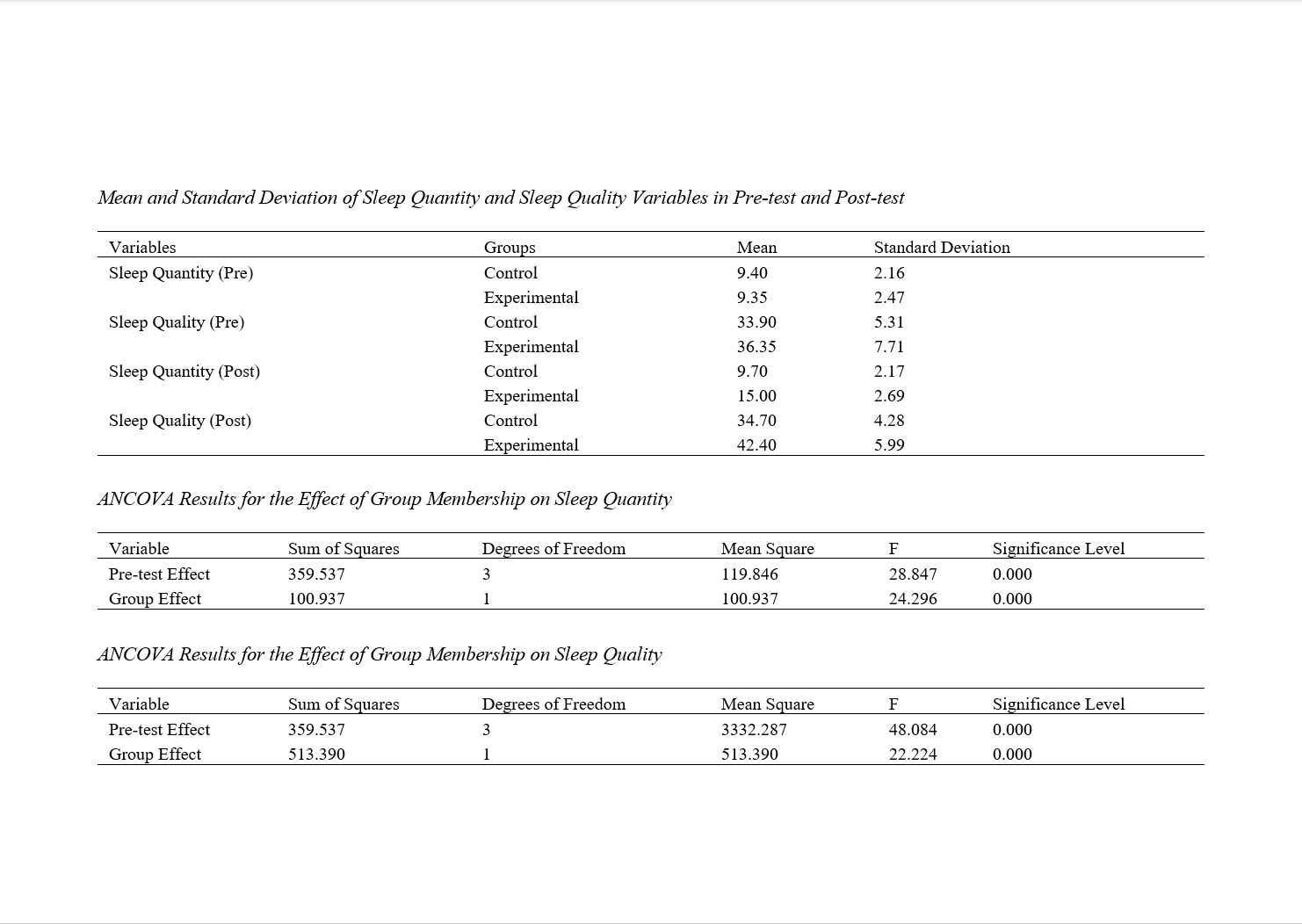
Findings: ANCOVA results showed that the intervention had a statistically significant effect on both sleep quantity (F = 24.296, p < 0.001) and sleep quality (F = 22.224, p < 0.001), after controlling for pre-test scores. The experimental group demonstrated significant post-test improvements in both variables compared to the control group, indicating the effectiveness of CBT in enhancing sleep outcomes among adolescents with depressive symptoms.
Conclusion: Cognitive behavioral therapy is effective in improving both sleep quantity and quality in adolescents experiencing symptoms of depression. These findings support the application of structured CBT interventions within adolescent mental health services, particularly for addressing sleep-related issues associated with mood disturbances.
Downloads
References
Arab, S., & Mohammadi, A. (2023). The Effectiveness of Cognitive-Behavioral Therapy on Sleep Disorder and Death Anxiety in the Elderly. Aging Psychology, 9(1), 102-189. https://jap.razi.ac.ir/article_2585_en.html?lang=en
Cojocaru, C. M., Popa, C. O., Schenk, A., Suciu, B. A., & Szasz, S. (2024). Cognitive-behavioral therapy and acceptance and commitment therapy for anxiety and depression in patients with fibromyalgia: a systematic review and meta-analysis. Med Pharm Rep, 97(1), 26-34. https://doi.org/10.15386/mpr-2661
Ebrahimi, F., Barghi irani, Z., & Ali Akbari, M. (2023). Comparison of Cognitive-Behavioral Therapy and Acceptance and Commitment Therapy in Reducing Mood Swings, Sleep Quality and Sexual Performance in Postmenopausal Women. Health Psychology, 11(44), 73-88. https://doi.org/10.30473/hpj.2023.59513.5289
Elham, A., Golparvar, M., & Sajadian, E. (2022). Comparing the effectiveness of sleep-focused cognitive behavioral therapy, mindfulness-based cognitive therapy, and Fordyce happiness training on emotional capital in women with migraines. Feyz, 26(4), 446-456. https://feyz.kaums.ac.ir/browse.php?a_id=4645&sid=1&slc_lang=en
Elham, A., Golparvar, M., & Sajadian, E. (2022). Comparison of the Effectiveness of Cognitive Behavioral Therapy Focused on Sleep Improvement with Mindfulness-Based Cognitive Therapy and Fordyce's Happiness Training on the Emotional Capital of Women Suffering from Migraines. Research Journal of Feyz, 26(4), 446-456. https://feyz.kaums.ac.ir/browse.php?a_id=4645&sid=1&slc_lang=en
Ibrahim, H., Abouelil, M., Ahmed, S., Khalaf, S. A., & Aly, S. E. (2022). Effect of a Training Program About Cognitive Behavioral Therapy on Sleep Quality Among the Older Person. Egyptian Journal of Health Care, 13(3), 86-101. https://doi.org/10.21608/ejhc.2022.249360
Ito-Masui, A., Sakamoto, R., Matsuo, E., Kawamoto, E., Motomura, E., Tanii, H., Yu, H., Sano, A., Imai, H., & Shimaoka, M. (2023). Effect of an Internet–Delivered Cognitive Behavioral Therapy–Based Sleep Improvement App for Shift Workers at High Risk of Sleep Disorder: Single-Arm, Nonrandomized Trial. Journal of medical Internet research. https://doi.org/10.2196/45834
Kamalinasab, Z., Koushki, S., Bani Jamali, S. A., & Ourki, M. (2022). Comparing the effectiveness of cognitive-behavioral therapy and mindfulness on sleep quality and cognitive abilities of women with insomnia. Quarterly Journal of Clinical Psychology Studies, 12(48), 1-28. https://jcps.atu.ac.ir/article_15407.html
Kiani Rad, M. (2024). Effectiveness of Cognitive Behavioral Therapy on Body Image Concern in Women with Depression Symptoms. Journal of Psychological Dynamics in Mood Disorders (PDMD), 3(1), 124-138. https://doi.org/10.22034/pdmd.2024.434757.1039
Lai, H. L., Chen, C. I., Lu, C. Y., & Huang, C. Y. (2021). Cognitive Behavioral Therapy plus Coping Management for Depression and Anxiety on Improving Sleep Quality and Health for Patients with Breast Cancer. Brain Sciences, 11(12), 1614. https://doi.org/10.3390/brainsci11121614
Langenecker, S., & Schreinder, M. (2024). Rumination-focused cognitive behavioral therapy reduces rumination and targeted cross-network connectivity in youth with history of depression: replication in preregistered randomized clinical trial. Biological Psychiatry Global, 4(1), 1-10. https://doi.org/10.1016/j.bpsgos.2023.08.012
Mariappan, V., & Mukhtar, F. (2024). Effects of Internet Cognitive Behavioral Therapy for Insomnia and Internet Sleep Hygiene Education on Sleep Quality and Executive Function Among Medical Students in Malaysia: Protocol for a Randomized Controlled Trial. Jmir Research Protocols, 13(1), e59288. https://doi.org/10.2196/59288
Mason, E. C., Grierson, A. B., Sie, A., Sharrock, M. J., Li, I., Chen, A. Z., & Newby, J. M. (2023). Co-occurring insomnia and anxiety: a randomized controlled trial of internet cognitive behavioral therapy for insomnia versus internet cognitive behavioral therapy for anxiety. Sleep, 46(2), zsac205. https://doi.org/10.1093/sleep/zsac205
Norian, F., Rasouli, N., & Fathi, M. (2023). The Effectiveness of Cognitive Behavioral Hypnotherapy on Self-efficacy, Resilience, Mental Health and Sleep Disorders of Treatment Staff Involved in the Care of Patients with COVID-19: A Semi-Experimental Study. Journal of Critical Care Nursing, 16(1). https://doi.org/10.61186/iau.34.3.324
Orri, S., Gudmundur, S., & Eric, A. S. (2024). Cognitive Behavioral Therapy for Anxiety and Depression in Children and Adolescents. Review article, 47(2), 311-323. https://doi.org/10.1016/j.psc.2024.02.002
Rahmani, M., Namvar, H., & Hashemi Razini, H. (2024). The Effectiveness of Rational Emotive Behavior Therapy on Executive Functions and Academic Procrastination of Children with Sluggish Cognitive Tempo. Journal of Psychological Dynamics in Mood Disorders (PDMD), 2(4), 82-90. https://doi.org/10.22034/pdmd.2024.434756.1038
Ramfjord, L. S., Faaland, P., Scott, J., Saksvik, S. B., Lydersen, S., Vedaa, Ø., Kahn, N., Langsrud, K., Stiles, T. C., Ritterband, L. M., Harvey, A. G., Sivertsen, B., & Kallestad, H. (2023). Digital Cognitive Behaviour Therapy for Insomnia in Individuals With Self‐reported Insomnia and Chronic Fatigue: A Secondary Analysis of a Large Scale Randomized Controlled Trial. Journal of Sleep Research, 32(5). https://doi.org/10.1111/jsr.13888
Roghani, F., Jadidi, M., & Peymani, J. (2022). The Effectiveness of Floortime Play Therapy on Improving Executive Functions and Cognitive Emotion Regulation in Children with Attention Deficit / Hyperactivity Disorder (ADHD). International Journal of Education and Cognitive Sciences, 2(4), 30-44. https://doi.org/10.22034/injoeas.2022.160686
Scott, H., Cheung, Janet M. Y, Muench, Alexandria, Ivers, Hans, Grandner, Michael A, Morin, Charles M, Perlis, Michael L. (2023). Baseline sleep characteristics are associated with gains in sleep duration after cognitive behavioral therapy for insomnia. Sleep Medicine, 102, 199-204. https://doi.org/10.1016/j.sleep.2023.01.009
Shabannezhad, A. (2024). Comparison of Cognitive Behavioral Therapy and Mindfulness on Anxiety, and Positive and Negative Affect in Female Students. Journal of Adolescent and Youth Psychological Studies (JAYPS), 5(1), 133-141. https://doi.org/10.61838/kman.jayps.5.1.16
Yang, Y., Zhang, H., Li, Y., Liu, Z., Liu, S., Li, X., Fan, G., Xu, Y., & Wang, B.-q. (2022). The effectiveness of computer-assisted Cognitive Behavioral Therapy (cCBT) for psychological outcomes in patients with laryngectomy: Randomized controlled trial. Journal of affective disorders, 300, 59-65. https://www.sciencedirect.com/science/article/pii/S0165032721014002
Zolrahim, R., Nasiri Souma, A., Ali Asgari, R., & Asghari Varghan, Z. (2024). Investigating the Impact of Cognitive Behavioral Therapy on Depression and Anxiety in Patients with Type 2 Diabetes.
Downloads
Additional Files
Publication Timeline
- Submitted
- Revised
- Accepted
Issue
Section
License
Copyright (c) 2025 Alireza Salehi (Author); Akbar Atadokht Haji Siflo (Corresponding Author); Seyed Babak Razavi Dole Malal (Author)

This work is licensed under a Creative Commons Attribution-NonCommercial 4.0 International License.