Indicators of Healthy Digital Technology Use in Adolescents: A Qualitative Perspective
DOI:
https://doi.org/10.61838/kman.jayps.4353Keywords:
Healthy digital technology use, adolescents, digital well-being, online safety, digital literacyAbstract
Objective: This study aimed to explore the indicators of healthy digital technology use among adolescents.
Methods and Materials: A qualitative research design with an exploratory approach was employed to capture adolescents’ lived experiences and perceptions of healthy digital technology use. Nineteen adolescents aged 13–18 years from Tunisia participated, selected through purposive sampling to ensure diverse socio-demographic representation. Semi-structured, in-depth interviews were conducted until theoretical saturation was reached, with each interview lasting 45–60 minutes. All sessions were audio-recorded, transcribed verbatim, and analyzed using thematic analysis supported by NVivo 14 software. The analysis followed an inductive coding process, identifying categories, subcategories, and open codes that reflected participants’ narratives. Ethical procedures, including informed consent and confidentiality, were strictly observed.
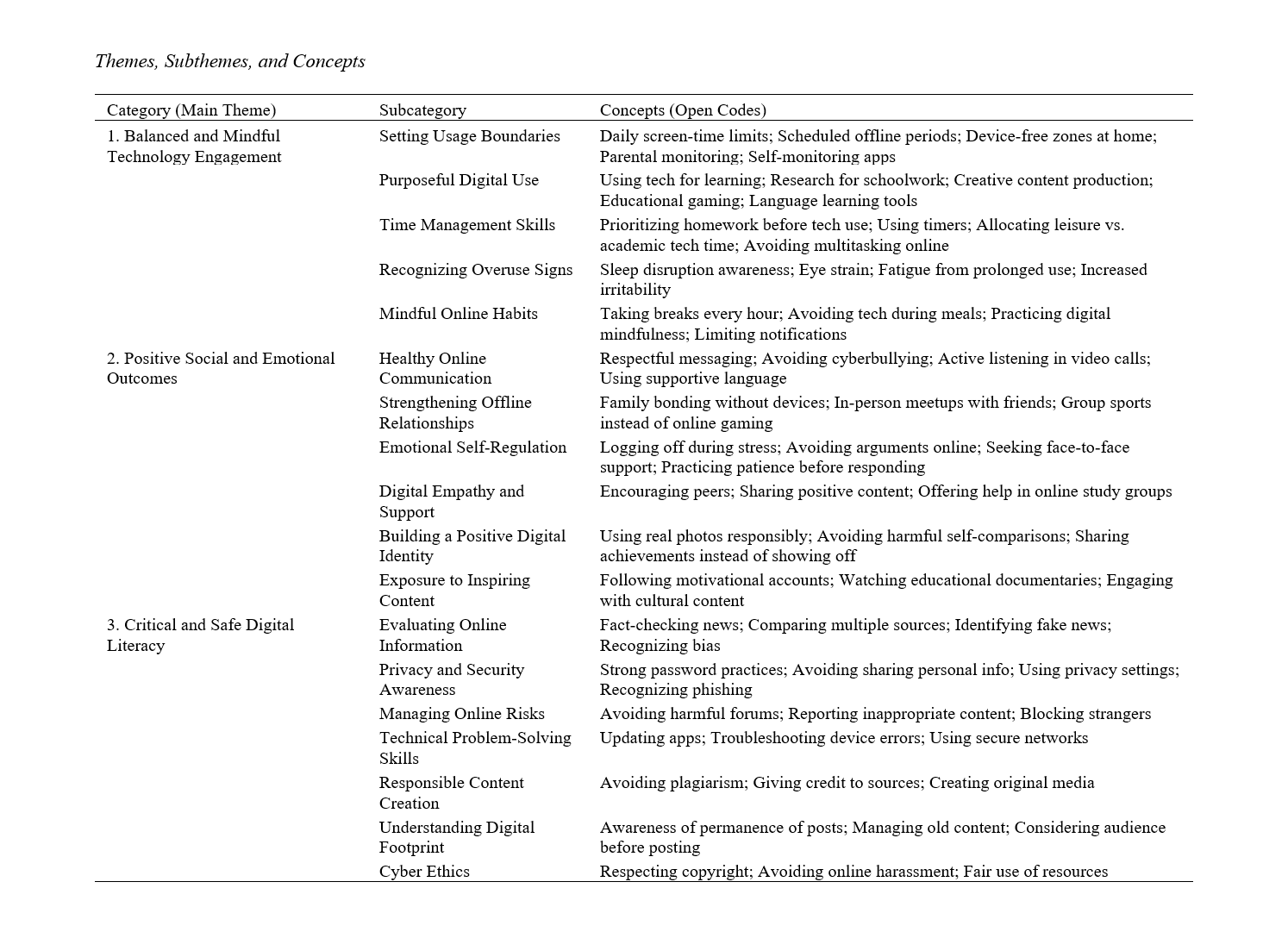
Findings: Analysis revealed three overarching themes: Balanced and Mindful Technology Engagement, Positive Social and Emotional Outcomes, and Critical and Safe Digital Literacy. Subthemes included setting usage boundaries, purposeful digital use, time management skills, recognizing overuse signs, mindful online habits, healthy online communication, strengthening offline relationships, emotional self-regulation, digital empathy and support, positive digital identity, inspiring content exposure, evaluating online information, privacy and security awareness, managing online risks, technical problem-solving skills, responsible content creation, understanding digital footprints, and adherence to cyber ethics. Participants described strategies such as device-free times, prioritizing educational content, proactive privacy management, and selective exposure to motivational resources.
Conclusion: Healthy adolescent digital technology use is shaped less by the quantity of screen time and more by the intentionality, quality, and contextual appropriateness of engagement.
Downloads
References
Anne Eppinger Ruiz de, Z., Thiel, A., Sudeck, G., Dierkes, K., John, J. M., Nieß, A. M., & Gawrilow, C. (2023). Well-Being of Adolescents During the COVID-19 Pandemic. Zeitschrift Für Psychologie, 231(2), 83-92. https://doi.org/10.1027/2151-2604/a000518
Buerger, S., Holzer, J., Yanagida, T., Schober, B., & Spiel, C. (2023). Measuring Adolescents’ Well-Being in Schools: The Adaptation and Translation of the EPOCH Measure of Adolescent Well-Being—A Validation Study. School Mental Health, 15(2), 611-626. https://doi.org/10.1007/s12310-023-09574-1
Chan, E. W., Chan, K., McCanny, A., Tse, T.-S., Fung, T., & Cheung, F. (2025). When Screen Time Helps, Hurts, and Has No Effect on Adolescent Well-Being. https://doi.org/10.31234/osf.io/nfy7j_v1
Chao, W.-C., Khan, A., Shih, J.-C., Li, W., Wu, C.-L., Chen, K., & Cheng, B. (2025). Optimising Psychological Well-Being in Chinese-Australian Adolescents: A 24-Hour Movement Guidelines Approach. Children, 12(3), 329. https://doi.org/10.3390/children12030329
Danmaisoro, H. B., & Mozayani, A. (2024). Effects of Screen Time on the Social Well-Being of Adolescents. Forensic Research & Criminology International Journal, 12(2), 155-157. https://doi.org/10.15406/frcij.2024.12.00412
EkİNcİ, N. (2024). Mental Well-Being in Adolescence: A Systematic Review. Psikiyatride Guncel Yaklasimlar - Current Approaches in Psychiatry, 16(1), 102-110. https://doi.org/10.18863/pgy.1315698
Garrido-López, B., Villarino, M. Á. F., Valeiro, M. G., Andreu‐Caravaca, L., Martins, J., & Dopico-Calvo, X. (2025). Gender Differences in Eating Habits, Screen Time, Health-Related Quality of Life and Body Image Perception in Primary and Secondary School Students: A Cross-Sectional Study in Spain. Education Sciences, 15(4), 470. https://doi.org/10.3390/educsci15040470
Jacob, L., & Reddy, K. J. (2024). Unlocking Eudaimonic Well-Being. 368-375. https://doi.org/10.4018/979-8-3693-1265-0.ch021
Jaismin, Chukkali, S., Peter, A., Maurya, R., & Panchal, S. (2025). Effects of Mindfulness-Based Intervention on Academic Anxiety: Enhancing Well-Being of Rural Adolescents. Journal of Health Management. https://doi.org/10.1177/09720634251326491
Joana Marcela Sales de, L., Loch, M. R., Eduarda Cristina da Costa, S., & José Cazuza de Farias, J. (2022). Sedentary Behavior and Health-Related Quality of Life in Adolescents. Ciência & Saúde Coletiva, 27(6), 2143-2152. https://doi.org/10.1590/1413-81232022276.11842021
Jokić, B., Dedić, Z. R., & Šimon, J. (2024). Time Spent Using Digital Technology, Loneliness and Well-Being Among Three Cohorts of Adolescent Girls and Boys – A Moderated Mediation Analysis. Psihologijske teme, 33(1), 25-46. https://doi.org/10.31820/pt.33.1.2
Kaur, H., & R., H. S. (2024). Screen Time Usage and Mental Well-Being Among Adolescents: A Cross-Sectional Study. International Journal for Multidisciplinary Research, 6(4). https://doi.org/10.36948/ijfmr.2024.v06i04.25671
Marciano, L., Ostroumova, M., Schulz, P. J., & Camerini, A.-L. (2022). Digital Media Use and Adolescents' Mental Health During the Covid-19 Pandemic: A Systematic Review and Meta-Analysis. Frontiers in Public Health, 9. https://doi.org/10.3389/fpubh.2021.793868
Mihajlović, I., Djevojić, C., & Stanković, M. (2023). Adolescent Well-Being and Life Satisfaction: Impact of Digital Technology Usage. Business Systems Research Journal, 14(2), 124-144. https://doi.org/10.2478/bsrj-2023-0015
Odgers, C. L., Allen, N. B., Pfeifer, J. H., Dahl, R., Nesi, J., Schueller, S. M., Williams, J. L., & Adolescence, S. C. o. (2022). Engaging, Safe, and Evidence-Based: What Science Tells Us About How to Promote Positive Development and Decrease Risk in Online Spaces. https://doi.org/10.31234/osf.io/rvn8q
Rahaman, N. H., & Saidi, L. A. (2024). Exploring the Relationship Between Screen Dependency Disorder and Psychological Well-Being Among Adolescents: A Literature Review. International Journal of Education Psychology and Counseling, 9(54), 223-229. https://doi.org/10.35631/ijepc.954017
Rosič, J. (2025). Adolescents’ Perceptions Regarding Their Smartphone Use: Longitudinal Relationships Between Perceived Digital Well-Being and Self-Esteem. Journal of Computer-Mediated Communication, 30(3). https://doi.org/10.1093/jcmc/zmaf005
Santos, R. M. S., Mendes, C. G., Bressani, G. Y. S., Ventura, S. d. A., Yago Jean de Almeida, N., Miranda, D. M. d., & Romano‐Silva, M. A. (2023). The Associations Between Screen Time and Mental Health in Adolescents: A Systematic Review. BMC psychology, 11(1). https://doi.org/10.1186/s40359-023-01166-7
Singh, D., Schumacher, H., Pellegrino, C. A., Holmes, B., Garfield, R. L., & Harder, V. S. (2024). Assessing Strengths and Well-Being in Primary Care for Adolescents With Mental Health and Substance Use Concerns. Clinical Pediatrics, 64(3), 340-347. https://doi.org/10.1177/00099228241264769
Tejada‐Gallardo, C., Bălţătescu, S., Mora, C. A., & Bacter, C. (2024). Differences in Subjective and Psychological Well-Being of Romanian Adolescents Over a Four-Year Period and Its Relationship With Free Time. Child Indicators Research, 17(3), 985-999. https://doi.org/10.1007/s12187-024-10114-9
Vekara, L., Kantanen, S., Kolho, K. L., Räsänen, K., Lakka, T. A., Huhtala, H., Piippo‐Savolainen, E., Arikoski, P., & Hiltunen, P. (2024). Psychological Well‐being of Children and Adolescents With Inflammatory Bowel Disease. Journal of Pediatric Gastroenterology and Nutrition, 78(6), 1287-1296. https://doi.org/10.1002/jpn3.12220
Volkova, E., & Sorokoumova, G. V. (2024). Psychological Criteria of Adolescent Well-Being in the Context of Digital Socialization. Social Psychology and Society, 15(2), 12-27. https://doi.org/10.17759/sps.2024150202
Zhang, B. x., Jin, Y., Zhu, S., Xiang, W., Xin, J., Niu, H., Feng, J., Hong, P., Li, X., & Yang, W. (2024). Screen Time and Risky Sexual Behavior: The Mediating Role of Adverse Psychological Effect Among Adolescents. https://doi.org/10.21203/rs.3.rs-4081257/v1
Downloads
Additional Files
Publication Timeline
- Submitted
- Revised
- Accepted
Issue
Section
License

This work is licensed under a Creative Commons Attribution-NonCommercial 4.0 International License.