Small Acts of Resistance: Factors Underlying Youth Coping with Stereotype Threat in Schools
DOI:
https://doi.org/10.61838/kman.jayps.4431Keywords:
Stereotype threat, youth coping strategies, small acts of resistance, identity negotiation, South Africa, resilience, educationAbstract
Objective: The purpose of this study was to explore the coping mechanisms and everyday acts of resistance employed by South African adolescents in response to stereotype threat within school contexts.
Methods and Materials: This qualitative study utilized semi-structured interviews with 26 secondary school students aged 15–19 from diverse socio-economic and cultural backgrounds in South Africa. Participants were recruited purposively to ensure direct experience with stereotype threat in educational settings. Interviews, each lasting 45–60 minutes, were conducted until theoretical saturation was achieved. Data were transcribed verbatim and analyzed thematically using NVivo 14 software, with coding conducted in iterative stages of open, axial, and selective coding. Rigor was enhanced through independent coding, reflexive memoing, and maintaining an audit trail.
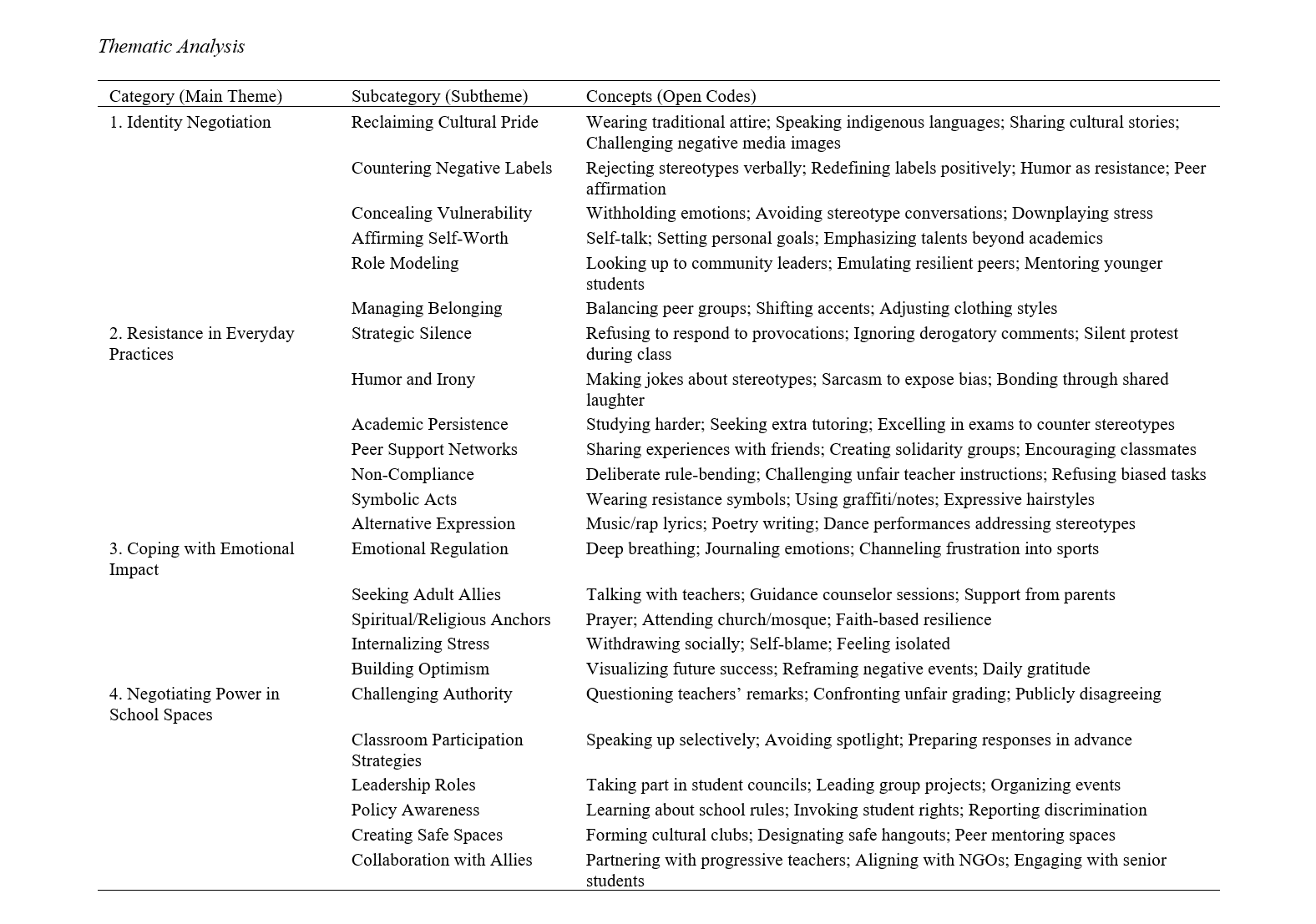
Findings: Analysis revealed four main themes: identity negotiation, resistance in everyday practices, coping with emotional impact, and negotiating power in school spaces. Under identity negotiation, youth reclaimed cultural pride, countered negative labels, and affirmed self-worth. Everyday resistance included humor, strategic silence, academic persistence, peer support, and symbolic acts. Emotional coping involved both adaptive strategies such as journaling, sports, and spirituality, as well as maladaptive responses like social withdrawal. Finally, participants described negotiating power by challenging authority, assuming leadership roles, invoking policy awareness, and creating safe spaces with allies. These findings illustrate that adolescents’ responses to stereotype threat are multifaceted, ranging from subtle acts of defiance to collective strategies of resilience.
Conclusion: The study demonstrates that South African youth are not passive in the face of stereotype threat but actively resist and reframe their experiences through diverse coping mechanisms. These small acts of resistance preserve identity, foster belonging, and create pathways for empowerment in restrictive school environments. Recognizing and supporting these strategies has critical implications for educators, policymakers, and practitioners seeking to reduce the harmful effects of stereotypes in education.
Downloads
References
Brussino, O., & McBrien, J. L. (2022). Gender Stereotypes in Education. https://doi.org/10.1787/a46ae056-en
Casad, B. J., Hale, P., & Wachs, F. L. (2017). Stereotype Threat Among Girls. Psychology of Women Quarterly, 41(4), 513-529. https://doi.org/10.1177/0361684317711412
Chaffee, K. E., Plante, I., Good, C., Aronson, J., Kinch, S. B., & Gauvin, I. (2023). When Stereotypes Disadvantage Boys: Strength of Stereotypes in Mathematics and Language Arts and Their Relations With Grades. Journal of Applied Social Psychology, 54(2), 71-82. https://doi.org/10.1111/jasp.13013
Conley, M. I., Dinc, E. N., Xiang, Z., & Baskin‐Sommers, A. (2024). Using Latent Transition Analysis to Evaluate the Impact of Perceived Threats on Emotional and Behavioral Development. Child development, 95(6), 2150-2165. https://doi.org/10.1111/cdev.14138
Cormack, E. E., & Hand, C. J. (2020). A Systematic Review of Gender Stereotype Beliefs and Their Relationship With Youth Sport Participation and Performance. Sport & Exercise Psychology Review, 16(2), 39-60. https://doi.org/10.53841/bpssepr.2020.16.2.39
Cornell, D. G., & Burnette, A. G. (2021). Threat Assessment and Management in K-12 Schools. 136-148. https://doi.org/10.1093/med-psych/9780190940164.003.0007
Coundouris, S. P., Hippel, C. v., Lehn, A., & Henry, J. D. (2022). The Antecedents and Consequences of Stereotype Threat in Parkinson's Disease. British Journal of Clinical Psychology, 62(1), 1-9. https://doi.org/10.1111/bjc.12390
Cureton, A., & Aguinaldo, E. R. (2023). Good Muslim, Bad Muslim: Muslim Refugee Youths’ Identity Development and Civic Engagement in School-Based Settings. Youth & Society, 56(5), 795-812. https://doi.org/10.1177/0044118x231199125
Fleming, M., Stevenson, H. C., Aisenbrey, E. A., & McWhirter, B. T. (2024). Using RECAST Theory to Examine Racial Stress Appraisal Across High Schools: Differences in Racial Threat and Support. Social Psychology of Education, 27(5), 2503-2526. https://doi.org/10.1007/s11218-024-09950-y
Ladewig, A., Köller, O., & Neumann, K. (2022). Stereotypes in the German Physics Olympiad - Hurdle or No Harm at All? Frontiers in Education, 7. https://doi.org/10.3389/feduc.2022.957716
Lee, M. Y., Xin, Y., Liu, C., & Wang, Y. (2024). Asian Students and Families. 681-694. https://doi.org/10.1093/oso/9780197603413.003.0050
Lehmann, P., & Meldrum, R. C. (2022). Racial and Ethnic Identity, Gender, and School Suspension: Heterogeneous Effects Across Hispanic and Caribbean Subgroups. Journal of Research in Crime and Delinquency, 60(2), 167-212. https://doi.org/10.1177/00224278221120689
Neves, S., Ieracitano, F., Topa, J., Silva, E., Davó-Blanes, M. C., Costa, D., Mocanu, V., Gotcã, I., & Vives‐Cases, C. (2022). Using Cinema Voice to Promote Positive Intimate Relationships Among European Youth: The Lights4Violence Project. Children & Society, 37(2), 634-653. https://doi.org/10.1111/chso.12621
Pérez‐Garín, D., Bustillos, A., & Molero, F. (2017). Revealing Stereotype Threat Effects and Women’s Maths Performance: The Moderating Role of Mathematical Anxiety / Análisis De Los Efectos De La Amenaza Del Estereotipo Y El Rendimiento Matemático De Las Mujeres: El Rol Moderador De La Ansiedad Matemática. International Journal of Social Psychology Revista De Psicología Social, 32(2), 276-300. https://doi.org/10.1080/02134748.2017.1291746
Perry, S., Wages, J., Skinner, A. L., Burke, S. E., Hardeman, R. R., & Phelan, S. M. (2021). Testing a Self‐affirmation Intervention for Improving the Psychosocial Health of Black and White Medical Students in the United States. Journal of Social Issues, 77(3), 769-800. https://doi.org/10.1111/josi.12448
Rodriguez-Operana, V. C., Mistry, R. S., & Chen, Y.-J. (2017). Disentangling the Myth: Social Relationships and Filipino American Adolescents’ Experiences of the Model Minority Stereotype. Asian American Journal of Psychology, 8(1), 56-71. https://doi.org/10.1037/aap0000071
Rozek, C. S., & Gaither, S. E. (2020). Not Quite White or Black: Biracial Students’ Perceptions of Threat and Belonging Across School Contexts. The Journal of Early Adolescence, 41(9), 1308-1337. https://doi.org/10.1177/0272431620950476
Ryan, J. L., Fox, J. K., Lowe, S. R., & Warner, C. M. (2019). Do Social Threat Cognitions Decrease With School-Based CBT and Predict Treatment Outcome in Adolescents With Social Anxiety Disorder? Journal of Cognitive Psychotherapy, 33(4), 331-342. https://doi.org/10.1891/0889-8391.33.4.331
Stuckert, M. O., Ihme, T. A., Südkamp, A., & Møller, J. (2021). Throw Them All in One Pot? Differences in Stereotypes About Subgroups of Pre-Service Teachers. Frontiers in Education, 6. https://doi.org/10.3389/feduc.2021.679410
Tan, S. C., & Barber, S. J. (2018). Confucian Values as a Buffer Against Age-Based Stereotype Threat for Chinese Older Adults. The Journals of Gerontology Series B, 75(3), 504-512. https://doi.org/10.1093/geronb/gby049
Wasserberg, M. J. (2017). Stereotype Threat Effects on African American and Latina/O Elementary Students Tested Together. Journal for Multicultural Education, 11(1), 51-60. https://doi.org/10.1108/jme-03-2016-0024
Wu, N., Fu, A., Liu, Y., Yue, T., Li, J., Wang, X., & Huang, X. (2023). The Impact of Stereotype Threat on Endogenous Poverty-Elimination Dynamics in Generationally Poor Individuals. Frontiers in psychology, 14. https://doi.org/10.3389/fpsyg.2023.1174614
Young-Alfaro, M. V. (2019). School Violence Inside Youth Prison Schools. 98-118. https://doi.org/10.4018/978-1-5225-6246-7.ch004
Zhao, F., Li, S., Li, T., & Yu, G. (2019). Does Stereotype Threat Deteriorate Academic Performance of High School Students With Learning Disabilities? The Buffering Role of Psychological Disengagement. Journal of Learning Disabilities, 52(4), 312-323. https://doi.org/10.1177/0022219419849107
Downloads
Additional Files
Publication Timeline
- Submitted
- Revised
- Accepted
Issue
Section
License

This work is licensed under a Creative Commons Attribution-NonCommercial 4.0 International License.