Youth Conceptions of Happiness: A Phenomenological Inquiry into Emotional Well-Being
DOI:
https://doi.org/10.61838/kman.jayps.4499Keywords:
Happiness, Adolescents, Emotional Well-being, Phenomenology, Colombia, Qualitative ResearchAbstract
Objective: The objective of this study was to explore and describe how Colombian adolescents conceptualize and experience happiness within their sociocultural context.
Methods and Materials: This qualitative study employed a phenomenological design to capture the lived experiences of youth. A total of 24 participants (13 females, 11 males), aged 18–25 years, were recruited from various urban and rural regions in Colombia through purposive sampling. Data were collected via semi-structured, in-depth interviews conducted in Spanish, focusing on definitions, sources, and experiences of happiness. Interviews lasted between 45 and 70 minutes and were transcribed verbatim. Data collection continued until theoretical saturation was achieved. Transcripts were analyzed thematically using NVivo 14 software, following an iterative process of coding, clustering, and interpretation to extract the essence of adolescents’ conceptions of happiness.
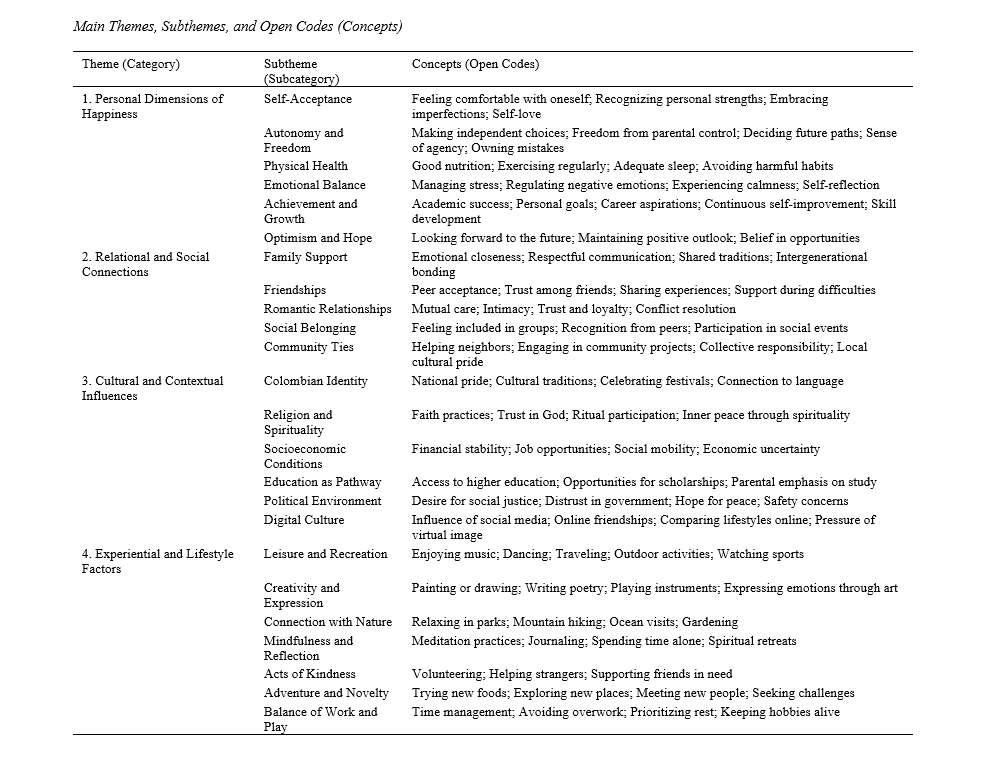
Findings: The analysis generated four overarching themes: (1) Personal Dimensions of Happiness (self-acceptance, autonomy, health, emotional balance, optimism, and achievement); (2) Relational and Social Connections (family support, friendships, romantic relationships, belonging, and community ties); (3) Cultural and Contextual Influences (Colombian identity, spirituality, socioeconomic conditions, education, political climate, and digital culture); and (4) Experiential and Lifestyle Factors (leisure, creativity, nature, mindfulness, kindness, novelty, and balance). Participants consistently emphasized the interdependence of personal strengths, social bonds, cultural traditions, and lifestyle practices in shaping their happiness.
Conclusion: This study highlights the multidimensional nature of adolescent happiness, revealing it as a construct deeply embedded in personal growth, relationships, cultural identity, and contextual realities. The findings underscore the importance of adopting culturally sensitive and holistic approaches to promoting youth well-being in Colombia and similar settings. By centering adolescents’ own voices, this research contributes to global understandings of happiness and provides insights for policies, educational initiatives, and community interventions aimed at fostering emotional well-being among youth.
Downloads
References
Annisa, N. I., Lutfianawati, D., & Putri, A. M. (2025). The Role of Gender and Friendship Quality on Happiness Among Adolescents in Bandar Lampung. Seurune Jurnal Psikologi Unsyiah, 8(1), 42-48. https://doi.org/10.24815/s-jpu.v8i1.41016
Aulia, M., Junaidi, W., Adha, F. A., Suyida, N. A., Nurjihan, T., & Sari, K. (2025). Makna Kebahagiaan Pada Remaja Yatim Piatu Di Banda Aceh. SKPJ, 3(1), 30-43. https://doi.org/10.24815/skpj.v3i1.30772
Aumose, L. (2025). The Crucial Trio for Adolescent Happiness: Mental Health, Social Support and Stress. Journal of Information Systems Engineering & Management, 10(33s), 933-941. https://doi.org/10.52783/jisem.v10i33s.5738
Baltaci, Ö., & Akbulut, Ö. F. (2021). Ergenlerin Mutluluk Ve Okulda Öznel İyi Oluş Düzeylerinin İncelenmesi. TAY Journal, 5(1), 24-50. https://doi.org/10.29329/tayjournal.2021.489.02
Batubara, I. M. S., Daulima, N. H. C., Wardani, I. Y., Kusumawati, H. N., Setiyawan, S., Oktariani, M., & Rumiyati, E. (2021). Resilience of Adolescents Survivors of Domestic Violence: A Qualitative Study. Open Access Macedonian Journal of Medical Sciences, 9(G), 211-216. https://doi.org/10.3889/oamjms.2021.6772
Çiftçi, N., & Sarman, A. (2024). The Effect of Future Expectation on Happiness and Healthy Lifestyle Belief in Adolescents: A Structural Equality Model. Sağlık Bilimleri Dergisi, 33(1), 138-144. https://doi.org/10.34108/eujhs.1376049
Guanizo, M. (2021). Suicide Ideation Among Early Adolescents in Selected Academic Institutions: A Basis for Specialized Guidance and Counseling Program. International Journal of Research Studies in Education, 10(14). https://doi.org/10.5861/ijrse.2021.a068
Hashim, I. H. M., & Zaharim, N. M. (2020). Happiness Among Malaysian Adolescents: The Role of Sociodemographic Factors and Everyday Events. Sage Open, 10(3). https://doi.org/10.1177/2158244020940695
Kim, E.-J., Kang, H.-W., & Park, S. M. (2024). Determinants of the Happiness of Adolescents: A Leisure Perspective. PLoS One, 19(4), e0301843. https://doi.org/10.1371/journal.pone.0301843
Kim, M. H., Kim, H. J., & Choi, J. H. (2022). The Mediating Effect of Attention and Grit on the Relationship Between Parents' Inconsistent Parenting Attitude and Adolescent's Happiness. Korean Association for Learner-Centered Curriculum and Instruction, 22(11), 17-32. https://doi.org/10.22251/jlcci.2022.22.11.17
Lee, Y. K., & Ha, Y. S. (2022). Analysis of Attribution Factors for Happiness in High School Students. Korean Association for Learner-Centered Curriculum and Instruction, 22(14), 723-736. https://doi.org/10.22251/jlcci.2022.22.14.723
MÜRtezaoĞLu, Ç., & Çıkrıkçı, Ö. (2022). Ergenlerde Mutluluk, Öz-Yeterlik, Akran İlişkileri Ve Sosyal Onay İhtiyacı Arasındaki İlişkilerin İncelenmesi. Erzincan Üniversitesi Eğitim Fakültesi Dergisi, 24(3), 483-498. https://doi.org/10.17556/erziefd.1103962
O’Sullivan, I. C., Costa, N. C. d., Smith, M. M. F., Vicenzino, B., Crossley, K. M., Kamper, S. J., Middelkoop, M. v., Menz, H. B., Tucker, K., O'Leary, K. T., & Collins, N. J. (2022). Adolescent Perspectives on Participating in a Feasibility Trial Investigating Shoe Inserts for Patellofemoral Pain. Journal of Foot and Ankle Research, 15(1). https://doi.org/10.1186/s13047-022-00537-4
Putri, R. D., Mansoer, W. W. D., & Nesi, N. (2023). Resilience as a Predictor of Adolescent Happiness in Orphanages in Jakarta. Kne Social Sciences. https://doi.org/10.18502/kss.v8i19.14357
Rafi, M., & Netrawati, N. (2019). Happiness of Adolescent Social Orphanage Children Tri Murni Padang Panjang. Jur. NeoKons., 1(4). https://doi.org/10.24036/00163kons2019
Susanto, M. R., & Darmayanti, K. K. H. (2023). The Effect of Forgiveness on Happiness in Adolescents After Broken Love in Palembang City. Jurnal Sains Psikologi, 12(1), 90. https://doi.org/10.17977/um023v12i12023p90-98
Tabbasam, U., Amjad, A. I., Ahmed, T., & Xing, Q. (2023). Comparison of Self-Strength, Seeking Help and Happiness Between Pakistani and Chinese Adolescents: A Positive Psychology Inquiry. International Journal of Mental Health Promotion, 25(3), 389-402. https://doi.org/10.32604/ijmhp.2023.024130
Yin, N., Zhang, J., Ren, H., Wang, B., Zhao, G., & Du, Y. (2025). Examining the Relationships of Happiness and Emotional Symptoms, Regular Exercise and Demographic Characteristics Among Adolescents Seeking Psychological Services: Cross-Sectional Study With Mediation Analysis. BJPsych Open, 11(2). https://doi.org/10.1192/bjo.2025.22
Downloads
Additional Files
Publication Timeline
- Submitted
- Revised
- Accepted
Issue
Section
License

This work is licensed under a Creative Commons Attribution-NonCommercial 4.0 International License.