Development of a Cognitive–Physical Dual-Task Intervention Package and Its Effectiveness on Evidence Rate (Evidence Accumulation Speed) in Adolescent Girls
DOI:
https://doi.org/10.61838/kman.jayps.4762Keywords:
cognitive–physical dual-task, evidence accumulation rate, adolescent girlsAbstract
Objective: The present study was conducted with the aim of developing a cognitive–physical dual-task intervention package and examining its effectiveness on the evidence rate (evidence accumulation speed) in adolescent girls.
Methods and Materials: This research employed a quasi-experimental design with pretest–posttest–follow-up and a control group. The statistical population consisted of low-active adolescent girls in Tehran in the 2024–25 academic year. Using convenience sampling, 50 participants were selected and randomly assigned to experimental and control groups (25 in each group). The experimental group received training based on the designed cognitive–physical dual-task package over eight weeks in twenty-four 20-minute sessions. The control group performed moderate-intensity aerobic exercises, starting from below-threshold intensity and progressing to moderately high intensity. To assess cognitive changes, the Wisconsin Card Sorting Test (WCST) was used, with “perseverative errors” and “total errors” serving as indices of cognitive flexibility and evidence accumulation speed. The process of developing the intervention package included designing training lesson plans, a teenager’s workbook, and evaluating content validity using CVR and CVI indices, which ranged from 0.8 to 1 and 0.9 to 1, respectively, confirming the satisfactory validity of the package. Data were analyzed using repeated measures ANOVA.
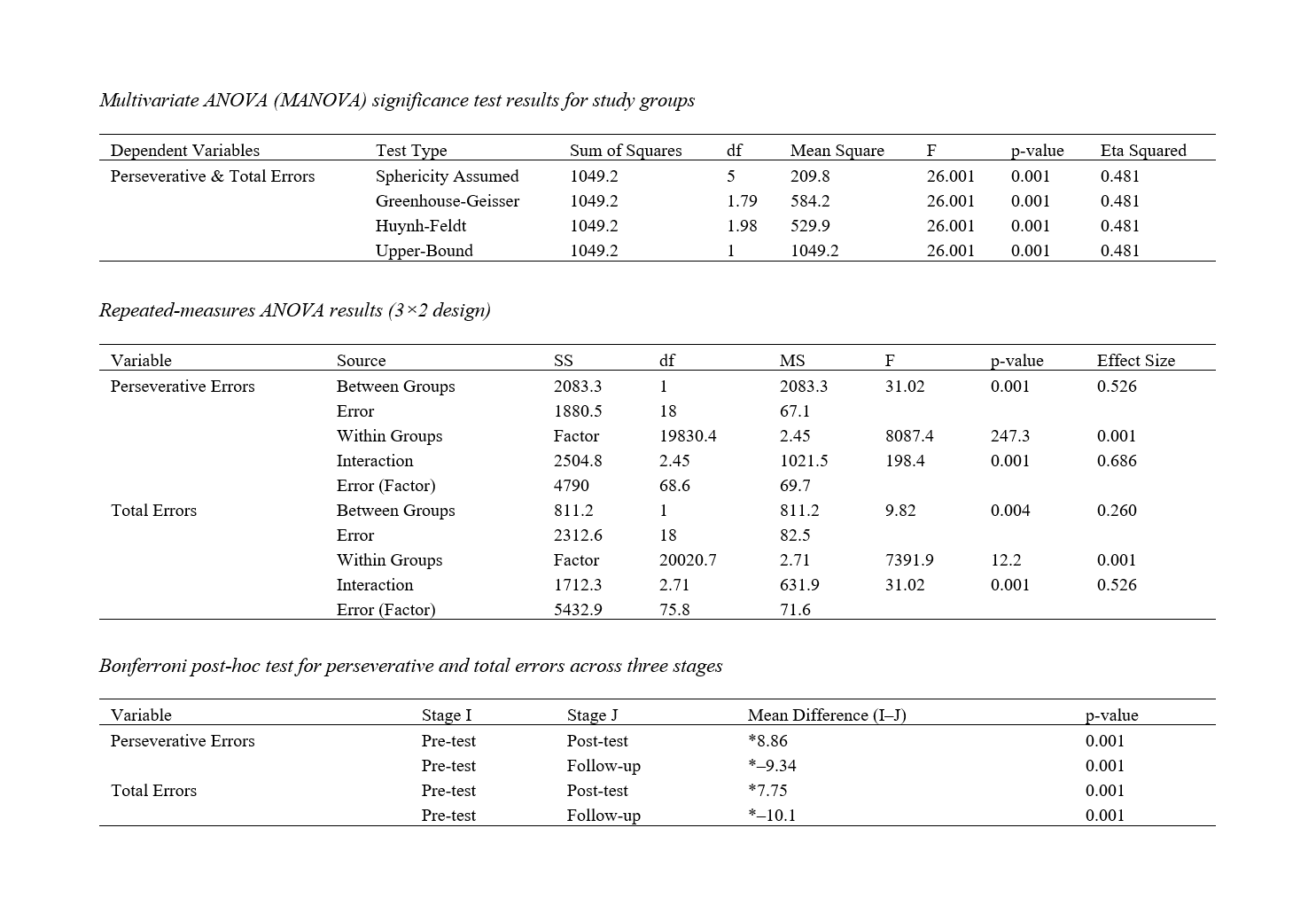
Findings: The results showed that the mean perseverative errors and total errors in the experimental group decreased significantly compared to the control group at posttest and follow-up (p < 0.01). Effect size and eta squared also indicated a considerable impact of the cognitive–physical exercises on increasing the evidence accumulation rate.
Conclusion: The designed package significantly improved cognitive flexibility and decision-making processing speed in adolescent girls. These findings support the effectiveness of integrative mind–body approaches in enhancing fine-grained cognitive indices during adolescence.
Downloads
References
Balcı, L. A., Soğukkanlı, K., Burcu, S., & Hanoğlu, L. (2022). Effects of single-task, dual-task and successive physical-cognitive training on fall risk and balance performance in older adults: a randomized trial. Journal of Exercise Therapy and Rehabilitation, 9(1), 1-11. https://doi.org/10.15437/jetr.675975
Brosnan, M., Pearce, D. J., O'Neill, M. H., Loughnane, G. M., Fleming, B., Zhou, S. H., & Bellgrove, M. A. (2023). Evidence accumulation rate moderates the relationship between enriched environment exposure and age-related response speed declines. Journal of Neuroscience, 43(37), 6401-6414. https://doi.org/10.1523/JNEUROSCI.2260-21.2023
Campos-Magdaleno, M., Pereiro, A., Navarro-Pardo, E., Juncos-Rabadán, O., & Facal, D. (2022). Dual-task performance in old adults: cognitive, functional, psychosocial and socio-demographic variables. Aging Clinical and Experimental Research, 34(4), 827-835. https://doi.org/10.1007/s40520-021-02002-x
Gallou-Guyot, M., Mandigout, S., Bherer, L., & Perrochon, A. (2020). Effects of exergames and cognitive-motor dual-task training on cognitive, physical and dual-task functions in cognitively healthy older adults: an overview. Ageing Research Reviews, 63, 101135. https://doi.org/10.1016/j.arr.2020.101135
Gupta, D., DePasquale, B., Kopec, C. D., & Brody, C. D. (2024). Trial-history biases in evidence accumulation can give rise to apparent lapses in decision-making. Nature Communications, 15(1), 662. https://doi.org/10.1038/s41467-024-44880-5
Kim, J. H., & Park, J. H. (2023). Does Cognitive-Physical Dual-Task Training Have Better Clinical Outcomes than Cognitive Single-Task Training Does? A Single-Blind, Randomized Controlled Trial. Healthcare, 11(11), 1544. https://doi.org/10.3390/healthcare11111544
Kim, Y., Kim, S., & Yang, H. (2023). Effectiveness of an enhanced simultaneous cognitive-physical dual-task training based on fairy tales (ESCARF) in older adults with mild cognitive impairment. Geriatric Nursing, 53, 57-65. https://doi.org/10.1016/j.gerinurse.2023.07.002
Kuo, H. T., Yeh, N. C., Yang, Y. R., Hsu, W. C., Liao, Y. Y., & Wang, R. Y. (2022). Effects of different dual task training on dual task walking and responding brain activation in older adults with mild cognitive impairment. Scientific reports, 12(1), 8490. https://doi.org/10.1038/s41598-022-11489-x
Lawshe, C. H. (1975). A quantitative approach to content validity. Personnel psychology, 28(4). https://parsmodir.com/wp-content/uploads/2015/03/lawshe.pdf
Mehri-Nejad, S. A., Mozafari, M., & Khodabakhsh Pir Kalani, R. (2021). Investigation of cognitive complications following general anesthesia in patients undergoing coronary artery bypass graft surgery using the Wisconsin Card Sorting Test. Scientific Journal of Kurdistan University of Medical Sciences, 26(1), 1-11. https://doi.org/10.52547/sjku.26.1.1
Park, J. H. (2021). Effects of cognitive-physical dual-task training on executive function and activity in the prefrontal cortex of older adults with mild cognitive impairment. Brain & Neurorehabilitation, 14(3), e23. https://doi.org/10.12786/bn.2021.14.e23
Surkar, S. M., Lin, C. C., Trotter, B., Phinizy, T., & Sylcott, B. (2025). Effects of dual-task training on cognitive-motor learning and cortical activation: A non-randomized clinical trial in healthy young adults. PLoS One, 20(5), e0322036. https://doi.org/10.1371/journal.pone.0322036
Tan, X., Wang, K., Sun, W., Li, X., Wang, W., & Tian, F. (2024). A review of recent advances in cognitive-motor dual-tasking for Parkinson's disease rehabilitation. Sensors, 24(19), 6353. https://doi.org/10.3390/s24196353
Tao, X., Sun, R., Han, C., & Gong, W. (2022). Cognitive-motor dual task: An effective rehabilitation method in aging-related cognitive impairment. Frontiers in Aging Neuroscience, 14, 1051056. https://doi.org/10.3389/fnagi.2022.1051056
Van Maanen, L., Portoles, O., & Borst, J. P. (2021). The discovery and interpretation of evidence accumulation stages. Computational Brain & Behavior, 4(4), 395-415. https://doi.org/10.1007/s42113-021-00105-2
Wu, J., Qiu, P., Lv, S., Chen, M., & Li, Y. (2024). The effects of cognitive-motor dual-task training on athletes' cognition and motor performance. Frontiers in psychology, 15, 1284787. https://doi.org/10.3389/fpsyg.2024.1284787
Yu, D., Li, X., He, S., Zhu, H., Lam, F. M. H., & Pang, M. Y. C. (2024). The effect of dual-task training on cognitive ability, physical function, and dual-task performance in people with dementia or mild cognitive impairment: A systematic review and meta-analysis. Clinical Rehabilitation, 38(4), 443-456. https://doi.org/10.1177/02692155231216621
Downloads
Additional Files
Publication Timeline
- Submitted
- Revised
- Accepted