Predicting Risky Behaviors Based on Emotional Schemas and Rumination in Adolescents
DOI:
https://doi.org/10.61838/kman.jayps.4770Keywords:
Risky behaviors, Emotional schemas, Rumination, AdolescentsAbstract
Objective: This study aimed to predict risky behaviors in adolescents based on emotional schemas and rumination.
Methods and Materials: This applied, descriptive–correlational study was conducted among 150 male high school students in District 1 of Baharestan during the 2024–2025 academic year. Participants were selected through purposive sampling based on the population structure of the region. Data were collected using three validated instruments: the Risky Behaviors Questionnaire (Zadehmohammadi & Ahmadabadi, 2008), the Emotional Schema Scale—Second Version (Leahy, 2012), and the Rumination Response Scale (Nolen-Hoeksema & Morrow, 1991). After verifying statistical assumptions, inferential analyses were performed using Pearson correlation and simultaneous multiple regression in SPSS-27 to examine the predictive power of emotional schemas and rumination for risky behaviors.
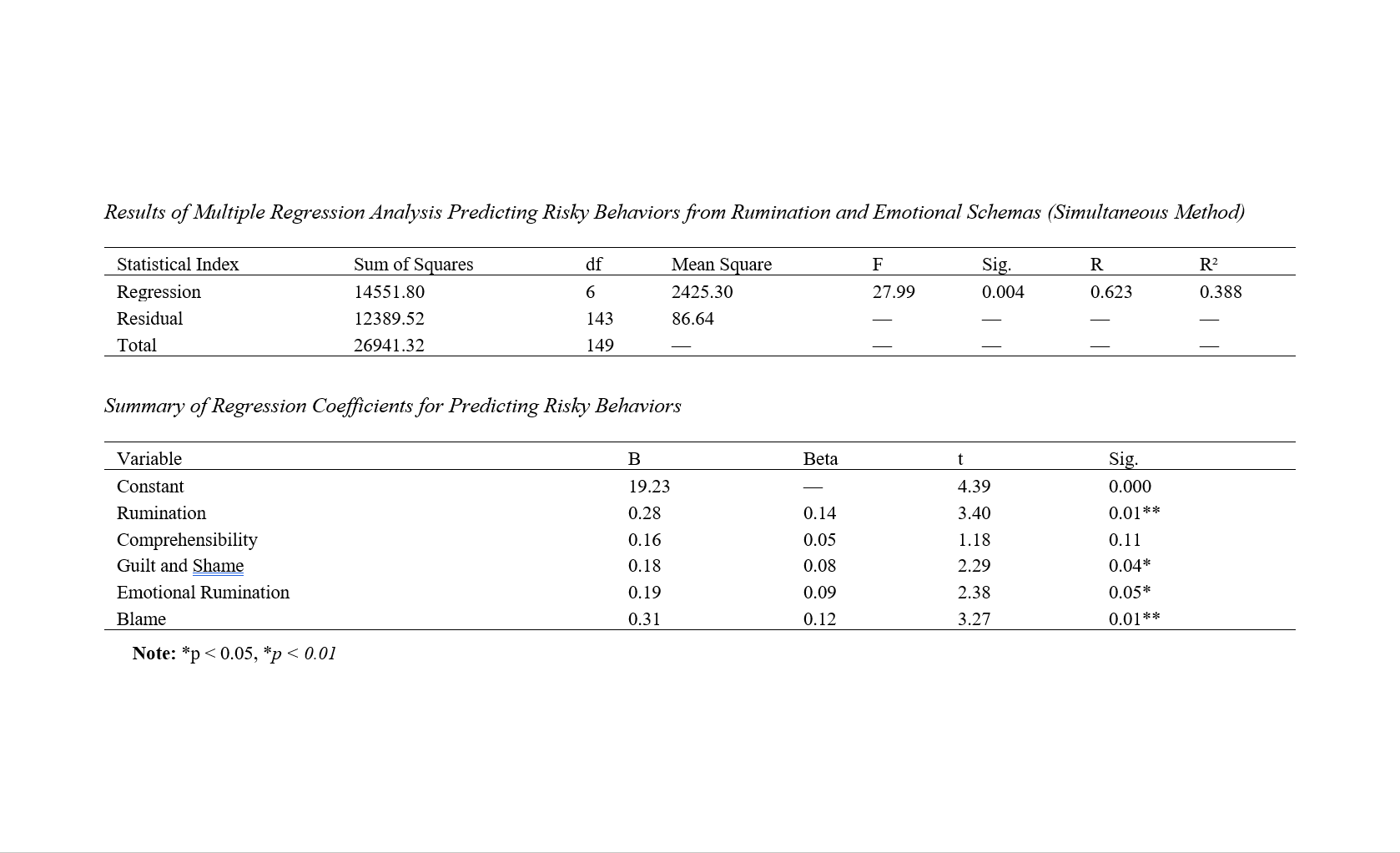
Findings: Pearson correlation results indicated significant positive relationships between risky behaviors and rumination, emotional rumination, guilt and shame, and blame, while comprehensibility showed a weak negative correlation. The simultaneous regression model was significant, F(6,143) = 27.99, p = 0.004, demonstrating that emotional schemas and rumination collectively explained 38.8% of the variance in risky behaviors (R = 0.623, R² = 0.388). Among predictors, rumination (β = 0.14, p = 0.01), guilt and shame (β = 0.08, p = 0.04), emotional rumination (β = 0.09, p = 0.05), and blame (β = 0.12, p = 0.01) had significant positive effects, while comprehensibility did not significantly predict risky behaviors (p = 0.11).
Conclusion: The findings highlight the substantial role of emotional schemas and rumination in shaping adolescents’ risky behavioral tendencies, demonstrating that maladaptive emotional beliefs and repetitive negative thinking significantly contribute to engagement in harmful behaviors. Interventions targeting emotional schemas and rumination may effectively reduce risk-taking among adolescents.
Downloads
References
Dabir Ghorusi, M. (2022). Predicting risky behaviors in adolescents based on the five-factor personality traits, with the mediating roles of executive functions and emotional regulation Master's thesis, Institute of Higher Education in Literature].
Jafarpoor, S. S., GhaseminiZhad, S., & Molaei, M. (2023). The role of Frustration and Psychological Hardiness in predicting the of High-risk Behaviors of Students. Iranian Journal of Neurodevelopmental Disorders, 2(3), 42-49. https://maherpub.com/jndd/article/view/35
Kermani, A., Rahimi, S., Fanoudi, H., & Narimani, M. (2021). Tendency to risky behaviors in adolescent boys: The predictive role of maladaptive cognitive emotion regulation strategies and interpersonal cognitive distortion. https://frooyesh.ir/article-1-2957-fa.html
Khayabani, F. (2024). The Effectiveness of Emotional Schema Therapy on Emotion Regulation Strategies, Distress Tolerance, Social Problem Solving, and Reducing Risky Behaviors in Adolescent Boys in Kashmar County Master's Thesis in General Psychology, Islamic Azad University, Sabzevar Branch].
Maleki, M., Mohagheghi, H., & Nabizadeh, S. (2019). Predicting the Tendency to Risky Behaviors Based on Anger Rumination and Emotional Expression. Thought and Behavior, 13(52), 7-16. https://www.sid.ir/paper/365836/fa
Marengo, S. M., Klibert, J., Langhinrichsen-Rohling, J., Warren, J., & Smalley, K. B. (2019). The Relationship of Early Maladaptive Schemas and Anticipated Risky Behaviors in College Students. Journal of Adult Development, 26(3), 190-200. https://doi.org/10.1007/s10804-018-9313-1
Mina, F., & Amini Manesh, S. (2021). Predictors of risky behavior tendencies in adolescent girls: The roles of emotional dysregulation, differentiation, and self-assertion. Social Psychology Research, 11(44), 183-197. https://www.socialpsychology.ir/&url=http://www.socialpsychology.ir/article_145808.html
Mirzaalian Dastjerdi, F. (2022). Prediction of Risky Behaviors Based on Childhood Maltreatment with the Mediation of Maladaptive Schemas in High School Students. New Approach to Children's Education Journal, 4(3), 76-83. https://ensani.ir/fa/article/508047/
Mohammadi-Hosseini-Asl, F., Sakin-Azari, R., Abdol Tajadini, P., & Aghdasi, A. (2022). Predicting risky behaviors based on the satisfaction of psychological basic needs, cognitive emotional regulation, and attachment styles with the mediating role of mental vitality in female adolescents. Journal of Cognitive Psychology and Psychiatry, 9(2), 117-130. https://doi.org/10.32598/shenakht.9.2.117
Motavalli, R., Shayeghi, H., Mousazadeh, T., Apay, S. E., & Aktaş, E. O. (2025). The Impact of the Dark Triad Personalities and Parental Interaction Patterns in Predicting the Tendency Toward Risky Behaviors Among Adolescent Girls in Ardabil, Iran in 2024. BMC psychology, 13(1). https://doi.org/10.1186/s40359-024-02199-2
Mozaffari, N. (2022). Predicting adolescents' risky behaviors based on neurobehavioral systems and executive functions, mediated by emotional regulation and sensation-seeking Doctoral dissertation, Shahid Beheshti University, Tehran]. https://www.google.com/url?sa=t&source=web&rct=j&opi=89978449&url=https://iranpa.org/
Nikogoftar, M., & Shourangiz, K. (2023). Developing a Post-Traumatic Growth Model Based on Emotional Schemas with the Mediating Role of Self-Compassion Among Widowed Women Who Lost Their Husbands to COVID-19. Journal of Positive Psychology Research(2), 83-102. https://ppls.ui.ac.ir/article_27834.html?lang=en
Poursaeed Isfahani, M., Sharifi, H., & Akrami, N. (2021). Predicting risky behavior based on self-differentiation and interpersonal problems in female students. Journal of Developmental Psychology, 60(3), 55-64. https://www.google.com/url?sa=t&source=web&rct=j&opi=89978449&url=https://frooyesh.ir/article-1-2529-fa.html&ved=2ahUKEwix14Kph6aOAxW46wIHHUmTN4QQFnoECBcQAQ&usg=AOvVaw0Hw15L6cGDVJOWF93Zr3bl
Qiu, W. F., Ma, J. P., Xie, Z. Y., Xie, X. T., Wang, C. X., & Ye, Y. D. (2023). Online risky behavior and sleep quality among Chinese college students: The chain mediating role of rumination and anxiety. Current Psychology, 42(16), 13658-13668. https://doi.org/10.1007/s12144-021-02641-3
Roemmele, M., & Messman‐Moore, T. L. (2011). Child Abuse, Early Maladaptive Schemas, and Risky Sexual Behavior in College Women. Journal of Child Sexual Abuse, 20(3), 264-283. https://doi.org/10.1080/10538712.2011.575445
Roshan Chesli, R., Farahani, H., & Morvaridi, M. (2023). Developing and Evaluating a Structural Model of the Relationship Between Attachment Styles and Emotional Schemas Related to the Desire for Marriage Regarding the Mediating Variable of Emotion Regulation and Cognitive Flexibility. Clinical Psychology and Personality, 21(1), 57-72. https://doi.org/10.22070/cpap.2023.16191.1227
Sebastião, R., & Neto, D. D. (2024). Longitudinal Association of Stress With Mental Health in the Context of COVID‐19: The Mediating Role of Psychological Flexibility and Emotional Schemas. Applied Psychology Health and Well-Being, 17(1). https://doi.org/10.1111/aphw.12614
Downloads
Additional Files
Publication Timeline
- Submitted
- Revised
- Accepted