The Effectiveness of Assertiveness Training on Resilience and Empathy in High School Girls in Varamin
DOI:
https://doi.org/10.61838/kman.jayps.4839Keywords:
Assertiveness training, Resilience, Empathy, High-school studentsAbstract
Objective: The objective of this study was to determine the effectiveness of assertiveness training on enhancing resilience and empathy among high-school girls in Varamin.
Methods and Materials: This quasi-experimental study employed a pre-test–post-test design with a control group. The statistical population included all high-school girls in Varamin, from which 30 participants were selected through convenient sampling. Participants were randomly assigned to experimental and control groups, each consisting of 15 students. The experimental group received assertiveness training across structured educational sessions, while the control group received no intervention during the study period. Data were collected using the Connor–Davidson Resilience Scale (CD-RISC) and the Davis Empathy Questionnaire, both of which demonstrated acceptable reliability in this study (α = 0.86 and α = 0.79, respectively). Descriptive statistics and inferential analyses, including multivariate and univariate analyses of covariance (MANCOVA and ANCOVA), were conducted using SPSS version 25 to compare post-test outcomes while controlling for pre-test scores.
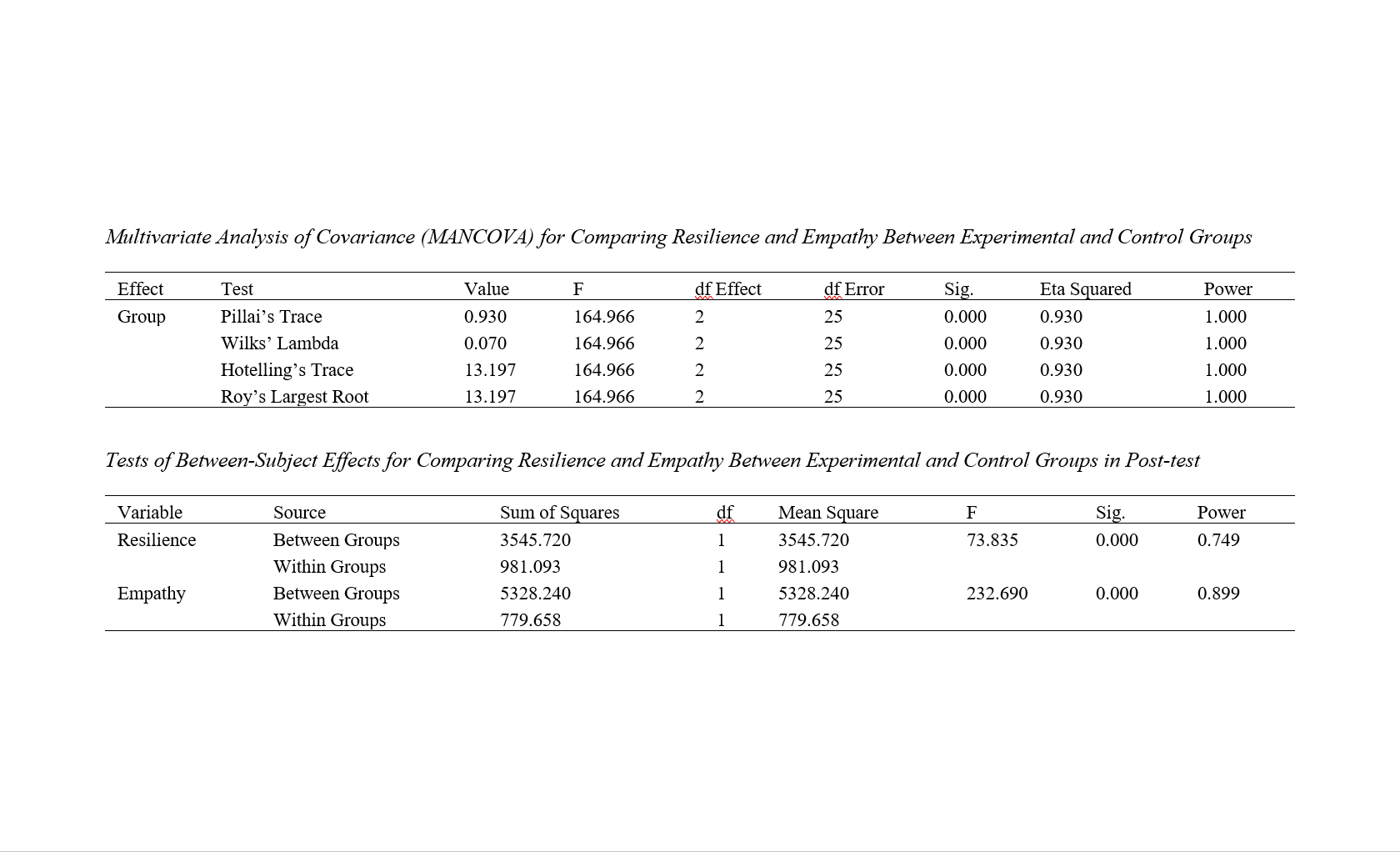
Findings: Inferential results showed a significant multivariate effect of group membership on the combined dependent variables of resilience and empathy (Pillai’s Trace = 0.930, F(2, 25) = 164.966, p < 0.001). Between-subject effects indicated that the intervention significantly improved resilience (F = 73.835, p < 0.001) and empathy (F = 232.690, p < 0.001) in the experimental group compared to the control group. Effect sizes were large for both variables (η² = 0.749 for resilience and η² = 0.899 for empathy), and statistical power values were high, demonstrating the robustness of the findings.
Conclusion: The results indicate that assertiveness training is a highly effective intervention for improving both resilience and empathy among high-school girls. Incorporating assertiveness-based programs into school mental health initiatives may support adolescents’ emotional well-being and interpersonal functioning.
Downloads
References
Abdolghaderi, M., Kafie, M., & Khosromoradi, T. (2021). The effectiveness of assertiveness training on social anxiety and coping with stress among high school female students. Journal of Research in Psychopathology, 2(4), 23-29. https://doi.org/10.22098/jrp.2021.1198
Ahmadi, M., Ghasemi, M., & Ahmadi, M. S. (2021). Effectiveness of Emotion Regulation Training and Assertiveness Training on Resilience and Clinical Symptoms of Students With Generalized Anxiety Disorder. International Clinical Neuroscience Journal, 8(4), 188-192. https://doi.org/10.34172/icnj.2021.37
Alcorta-Garza, A., Vidal-Gutiérrez, Ó., González-Guerrero, J. F., Alcorta-Núñez, F., Garza, G. A. P., San-Martín, M., Bolton, R. C. D., & Vivanco, L. (2025). Characterizing the Early Relationship Between Covert Narcissism and Cognitive Empathy in Medical Students: A Cross-Sectional Study. BMC Medical Education, 25(1). https://doi.org/10.1186/s12909-024-06626-1
Ammouri, A. E., Chamsi, F. Z., Agdai, I., Radouane, O., Abrebak, H., Rassame, Y., Nsabi, F., Haouiddeg, M., Atrassi, S., Belafki, H., Bousgheiri, F., Chraïbi, M., Najdi, A., & Sbaï, H. (2022). Impact of Assertiveness Program Among Students of Thefaculty of Medicine of Tangier (Morocco). International Journal of Advanced Research, 10(7), 949-955. https://doi.org/10.21474/ijar01/15119
Ayhan, D., & Seki Öz, H. (2021). Effect of assertiveness training on the nursing students' assertiveness and self‐esteem levels: Application of hybrid education in COVID‐19 pandemic. Nursing Forum, 56(4), 807-815. https://doi.org/10.1111/nuf.12610
Azimpoor, E., Ozaei, N., & Azareh, A. (2021). Providing a Causal Model for Predicting Academic Progress Based on Problem-Solving and Assertiveness Variables Mediated by Academic Resilience. Biannual Journal of Cognitive Strategies in Learning, 9(16), 119-138. https://asj.basu.ac.ir/article_4056.html
De Acedo Lizarraga, M. L. S., Ugarte, M. D., Cardelle-Elawar, M., Iriarte, M. D., & de Acedo Baquedano, M. T. S. (2003). Enhancement of self-regulation, assertiveness, and empathy. Learning and Instruction, 13(4), 423-439. https://doi.org/10.1016/S0959-4752(02)00026-9
Ghazvineh, J., Jadidi, H., Taghvaeinia, A., & Morovvati, Z. (2022). The effect of Emotional Intelligence, Self-Regulation and Assertiveness on Academic Satisfaction with mediation of Perceived Social Support in students of the second high school. Journal of Research in Educational Systems, 16(59), 49-62. https://www.jiera.ir/article_169448_en.html
Goli, Z. S., Mir Safi Fard, L. S., & Akhbari, F. (2021). The effectiveness of a mindfulness-based stress reduction program on improving mindfulness and assertiveness in students with social anxiety. Biannual Journal of Studies and Novelties in Adolescent and Youth Psychology, 2(1), 83-95. https://doi.org/10.61838/kman.jayps.1.1.23
Lee, S. E., Kim, E., Lee, J. Y., & Morse, B. L. (2023). Assertiveness educational interventions for nursing students and nurses: A systematic review. Nurse Education Today, 120, 105655. https://doi.org/10.1016/j.nedt.2022.105655
Maryati, T., Rahman, A., Kongkoli, E. Y., & Askar, M. (2020). The Effect Of Assertiveness Training On The Management Of Student Emotion In Preventing Violent Behavior. Indian Journal of Public Health Research & Development, 11(7). https://medicopublication.com/index.php/ijphrd/article/view/10279/9620
Parray, W. M., Kumar, S., & David, B. E. (2020). Investigating the impact of assertiveness training on assertiveness and self-esteem of high school students. Polish Psychological Bulletin, 51(3), 171-176. https://www.researchgate.net/publication/346962737_Investigating_the_impact_of_assertiveness_training_on_assertiveness_and_Self-esteem_of_High_School_students
Rouhani, F., Ahmadi, S. M., Sharifi, Y., & Ahmadi, Z. (2024). The effectiveness of assertiveness training on the active well-being of students in the city of Marivan. 6th National Conference on Professional Research in Psychology and Counseling from the Teacher's Perspective,
Sadat Mousavi, S. (2022). The effectiveness of emotion regulation strategy training on self-esteem and assertiveness in students. 6th National Conference on Psychology (The Science of Life), Shiraz. https://en.civilica.com/doc/1657106/
Sun, Y., Chen, S., Miao, L., Chen, S., Piao, Z., & Tong, C. (2024). The Relationship Between Personality, Resilience, and Empathy in Dental Students: A Cross-Sectional Study (Preprint). https://doi.org/10.2196/preprints.56133
Tatari, F., Farnia, V., Momeni, K., Davarinejad, O., Salemi, S., Soltani, B., & Alikhani, M. (2021). Predicting addiction potential based on sensation-seeking, psychological hardiness and assertiveness in students in western Iran: an analytical study. Journal of Substance Use, 26(1), 7-12. https://doi.org/10.1080/14659891.2020.1760371
Toktas, S., Demir, A., & Barut, A. I. (2022). Examining of University Students' Assertiveness Levels and Attitudes towards Physical Education Course. African Educational Research Journal, 10(3), 388-393. https://doi.org/10.30918/AERJ.104.21.150
Downloads
Additional Files
Publication Timeline
- Submitted
- Revised
- Accepted