A Randomized Controlled Trial of Moral Reasoning Training versus General Life Skills Training to Reduce Impulsivity and Non-Suicidal Self-Injury in Adolescents
DOI:
https://doi.org/10.61838/kman.jayps.4853Keywords:
adolescents, non suicidal self injury, impulsivity, moral reasoning, randomized controlled trial.Abstract
Objective: This study aimed to evaluate whether a manualized Moral Reasoning Training (MRT) reduces impulsivity and non suicidal self injury (NSSI) in adolescents more effectively than an active General Life Skills Training (LST) control, and to test whether changes in moral reasoning mediate intervention effects.
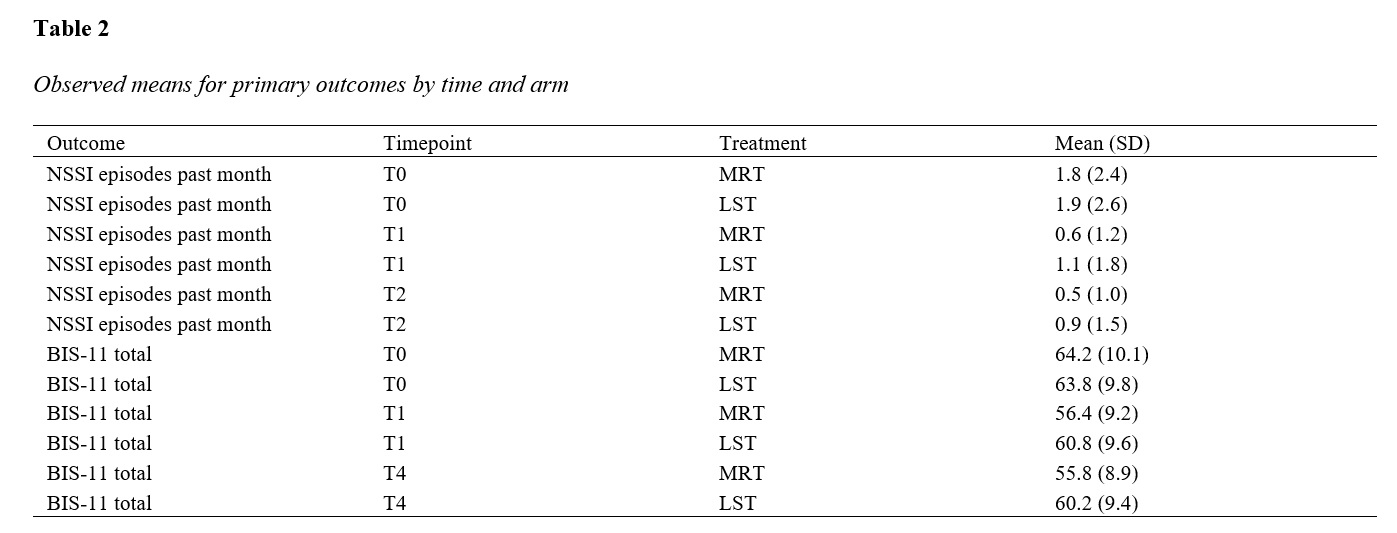
Methods and Materials: In a single blind, parallel group randomized controlled trial, 240 adolescents (aged 13–17) reporting recent NSSI or elevated impulsivity were randomized to MRT (n = 120) or LST (n = 120). Both interventions comprised eight weekly 90 minute group sessions and were matched for duration and facilitator contact. Primary outcomes were monthly NSSI episode frequency (clinician interview) and trait impulsivity (self report Barratt Impulsiveness Scale); secondary outcomes included principled moral reasoning (DIT 2), behavioral inhibition (Go/No Go), emotion regulation (DERS), depressive symptoms, and global functioning. Assessments occurred at baseline, post treatment (8 weeks), and 3, 6, and 12 months. Analyses followed intent to treat principles using mixed effects models and longitudinal mediation with bootstrapped confidence intervals.
Findings: Retention at 12 months was 84%. MRT produced significantly greater reductions in monthly NSSI episodes at post intervention compared with LST (adjusted incidence rate ratio = 0.62, 95% CI 0.50–0.77, p < .001) and larger decreases in trait impulsivity (between group Cohen’s d = 0.42 at post; maintained at 12 months). MRT participants showed larger gains in principled moral reasoning (mean DIT 2 increase ≈ +6.2 vs +1.8) and greater improvement on behavioral inhibition tasks. Longitudinal mediation indicated that DIT 2 change accounted for approximately 45–50% of MRT’s effect on impulsivity and NSSI. Interventions were feasible and safe; no trial related serious adverse events occurred.
Conclusion: Targeted moral reasoning training yielded clinically meaningful and durable reductions in impulsivity and NSSI relative to an active life skills control, with mediation by enhanced principled moral reasoning and corroborating behavioral evidence. MRT represents a promising, mechanism based approach for school delivered prevention of adolescent self injury.
Downloads
References
Birmaher, B., Khetarpal, S., Brent, D., Cully, M., Balach, L., Kaufman, J., & Neer, S. M. (1997). The Screen for Child Anxiety Related Emotional Disorders (SCARED): Scale construction and psychometric characteristics. Journal of the American Academy of Child & Adolescent Psychiatry, 36(4), 545-553. https://doi.org/10.1097/00004583-199704000-00018
Blakemore, S. J., & Mills, K. L. (2014). Is adolescence a sensitive period for sociocultural processing? Annual review of psychology, 65, 187-207. https://doi.org/10.1146/annurev-psych-010213-115202
Daddis, C., & Meadows, E. (2021). Middle school students’ engagement in and beliefs about student misbehavior: A social domain approach. Journal of adolescence, 90(1), 66-78. https://doi.org/10.1016/j.adolescence.2021.06.004
Gratz, K. L., & Roemer, L. (2004). Multidimensional assessment of emotion regulation and dysregulation: Development, factor structure, and initial validation of the Difficulties in Emotion Regulation Scale (DERS). Journal of psychopathology and behavioral assessment, 26(1), 41-54. https://doi.org/10.1023/B:JOBA.0000007455.08539.94
Hao, J., & Wu, C. (2019). Deaf Children’s Moral Behavior, Moral Reasoning and Emotion Attribution. The Journal of Deaf Studies and Deaf Education, 24(2), 95-103. https://doi.org/10.1093/deafed/eny047
Jiang, Y. (2024). Effects of Decision Making and Impulsivity on the Addictive Characteristics of Non-Suicidal Self-Injurious Behavior in Adolescents With Depressive Disorders. https://doi.org/10.21203/rs.3.rs-3856456/v1
Kerbage, H. (2025). Assessment and Management of PTSD Among Children and Adolescents With ADHD as a Preventive Strategy for Suicidal Behaviours. European Psychiatry, 68(S1), S43-S43. https://doi.org/10.1192/j.eurpsy.2025.154
Kirby, K. N., Petry, N. M., & Bickel, W. K. (1999). Heroin addicts have higher discount rates for delayed rewards than non drug using controls. Journal of Experimental Psychology: General, 128(1), 78-87. https://doi.org/10.1037/0096-3445.128.1.78
Kounkroo, N. (2025). Developing 21st century life skills and career competencies among university students: a case study of Buddhist University in Thailand. Insights in Modern Education (I-ME), 2(1), 1-7. https://doi.org/10.1002/asi.24750
Kovacs, M. (2011). Children's Depression Inventory 2 (CDI 2) manual. Multi Health Systems. https://doi.org/10.1037/t04948-000
Lajm Orak, Z. (2024). Investigating the effect of life skills training on increasing hope for life and self-esteem among students. 16th National Conference on Law, Social Sciences and Humanities, Psychology and Counseling,
Leichtmann, B., Hinterreiter, A., Humer, C., Ventura, A., Streit, M., & Mara, M. (2024). Moral Reasoning in a Digital Age: Blaming Artificial Intelligence for Incorrect High-Risk Decisions. Current Psychology, 43(41), 32412-32421. https://doi.org/10.1007/s12144-024-06658-2
Muradian, A. A., Timerbulatova, M. F., & Timerbulatov, I. F. (2025). Non-Suicidal Self-Harm and Its Addictive Potential in Adolescents With Drug-Related Disorders. Vestnik Nevrologii Psihiatrii I Nejrohirurgii (Bulletin of Neurology Psychiatry and Neurosurgery)(4), 441-448. https://doi.org/10.33920/med-01-2504-02
Nikolić, N., Srećković, M., & Malbaša, J. D. (2025). Risk Factors for Suicidal Tendencies Among Adolescents: The Role of Family System, Emotional Regulation, Cyberbullying,and Sleep Issues. 322-337. https://doi.org/10.46793/girr25.322n
Nock, M. K., & Banaji, M. R. (2007). Prediction of suicide ideation and attempts among adolescents using a brief performance based test. Journal of consulting and clinical psychology, 75(5), 707-715. https://doi.org/10.1037/0022-006X.75.5.707
Nock, M. K., Holmberg, E. B., Photos, V. I., & Michel, B. D. (2007). The Self Injurious Thoughts and Behaviors Interview: Development, reliability, and validity in an adolescent sample. Psychological assessment, 19(3), 309-317. https://doi.org/10.1037/1040-3590.19.3.309
Nwafor, C. E., Ugwu, P. C., Okoye, C. F. A., Obi‐Nwosu, H., & Ofonedu, M. E. (2024). Religious coping and delinquent behaviors: Moderated mediation roles of religion affiliation and prosocial moral reasoning. Journal of Research on Adolescence.
Patton, J. H., Stanford, M. S., & Barratt, E. S. (1995). Factor structure of the Barratt Impulsiveness Scale. Journal of Clinical Psychology, 51(6), 768-774. https://doi.org/10.1002/1097-4679(199511)51:6<768::AID-JCLP2270510607>3.0.CO;2-1
Posner, K., Brown, G. K., Stanley, B., Brent, D. A., Yershova, K. V., Oquendo, M. A., Currier, G. W., Melvin, G. A., Greenhill, L., Shen, S., & Mann, J. J. (2011). The Columbia-Suicide Severity Rating Scale: Initial validity and internal consistency findings from three multisite studies with adolescents and adults. American Journal of Psychiatry, 168(12), 1266-1277. https://doi.org/10.1176/appi.ajp.2011.10111704
Prades-Caballero, V., Navarro-Pérez, J. J., & Carbonell, Á. (2025). Factors Associated with Suicidal Behavior in Adolescents: An Umbrella Review Using the Socio-Ecological Model. Community Mental Health Journal, 61(4), 612-628. https://doi.org/10.1007/s10597-024-01368-2
Rest, J. R., Narvaez, D., Thoma, S. J., & Bebeau, M. J. (1999). DIT 2: Devising and testing a revised instrument of moral judgment. Journal of Educational Psychology, 91(4), 644-659. https://doi.org/10.1037/0022-0663.91.4.644
Shaffer, D., Gould, M. S., Brasic, J., Ambrosini, P., Fisher, P., Bird, H., & Aluwahlia, S. (1983). A Children's Global Assessment Scale (CGAS). Archives of General Psychiatry, 40(11), 1228-1228. https://doi.org/10.1001/archpsyc.1983.01790100074010
Shekofteh, M., & Shahnaz, R. (2024). Life Skills and its Impact on Personality Development. International Journal for Multidisciplinary Research, 6(3). https://doi.org/10.36948/ijfmr.2024.v06i03.22834
Stanovich, K. E., & West, R. F. (2000). Individual differences in reasoning: Implications for the rationality debate? Behavioral and brain sciences, 23(5), 645-665. https://doi.org/10.1017/S0140525X00003435
Villacís, J. L., Naval, C., & De la Fuente, J. (2023). Character strengths, moral motivation and vocational identity in adolescents and young adults: a scoping review. Current Psychology, 42(27), 23448-23463. https://doi.org/10.1007/s12144-022-03427-x
Villacura-Herrera, C., Ávalos-Tejeda, M., Gaete, J., Robinson, J., & Núñez, D. (2025). The underlying dynamics of a suicidal ideation latent network model: The role of hopelessness, psychopathology, emotion regulation, and behavioral coping skills in adolescents from the general population. Journal of affective disorders, 379, 540-548. https://doi.org/10.1016/j.jad.2025.02.101
von Grundherr, M., Geisler, A., Stoiber, M., & Schäfer, M. (2017). School Bullying and Moral Reasoning Competence. Social Development, 26(2), 278-294. https://doi.org/10.1111/sode.12199
Wang, X., Lei, L., Liu, D., & Hu, H. (2016). Moderating effects of moral reasoning and gender on the relation between moral disengagement and cyberbullying in adolescents. Personality and individual differences, 98, 244-249. https://www.sciencedirect.com/science/article/pii/S0191886916303178
Wei, C., B, L., Wang, Y., Wang, Y., & Xu, Q. (2024). The Roles of Psychological Needs Satisfaction and Impulsivity to Parent-Child Conflict and Non-Suicidal Self-Injury. Frontiers in Psychiatry, 15. https://doi.org/10.3389/fpsyt.2024.1501983
Wu, W., Cui, Z., Lei, C., Duan, Y., Qu, D., Wu, J., & Zhang, C. (2025). The 1st SpeechWellness Challenge: Detecting Suicidal Risk Among Adolescents. arXiv preprint. https://doi.org/10.48550/arXiv.2501.06474
Downloads
Additional Files
Publication Timeline
- Submitted
- Revised
- Accepted