The Relationship Between Emotional Schemas and Self-Compassion with the Regulation of Psychological Needs in Students
DOI:
https://doi.org/10.61838/kman.jayps.4859Keywords:
Emotional schemas, self-compassion, psychological needs regulation, university students, emotional processingAbstract
Objective: This study aimed to examine the relationship between emotional schemas and self-compassion with the regulation of basic psychological needs among university students.
Methods and Materials: This descriptive-correlational study was conducted among 321 university students selected through stratified cluster sampling. Participants completed three standardized instruments measuring emotional schemas, self-compassion, and the regulation of basic psychological needs. Data analysis was performed using descriptive statistics, Pearson correlation coefficients, and multiple linear regression to determine the strength and direction of relationships as well as the predictive power of the studied variables.
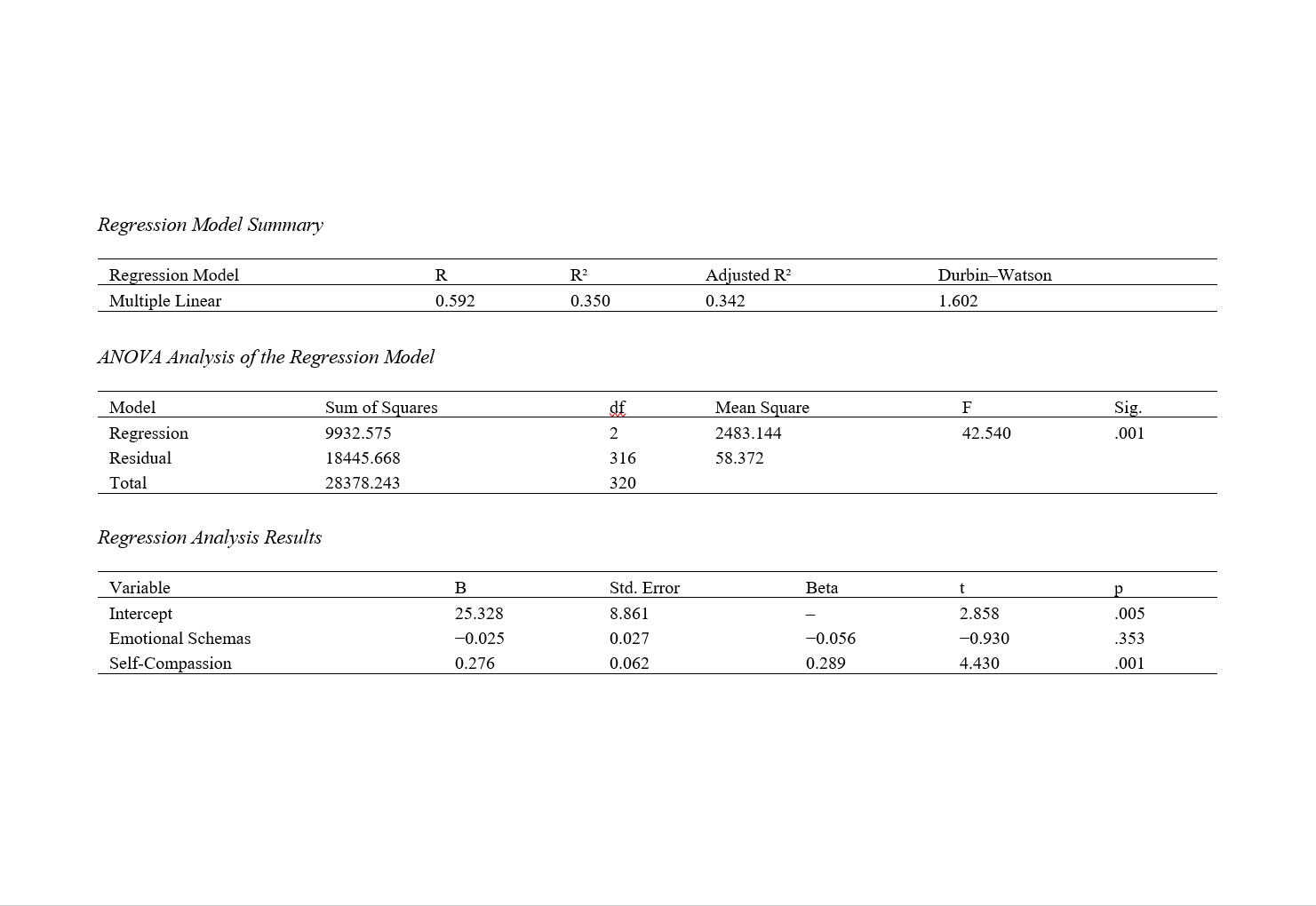
Findings: Pearson correlation analysis revealed significant negative correlations between psychological needs regulation and multiple emotional schema components, including rumination (r = –0.172, p = .002), blaming others (r = –0.151, p = .007), guilt (r = –0.178, p = .001), emotional simplification (r = –0.255, p = .001), worthlessness (r = –0.180, p = .001), lack of control (r = –0.236, p = .001), numbness (r = –0.182, p = .001), irrationality (r = –0.267, p = .001), negative affect persistence (r = –0.216, p = .001), and non-agreeableness (r = –0.222, p = .001). Total emotional schemas showed a significant negative correlation with psychological needs regulation (r = –0.238, p = .001). Significant positive correlations were found between psychological needs regulation and self-kindness (r = .462, p = .001), common humanity (r = .417, p = .001), and mindfulness (r = .389, p = .001), while total self-compassion was strongly correlated with psychological needs regulation (r = .511, p = .001). Regression analysis showed that only self-compassion significantly predicted psychological needs regulation (B = .276, t = 4.430, p = .001), whereas emotional schemas did not.
Conclusion: Self-compassion plays a significant and unique role in predicting the regulation of psychological needs, while emotional schemas, although correlated, do not independently predict need regulation, highlighting the importance of fostering compassionate self-relating to enhance students’ psychological functioning.
Downloads
References
Abdollahi Arpanahi, Z. (2023). The relationship between the satisfaction of fundamental psychological needs, maladaptive schemas, and emotional regulation disorders in couples in Ahvaz Master's thesis in Psychology, Aryan Babol Non-Profit Institute].
Biravand, K. (2014). A comparison of cognitive distortions and emotional schemas in individuals with migraine versus healthy individuals Master's thesis, Islamic Azad University, Borujerd Science and Research Branch].
Costa, J., & Pinto-Gouveia, J. (2011). Acceptance of pain, self-compassion and psychopathology: Using the Chronic Pain Acceptance Questionnaire to identify patients' subgroups. Clinical Psychology and Psychotherapy, 18, 292-302. https://doi.org/10.1002/cpp.718
Cruz, S., Sousa, M., & Peixoto, M. (2024). The interplay between emotional well-being, self-compassion, and basic psychological needs in adolescents. International Journal of Adolescence and Youth, 29(1), 2318340. https://doi.org/10.1080/02673843.2024.2318340
Edwards, E. R., Liu, Y., Ruiz, D., Brosowsky, N. P., & Wupperman, P. (2020). Maladaptive Emotional Schemas and Emotional Functioning: Evaluation of an Integrated Model Across Two Independent Samples. Journal of Rational-Emotive & Cognitive-Behavior Therapy, 39(3), 428-455. https://doi.org/10.1007/s10942-020-00379-8
Faustino, B., Fonseca, I., Antonio, A. B., Baião, M., Lopes, P., & Oliveira, A. (2020). Early Maladaptive Schemas and Emotional Difficulties on Regulation of Psychological Needs: A study with behavioral indicators. Revista de Psicossomática, 4. https://pmc.ncbi.nlm.nih.gov/articles/PMC7513613/
Faustino, B., & Vasco, A. B. (2020a). Early maladaptive schemas and cognitive fusion on the regulation of psychological needs. Journal of Contemporary Psychotherapy, 50, 105-112. https://doi.org/10.1007/s10879-019-09446-3
Faustino, B., & Vasco, A. B. (2020b). Relationships between emotional processing difficulties and early maladaptive schemas on the regulation of psychological needs. Clinical Psychology & Psychotherapy, 27(6), 804-813. https://doi.org/10.1002/cpp.2464
Gao, Y., Wang, X., & Reynolds, B. L. (2025). The Mediating Roles of Resilience and Flow in Linking Basic Psychological Needs to Tertiary EFL Learners’ Engagement in the Informal Digital Learning of English: A Mixed-Methods Study. Behavioral Sciences, 15(1), 85. https://doi.org/10.3390/bs15010085
Gazo, A. M., Mahasneh, A. M., & Al-Jobour, F. Q. (2023). Basic Psychological Needs and its Relationship with Self-compassion among University Students. Islamic Guidance and Counseling Journal, 6(2). https://doi.org/10.25217/0020236395600
Gilbert, P., McEwan, K., Matos, M., & Rivis, A. (2011). Fears of compassion: Development of three self-report measures. Psychology & Psychotherapy: Theory, Research and Practice, 84(3), 239-255. https://doi.org/10.1348/147608310X526511
Greenberg, L. S. (2015). Emotion-Focused Therapy: Coaching Clients to Work Through Their Feelings. American Psychological Association. https://doi.org/10.1037/14692-000
Khayatan, F., Hadian, S., & Golparvar, M. (2025). A Comparison of the Effectiveness of Emotion-Focused Schema Therapy, Compassion-Focused Forgiveness Therapy, and Cognitive-Behavioral Therapy on Emotional Capital and Its Dimensions in Women Victims of Domestic Violence. Yazd Health Dawn, 23(6), 92-108. https://tbj.ssu.ac.ir/browse.php?a_id=3704&sid=1&slc_lang=en&html=1
Kim, S.-H., & Kim, E. (2025). Moderating Effects of Basic Psychological Need Satisfaction and Balance in the Relationship Between Andropause, Loneliness, and Depression Among Middle-Aged Men. Korean Association for Learner-Centered Curriculum and Instruction, 25(6), 451-468. https://doi.org/10.22251/jlcci.2025.25.6.451
Kocur, D., Flakus, M., & Fopka-Kowalczyk, M. (2022). Validity and reliability of the Polish version of the Self-Compassion Scale and its correlates. PLoS One, 17(5), e0267637. https://doi.org/10.1371/journal.pone.0267637
Leahy, R. L. (2002). A Model of Emotional Schemas. Cognitive and Behavioral Practice, 9(3), 177-190. https://doi.org/10.1016/S1077-7229(02)80048-7
Leahy, R. L. (2015). Emotional Schema Therapy. Guilford Publications. https://psyjournals.ru/journals/cpp/archive/cpp_2021_n3.pdf#page=47
Leahy, R. L. (2019). Introduction: Emotional Schemas and Emotional Schema Therapy. International Journal of Cognitive Therapy, 12(1), 1-4. https://doi.org/10.1007/s41811-018-0038-5
MacBeth, A., & Gumley, A. (2012). Exploring compassion: a meta-analysis of the association between self-compassion and psychopathology. Clinical psychology review, 32(6), 545-552. https://doi.org/10.1016/j.cpr.2012.06.003
Neff, K. D. (2003). Self-compassion: an alternative conceptualization of a healthy attitude toward oneself. Self and identity, 2, 85-102. https://doi.org/10.1080/15298860309032
Pascual-Leone, A., & Greenberg, L. S. (2007). Emotional processing in experiential therapy: Why "the only way out is through". Journal of consulting and clinical psychology, 75(6), 875-887. https://doi.org/10.1037/0022-006X.75.6.875
Raes, F. (2011). The effect of self-compassion on the development of depression symptoms in a non-clinical sample. Mindfulness, 2, 33-36. https://doi.org/10.1007/s12671-011-0040-y
Raque-Bogdan, T. L., Ericson, S. K., Jackson, J., Martin, H. M., & Bryan, N. A. (2011). Attachment and mental and physical health: Self compassion and mattering as mediators. Journal of counseling psychology, 58, 272-278. https://doi.org/10.1037/a0023041
Razzaghi, M., Zemestani, M., & Mashhadi, A. (2025). Effectiveness of Emotional Schema Therapy on Anxiety Symptoms, Emotion Regulation, and Marital Satisfaction in Women with Anxiety Disorders: A Preliminary Study. International Journal of Cognitive Behavioral Therapy. https://link.springer.com/article/10.1007/s41811-025-00238-3
Ryan, R. M., & Deci, E. L. (2017). Self-Determination Theory: Basic Psychological Needs in Motivation, Development, and Wellness. New York: Guilford Press. https://doi.org/10.1521/978.14625/28806
Shahbazi, M., Rajabi, G., Maqami, E., & Jaloudari, A. (2015). Confirmatory factor structure of the Persian version of the Revised Self-Compassion Scale in a group of prisoners. Psychological Methods and Models, 6(19), 31-46. https://www.noormags.ir/view/en/articlepage/1077492/
Shepherd, D. A., & Cardon, M. S. (2009). Negative Emotional Reactions to Project Failure and the Self-Compassion to Learn from the Experience. Journal of Management Studies, 46(6), 923-949. https://doi.org/10.1111/j.1467-6486.2009.00821.x
Thim, J. (2017). Relationships between Early Maladaptive Schemas, Mindfulness, Self-compassion, and Psychological Distress. International journal of psychology and psychological therapy, 17(1), 3-17. https://www.redalyc.org/pdf/560/56049624001.pdf
Vasco, A. B., Conceição, N., Silva, A. N., Ferreira, J. F., & Vaz-Velho, C. (2018). O (meta) modelo de complementaridade paradigmática (MCP) Psicoterapias. Lisbon: Pactor. https://www.researchgate.net/publication/324481966_O_MetaModelo_de_Complementaridade_Paradigmatica_MCP
Zamani, S., Ahmadi, S., & Behzadi Nia, B. (2022). The relationship between compassionate behaviors and basic needs and motivational structures in sports coaches. Scientific Journal of the Medical System Organization of the Islamic Republic of Iran, 40(3), 165-172. http://jmciri.ir/browse.php?a_id=3208&sid=1&slc_lang=fa&ftxt=0
Downloads
Additional Files
Publication Timeline
- Submitted
- Revised
- Accepted