The Relationship Between Mental Toughness, Emotional Intelligence, and Stress Coping With the Incidence of Unstable Ankle Injury in Athletes
DOI:
https://doi.org/10.61838/kman.jayps.4873Keywords:
mental toughness, emotional intelligence, stress coping, unstable ankle injuryAbstract
Objective: The objective of this study was to examine the relationships between mental toughness, emotional intelligence, and stress coping skills with the incidence of unstable ankle injury among university volleyball and basketball athletes.
Methods and Materials: This applied, correlational study was conducted among male and female university athletes competing in volleyball and basketball at regional university competitions in 2017. A total of 118 athletes who met the inclusion criteria were selected using convenience sampling. Data were collected using standardized self-report instruments assessing mental toughness, emotional intelligence in sport, stress coping styles, and ankle instability. Questionnaires were administered during official competitions following coordination with university sports authorities. Data analysis was performed using SPSS (Version 20). Normality of distributions was assessed using the Kolmogorov–Smirnov test. Pearson correlation coefficients were calculated to examine bivariate relationships, and multiple regression analysis was conducted to determine the predictive contribution of psychological variables to unstable ankle injury incidence at an alpha level of .05.
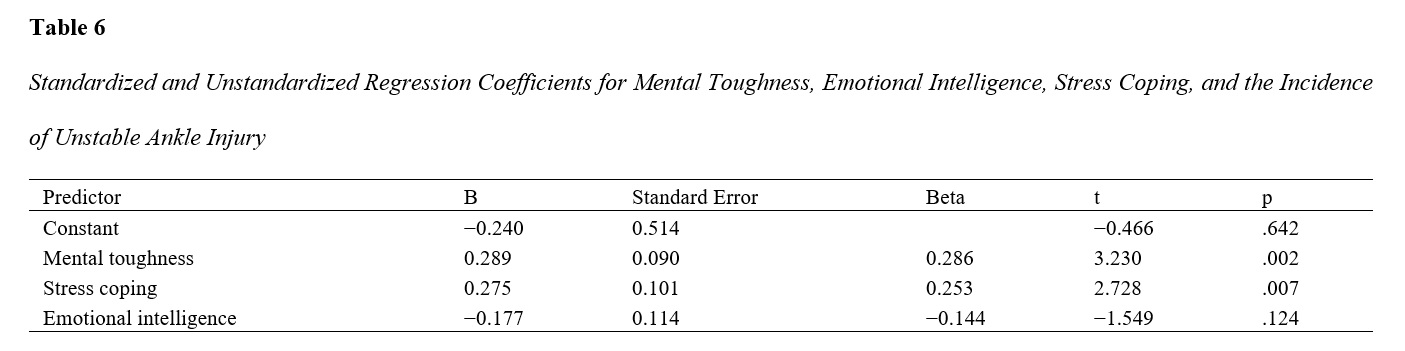
Findings: Inferential analyses showed a significant positive correlation between mental toughness and unstable ankle injury (r = 0.277, p = .003), as well as significant correlations with right ankle injury (r = 0.249, p = .007) and left ankle injury (r = 0.200, p = .033). Stress coping skills were significantly correlated with overall unstable ankle injury (r = 0.215, p = .021) and left ankle injury (r = 0.184, p = .050), while the correlation with right ankle injury was not statistically significant (r = 0.174, p = .063). Emotional intelligence was not significantly associated with unstable ankle injury (r = −0.035, p = .708), right ankle injury (r = −0.033, p = .726), or left ankle injury (r = −0.024, p = .804). Multiple regression analysis indicated that mental toughness (β = 0.286, t = 3.23, p = .002) and stress coping (β = 0.253, t = 2.73, p = .007) were significant predictors of unstable ankle injury, whereas emotional intelligence was not (β = −0.144, t = −1.55, p = .124). The model explained 13% of the variance in unstable ankle injury (R = 0.372, R² = 0.139, adjusted R² = 0.115; F(3,111) = 5.96, p = .01).
Conclusion: The findings suggest that mental toughness and stress coping skills are significant psychological correlates of unstable ankle injury among university athletes, while emotional intelligence does not independently predict injury incidence. These results highlight the complex and context-dependent role of psychological resources in sport injury and underscore the importance of integrating psychological factors into injury prevention and athlete support programs.
Downloads
References
Abedini, M., & Joibari, A. Y. (2023). The Relationship Between Resilience and Mindfulness With Mental Toughness by the Mediating Role of Self-Compassion in Cancer Patients. Basic & Clinical Cancer Research. https://doi.org/10.18502/bccr.v14i1.14390
Akbar, A., Karim, Z. A., Zakaria, J., Kurniawan, R., Dwatra, F. D., & Cahyani, F. I. (2024). Understanding Mental Toughness in Student-Athletes: Insights From Sport Psychology. Retos, 54, 1-9. https://doi.org/10.47197/retos.v54.102230
Akoğlu, H. E. (2024). The Impact of Mental Toughness on Resilience and Well‐being: A Comparison of Hearing‐impaired and Non‐hearing‐impaired Athletes. Journal of Community & Applied Social Psychology, 34(4). https://doi.org/10.1002/casp.2841
Ceylan, M. (2023). Examination of the Relationship Between Trait Anxiety and Mental Toughness in Sailing Athletes. Asian Journal of Education and Training, 9(1), 1-6. https://doi.org/10.20448/edu.v9i1.4410
Dagnall, N., Drinkwater, K., Denovan, A., & Walsh, R. S. (2021). The Potential Benefits of Non-Skills Training (Mental Toughness) for Elite Athletes: Coping With the Negative Psychological Effects of the COVID-19 Pandemic. Frontiers in Sports and Active Living. https://doi.org/10.3389/fspor.2021.581431
De La Cerna, L., & Diego, A. A. (2022). Exploring mental toughness among selected private university elite athletes in Manila: A qualitative study. International Journal of Psychology and Counselling, 14(1), 7–16. https://doi.org/10.5897/IJPC2020.0634
Emesi, K. E., Anyanwu, A. N., & Ezenwosu, E. N. (2024). Examining Students' Mental Toughness, Self-Worth and Critical Thinking Skill as Predictors of Academic Achievement in Mathematics in Anambra State, Nigeria. European Journal of Contemporary Education and E-Learning, 2(1), 88-102. https://doi.org/10.59324/ejceel.2024.2(1).08
Guszkowska, M., & Wójcik, K. (2021). Effect of mental toughness on sporting performance: review of studies. Baltic J Health Phys Activity, 13(7), 1. https://doi.org/10.29359/BJHPA.2021.Suppl.2.01
Hassan, S., Bhatti, M. I., Habib, S., Fatima, S., Bhader, S., Khan, N. H., & Jiang, E. (2023). How Fear of Intimacy Affects Infertile Men’s Neuropsychological Functioning Through Mental Toughness. Frontiers in Psychiatry, 14. https://doi.org/10.3389/fpsyt.2023.1049008
Hsieh, Y. C., Lu, F. J. H., Gill, D. L., Hsu, Y. W., Wong, T. L., & Kuan, G. (2023). Effects of mental toughness on athletic performance: a systematic review and meta-analysis. International Journal of Sport and Exercise Psychology, 1–22. https://doi.org/10.1080/1612197X.2023.2204312
Johnson, K. L., Cormier, D. L., Kowalski, K. C., & Mosewich, A. D. (2023). Exploring the Relationship Between Mental Toughness and Self-Compassion in the Context of Sport Injury. Journal of Sport Rehabilitation, 32(3), 256-264. https://doi.org/10.1123/jsr.2022-0100
Kinrade, C., Hart, W., & Lambert, J. T. (2022). Mental toughness, rather than self-esteem, moderates effects of grandiose narcissism on aggression under conditions of ego-threat. Personality and individual differences, 189, 111518. https://doi.org/10.1016/j.paid.2022.111518
Ni, F. (2024). Mental Toughness in Adolescents: Bridging Family Relationships and Depression Across Personality Traits. BMC psychology, 12(1). https://doi.org/10.1186/s40359-024-01702-z
Ojio, Y., Yamada, K., Amemiya, R., Kawamura, S., Rice, S., & Purcell, R. (2024). Understanding the Relationship Between Sport-Related Psychological Safety and Mental Toughness in Male Elite Athletes. https://doi.org/10.21203/rs.3.rs-5315778/v1
Omrani, S., Baratian, M., Zareh Hoseinzadeghan, Z., & Jedari Seyedi, Z. (2022). The Effectiveness of Emotionally Focused Therapy on Mental Toughness and Sleep Quality Among People with a History of Hospitalization Because of Coronavirus. Journal of Applied Family Therapy, 2(Covid-19 Articles Collection), 215-228. https://doi.org/10.61838/kman.aftj.2.5.14
ÖZcan, V. (2022). Burnout and Mental Well-Being in Sports: The Mediating Role of Athlete Engagement and Mental Toughness. Journal of Educational Issues. https://doi.org/10.5296/jei.v8i2.19951
Parsaiezadeh, M., Shahbazimoghadam, M., Derakhshande, M., & Namjoo, M. (2024). Exploring the Predictive Relationship between Mental Toughness and Subjective Well-Being: A Quantitative Analysis. Journal of Personality and Psychosomatic Research (JPPR), 2(1), 29-35. https://doi.org/10.61838/kman.jppr.2.1.6
Ramirez, A., & Delariarte, C. F. (2023). The Spectrum of First-Generation Student-Athletes’ Mental Toughness: Moderation and Mediation Analyses. 4-14. https://doi.org/10.2991/978-94-6463-356-6_2
Ranjbar, S., Akbarnejad, A., Alizadeh, A., & Fadakar, A. (2023). Is Mental Toughness Related With Motor Learning in Wrestling? International Journal of Sport Studies for Health, 5(2). https://doi.org/10.5812/intjssh-133845
Razavian, F.-S., Imani, S., & nourbakhsh, s. m. k. (2021). Effectiveness of mental toughness on distress tolerance and mental vitality in parents of children with leukemia. Applied Psychology, 15(3), 422-403. https://doi.org/10.52547/apsy.2021.222302.1062
Rintaugu, E. G., Mwangi, F. M., Andanje, N., Tian, X., Fuku, N., & Kidokoro, T. (2022). Mental Toughness Characteristics of Male University Athletes in Relation to Contextual Factors. Journal of Human Kinetics, 81, 243-251. https://doi.org/10.2478/hukin-2022-0019
Sallam, M., Cristian, P., & Carmen, B. (2022). Effect of mental toughness training on performance strategies and performance level of complex skills for youth epee fencers. XXII(1), 48–54. https://www.analefefs.ro/en/anale-fefs/2022/i1/pe-autori/11.%20MAHMOUD%20SALLAM,%20POPA%20CRISTIAN,%20BOTEA%20CARMEN.pdf
Soundara Pandian, P. R., Balaji Kumar, V., Kannan, M., Gurusamy, G., & Lakshmi, B. (2023). Impact of mental toughness on athlete's performance and interventions to improve. Journal of Basic and Clinical Physiology and Pharmacology, 34(4), 409–418. https://doi.org/10.1515/jbcpp-2022-0129
Tawil, S., Kassis, V., Bassil, T., Farhat, K., Hourani, E., Massoud, L., & Najem, C. (2025). Intermediary role of mental toughness beliefs on the relationship between pain self-efficacy and fear avoidance in Elite injured athletes. BMC Sports Science, Medicine and Rehabilitation, 17(1), 124. https://doi.org/10.1186/s13102-025-01171-w
Tian, S., Chen, S., & Cui, Y. (2022). Belief in a Just World and Mental Toughness in Adolescent Athletes: The Mediating Mechanism of Meaning in Life. Front. Psychol., 13, 901497. https://doi.org/10.3389/fpsyg.2022.901497
Turkington, G. D., Tinlin-Dixon, R., & St Clair-Thompson, H. (2023). A mixed-method exploration of mental toughness, perceived stress and quality of life in mental health workers. Journal of Psychiatric and Mental Health Nursing, 30(6), 1152-1169. https://doi.org/10.1111/jpm.12948
Vella-Fondacaro, D., & Romano-Smith, S. (2023). The Impact of a Psychological Skills Training and Mindfulness-Based Intervention on the Mental Toughness, Competitive Anxiety, and Coping Skills of Futsal Players-A Longitudinal Convergent Mixed-Methods Design. Sports, 11(9), 162. https://doi.org/10.3390/sports11090162
Wang, Y., Tian, J., & Yang, Q. (2021). On Mindfulness Training for Promoting Mental Toughness of Female College Students in Endurance Exercise. Evidence-Based Complementary and Alternative Medicine, 5596111. https://doi.org/10.1155/2021/5596111
Wu, C. H., Nien, J. T., Lin, C. Y., Nien, Y. H., Kuan, G., Wu, T. Y., Ren, F. F., & Chang, Y. K. (2021). Relationship between mindfulness, psychological skills and mental toughness in college athletes. International journal of environmental research and public health, 18(13). https://doi.org/10.3390/ijerph18136802
Yalçın, İ., Ayhan, C., Araz, G. Y., Bayram, A., & Birkök, M. C. (2022). The Effect of Imagery Ability on Mental Toughness and Sportive Confidence Level in Athletes. Akdeniz Spor Bilimleri Dergisi, 5(Özel Sayı 2), 895-905. https://doi.org/10.38021/asbid.1210993
Zhong, Z. M., Jiang, H., Wang, H., & Liu, Y. (2025). The Association Between Mindfulness and Athletes' Distress Tolerance: The Mediating Roles of Cognitive Reappraisal and Mental Toughness. Behavioral Sciences, 15(3), 298. https://doi.org/10.3390/bs15030298
Downloads
Additional Files
Publication Timeline
- Submitted
- Revised
- Accepted