Using Random Forest Models to Identify Predictors of Adolescent Aggression
DOI:
https://doi.org/10.61838/kman.jayps.4876Keywords:
Adolescent aggression, Random Forest, machine learning, emotion regulation, impulsivityAbstract
Objective: The objective of this study was to identify and rank the most important individual, familial, and contextual predictors of adolescent aggression using a Random Forest machine learning approach.
Methods and Materials: This study employed a cross-sectional predictive design involving adolescents aged 13–18 years recruited from public secondary schools in Tehran, Iran. Data were collected using validated self-report instruments assessing aggression and a broad range of psychological, family, peer, and school-related variables. After data screening and preprocessing, a Random Forest model was developed to predict levels of adolescent aggression. The dataset was partitioned into training and testing subsets, and model hyperparameters were optimized using cross-validation procedures. Model performance was evaluated using explained variance and error-based indices, and variable importance metrics were extracted to determine the relative contribution of each predictor.
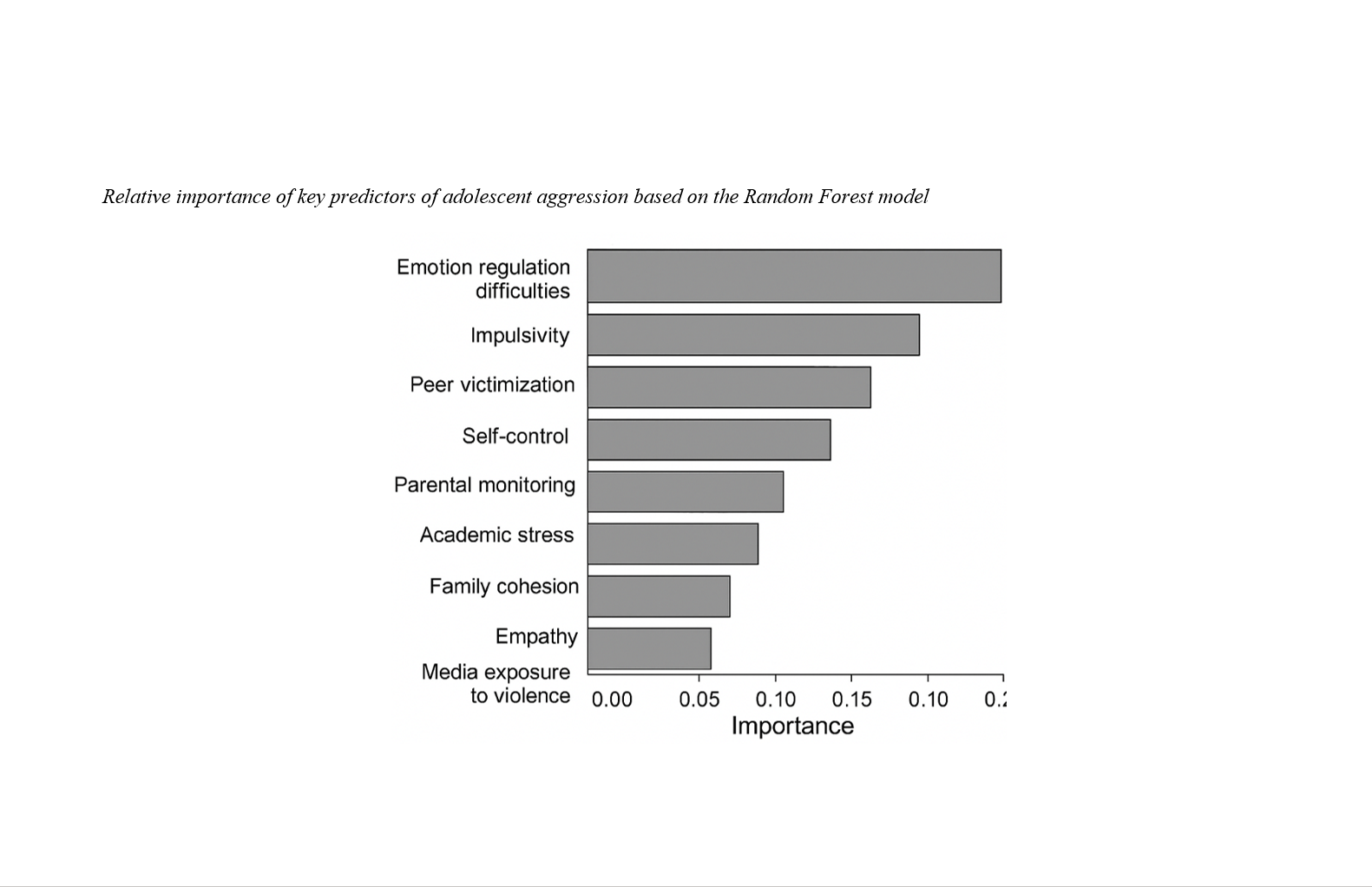
Findings: The Random Forest model demonstrated strong predictive performance, explaining a substantial proportion of variance in adolescent aggression and maintaining good generalizability across training and testing samples. Emotion regulation difficulties emerged as the strongest predictor of aggression, followed by impulsivity and peer victimization. Self-control, parental monitoring, academic stress, and family cohesion also contributed meaningfully to the model, while demographic variables showed comparatively weaker predictive power. Incremental analyses indicated that individual psychological variables accounted for the largest increase in explained variance, with additional contributions from family and peer–school contextual factors.
Conclusion: The findings highlight the utility of Random Forest modeling for capturing the complex, multilevel determinants of adolescent aggression and demonstrate that emotional and self-regulatory processes play a central role in aggressive behavior.
Downloads
References
Abbasi, M., & Nejad, M. H. (2025). Positive Parenting as a Moderator of the Association Between Alexithymia and Adolescent Aggression. https://doi.org/10.20944/preprints202505.0966.v1
Antikaningsih, Y. E., & Sarajar, D. K. (2025). Adolescents From Broken Homes: The Role of Emotional Regulation in Reducing Aggressive Tendencies. Jurnal Bimbingan dan Konseling Terapan, 9(1), 86-100. https://doi.org/10.30598/bkt.v9i1.17112
Braithel, D., & Allaouna, R. (2025). Employing Psychodrama as a therapeutic method to reduce aggressive behavior among adolescents (Experimental Study). Lessons in Deviant Psychology, 9(2), 262-2472. https://asjp.cerist.dz/en/article/261252
Cima, M., Meulenbeek, K., Spagnuolo, F., Oosterink, F., Thijssen, S., Smeijers, D., & Loheide-Niesmann, L. (2025). A systematic review of the relationship between cortisol, testosterone, and aggression in children and adolescents. Aggression and Violent Behavior, 102051. https://doi.org/10.1016/j.avb.2025.102051
Dekkers, T. J., Popma, A., Bosch, J. A., Zadelaar, J. N., & Huizenga, H. M. (2025). Driven by Hormones? An Investigation of the Joint Influence of Testosterone and Cortisol on Risk Taking, Aggression and Sensation Seeking in Adolescents With and Without ADHD. https://doi.org/10.31234/osf.io/ujzs3_v1
Gong, J., & Popescu, A. C. (2024). Predicting Aggressive Behavior From Exposure to Violence and Emotion Dysregulation in Adolescents. Jayps, 5(7), 163-171. https://doi.org/10.61838/kman.jayps.5.7.18
Gupta, M., & Gupta, N. (2025). A Narrative Review on Aggression in Children and Adolescents: Anthropology, Developmental Phenomenology, Transdiagnostic Trajectories, Contextual Nosology, and Strategic Pathways For Interventions. Adolescent Psychiatry, 15. https://doi.org/10.2174/0122106766336153241216081316
Isaksson, J., Sukhodolsky, D. G., Koposov, R., Stickley, A., Ramklint, M., & et al. (2025). Attention-Deficit/Hyperactivity Disorder Symptoms and Anger and Aggression in Russian Adolescents. Journal of the American Academy of Child & Adolescent Psychiatry, 3(1), 126-136. https://doi.org/10.1016/j.jaacop.2024.01.006
Jabarian, M., Rad, F. G., & Shalchi, B. (2024). The Relationship Between Internalizing Syndromes and Morbid Curiosity and Cyber Aggression in Adolescents. International Journal of Medical Toxicology and Forensic Medicine, 14(03). https://pajouhesh.azaruniv.ac.ir/_Pages/Research.aspx?Id=50460
Kapoor, P., Bhardwaj, S., & Jain, S. (2024). Resilience And Aggression As Predictors Of Mindfulness In Adolescents. Educational Administration: Theory and Practice, 30(5), 5745-5750. https://doi.org/10.53555/kuey.v30i5.3850
Kim, J. A., Choi, J. I., Lee, S. J., & Jeong, E. J. (2025). The Influence of Negative Emotions on Adolescents' Pathological Gaming: The Role of Self-Control in the Associations With Aggression, Academic Stress, and Pathological Gaming. Frontiers in psychology, 16. https://doi.org/10.3389/fpsyg.2025.1539162
Kim, S., & Cho, Y. I. (2024). The Effect of Adolescents' Social Withdrawal on Aggression: The Longitudinal Mediating Effect of Smartphone Dependency. Korean Soc Private Secur, 23(5), 169-198. https://doi.org/10.56603/jksps.2024.23.5.169
Leff, S. S., Paskewich, B. S., Fu, R., & Waasdorp, T. E. (2024). School-based aggression and bullying prevention program implementation in real-world conditions. In In Cyber and Face-to-Face Aggression and Bullying among Children and Adolescents (pp. 120-131). https://doi.org/10.4324/9781003414933-11
Lindsey, E. W. (2025). Parent–Child Dyadic Synchrony, Prosocial and Aggressive Behavior With Peers, and Friendship Quality in Early Adolescence. Psychology International, 7(1), 22. https://doi.org/10.3390/psycholint7010022
Mansouri, K., & Khodabakhshi-Koolaee, A. (2024). The Effectiveness of Motivational Interview (MI) on Aggression and High-risk Behaviors of Adolescent Girls. JPEN, 10(4), 41-49. https://civilica.com/doc/2029606/
Matthys, W., & Schutter, D. J. (2024). Involving Parents in Cognitive Behavioral Therapy for Children and Adolescents With Conduct Problems: Goals, Outcome Expectations, and Normative Beliefs About Aggression Are Targeted in Sessions With Parents and Their Child. Clinical Child and Family Psychology Review, 27(2), 561-575. https://doi.org/10.1007/s10567-024-00486-3
Mg, Y., Reddy, K. J., & Bennet, C. N. (2025). Social Intelligence Deficits and Aggression in Children in Conflict With the Law: A Comparative Study With Typically Developing Adolescents. https://doi.org/10.21203/rs.3.rs-6161190/v1
Oh, J. K., Lee, T. W., Zhang, J., & Lee, M. W. (2024). The Impact of Negative Parenting Attitudes on Adolescents’ Cyber Delinquency: The Dual Mediating Effects of Grit and Aggression. Korean Association for Learner-Centered Curriculum and Instruction, 24(21), 577-593. https://doi.org/10.22251/jlcci.2024.24.21.577
Pan, Y., Motevalli, S., & Yu, L. (2024). The Relationship between Game Addiction and Aggression among Adolescents with Mediating Role of Narcissism and Self-Control. Iranian Journal of Psychiatry, 1-11. https://doi.org/10.18502/ijps.v19i3.15804
Rean, A. А., Konovalov, I. A., & Егорова, А. В. (2024). Social Representations of Gender-Based Aspects of Verbal Aggression Among Adolescents as Perceived by Teachers. Sibirskiy Psikhologicheskiy Zhurnal(92), 26-43. https://doi.org/10.17223/17267080/92/2
Sobhani Najafabadi, A., Fadavi, M. S., & Mahdad, A. (2024). Developing a Nonviolent Communication Training Program and Evaluating its Effectiveness on the Social Adaptation and Academic Self-Efficacy of Aggressive Male Students. Journal of Adolescent and Youth Psychological Studies (JAYPS), 5(8), 38-47. https://doi.org/10.61838/kman.jayps.5.8.5
Tafà, M., Cerniglia, L., & Cimino, S. (2025). The Role of Parental and Adolescent Psychosocial Factors in Different Aggression Profiles: A Comparative Approach. Journal of clinical medicine, 14(6), 1924. https://doi.org/10.3390/jcm14061924
Undiyaundeye, F. A., Basake, J. A., & Abanbeshie, J. A. (2024). Aggression and Violence as Correlates of Adolescents Social Competence in Secondary Schools in Ogoja Educational Zone, Cross River State, Nigeria. Journal of Popular Education in Africa, 8(1), 52-63. https://doi.org/10.1111/j.1746-1561.2011.00636.x
Wangsa, P. R. P. (2024). Factors Influencing Aggression Among Adolescents in Indonesia: A Literature Review. Nusant. J. Behav. And. Soc. Sci, 3(2), 53-62. https://doi.org/10.47679/202448
Wulandari, A. N. (2025). Self-Esteem as a Moderator of the Influence of Peer Pressure on Adolescent Aggression. Psychological-Educational Studies, 17(1), 53-63. https://doi.org/10.17759/psyedu.2025170104
Zhou, J., Wang, L. A., Zhu, D., & Gong, X. (2024). Social anxiety and peer victimization and aggression: examining reciprocal trait-state effects among early adolescents. Journal of youth and adolescence, 53(3), 701-717. https://doi.org/10.1007/s10964-023-01920-5
Downloads
Additional Files
Publication Timeline
- Submitted
- Revised
- Accepted