Prediction of Infidelity Tendency Based on Love Styles and Personality Traits in Married Students
DOI:
https://doi.org/10.61838/kman.jayps.4894Keywords:
Infidelity tendency, love styles, personality traits, marriageAbstract
Objective: The present study aimed to predict infidelity tendency among married students based on love styles and personality traits.
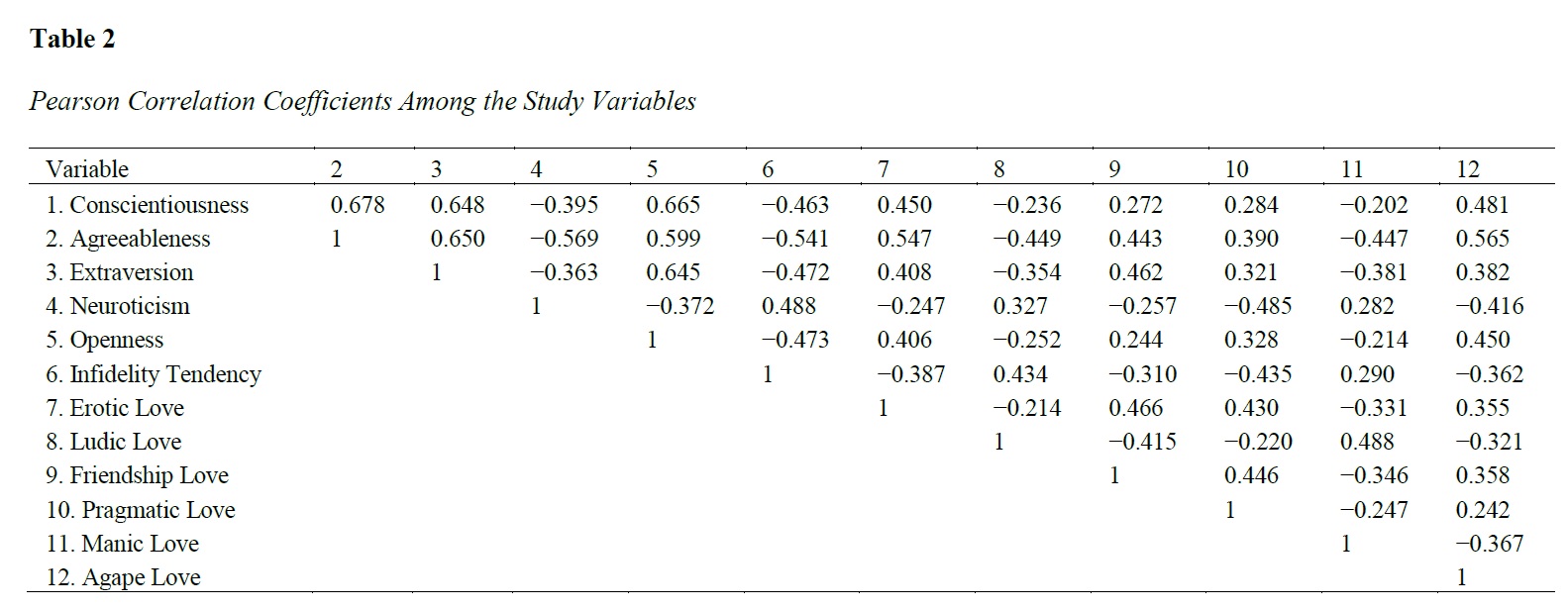
Methods and Materials: This applied research employed a descriptive–correlational design. The statistical population consisted of married students enrolled at Tehran West University during the 2024–2025 academic year. Using convenience and voluntary sampling, 150 participants completed the study instruments, including the Attitudes Toward Infidelity Scale (ATIS), the Short Form of the Love Attitudes Scale (LAS), and the NEO Five-Factor Inventory (NEO-FFI). Data were analyzed using SPSS software. Inferential analyses included Pearson correlation coefficients and multiple regression analysis. Prior to hypothesis testing, assumptions of normality, multicollinearity, and independence of residuals were examined using the Kolmogorov–Smirnov test, variance inflation factors, tolerance values, and the Durbin–Watson statistic. Stepwise multiple regression models were estimated to determine the predictive contribution of love styles and personality traits to infidelity tendency.
Findings: Inferential results indicated that agreeableness (β = −0.264, p < .01), pragmatic love (β = −0.267, p < .001), erotic love (β = −0.157, p < .05), agape love (β = −0.147, p < .05), and openness to experience (β = −0.220, p < .01) significantly and negatively predicted infidelity tendency, whereas neuroticism (β = 0.256, p < .01) and ludic love (β = 0.294, p < .001) were significant positive predictors. Combined, personality traits and love styles explained a substantial proportion of variance in infidelity tendency, with the final regression model accounting for approximately 43% of the total variance (R² = .434, F = 22.11, p < .001).
Conclusion: The findings demonstrate that both stable personality characteristics and relational love orientations play critical roles in shaping vulnerability to infidelity, underscoring the value of integrative assessment and targeted interventions in marital counseling for married students
Downloads
Downloads
Additional Files
Publication Timeline
- Submitted
- Revised
- Accepted