Comparison of the Effectiveness of Emotion Regulation Training and Self-Differentiation Training on Behavioral Problems of Tenth-Grade Female Students in Baghbahadoran
DOI:
https://doi.org/10.61838/kman.jayps.4944Keywords:
emotion regulation training, self-differentiation training, behavioral problems, adolescentAbstract
Objective: The objective of this study was to compare the effectiveness of emotion regulation training and self-differentiation training on reducing internalizing and externalizing behavioral problems among tenth-grade female students.
Methods and Materials: This study adopted a quantitative, applied, quasi-experimental design with pretest, posttest, and a three-month follow-up, including two experimental groups and one control group. The statistical population consisted of tenth-grade female students in Baghbahadoran during the 2023–2024 academic year, from which 81 students were initially selected through cluster random sampling and convenience sampling. Participants were randomly assigned to an emotion regulation training group, a self-differentiation training group, or a control group. The emotion regulation intervention was implemented using the ten-session “Think Cool, Act Cool” program, while self-differentiation training was delivered based on Bowen’s theory in ten structured sessions. Behavioral problems were assessed at three time points using the Achenbach Youth Self-Report questionnaire. Data were analyzed using repeated measures analysis of variance and mixed analysis of variance in SPSS version 27.
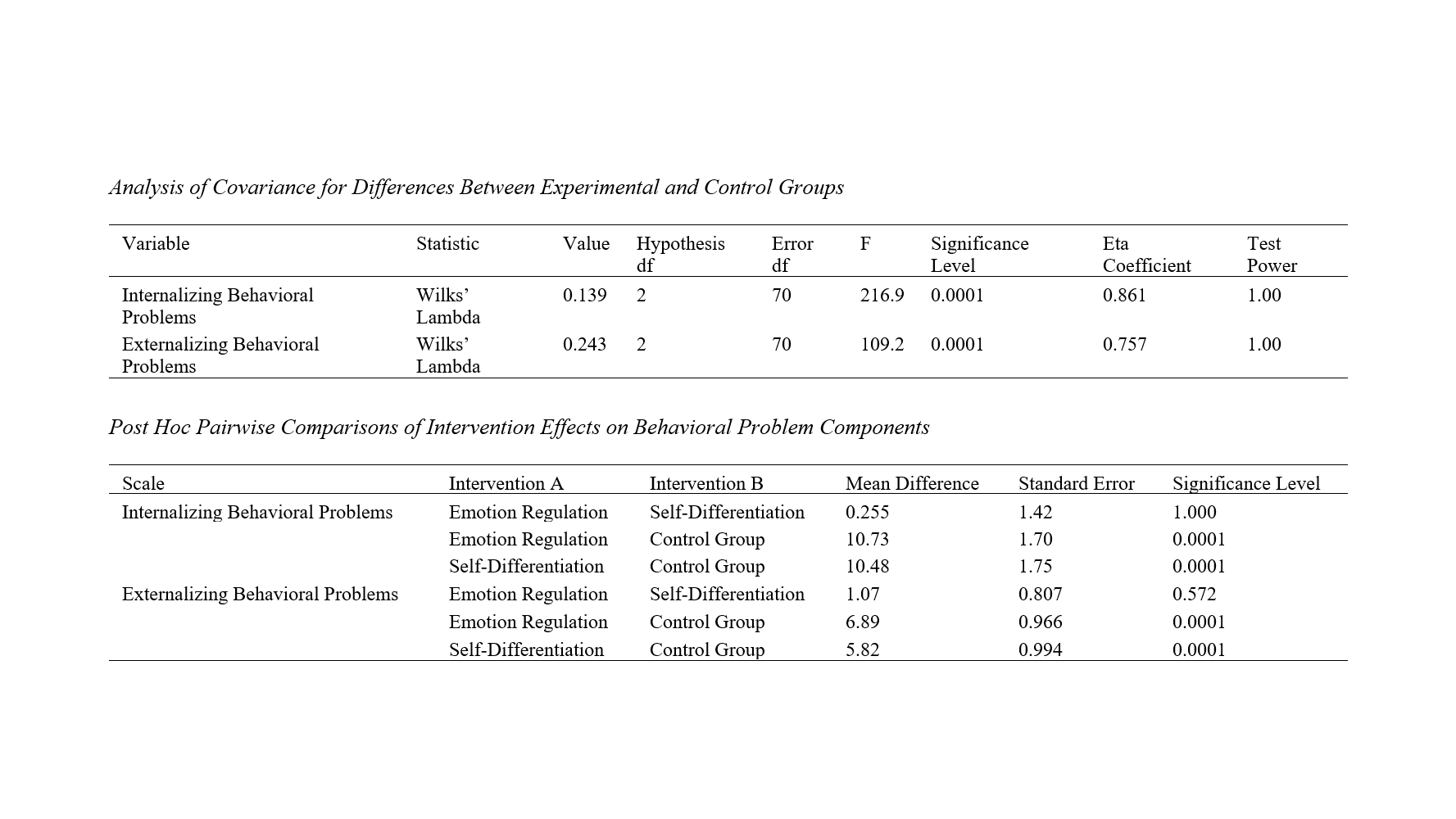
Findings: The results indicated a significant main effect of time for both internalizing and externalizing behavioral problems, demonstrating substantial reductions from pretest to posttest that were maintained at follow-up. Significant group differences were observed, with both intervention groups showing significantly lower levels of internalizing and externalizing problems compared to the control group. No statistically significant differences were found between the emotion regulation and self-differentiation training groups. Effect sizes were large for both outcome variables, indicating strong intervention effects.
Conclusion: Both emotion regulation training and self-differentiation training were equally effective in reducing internalizing and externalizing behavioral problems in adolescent girls, and the beneficial effects remained stable over time. These findings support the use of either intervention as an effective school-based approach for improving adolescents’ emotional and behavioral adjustment.
Downloads
References
Andrews, J. L., Ahmed, S. P., & Blakemore, S. J. (2021). Navigating the Social Environment in Adolescence: The Role of Social Brain Development. Biological Psychiatry, 89(2), 109-118. https://doi.org/10.1016/j.biopsych.2020.09.012
Arslan, İ. B., Lucassen, N., Van Lier, P. A., De Haan, A. D., & Prinzie, P. (2021). Early childhood internalizing problems, externalizing problems and their co-occurrence and (mal) adaptive functioning in emerging adulthood: A 16-year follow-up study. Social Psychiatry and Psychiatric Epidemiology, 56(2), 193-206.
Babicka-Wirkus, A., Kozłowski, P., Wirkus, Ł., & Stasiak, K. (2023). Internalizing and externalizing disorder levels among adolescents: Data from Poland. International journal of environmental research and public health, 20(3), 2752.
Calatrava, M., Martins, M. V., Schweer-Collins, M., Duch-Ceballos, C., & Rodríguez-González, M. (2022). Differentiation of self: A scoping review of Bowen Family Systems Theory’s core construct. Clinical psychology review, 91. https://doi.org/10.1016/j.cpr.2021.102101
Carlson, G. A., Singh, M. K., Amaya-Jackson, L., Benton, T. D., Althoff, R. R., Bellonci, C., Bostic, J. Q., Chua, J. D., Findling, R. L., Galanter, C. A., Gerson, R. S., Sorter, M. T., Stringaris, A., Waxmonsky, J. G., & McClellan, J. M. (2023). Narrative Review: Impairing Emotional Outbursts: What They Are and What We Should Do About Them. Journal of the American Academy of Child and Adolescent Psychiatry, 62(2), 135-150. https://doi.org/10.1016/j.jaac.2022.03.014
Carroll, P., Hirvikoski, T., Lindholm, C., & Thorell, L. (2021). Group-based emotion regulation skills training for adults with ADHD: A feasibility study in an outpatient psychiatric setting. Applied Neuropsychology: Adult, 30. https://doi.org/10.1080/23279095.2021.1910512
Cavanagh, M., Quinn, D., Duncan, D., Graham, T., & Balbuena, L. (2014). Oppositional Defiant Disorder Is Better Conceptualized as a Disorder of Emotional Regulation. Journal of Attention Disorders, 21(5), 381-389. https://doi.org/10.1177/1087054713520221
De Neve, D., Bronstein, M. V., & Leroy, A. (2023). Emotion Regulation in the Classroom: A Network Approach to Model Relations among Emotion Regulation Difficulties, Engagement to Learn, and Relationships with Peers and Teachers. Journal of youth and adolescence, 52, 273-286. https://doi.org/10.1007/s10964-022-01678-2
Dixius, A., Michael, T., Altpeter, A., Ramos Garcia, R., & Möhler, E. (2023). Adolescents in acute mental health crisis—Pilot-evaluation of a low-threshold program for emotional stabilization. Frontiers in Child and Adolescent Psychiatry, 2. https://doi.org/10.3389/frcha.2023.1177342
Dolz-del-Castellar, B., & Oliver, J. (2021). Relationship between family functioning, differentiation of self and anxiety in Spanish young adults. PLoS One, 16(3). https://doi.org/10.1371/journal.pone.0246875
Eadeh, H. M., Breaux, R., & Nikolas, M. A. (2021). A Meta-Analytic Review of Emotion Regulation Focused Psychosocial Interventions for Adolescents. Clinical Child and Family Psychology Review, 24(4), 684-706. https://doi.org/10.1007/s10567-021-00362-4
Fu, L., Wang, P., Zhao, M., Xie, X., Chen, Y., Nie, J., & Lei, L. (2020). Can emotion regulation difficulty lead to adolescent problematic smartphone use? A moderated mediation model of depression and perceived social support. Children and Youth Services Review, 108. https://doi.org/10.1016/j.childyouth.2019.104660
Gómez-León, M. I. (2025). Serious games to support emotional regulation strategies in educational intervention programs with children and adolescents: Systematic review and meta-analysis. Heliyon.
Gonçalves, S. F., Chaplin, T. M., Turpyn, C. C., Niehaus, C. E., Curby, T. W., Sinha, R., & Ansell, E. B. (2019). Difficulties in emotion regulation predict depressive symptom trajectory from early to middle adolescence. Child Psychiatry & Human Development, 50(4), 618-630.
Gruhn, M. A., & Compas, B. E. (2020). Effects of maltreatment on coping and emotion regulation in childhood and adolescence: A meta-analytic review. Child abuse & neglect, 103, 104446.
Helland, S. S., Baardstu, S., Kjøbli, J., Aalberg, M., & Neumer, S. P. (2023). Exploring the Mechanisms in Cognitive Behavioral Therapy for Anxious Children: Does Change in Emotion Regulation Explain Treatment Effect? Prevention Science, 24(2), 214-225. https://doi.org/10.1007/s11121-022-01341-z
Hemmati, R. (2017). The effectiveness of emotional self-regulation training on increasing social skills, reducing behavioral problems, and reducing perfectionism in gifted students [Master's thesis, University of Mohaghegh Ardabili].
Józefczyk, A. (2023). Multigenerational transmission of differentiation of self–Toward a more in-depth understanding of Bowen's theory concept. Journal of marital and family therapy.
Keyes, K. M., & Platt, J. M. (2024). Annual Research Review: Sex, gender, and internalizing conditions among adolescents in the 21st century–trends, causes, consequences. Journal of Child Psychology and Psychiatry, 65(4), 384-407.
Kraft, L., Ebner, C., Leo, K., & Lindenberg, K. (2023). Emotion Regulation Strategies and Symptoms of Depression, Anxiety, Aggression, and Addiction in Children and Adolescents: A Meta-Analysis and Systematic Review. Clinical Psychology: Science and Practice. https://doi.org/10.1037/cps0000156
Kulkarni, T., Sullivan, A. L., & Kim, J. (2021). Externalizing behavior problems and low academic achievement: Does a causal relation exist? Educational psychology review, 33(3), 915-936.
Lennarz, H. K., Hollenstein, T., Lichtwarck-Aschoff, A., Kuntsche, E., & Granic, I. (2019). Emotion regulation in action: Use, selection, and success of emotion regulation in adolescents’ daily lives. International Journal of Behavioral Development, 43(1), 1-11. https://doi.org/10.1177/0165025418755540
López-Martínez, L. F., Carretero, E. M., Carrasco, M. A., & Pérez-García, A. M. (2025). Self-Regulation, Emotional Symptomatology, Substance Use, and Social Network Addiction in Adolescent Self-Harm. Behavioral Sciences, 15(3), 257. https://doi.org/10.3390/bs15030257
Mehraban, R., & Alivandivafa, M. (2022). Examining Aggression, Rumination and Self-Control under the Influence of Emotion Regulation Training and Mindfulness Training in Students with Low Academic Performance. Journal of Adolescent and Youth Psychological Studies, 3(3), 1-6.
Menzel, C. W., Ebbes, R., Hensums, M., Wagemaker, E., Zaharieva, M. S., Staaks, J. P. C., Van Den Akker, A. L., Visser, I., Hoeve, M., Brummelman, E., Dekkers, T. J., Schuitema, J. A., Larsen, H., Colonnesi, C., Jansen, B. R. J., Overbeek, G., Huizenga, H. M., & Wiers, R. W. (2023). Development and socialization of self-regulation from infancy to adolescence: A meta-review differentiating between self-regulatory abilities, goals, and motivation. Developmental Review, 69, 101090. https://doi.org/10.1016/j.dr.2023.101090
Mohammadi, M., & Alibakhshi, S. Z. (2021). Research Paper: The Effectiveness of the Self-differentiation Training Based on the Bowen Theory on Marital Satisfaction. Journal of Research and Health, 11(5), 333-340. https://doi.org/10.32598/JRH.11.5.1574.1
Mohammadzadeh, R. (2017). The role of cognitive emotion regulation strategies in symptoms of internalized and externalized disorders in children [Master's thesis, University of Tabriz].
Murdock, N. L., Flynn, M. C., & Bresin, R. C. (2022). Differentiation of self, anxiety, triangling and distress: A test of Bowen theory. Family Process. https://doi.org/10.1111/famp.12845
Najafi Chaleshtori, M., Heidari, A., Asgari, P., Dasht Bozorgi, Z., & Hafezi, F. (2021). Comparison of the Effectiveness of Mindfulness-based Stress Reduction Therapy and Emotion Regulation Training on the Distress Tolerance of Adolescent Girls with a Drug-Dependent Parent. Jundishapur Journal of Health Sciences, 14(1). https://doi.org/10.5812/jjhs.120763
Nook, E. C., Vidal Bustamante, C. M., Cho, H. Y., & Somerville, L. H. (2020). Use of linguistic distancing and cognitive reappraisal strategies during emotion regulation in children, adolescents, and young adults. Emotion, 20(4), 525-540. https://doi.org/10.1037/emo0000570
Peleg, O., & Messerschmidt-Grandi, C. (2019). Differentiation of self and trait anxiety: A cross-cultural perspective. International journal of psychology, 54(6), 816-827.
Polack, R. G., Everaert, J., Uddenberg, C., Kober, H., & Joormann, J. (2021). Emotion Regulation and Self-Criticism in Children and Adolescence: Longitudinal Networks of Transdiagnostic Risk Factors. Emotion, 21(7), 1438-1451. https://doi.org/10.1037/emo0001041
Ravanbakhsh, A. (2018). Investigating the effectiveness of emotion regulation training on reducing disciplinary and behavioral problems and on academic achievement of students with high-risk behavior in art school [Master's thesis, Payam Noor University, Isfahan Province].
Renna, M. E. (2021). A review and novel theoretical model of how negative emotions influence inflammation: The critical role of emotion regulation. Brain, Behavior, & Immunity - Health, 18, 100397. https://doi.org/10.1016/j.bbih.2021.100397
Safaei, F. (2021). Investigating the transdiagnostic role of repetitive negative thoughts and difficulty in emotion regulation in predicting internalized disorders [Master's thesis, Ferdowsi University].
Salehi Esfahani, N. (2024). The Impact of Group Emotion Regulation Training Based on Gross’s Model on Reducing Depression and Risky Behaviors in Depressed Adolescents. Journal of Adolescent and Youth Psychological Studies (JAYPS), 5(8), 58-67. https://doi.org/10.61838/kman.jayps.5.8.7
Sanchis-Sanchis, A., Grau, M. D., Moliner, A. R., & Morales-Murillo, C. P. (2020). Effects of Age and Gender in Emotion Regulation of Children and Adolescents. Frontiers in psychology, 11. https://doi.org/10.3389/fpsyg.2020.00946
Schwartz-Mette, R. A., Lawrence, H. R., Shankman, J., Fearey, E., & Harrington, R. (2021). Intrapersonal Emotion Regulation Difficulties and Maladaptive Interpersonal Behavior in Adolescence. Research on Child and Adolescent Psychopathology, 49(6), 749-761. https://doi.org/10.1007/s10802-020-00739-z
Silvers, J. A. (2022). Adolescence as a pivotal period for emotion regulation development for consideration at current opinion in psychology. Current opinion in psychology, 44, 258-263. https://doi.org/10.1016/j.copsyc.2021.09.023
Singh, P., & Singh, A. (2023). Emotion regulation difficulties and health-risk behaviours in adolescents. Behaviour Change, 40(2), 86-102.
Stoykova, P. (2024). The role of affective control and emotion regulation in the development of adolescent depressive symptoms [Doctoral dissertation, Ghent University].
Te Brinke, L. W., Schuiringa, H. D., Menting, A. T., Deković, M., & De Castro, B. O. (2018). A cognitive versus behavioral approach to emotion regulation training for externalizing behavior problems in adolescence: Study protocol of a randomized controlled trial. BMC psychology, 6(1), 49.
Wartberg, L., Thomasius, R., & Paschke, K. (2021). The relevance of emotion regulation, procrastination, and perceived stress for problematic social media use in a representative sample of children and adolescents. Computers in human Behavior, 121. https://doi.org/10.1016/j.chb.2021.106788
Yavuz Güler, Ç., & Karaca, T. (2021). The role of differentiation of self in predicting rumination and emotion regulation difficulties. Contemporary Family Therapy, 43(2), 113-123.
Young, K. S., Sandman, C. F., & Craske, M. G. (2019). Positive and negative emotion regulation in adolescence: links to anxiety and depression. Brain Sciences, 9(4), 76.
Zhang, B. G., & Qian, X. F. (2024). Path of physical exercise’s impact on deviant behavior among Chinese adolescents. Psychology research and behavior management, 17, 1561-1571. https://doi.org/10.2147/PRBM.S452606
Downloads
Additional Files
Publication Timeline
- Submitted
- Revised
- Accepted