The Effectiveness of Dialectical Behavior Therapy on Emotion Dysregulation and Social Cognition in Students With Self-Injurious Behaviors
DOI:
https://doi.org/10.61838/kman.jayps.4982Keywords:
Dialectical Behavior Therapy, emotion dysregulation, social cognition, self-injury, studentsAbstract
Objective: The present study aimed to determine the effectiveness of Dialectical Behavior Therapy on emotion dysregulation and social cognition in students with self-injurious behaviors.
Methods and Materials: This study employed a quasi-experimental design using a pretest–posttest approach with a control group. The statistical population included all male upper secondary school students in Babol during the 2021–2022 academic year. The sample consisted of 30 students selected through convenience sampling and randomly assigned, using a lottery method, to an experimental group (n = 15) and a control group (n = 15). Participants completed the Deliberate Self-Harm Inventory (Gratz, 2001), the Difficulties in Emotion Regulation Scale (Gratz & Roemer, 2004), and the Social Cognition Questionnaire (Nejati et al., 2018) before and after the intervention. Dialectical Behavior Therapy was administered to the experimental group in twelve 90-minute sessions, twice weekly, while the control group received no intervention during this period. Data were analyzed using descriptive statistics (mean and standard deviation) and analysis of covariance (ANCOVA) with SPSS software, version 24.
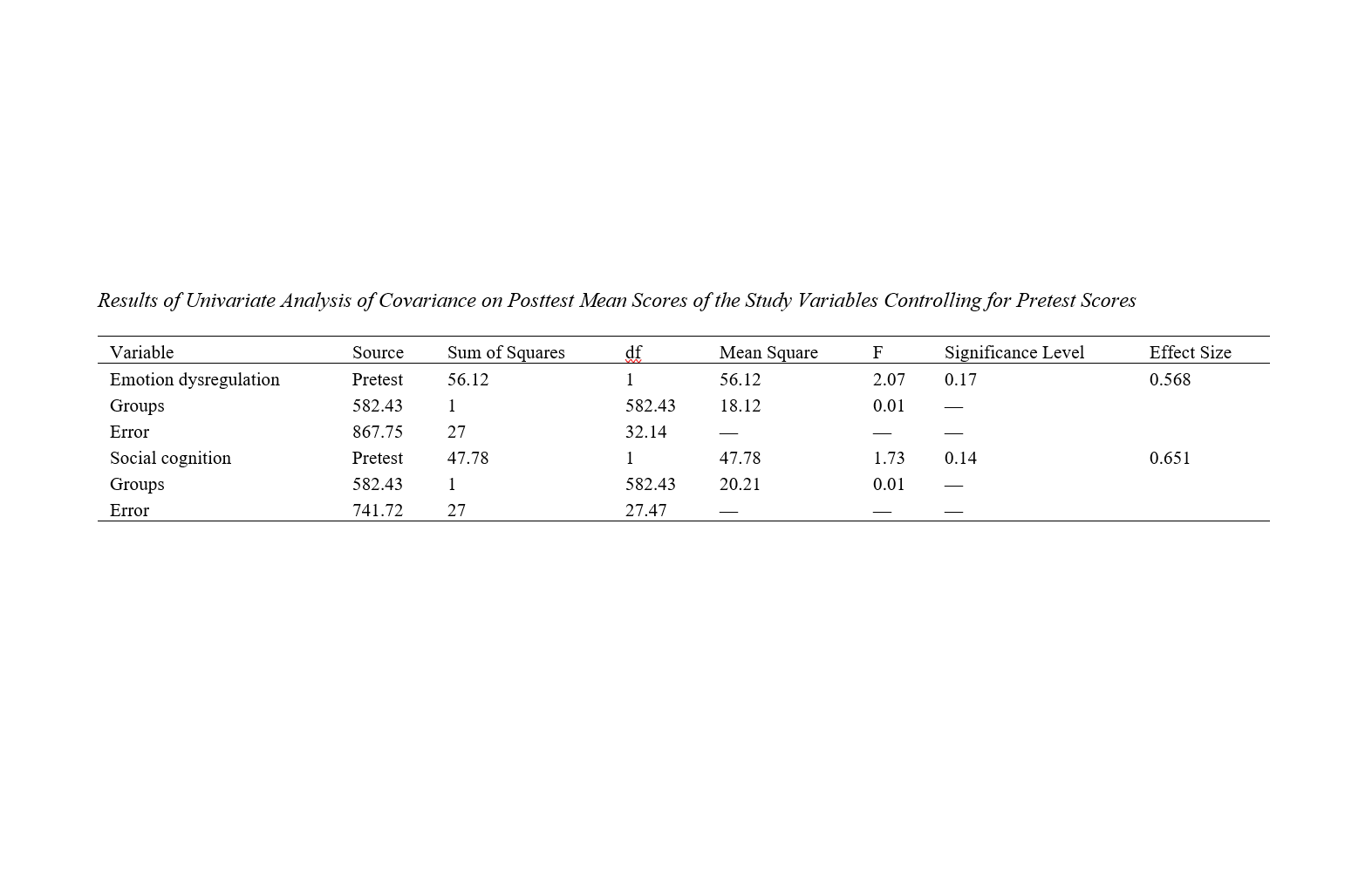
Findings: The results indicated that Dialectical Behavior Therapy had a significant effect on reducing emotion dysregulation and improving social cognition in students with self-injurious behaviors (P < 0.01). The mean ± standard deviation of emotion dysregulation decreased from 78.87 ± 7.12 at the pretest stage to 62.15 ± 6.04 at the posttest stage. Additionally, the mean ± standard deviation of social cognition increased from 56.55 ± 5.74 at the pretest stage to 67.82 ± 6.12 at the posttest stage.
Conclusion: Based on the findings, Dialectical Behavior Therapy was effective in reducing emotion dysregulation and enhancing social cognition among students with self-injurious behaviors. Therefore, Dialectical Behavior Therapy can be recommended as an appropriate intervention for reducing problems in students who engage in self-injury.
Downloads
References
Amighi, H., Ebrahimi Moghadam, H., & Kashani Vahid, L. (2023). Comparison the effectiveness of dialectical behavior therapy and cognitive-behavioral therapy on anxiety and aggression in people with obsessive-compulsive disorder. Shenakht Journal of Psychology and Psychiatry, 10(5), 51-55.
Amighi, H., Ebrahimi Moghadam, H., & Kashani Vahid, L. (2025). Comparing the Effectiveness of Dialectical Behavior Therapy and Cognitive Behavioral Therapy on the Attention Level of Female Students with Obsessive-Compulsive Disorder. Sadra Medical Sciences Journal, 13(2), 256-270. https://smsj.sums.ac.ir/article_51030.html?lang=en
Badanfiroz, A. (2025). Comparison of the Effectiveness of Dialectical Behavior Therapy and Emotion-Focused Therapy on Communication Patterns and Marital Intimacy in Marital Infidelity Among Women. Jarac, 7(1), 127-137. https://doi.org/10.61838/kman.jarac.7.1.15
Cao, C., Zhang, J., & Meng, Q. (2023). A social cognitive model predicting international students' cross-cultural adjustment in China. Current Psychology, 42(17), 14529-14541. https://doi.org/10.1007/s12144-022-02784-x
Caparaso, J. S., Boseovski, J. J., & Marcovitch, S. (2019). The individual contributions of three executive function competence. Infant and Child Development, 28(4), 1-17. https://doi.org/10.1002/icd.2132
Denney, M. R., Brem, M. J., & Stuart, G. L. (2022). Emotion dysregulation explains the association between borderline personality traits and cyber dating abuse perpetration among college students. Partner Abuse, 13(2), 283-295.
Gratz, K. L., & Roemer, L. (2004). Multidimensional assessment of emotion regulation and dysregulation: Development, factor structure, and initial validation of the difficulties in emotion regulation scale. Journal of psychopathology and behavioral assessment, 26, 41-54. https://doi.org/10.1023/B:JOBA.0000007455.08539.94
Hassani, F., Alipour, A., Safarinia, M., & Aghayosefi, A. (2021). Comparison of the effectiveness of teaching social skills and cognitive-behavioral play therapy on social adjustment and social acceptance of hyperactive children. Social Cognition, 10(1), 169-186.
Kells, M., Joyce, M., Flynn, D., Spillane, A., & Hayes, A. (2020). Dialectical behaviour therapy skills reconsidered: applying skills training to emotionally dysregulated individuals who do not engage in suicidal and self-harming behaviours. Borderline personality disorder and emotion dysregulation, 7(1), 1-8. https://doi.org/10.1186/s40479-020-0119-y
Landes, S. J., Pitcock, J. A., Harned, M. S., Connolly, S. L., Meyers, L. L., & Oliver, C. M. (2022). Provider perspectives on delivering dialectical behavior therapy via telehealth during COVID-19 in the Department of Veterans Affairs. Psychological Services, 19(3), 562-575. https://doi.org/10.1037/ser0000571
Muehlenkamp, J. J., Brausch, A. M., & Littlefield, A. (2023). Concurrent changes in nonsuicidal self-injury and suicide thoughts and behaviors. Psychological medicine, 53(11), 4898-4903. https://doi.org/10.1017/S0033291722001763
Nazarifar, M., Savari, H., & Moghaddam, H. K. (2022). The effectiveness of group-based dialectical behavior therapy in aggression and social adjustment of single-parent adolescents. International Journal of Health Studies, 8(4), 47-52.
Nejati, V., Kamari, S., & Jafari, S. (2018). Construction and examine the psychometric characteristics of student social cognition questionnaire (SHAD). Social Cognition, 7(2), 123-144.
Pajouhinia, S., Abavisani, Y., & Rezazadeh, Z. (2020). Explaining the obsessive-compulsive symptoms based on cognitive flexibility and social cognition. Practice in Clinical Psychology, 8(3), 233-242. https://doi.org/10.32598/jpcp.8.3.10.717.1
Rezaei, Z., Vahed, N., Rasuli-Azad, M., Mousavi, G. A., & Ghaderi, A. (2019). Effect of dialectical behavior therapy on emotion regulation and distress tolerance in people under methadone therapy. KAUMS Journal (FEYZ), 23(1), 52-60.
Safari, A., & Aftab, R. (2021). The effectiveness of online dialectical behavior therapy on the emotion regulation difficulties, guilt feeling and dissociative symptoms in depressed people. Applied Psychology, 15(4), 179-206. https://doi.org/10.52547/apsy.2021.223466.1132
Shamshir saz, T. (2024). Effectiveness of dialectical behavior therapy on depression symptoms and emotion regulation of self-injury teenagers. Child Emotional Development Psychology, 1(1). https://www.journalcedp.com/article_206668.html?lang=en
Suveg, C., Kingery, J. N., Davis, M., Jones, A., Whitehead, M., & Jacob, M. L. (2017). Still lonely: social adjustment of youth with and without social anxiety disorder following cognitive behavioral therapy. Journal of anxiety disorders, 52(4), 72-78. https://doi.org/10.1016/j.janxdis.2017.10.005
Taheri, E., Taremian, F., Dolatshahee, B., & Sepehrnia, N. (2021). Comparative study of believing in deserving of pain and punishment and access to self-harm-related mental associations in student with no suicidal self-injury and normal students. Nurse and Physician Within War, 9(32), 88-99.
Vardikhan, S. K. I. (2024). Examining the Effectiveness of Dialectical Behavior Therapy on Impulsivity, Emotion Regulation, Rumination, and Self-Criticism in Individuals With Trichotillomania. Healh Nexus, 2(1), 57-65. https://doi.org/10.61838/kman.hn.2.1.7
Yasfard, G., Abaspour Azar, Z., & Hosseini Almadani, S. A. (2020). Comparing the effectiveness of group dialectical behavior therapy and solution-focused brief therapy on self-esteem, cognitive-emotional regulation and non-suicidal self-injury in daughters. Iranian Journal of Health Education and Health Promotion, 7(4), 343-358. https://doi.org/10.29252/ijhehp.7.4.343
Downloads
Additional Files
Publication Timeline
- Submitted
- Revised
- Accepted