Explainable AI Modeling of Adolescents’ Psychological Adjustment Using Coping Styles, Social Support Quality, and Life Stress Exposure
DOI:
https://doi.org/10.61838/kman.jayps.4991Keywords:
Adolescent mental health, psychological adjustment, coping strategies, social support, life stressAbstract
Objective: The objective of this study was to develop and interpret an explainable artificial intelligence model to predict adolescents’ psychological adjustment from coping styles, social support quality, and life stress exposure in a representative sample of Iraqi secondary school students.
Methods and Materials: This cross-sectional study was conducted among 612 adolescents aged 14–18 years recruited from public secondary schools in Baghdad, Najaf, and Basra using multistage cluster sampling. Participants completed validated measures assessing psychological adjustment, coping styles, perceived social support quality, and life stress exposure. Data were preprocessed through normalization, missing-value imputation, and outlier screening. Machine learning models including random forest, extreme gradient boosting, and multilayer perceptron neural networks were trained using five-fold cross-validation. Model interpretability was achieved through SHapley Additive exPlanations, permutation feature importance, and partial dependence analyses.
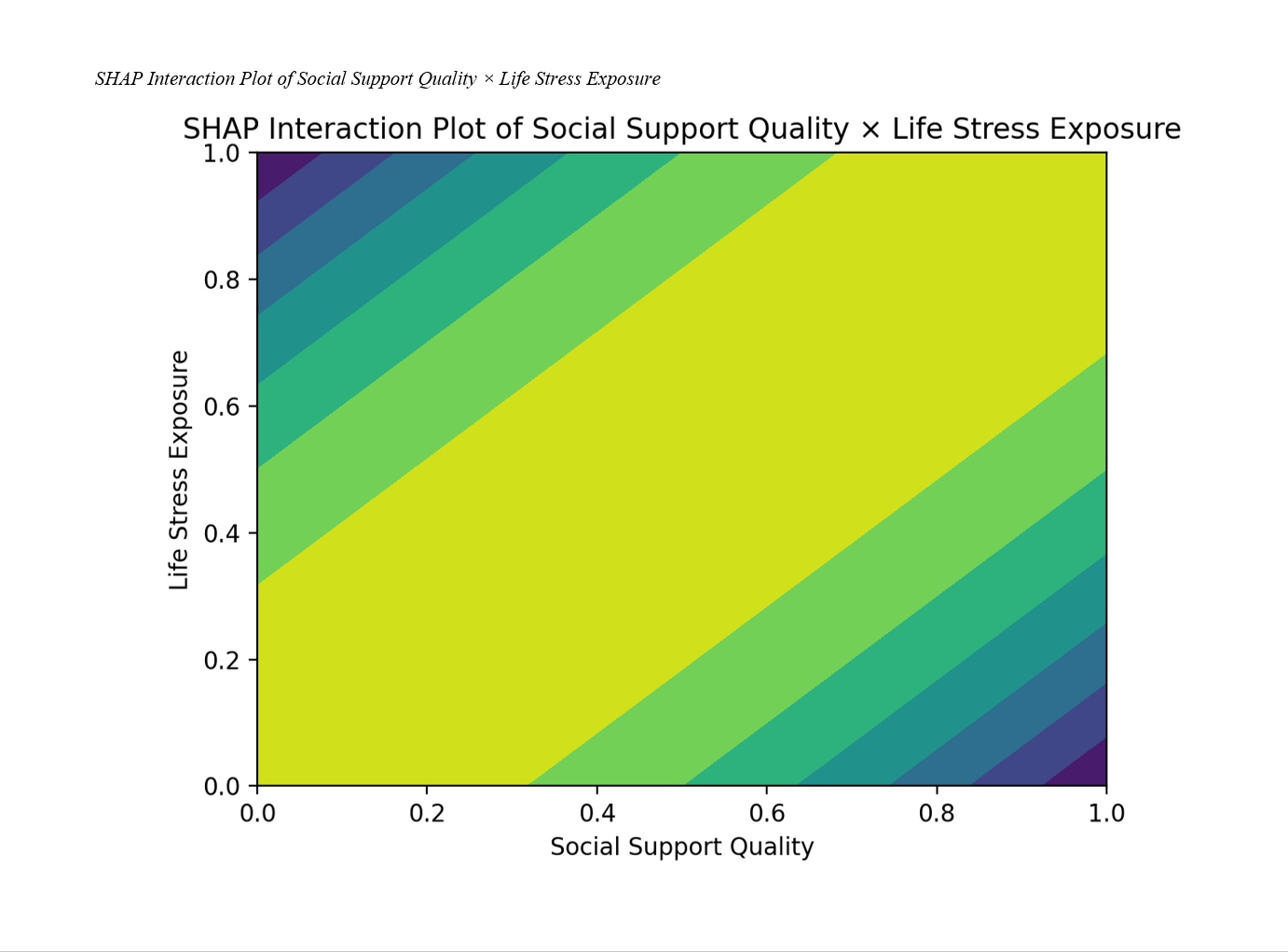
Findings: The XGBoost model demonstrated the highest predictive performance (R² = 0.76, RMSE = 0.29, MAE = 0.22). Social support quality emerged as the strongest positive predictor of psychological adjustment, followed by problem-focused coping. Life stress exposure exerted a substantial negative effect. Avoidance coping significantly predicted poorer adjustment, whereas emotion-focused coping displayed nonlinear effects depending on stress levels. Interaction analysis revealed that high social support significantly buffered the adverse effects of life stress on psychological adjustment.
Conclusion: The findings demonstrate that adolescents’ psychological adjustment is governed by complex nonlinear interactions among coping strategies, social support, and stress exposure, and that explainable artificial intelligence offers a powerful framework for modeling these processes with high predictive accuracy and theoretical transparency.
Downloads
References
Chen, T., & Lucock, M. (2022). The Mental Health of University Students During the COVID-19 Pandemic: An Online Survey in the UK. PLoS One, 17(1), e0262562. https://doi.org/10.1371/journal.pone.0262562
Cheung, D. H., Hall, C. D. X., Okantey, B., Meng, Z., Sabuncu, C., Lane, B., Millender, E., Artur Acelino Francisco Luz Nunes, Q., Kim, J. H., Okada, L., Gillespie, A., Simoncini, G., Barile, J. P., Grace, X., & Wong, F. Y. (2025). Mediating Roles of Social Support in Lives of Men Who Have Sex With Men Living With HIV. Health Psychology, 44(3), 234-246. https://doi.org/10.1037/hea0001490
Dong, P., Lin, X., Wu, F., Lou, S., Li, N., Hu, S., Shi, L., He, J., Ma, Y., Bao, Y., Lü, L., Sun, W., & Sun, H. (2023). Depression, Anxiety, and Burnout Among Psychiatrists During the COVID-19 Pandemic: A Cross-Sectional Study in Beijing, China. BMC psychiatry, 23(1). https://doi.org/10.1186/s12888-023-04969-5
García, F. E., Andrades, M., Kilmer, R. P., Rodríguez, F., Lucero, C., & Díaz, Z. (2024). Mental Health in Chilean Higher Education Students During the COVID-19 Pandemic: A Longitudinal Study. Psychological Trauma Theory Research Practice and Policy, 16(4), 559-567. https://doi.org/10.1037/tra0001363
Hellström, L., Sjöman, M., & Enskär, K. (2024). Conceptualizing Adolescents’ Everyday Stressors to Underscore Areas for Support. Frontiers in Education, 9. https://doi.org/10.3389/feduc.2024.1370791
Julian, M., Somers, J. A., Schetter, C. D., & Guardino, C. M. (2023). Resilience Resources, Life Stressors, and Postpartum Depressive Symptoms in a Community Sample of Low and Middle‐income Black, Latina, and White Mothers. Stress and Health, 40(1). https://doi.org/10.1002/smi.3275
Kaniasty, K., & Meulen, E. v. d. (2024). Impact of COVID-19 on Psychological Distress in Subsequent Stages of the Pandemic: The Role of Received Social Support. PLoS One, 19(9), e0310734. https://doi.org/10.1371/journal.pone.0310734
Maltseva, K. (2024). Stress Exposure, Perceived Stress, Protective Psychosocial Factors, and Health Status in Ukraine After the Full-Scale Invasion. Journal of Health Psychology, 29(14), 1640-1652. https://doi.org/10.1177/13591053241259728
Nuetzel, B. (2023). Coping Strategies for Handling Stress and Providing Mental Health in Elite Athletes: A Systematic Review. Frontiers in Sports and Active Living, 5. https://doi.org/10.3389/fspor.2023.1265783
Oh, W. O., Yeom, I., & Lim, S.-H. (2022). Structural Equation Model Based on Salutogenesis Theory for Evaluating Factors Affecting Health-Related Quality of Life in Adolescents With Moyamoya Disease. Scientific reports, 12(1). https://doi.org/10.1038/s41598-022-24825-y
Parviniannasab, A. M., Rakhshan, M., Momennasab, M., Soltanian, M., Rambod, M., & Akbarzadeh, M. (2022). The Mediating Role of Courageous Coping in the Relations Between Spirituality and Social Support With Resilience Among Adolescents With Hemophilia. Clinical Child Psychology and Psychiatry, 27(4), 1141-1154. https://doi.org/10.1177/13591045211055081
Rambod, M., Hamidizadeh, S., Bazrafshan, M.-R., & Parviniannasab, A. M. (2023). Risk and Protective Factors for Resilience Among Adolescents and Young Adults With Beta-Thalassemia Major. BMC psychology, 11(1). https://doi.org/10.1186/s40359-023-01268-2
Sailer, L. L., Patel, P., Park, A., Moon, J., Hanadari-Levy, A., & Ophir, A. G. (2022). Synergistic Consequences of Early-Life Social Isolation and Chronic Stress Impact Coping and Neural Mechanisms Underlying Male Prairie Vole Susceptibility and Resilience. Frontiers in Behavioral Neuroscience, 16. https://doi.org/10.3389/fnbeh.2022.931549
Segrin, C., & Cooper, R. A. (2021). The Association Between Social Adversity and Alcohol Consumption Is Moderated by Social Support. International Journal of Stress Management, 28(4), 283-294. https://doi.org/10.1037/str0000233
Sheldon, E., Simmonds‐Buckley, M., Bone, C., Mascarenhas, T. S., Chan, N., WİNcott, M., Gleeson, H., Sow, K., Hind, D., & Barkham, M. (2021). Prevalence and Risk Factors for Mental Health Problems in University Undergraduate Students: A Systematic Review With Meta-Analysis. Journal of affective disorders, 287, 282-292. https://doi.org/10.1016/j.jad.2021.03.054
Shinan‐Altman, S., Rosenne, H., Chen, W., Kaofer, H., Zeevi, S., Nir‐Paz, R., Daphna–Tekoah, S., Guttman, N., & Schiff, M. (2025). Professional Quality of Life Among Israeli Social Workers in Hospitals and a Health Maintenance Organization (HMO) During the COVID-19 Pandemic. American Journal of Orthopsychiatry, 95(4), 396-408. https://doi.org/10.1037/ort0000798
Sommer, J. L., Bolton, S. L., El‐Gabalawy, R., Afifi, T. O., Sareen, J., & Mota, N. (2024). Protective Factors for Mental Disorders Among Survivors of Military Sexual Trauma: A Canadian Population-Based Study: Facteurs De Protection Relatifs À L’apparition De Troubles Mentaux Chez Les Survivantes Et Survivants De Traumatismes Sexuels Liés Au Service Militaire : Une Étude Basée Sur La Population Canadienne. The Canadian Journal of Psychiatry, 69(11), 820-830. https://doi.org/10.1177/07067437241293977
Sun, W., Zhang, L., Chen, W. T., Arbing, R., Shen, L., Zhang, J., & Jiang, R. (2024). Perceived Stress and Coping Strategies for Frontline Nurses Caring for COVID-19 Patients: A Path Analysis. Western Journal of Nursing Research, 47(1), 15-23. https://doi.org/10.1177/01939459241296621
Sun, X., Li, B. J., Zhang, H., & Zhang, G. (2023). Social Media Use for Coping With Stress and Psychological Adjustment: A Transactional Model of Stress and Coping Perspective. Frontiers in psychology, 14. https://doi.org/10.3389/fpsyg.2023.1140312
Tian, X., Jin, Y., Chen, H., Tang, L., & Herrera, M. (2021). Relationships Among Social Support, Coping Style, Perceived Stress, and Psychological Distress in Chinese Lung Cancer Patients. Asia-Pacific Journal of Oncology Nursing, 8(2), 172-179. https://doi.org/10.4103/apjon.apjon_59_20
Varela, J. J., Pérez, J. C., Rodríguez‐Rivas, M. E., Chuecas, M. J., & Romo, J. (2023). Wellbeing, Social Media Addiction and Coping Strategies Among Chilean Adolescents During the Pandemic. Frontiers in Psychiatry, 14. https://doi.org/10.3389/fpsyt.2023.1211431
Worku, A., Tesfaw, G., & Getnet, B. (2022). Acute Stress Disorder and the Associated Factors Among Traumatized Patients Admitted at Felege-Hiwot and the University of Gondar Comprehensive Specialized Hospitals in Northwest Ethiopia. BMC psychiatry, 22(1). https://doi.org/10.1186/s12888-022-03961-9
Xu, Y., Zheng, Q. X., Jiang, X. M., Guo, S., Kang, Y., Lin, Y. P., & Liu, G. H. (2023). Effects of Coping on Nurses' Mental Health During the COVID‐19 Pandemic: Mediating Role of Social Support and Psychological Resilience. Nursing Open, 10(7), 4619-4629. https://doi.org/10.1002/nop2.1709
Downloads
Additional Files
Publication Timeline
- Submitted
- Revised
- Accepted