Explainable AI Modeling of Hope in Youth Using Feature Attribution of Optimism, Goal Orientation, and Family Support
DOI:
https://doi.org/10.61838/kman.jayps.4995Keywords:
Youth hope, optimism, goal orientation, family support, explainable artificial intelligence, feature attribution, machine learning, adolescent developmentAbstract
Objective: The objective of this study was to develop and interpret an explainable artificial intelligence model of youth hope by quantifying the individual and interactive contributions of optimism, goal orientation, and family support.
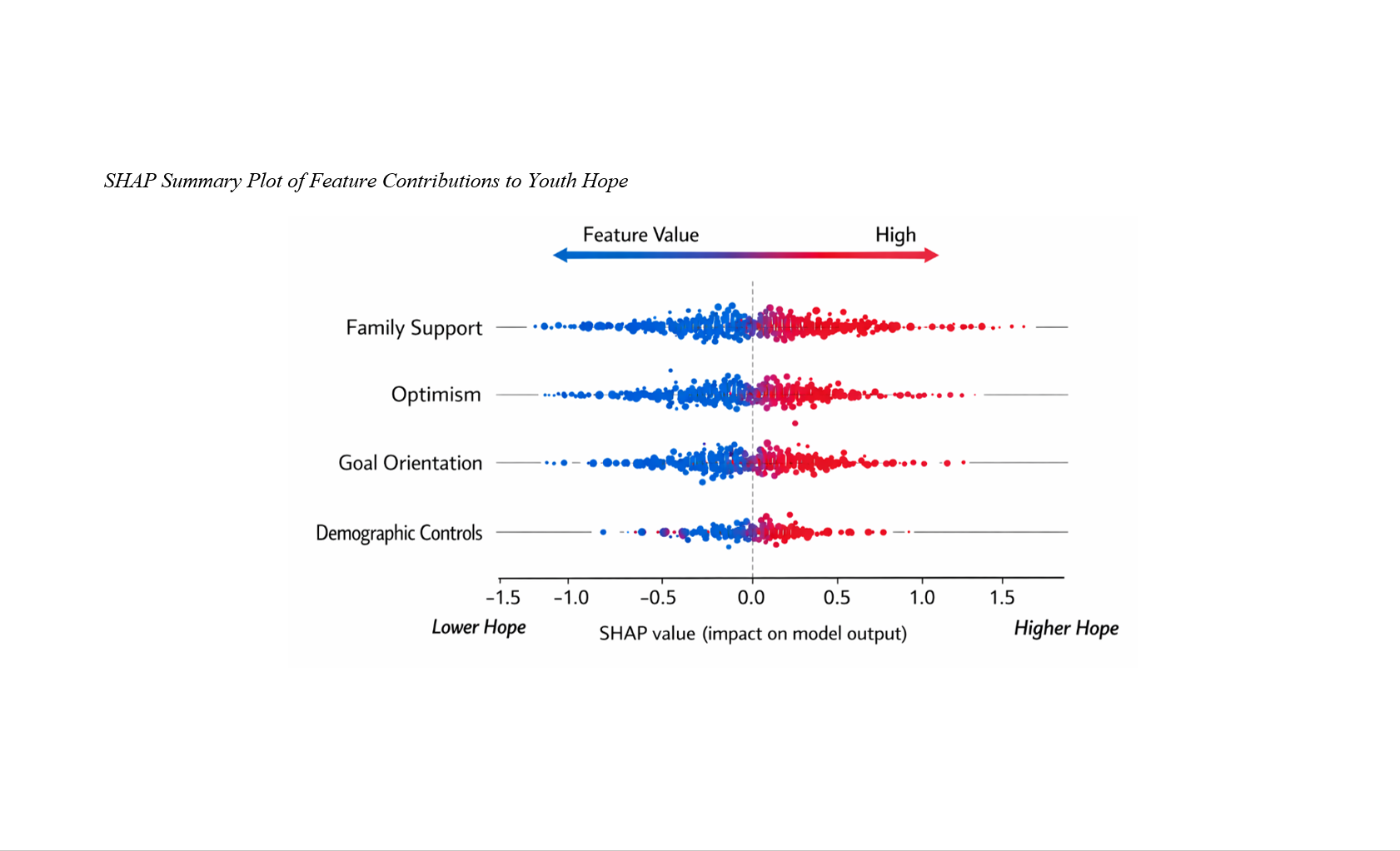
Methods and Materials: This cross-sectional study was conducted with 653 adolescents and emerging adults aged 15–24 from educational and community institutions in Georgia, United States. Participants completed standardized measures of hope, optimism, goal orientation, and perceived family support. Machine learning models including Random Forest, Gradient Boosting, and XGBoost were trained to predict hope, with model performance evaluated using cross-validation and error metrics. Explainability was achieved through SHAP and permutation-based feature attribution methods, enabling identification of global and individual predictor effects and nonlinear interactions.
Findings: The XGBoost model demonstrated the strongest predictive performance, explaining 84% of the variance in youth hope (R² = .84, RMSE = 2.19, MAE = 1.68). Feature attribution analyses indicated that family support contributed the largest proportion of predictive influence (38.6%), followed by optimism (32.1%) and goal orientation (25.3%). Significant interaction effects were observed between optimism and family support, as well as between goal orientation and family support, amplifying their combined impact on hope.
Conclusion: Youth hope is best explained as a multilevel construct arising from the integrated influence of motivational beliefs and family relational processes. Explainable AI offers a powerful methodological framework for advancing theoretical understanding and guiding personalized intervention strategies.
Downloads
References
Abreu, R. L., Martin, J. A., Hainsworth, S., Toomey, R. B., Vázquez, A., & Gattamorta, K. (2024). Radical Hope in Parents of Transgender and Gender Diverse Youth in the United States. Journal of Family Psychology, 38(6), 869-878. https://doi.org/10.1037/fam0001239
Champion, K. E., Hunter, E., Gardner, L. A., Thornton, L., Chapman, C., McCann, K., Spring, B., Slade, T., Teesson, M., & Newton, N. C. (2023). Parental Information Needs and Intervention Preferences for Preventing Multiple Lifestyle Risk Behaviors Among Adolescents: Cross-Sectional Survey Among Parents. Jmir Pediatrics and Parenting, 6, e42272. https://doi.org/10.2196/42272
Danley, W. T., Cooke, B. G., & Mizelle, N. (2025). “My Future”: A Qualitative Examination of Hope in the Lives of Black Emerging Adults. Social Sciences, 14(7), 428. https://doi.org/10.3390/socsci14070428
Guan, S., Meng, F., & Wu, C. (2025). Authoritative Filial Piety Rather Than Reciprocal Filial Piety Mediated the Relationship Between Parental Support, Career Decision Self-Efficacy, and Discrepancies Between Individual-Set and Parent-Set Career Goals. Behavioral Sciences, 15(8), 1135. https://doi.org/10.3390/bs15081135
Han, F., & Yuet Mui Celeste 袁月梅, Y. (2024). Roles of Parents in Life Satisfaction and Educational Hope Among Chinese High School Students. Frontiers in psychology, 15. https://doi.org/10.3389/fpsyg.2024.1334397
Harris, K. M., Feeken, M. C., Huntt, J. S., Fry, A. B., Seibel, L., Wolff, J. C., & Esposito‐Smythers, C. (2024). Parental Anxiety Symptoms, Parenting Confidence, and Family Functioning Following a Youth’s Hospitalization for Suicide Risk. Journal of Family Psychology, 38(8), 1170-1178. https://doi.org/10.1037/fam0001265
Hasselle, A. J., Howell, K. H., Garza, A., Thomsen, K. N., & Gilliam, H. C. (2025). A Randomized Controlled Trial Examining the Effect of Camp HOPE Tennessee on Youth Functioning: Results From a Pilot Study. Psychological Trauma Theory Research Practice and Policy, 17(4), 713-722. https://doi.org/10.1037/tra0001702
Hochgraf, A. K., Barry, M. R., Lanza, S. T., Jacobsen, M., & Neumark‐Sztainer, D. (2025). Constellations of Family Qualities and Links With Psychological and Behavioral Health in Adolescence and Young Adulthood. Journal of Child and Family Studies, 34(10), 2734-2748. https://doi.org/10.1007/s10826-025-03154-4
Hong, S. K., & Kim, C. H. (2023). A Case Study on Out-of-School Youth Withdrawal and Career Choice. Korean Association for Learner-Centered Curriculum and Instruction, 23(15), 713-726. https://doi.org/10.22251/jlcci.2023.23.15.713
Karna, W., Ahmmed, B., & Hakobyan, A. (2025). Exploring Hope and Future Orientation in Adolescents From Low-Income Communities. Jayps, 6(2), 127-135. https://doi.org/10.61838/kman.jayps.6.2.14
Li, S., Pan, Q., & Nie, Y. (2022). The Relationship Between Parental Career-Related Factors and Adolescents’ Ambivalence in Career Decision-Making: A Longitudinal Mediation Study. Journal of Career Assessment, 31(2), 262-281. https://doi.org/10.1177/10690727221107678
Lobo, F. M., Sánchez–Hernández, P., Garcia, J. L., Jones, D., Salcido, V. V., & Stein, G. L. (2025). Fostering Familial Resilience in Latinx Youth in the Context of COVID-19. Journal of Latinx Psychology, 13(3), 281-290. https://doi.org/10.1037/lat0000278
Lozano, A., Estrada, Y., Scott, D., Tapia, M. I., Santos, H. P., Carrico, A. W., Zolobczuk, J., Manker, A., & Prado, G. (2023). Familias Con Orgullo: Study Protocol for an Efficacy Study of a Family-Based Intervention for Hispanic Sexual Minority Youth. PLoS One, 18(12), e0295683. https://doi.org/10.1371/journal.pone.0295683
Makara, A., Howe, H. S., Cooper, M., Heckert, K., Weiss, S., Kellom, K., Scharf, D., Ubel, P. A., Orloff, N. C., & Timko, C. A. (2023). Modifying an Open Science Online Grocery for Parents of Youth With Anorexia Nervosa: A Proof‐of‐concept Study. International Journal of Eating Disorders, 56(5), 1011-1020. https://doi.org/10.1002/eat.23902
Møller, V., Roberts, B., & Zani, D. (2024). ‘Born Free’ Dreams: South African Township Youth Discuss Their Hopes for a Better Life in Future. Applied Research in Quality of Life, 19(4), 1681-1709. https://doi.org/10.1007/s11482-024-10303-2
Nelson, S., Smith, A., Jervis, K., Silvia, M., & Randall, E. T. (2022). Will This Treatment Help My Child? The Clinical Journal of Pain, 38(11), 651-658. https://doi.org/10.1097/ajp.0000000000001068
Singer, I., Klatte, I. S., Vries, R. d., Lugt, R. v. d., & Gerrits, E. (2022). Using Co‐design to Develop a Tool for Shared Goal‐setting With Parents in Speech and Language Therapy. International Journal of Language & Communication Disorders, 57(6), 1281-1303. https://doi.org/10.1111/1460-6984.12753
Stanek, C., Theroux, C. I., Olsavsky, A. L., Hill, K. N., Rausch, J. R., O’Brien, S. H., Quinn, G. P., Gerhardt, C. A., & Nahata, L. (2022). Study Protocol for Fertility Preservation Discussions and Decisions: A Family-Centered Psychoeducational Intervention for Male Adolescents and Emerging Adults Newly Diagnosed With Cancer and Their Families. PLoS One, 17(2), e0263886. https://doi.org/10.1371/journal.pone.0263886
Suarez‐Balcazar, Y., Balcázar, F. E., Torres, M. G., Garcia, C., & Arias, D. (2022). Goal Setting With Latinx Families of Children With Intellectual and Developmental Disabilities: Case Studies. Behavior and Social Issues, 31(1), 194-214. https://doi.org/10.1007/s42822-022-00094-2
Sulimani‐Aidan, Y., & Melkman, E. (2022). School Belonging and Hope Among At‐risk Youth: The Contribution of Academic Support Provided by Youths' Social Support Networks. Child & Family Social Work, 27(4), 700-710. https://doi.org/10.1111/cfs.12918
Zhou, N. (2024). Perceived Parental Career Expectation and Adolescent Career Development: The Mediating Role of Adolescent Career-Planning and Goal-Setting Self-Efficacy and the Moderating Role of Perceived Parent–adolescent Career Congruence. Journal of counseling psychology, 71(6), 621-632. https://doi.org/10.1037/cou0000736
Zhou, Y.-B., Bu, Y., Ruan, S.-J., & Bao, Q. (2025). When Exhaustion Becomes Control: Parental Burnout, Psychological Intrusion, and the Resilience of Adolescents. https://doi.org/10.21203/rs.3.rs-6893715/v1
Downloads
Additional Files
Publication Timeline
- Submitted
- Revised
- Accepted