The Structural Model of Identity Instability Based on Object Relations and Childhood Trauma with the Mediating Role of Mental Pain
DOI:
https://doi.org/10.61838/kman.jayps.5031Keywords:
identity instability, object relations, childhood trauma, mental pain, self-injurious behaviorAbstract
Objective: This study aimed to examine a structural model in which adverse childhood experiences and relational disturbances predict self-injurious behaviors through the mediating roles of identity diffusion and psychological pain in adolescents.
Methods and Materials: The study employed a descriptive–correlational design using structural equation modeling. Participants were adolescents who completed standardized self-report measures assessing adverse childhood experiences, relational disturbances, identity diffusion, psychological pain, and self-injurious behaviors. Data were analyzed using confirmatory factor analysis to evaluate the measurement model, followed by structural equation modeling to test direct and indirect pathways among variables. Model fit was assessed using multiple goodness-of-fit indices, and indirect effects were examined to determine the mediating roles of identity diffusion and psychological pain.
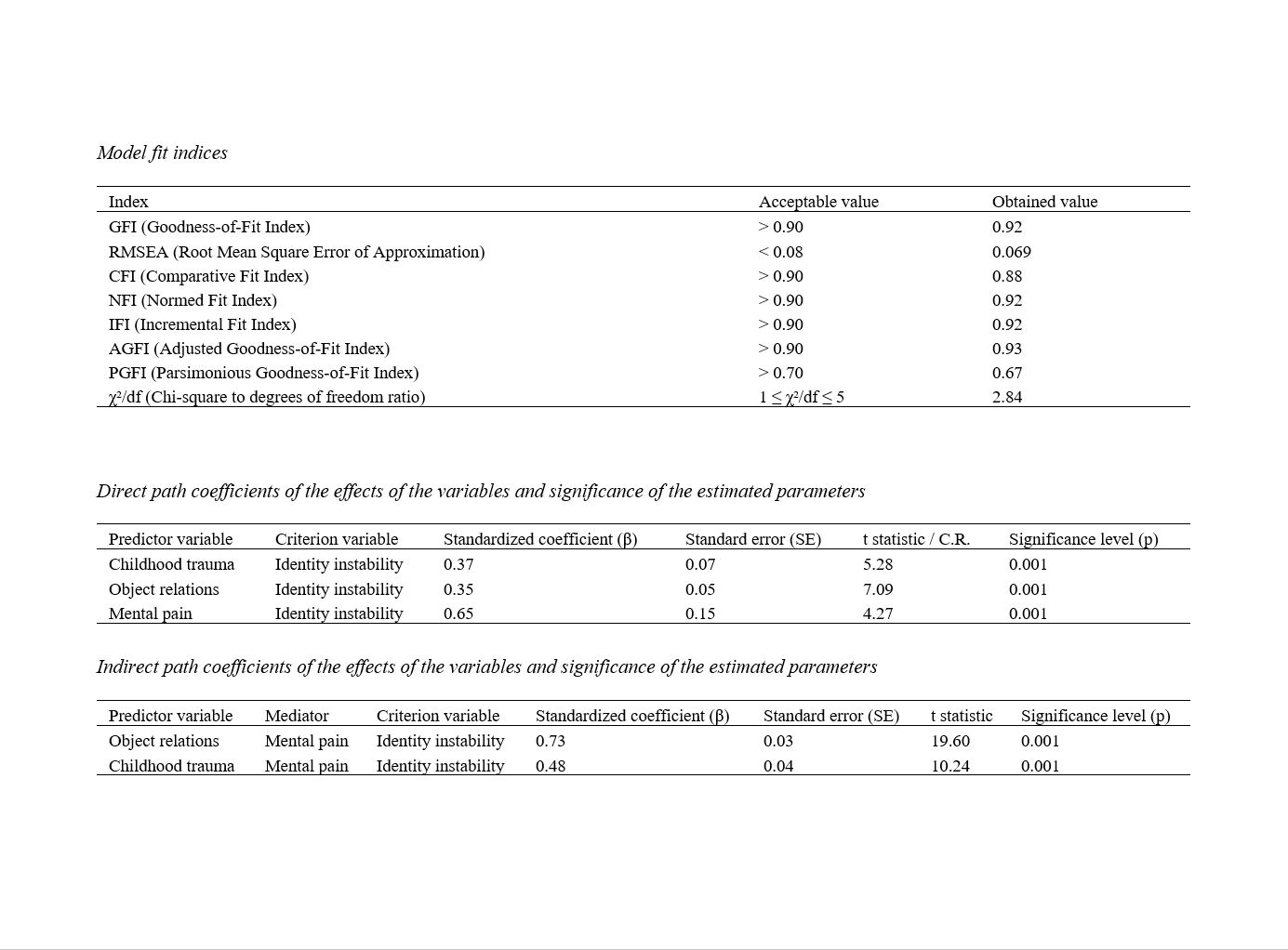
Findings: The results indicated that adverse childhood experiences and relational disturbances had significant positive effects on identity diffusion and psychological pain. Identity diffusion was a significant predictor of psychological pain, and psychological pain showed a strong direct effect on self-injurious behaviors. Indirect pathway analyses revealed that the effects of early relational adversity on self-injury were partially mediated by identity diffusion and psychological pain. The overall structural model demonstrated acceptable fit indices and substantial explanatory power for self-injurious behaviors.
Conclusion: The findings support a developmental–relational model of adolescent self-injury in which early adversity and relational disruptions contribute to identity fragmentation and psychological pain, thereby increasing vulnerability to self-injurious behaviors, highlighting the importance of addressing internal suffering and identity processes in prevention and intervention efforts.
Downloads
References
Aggarwal, S., Borschmann, R., & Patton, G. C. (2021). Tackling stigma in self-harm and suicide in the young. The Lancet Public Health, 6(1), e6-e7. https://doi.org/10.1016/S2468-2667(20)30259-0
Alves, M. I., Dias Junior, S. A., Martins, T., Felipe, A. O. B., Freitas, P. S., & Moreira, D. S. (2025). The relationship between excessive screen time, self-harm, and suicidal behavior in adolescents during the COVID-19 pandemic: An integrative literature review. Journal of Child and Adolescent Psychiatric Nursing, 38(2), e70015. https://doi.org/10.1111/jcap.70015
Bernstein, D. P., Stein, J. A., Newcomb, M. D., Walker, E., Pogge, D., Ahluvalia, T., & Zule, W. (2003). Development and validation of a brief screening version of the Childhood Trauma Questionnaire. Child abuse & neglect, 27(2), 169-190. https://doi.org/10.1016/S0145-2134(02)00541-0
Cassell, E. J. (1999). Diagnosing suffering: a perspective. Annals of Internal Medicine, 131(7), 531-534. https://doi.org/10.7326/0003-4819-131-7-199910050-00009
García-Iglesias, J. J., Gómez-Salgado, J., Fernández-Carrasco, F. J., Rodríguez-Díaz, L., Vázquez-Lara, J. M., Prieto-Callejero, B., & Allande-Cussó, R. (2022). Suicidal ideation and suicide attempts in healthcare professionals during the COVID-19 pandemic: A systematic review. Frontiers in Public Health, 10, 1043216. https://doi.org/10.3389/fpubh.2022.1043216
Glenn, C. R., Kleiman, E. M., Kellerman, J., Pollak, O., Cha, C. B., Esposito, E. C., Porter, A. C., Wyman, P. A., & Boatman, A. E. (2020). Annual Research Review: A meta-analytic review of worldwide suicide rates in adolescents. Journal of Child Psychology and Psychiatry, 61(3), 294-308. https://doi.org/10.1111/jcpp.13106
González-Arrimada, A., Martínez, R., & López, M. (2025). Lifestyle habits, problem behaviors, and non-suicidal self-injury in adolescents: A systematic review and meta-analysis. Child and Adolescent Social Work Journal, 42(1), 257-273. https://link.springer.com/article/10.1007/s40894-025-00257-3
Jiaa, H., & Lubetkin, E. I. (2020). Impact of adverse childhood experiences on quality-adjusted life expectancy in the U.S. population. Child abuse & neglect, 102, 104418. https://doi.org/10.1016/j.chiabu.2020.104418
Klifto, C. S., Lavery, J. A., Gold, H. T., Milone, M. T., Karia, R., Palusci, V., & Chu, A. (2020). Pediatric Fingertip Injuries: Association With Child Abuse. Journal of Hand Surgery Global Online, 2, 31-34. https://doi.org/10.1016/j.jhsg.2019.09.001
Nikousaft, Z., & Gharehbaghi, F. (2020). The moderating and mediating role of ego strength in the relationship between object relations and identity statuses in university students. Clinical and Personality Psychology, 18(2), 109-118. https://cpap.shahed.ac.ir/article_3228.html?lang=en
Orbach, I., Mikulincer, M., Sirota, P., & Gilboa-Schechtman, E. (2003). Mental pain: A multidimensional operationalization and definition. Suicide Life Threatening Behavior, 33(3), 219-230. https://doi.org/10.1521/suli.33.3.219.23219
Orben, A., Tomova, L., & Blakemore, S. J. (2020). The effects of social deprivation on adolescent development and mental health. The Lancet Child & Adolescent Health, 4(8), 634-640. https://doi.org/10.1016/S2352-4642(20)30186-3
Pompili, M., Girardi, P., Ruberto, A., & Tatarelli, R. (2018). Suicide in borderline personality disorder: A meta-analysis. Nordic journal of psychiatry, 62(4), 319-324. https://doi.org/10.1080/08039480500320025
Shehdadian, V., Golshani, F., & Baghdasarians, A. (2024). The mediating role of psychological pain in the relationship between coherent self-knowledge and self-injurious behaviors in adolescents. Royesh-e Psychology, 13(7), 101-110. https://frooyesh.ir/browse.php?a_id=5654&sid=1&slc_lang=en
Sun, J., Ban, Y., & Liu, J. (2024). Relationship between bullying victimization and suicide ideation among Chinese adolescents: A moderated chain mediation model. Children and Youth Services Review, 156, 107304. https://doi.org/10.1016/j.childyouth.2023.107304
Timpano, K. R., & Port, J. H. (2021). Object attachment and emotion (Dys)regulation across development and clinical populations. Current opinion in psychology, 39, 109-114. https://doi.org/10.1016/j.copsyc.2020.08.013
Valladares-Garrido, D., Zila-Velasque, J. P., Santander-Hernández, F. M., Guevara-Morales, M. A., Morocho-Alburqueque, N., Failoc-Rojas, V. E., Pereira-Victorio, C. J., Vera-Ponce, V. J., León-Figueroa, D. A., & Valladares-Garrido, M. J. (2023). Association between Love Breakup and Suicidal Ideation in Peruvian Medical Students: A Cross-Sectional Study during the COVID-19 Pandemic. Research Square, 3, 3085268. https://doi.org/10.21203/rs.3.rs-3085268/v1
Veloso-Besio, C., Cuadra-Peralta, A., Gallardo-Peralta, L., Cuadra-Fernandez, P., Quiroz, P. T., & Troncoso, N. V. (2023). The prevalence of suicide attempt and suicidal ideation and its relationship with aggression and bullying in Chilean adolescents. Frontiers in psychology, 14, 1133916. https://doi.org/10.3389/fpsyg.2023.1133916
Waterman, A. S. (2020). "Now what do I do?": Toward a conceptual understanding of the effects of traumatic events on identity functioning. Journal of adolescence, 79, 59-69. https://doi.org/10.1016/j.adolescence.2019.11.005
Wheeler, S. C., & Bechler, C. J. (2021). Objects and self-identity. Current opinion in psychology, 39, 6-11. https://doi.org/10.1016/j.copsyc.2020.07.013
Downloads
Additional Files
Publication Timeline
- Submitted
- Revised
- Accepted