Structural Equation Modeling of Intolerance of Uncertainty and Anxiety Sensitivity in Early Adolescence
DOI:
https://doi.org/10.61838/kman.jayps.5084Keywords:
Intolerance of Uncertainty, Anxiety Sensitivity, Early Adolescence, Structural Equation Modeling, Cognitive VulnerabilityAbstract
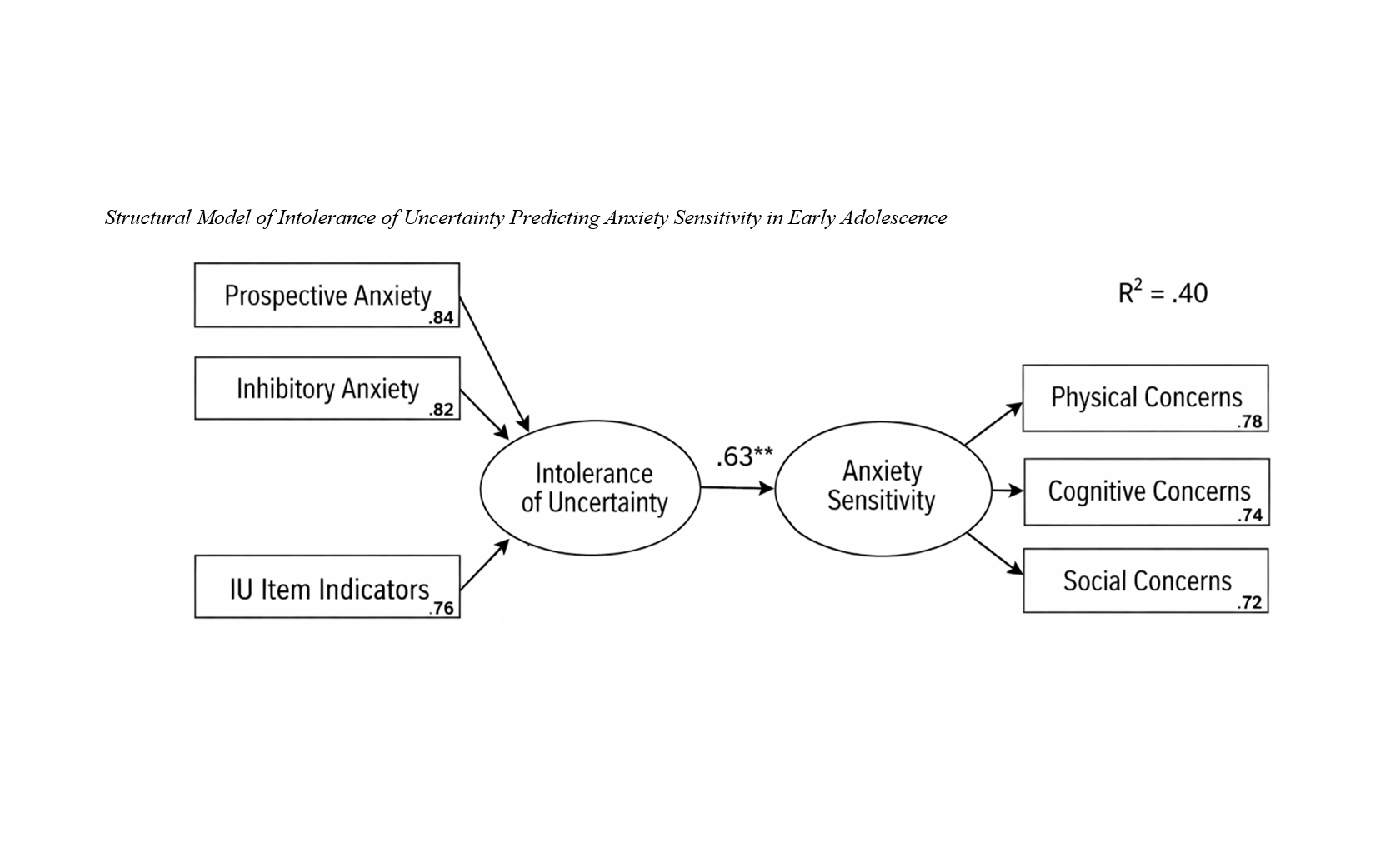
Objective: The present study aimed to examine, through structural equation modeling, the direct predictive effect of intolerance of uncertainty on anxiety sensitivity among early adolescents.
Methods and Materials: This quantitative cross-sectional study was conducted with a sample of 428 early adolescents aged 11 to 14 years enrolled in public middle schools in Turkey. Participants were selected using multistage cluster sampling from urban districts representing middle socioeconomic status. Data were collected using standardized self-report measures assessing intolerance of uncertainty and anxiety sensitivity, both of which demonstrated satisfactory internal consistency in the present sample. After preliminary screening for missing data, normality, and outliers, confirmatory factor analyses were conducted to validate the measurement models. Structural equation modeling with maximum likelihood estimation was then employed to test the hypothesized direct path from intolerance of uncertainty to anxiety sensitivity. Model fit was evaluated using multiple goodness-of-fit indices, including chi-square to degrees of freedom ratio, Comparative Fit Index, Tucker–Lewis Index, Root Mean Square Error of Approximation, and Standardized Root Mean Square Residual.
Findings: The measurement models demonstrated acceptable to good fit indices, confirming the adequacy of the latent constructs. The structural model also showed satisfactory fit to the data. Intolerance of uncertainty significantly and positively predicted anxiety sensitivity (β = .63, p < .001). The model explained 40 percent of the variance in anxiety sensitivity, indicating a substantial effect size. All standardized factor loadings were statistically significant and within acceptable ranges, supporting the reliability of the latent structure.
Conclusion: The findings indicate that intolerance of uncertainty functions as a strong cognitive vulnerability factor predicting anxiety sensitivity in early adolescence. These results support transdiagnostic models of anxiety and highlight the importance of targeting intolerance of uncertainty in early preventive and intervention efforts aimed at reducing anxiety-related sensitivity and emotional distress during adolescence.
Downloads
References
Bahadir, O., & Dündar, C. (2024). The Impact of Online Health Information Source Preference on Intolerance to Uncertainty and Cyberchondria in a Youthful Generation. Indian Journal of Psychiatry, 66(4), 360-366. https://doi.org/10.4103/indianjpsychiatry.indianjpsychiatry_715_23
Bijsterbosch, J. M., Hasenack, B., Rooijen, B. v., Sternheim, L., Boelen, P. A., Dijkerman, H. C., & Keizer, A. (2023). Intolerable Feelings of Uncertainty Within the Body: Associations Between Interoceptive Awareness, Intolerance of Uncertainty, and Body Dissatisfaction. Journal of adolescence, 95(8), 1678-1688. https://doi.org/10.1002/jad.12237
Bijsterbosch, J. M., Keizer, A., Boelen, P. A., Danner, U. N., & Sternheim, L. (2021). How Deep Is Your Thought? The Relations Between Intolerance of Uncertainty, Worry and Weight and Shape Concerns in Adolescent Girls With Anorexia Nervosa. https://doi.org/10.21203/rs.3.rs-882669/v1
Bottesi, G., Iannattone, S., Carraro, E., & Lauriola, M. (2022). The Assessment of Intolerance of Uncertainty in Youth: An Examination of the Intolerance of Uncertainty Scale-Revised in Italian Nonclinical Boys and Girls. Research on Child and Adolescent Psychopathology, 51(2), 209-222. https://doi.org/10.1007/s10802-022-00944-y
Clauss, K., Houtsma, C., Shapiro, M. O., McDermott, M. J., Macia, K. S., Franklin, C. L., & Raines, A. M. (2024). Anxiety Sensitivity and Intolerance of Uncertainty Among Veterans With Subthreshold Versus Threshold PTSD. Traumatology an International Journal, 30(3), 274-278. https://doi.org/10.1037/trm0000437
Daniels, S. (2025). A Single Session Online Training Reduces Intolerance of Uncertainty and Improves Mental Health in Emerging Adults. Psychological medicine, 55. https://doi.org/10.1017/s0033291725102419
DeSerisy, M., Musial, A., Comer, J. S., & Roy, A. K. (2020). Functional Connectivity of the Anterior Insula Associated With Intolerance of Uncertainty in Youth. Cognitive Affective & Behavioral Neuroscience, 20(3), 493-502. https://doi.org/10.3758/s13415-020-00780-x
Dorčić, T. M., Živčić–Bećirević, I., & Smojver‐Ažić, S. (2023). Anxiety in Early Adolescents During the Covid-19 Pandemic. European Journal of Psychology Open, 82(2), 45-55. https://doi.org/10.1024/2673-8627/a000035
Flynt, S., Cho, G. Y., Koscinski, B., Accorso, C., Knapp, A. A., Gorka, S. M., Suhr, J. A., Austin, M. J., & Allan, N. P. (2025). A One-Arm Pilot Trial of a Telehealth CBT-based Group Intervention Targeting Transdiagnostic Risk for Emotional Distress. PLoS One, 20(6), e0303131. https://doi.org/10.1371/journal.pone.0303131
Genç, A. B. (2024). The Mediating Role of Cognitive Flexibility in the Relationship Between Intolerance of Uncertainty and Subjective Well-Being in High School Students During the COVID 19 Pandemic. Türk Psikolojik Danışma Ve Rehberlik Dergisi, 14(72), 89-99. https://doi.org/10.17066/tpdrd.1311383_7
Goyal, D., & Sharma, U. (2022). Emotion, Cognition, and COVID-19: A Study Exploring the Association Between Fear of COVID-19 Intolerance of Uncertainty and Decision-Making in Indian Adolescents. Journal of Indian Association for Child and Adolescent Mental Health, 18(1), 92-99. https://doi.org/10.1177/09731342221096479
Hirsig, A., Häfeli, X. A., & Schmidt, S. J. (2024a). Efficacy of a Transdiagnostic Internet Prevention Approach in Adolescents (EMPATIA-Study): Study Protocol of a Randomized Controlled Trial. https://doi.org/10.21203/rs.3.rs-4188992/v1
Hirsig, A., Häfeli, X. A., & Schmidt, S. J. (2024b). Efficacy of a Transdiagnostic Internet Prevention Approach in Adolescents (EMPATIA Study): Study Protocol of a Randomized Controlled Trial. Trials, 25(1). https://doi.org/10.1186/s13063-024-08241-3
Jing, Z., Feng-qin, D., Sun, Y., Zhang, S., & Li, N. (2023). Comparing Depression Prevalence and Associated Symptoms With Intolerance of Uncertainty Among Chinese Urban and Rural Adolescents: A Network Analysis. Behavioral Sciences, 13(8), 662. https://doi.org/10.3390/bs13080662
Johnson, M., & Saunderson, H. (2023). Examining the Relationship Between Anxiety and Pathological Demand Avoidance in Adults: A Mixed Methods Approach. Frontiers in Education, 8. https://doi.org/10.3389/feduc.2023.1179015
Jungmann, S. M., & Dessauer, E. (2024). What Are You Googling? A Population-Based Survey on Health-Related Internet Use and Cyberchondria in Adolescents (Preprint). Journal of medical Internet research. https://doi.org/10.2196/65792
Li, Q., Luo, R., Zhang, X., Meng, G., Dai, B., & Liu, X. (2021). Intolerance of COVID-19-Related Uncertainty and Negative Emotions Among Chinese Adolescents: A Moderated Mediation Model of Risk Perception, Social Exclusion and Perceived Efficacy. International journal of environmental research and public health, 18(6), 2864. https://doi.org/10.3390/ijerph18062864
Llewelyn-Williams, J., Oliver, A., Wright, K. D., Runalls, S., Lahti, D. S., Bradley, T. J., Kakadekar, A., Pharis, S., Pockett, C., Erlandson, M., & Tomczak, C. R. (2022). Health Anxiety and Associated Constructs in School-Age Children and Adolescents With Congenital Heart Disease and Their Parents: A Children’s Healthy-Heart Activity Monitoring Program in Saskatchewan Cohort Study. Journal of Child Health Care, 27(3), 450-465. https://doi.org/10.1177/13674935221075896
MacLennan, K., Rossow, T., & Tavassoli, T. (2021). The Relationship Between Sensory Reactivity, Intolerance of Uncertainty and Anxiety Subtypes in Preschool-Age Autistic Children. Autism, 25(8), 2305-2316. https://doi.org/10.1177/13623613211016110
Malerba, A., Iannattone, S., Casano, G., Lauriola, M., & Bottesi, G. (2022). The Trap of the COVID-19 Pandemic: Italian Adolescents Fare Well at First, Maybe Thanks to Protective Trait Expression. Children, 9(11), 1631. https://doi.org/10.3390/children9111631
Moreno-Mansilla, S., Ricarte, J. J., & Hallford, D. J. (2021). Cannabis Use Among Early Adolescents and Transdiagnostic Mental Health Risk Factors. Clinical Child Psychology and Psychiatry, 26(2), 531-543. https://doi.org/10.1177/1359104521994637
Morillo‐Sarto, H., Torres‐Vallejos, J., Supervía, P. U., Barrada, J. R., & Juarros‐Basterretxea, J. (2025). The Impact of Social Media Disorder, Family Functioning, and Community Social Disorder on Adolescents’ Psychological Distress: The Mediating Role of Intolerance to Uncertainty. Children, 12(7), 861. https://doi.org/10.3390/children12070861
Okayama, S., Minihan, S., Andrews, J. L., Daniels, S., Grunewald, K., Richards, M., Wang, W., Hasan, Y., & Schweizer, S. (2023). Intolerance of Uncertainty and Psychological Flexibility as Predictors of Mental Health From Adolescence to Old Age. https://doi.org/10.21203/rs.3.rs-3531004/v1
Olino, T. M., Case, J. A., Hawes, M. T., Szenczy, A. K., Nelson, B. D., & Klein, D. N. (2021). Testing Invariance of Measures of Internalizing Symptoms Before and After a Major Life Stressor: The Impact of COVID-19 in an Adolescent and Young Adult Sample. Assessment, 29(7), 1371-1380. https://doi.org/10.1177/10731911211015315
Panarello, B., & Bukowski, W. M. (2021). Young Adolescent Experiences With the Intolerance of Uncertainty, Worry, and Anxious Arousal Across Contexts. Canadian Journal of Behavioural Science/Revue canadienne des sciences du comportement, 53(4), 514-521. https://doi.org/10.1037/cbs0000262
Pickard, H., Hirsch, C. R., Simonoff, E., & Happé, F. (2020). Exploring the Cognitive, Emotional and Sensory Correlates of Social Anxiety in Autistic and Neurotypical Adolescents. Journal of Child Psychology and Psychiatry, 61(12), 1317-1327. https://doi.org/10.1111/jcpp.13214
Reginadita, Z. S., Hidajat, H. G., & Farida, I. A. (2025). Intolerance of Uncertainty in Children and Adolescents: Developmental Trends and Implications a Systematic Literature Review. Formosa Journal of Multidisciplinary Research, 4(4), 1549-1564. https://doi.org/10.55927/fjmr.v4i4.135
Richdale, A. L., Lawson, L. P., Chalmers, A., Uljarević, M., Morris, E., Arnold, S. R. C., & Trollor, J. N. (2023). Pathways to Anxiety and Depression in Autistic Adolescents and Adults. Depression and Anxiety, 2023, 1-12. https://doi.org/10.1155/2023/5575932
Sandín, B., Espinosa, V., Valiente, R. M., García-Escalera, J., Schmitt, J. C., Arnáez, S., & Chorot, P. (2021). Effects of Coronavirus Fears on Anxiety and Depressive Disorder Symptoms in Clinical and Subclinical Adolescents: The Role of Negative Affect, Intolerance of Uncertainty, and Emotion Regulation Strategies. Frontiers in psychology, 12. https://doi.org/10.3389/fpsyg.2021.716528
Shipp, L., Leigh, E., Laverton, A., Percy, R., & Waite, P. (2024). Cognitive Processes in Adolescents With Generalised Anxiety Disorder: Exploring Intolerance of Uncertainty, Cognitive Avoidance, and Positive Beliefs About Worry. https://doi.org/10.31219/osf.io/hua6q
Shipp, L., Leigh, E., Laverton, A., Percy, R., & Waite, P. (2025). Cognitive Aspects of Generalised Anxiety Disorder in Adolescents: Exploring Intolerance of Uncertainty, Cognitive Avoidance, and Positive Beliefs About Worry. Child Psychiatry & Human Development. https://doi.org/10.1007/s10578-025-01809-3
Şimşek, M. K. (2023). Investigating the Relationships Between Obsessive Compulsive Symptoms (OCS) and Depression Symptoms and Intolerance of Uncertainty in Turkish Adolescents During Covid-19. Acta Educationis Generalis, 13(3), 98-114. https://doi.org/10.2478/atd-2023-0024
Therriault, D., Lane, J., Houle, A. A., Dupuis, A., Gosselin, P., Thibault, I., Dionne, P., Morin, P., & Dufour, M. (2022). Effects of the HORS‐PISTE Universal Anxiety Prevention Program Measured According to Initial Level of Student Problems. Psychology in the Schools, 60(4), 1299-1318. https://doi.org/10.1002/pits.22836
Türk, F., & Hamamcı, Z. (2025). The Turkish Adaptation and Psychometric Characteristics of the Intolerance of Uncertainty Index-a for Children. Bulletin of the Menninger clinic, 89(2), 134-153. https://doi.org/10.1521/bumc.2025.89.2.134
Viteri, C., & Mokoena, T. (2025). Childhood Adversity and Adolescent Anxiety: The Role of Intolerance of Uncertainty as a Mediator. Jayps, 6(5), 1-9. https://doi.org/10.61838/kman.jayps.6.5.17
Wu, J., Wang, C., Zheng, Y., Han, X., Guo, J., Cui, Y., Hu, J., Lin, M. P., & You, J. (2025). Intolerance of Uncertainty Predicts Suicidal Ideation Among Adolescents Through Maladaptive Cognitive Emotion Regulation Strategies and Psychache. Suicide and Life-Threatening Behavior, 55(2). https://doi.org/10.1111/sltb.70001
Xie, Z. (2025). Developmental Trajectories of Adolescent Problematic Mobile Phone Use and Their Longitudinal Associations With Intolerance of Uncertainty and Distress Tolerance: The Moderating Role of Early‐life Environmental Unpredictability. Journal of Research on Adolescence, 35(4). https://doi.org/10.1111/jora.70092
Yao, Z., Pang, L., Jin, X., Shi, S., & Min, O. (2023). The Relationship Between Social Anxiety and Self-Injury of Junior High School Students: Mediation by Intolerance of Uncertainty and Moderation by Self-Esteem. Frontiers in Public Health, 11. https://doi.org/10.3389/fpubh.2023.1046729
Ye, H., Li, Y., Huang, Y., Zhang, Y., Zhang, J., Wang, J., Liu, K., Yao, Y., Shi, X., Liu, Y., & Fan, F. (2025). Bidirectional Relationships Between Intolerance of Uncertainty and Generalized Anxiety Among Adolescents: Insights From Cross-Lagged Panel Network Analysis. Child and adolescent psychiatry and mental health, 19(1). https://doi.org/10.1186/s13034-025-00912-6
Zdebik, M. A., Pascuzzo, K., Bureau, J. F., & Moss, E. (2022). Childhood Behavioral Inhibition and Attachment: Links to Generalized Anxiety Disorder in Young Adulthood. Frontiers in psychology, 13. https://doi.org/10.3389/fpsyg.2022.933213
Downloads
Additional Files
Publication Timeline
- Submitted
- Revised
- Accepted