Explainable Boosting Models of Attachment Insecurity and Digital Dependency in Adolescents
DOI:
https://doi.org/10.61838/kman.jayps.5088Keywords:
Attachment anxiety, attachment avoidance, digital dependency, adolescents, explainable boosting machines, problematic smartphone useAbstract
Objective: The present study aimed to develop and interpret explainable machine learning models examining the nonlinear and interactive associations between attachment insecurity dimensions and digital dependency among adolescents.
Methods and Materials: This cross-sectional quantitative study was conducted among 742 secondary school adolescents aged 13–18 years recruited through multistage cluster sampling from urban regions. Participants completed standardized self-report measures assessing attachment anxiety and attachment avoidance, digital dependency, and demographic variables including daily screen time. Data were analyzed using Explainable Boosting Machines (EBMs), a transparent generalized additive modeling approach enhanced with gradient boosting. The dataset was divided into training and testing subsets, and model performance was evaluated using R², RMSE, and MAE indices. Five-fold cross-validation was implemented to optimize hyperparameters. Global feature importance scores, partial dependence functions, and interaction analyses were generated to examine nonlinear thresholds and synergistic risk patterns.
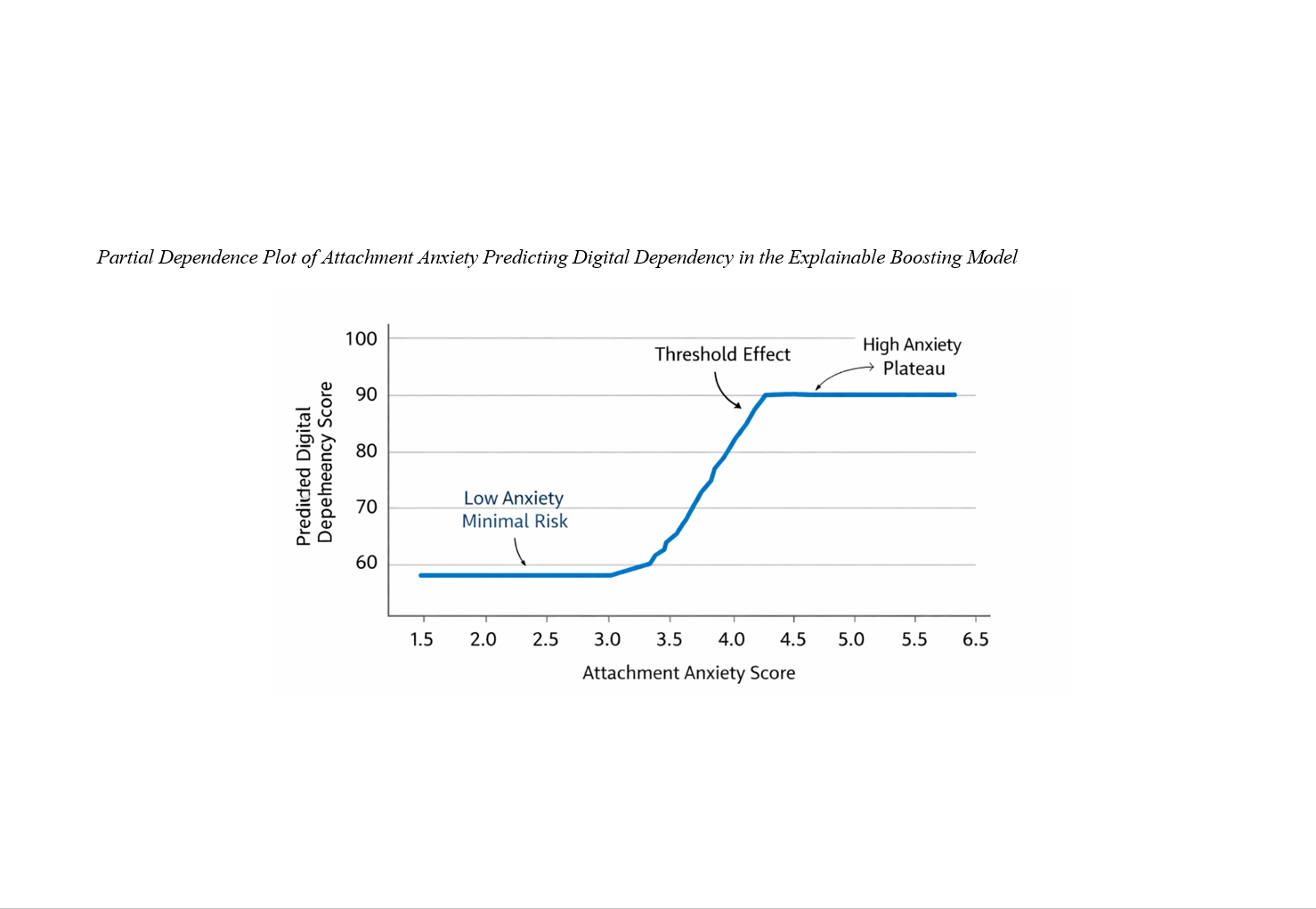
Findings: The EBM model explained a substantial proportion of variance in digital dependency scores (R² = 0.47) with satisfactory predictive accuracy. Attachment anxiety emerged as a strong psychological predictor, demonstrating a nonlinear threshold effect in which digital dependency increased sharply at moderate levels of anxiety and plateaued at very high levels. Attachment avoidance showed a weaker but significant positive association with digital dependency, characterized by a gradual linear trend. Daily screen time was the most influential predictor overall, and a significant interaction effect was identified between attachment anxiety and screen time, indicating amplified dependency risk among adolescents high on both variables.
Conclusion: The findings underscore the central role of attachment insecurity—particularly attachment anxiety—in shaping adolescents’ vulnerability to digital dependency and demonstrate the utility of explainable machine learning approaches for identifying nonlinear developmental risk patterns.
Downloads
References
Abiddin, N. R. Z., Maidin, A., & Hamzah, M. (2024). Assessing Youth Dependency on Social Media: An Analytical Study. International Journal of Research and Innovation in Social Science, VIII(X), 3329-3333. https://doi.org/10.47772/ijriss.2024.8100281
Ambhore, A. (2025). Gen-Z Challenges and Problems: A Research Review Study. International Journal for Multidisciplinary Research, 7(6). https://doi.org/10.36948/ijfmr.2025.v07i06.61228
Baker, W. L. (2023). Schools and Food Charity in England. British Educational Research Journal, 49(6), 1387-1402. https://doi.org/10.1002/berj.3931
Cao, Y., Zhang, H., Cao, X., & Wang, D. (2025). General Attachment and Behavioral Problem Among Chinese Adolescents: A Serial Multiple Mediation Model. Frontiers in psychology, 16. https://doi.org/10.3389/fpsyg.2025.1621111
Chen, H., & Zhang, H. (2023). COVID-19 Victimization Experience and University Students’ Smartphone Addiction: The Mediating Role of Emotional Intelligence. BMC public health, 23(1). https://doi.org/10.1186/s12889-023-16355-7
Chen, J., Li, S., & Nie, Y. (2024). Parent-Adolescent Conflict and Problematic Internet Use Among Chinese Adolescents: The Mediating Role of Depression and the Moderating Role of School Climate. BMC psychology, 12(1). https://doi.org/10.1186/s40359-024-01781-y
Eichenberg, C., Schott, M., & Schroiff, A. (2021). Problematic Smartphone Use—Comparison of Students With and Without Problematic Smartphone Use in Light of Personality. Frontiers in Psychiatry, 11. https://doi.org/10.3389/fpsyt.2020.599241
Gallegos, D., Eivers, A., Sondergeld, P., & Pattinson, C. (2021). Food Insecurity and Child Development: A State-of-the-Art Review. International journal of environmental research and public health, 18(17), 8990. https://doi.org/10.3390/ijerph18178990
Hodge, D. R., & Gebler-Wolfe, M. (2022). Understanding Technology’s Impact on Youth: Attachment Theory as a Framework for Conceptualizing Adolescents’ Relationship With Their Mobile Devices. Children & Schools, 44(3), 153-162. https://doi.org/10.1093/cs/cdac007
Hromková, M. (2020). Children in Social Work – Selected Problems of Social Work With Children Across the Europe. https://doi.org/10.31262/978-80-568-0309-7/2020
Izdebski, Z., Kozakiewicz, A., Michniewicz, S., Białorudzki, M., & Mazur, J. (2023). Quality of Communication With Patients and Difficulties in Close Relationships Among Health Care Workers During the COVID-19 Pandemic. Journal of Health Inequalities, 9(1), 29-36. https://doi.org/10.5114/jhi.2023.127535
Jasper, L., Bischoff, H., & Eichenberg, C. (2024). Relationship Between Attachment Anxiety and Attachment Avoidance, Mentalization Ability, and Various Digital Addictions: A Cross-Sectional Study Among University Students (Preprint). https://doi.org/10.2196/preprints.68194
Ji, Y., Liu, S., Xu, H., & Zhang, B. (2023). The Causes, Effects, and Interventions of Social Media Addiction. Journal of Education Humanities and Social Sciences, 8, 897-903. https://doi.org/10.54097/ehss.v8i.4378
Jiménez, M. V. J., Ricarte, J. J., Toledano, A., Mangialavori, S., Cacioppo, M., & Ros, L. (2021). Role of Attachment and Family Functioning in Problematic Smartphone Use in Young Adults. Journal of Family Issues, 43(2), 375-391. https://doi.org/10.1177/0192513x21993881
Jungmann, S. M., & Dessauer, E. (2024). What Are You Googling? A Population-Based Survey on Health-Related Internet Use and Cyberchondria in Adolescents (Preprint). Journal of medical Internet research. https://doi.org/10.2196/65792
Karayalçın, C., & Yaraş, E. (2024). Consumers’ Psychology Regarding Attachment to Social Media and Usage Frequency: A Mediated-Moderated Model. Behavioral Sciences, 14(8), 676. https://doi.org/10.3390/bs14080676
Lee, C., & Park, S. (2025). Mediating Roles of Self-Control and Social Support in the Relationship Between Problematic Internet Use and Depression Among Korean Children and Adolescents. Journal of Korean Academy of Child and Adolescent Psychiatry, 36(4), 245-253. https://doi.org/10.5765/jkacap.250039
Li, H.-R. (2023). Psychological Effects of Conservative Families on LGBTQ+ Teenagers in China. SHS Web of Conferences, 157, 01019. https://doi.org/10.1051/shsconf/202315701019
Liu, Y., Peng, W., Cao, M., Zhang, S., Ji, P., & Zhou, Z. (2023). Cyberchondria and Chinese Adolescent Mental Health in the Age of COVID-19 Pandemic. Cyberpsychology Behavior and Social Networking, 26(8), 631-639. https://doi.org/10.1089/cyber.2022.0319
Lozano, E. B., Sze, W. Y., Fraley, R. C., & Chong, J. Y. (2021). Dyadic Effects of Attachment and Relationship Functioning. Journal of Social and Personal Relationships, 38(5), 1572-1595. https://doi.org/10.1177/0265407521999443
Mohamad, F. F., Siti Nor Amalina Ahmad, T., Mustapha, R., Salim, S. S. M., Sumari, M., & Yahya, M. (2025). Smartphone Distraction and Its Behavioral Outcomes: Phubbing and Nomophobia Among Malaysian Youths. International Journal of Advanced and Applied Sciences, 12(8), 42-52. https://doi.org/10.21833/ijaas.2025.08.004
Mosley, M. A., Su, T., & Parker, M. L. (2021). Attached to Technology: Exploring Young Adults’ Attachments to Parents, Partners, and Phones. The Family Journal, 30(3), 450-458. https://doi.org/10.1177/10664807211063193
Mushkevych, M. (2025). Psychological Characteristics of an Internet-Dependent Personality. Psychological Journal, 11(2), 7-17. https://doi.org/10.31108/1.2025.11.2.1
Öztekin, G. G. (2024). Mediating Effect of Happiness in the Relationship Between Positive Childhood Experiences and Social Media Addiction in Young Adults. Bağımlılık Dergisi, 25(3), 235-243. https://doi.org/10.51982/bagimli.1389481
Ramirez, F., & Bolaños-Carpio, A. (2024). The Dialectic Link Between Trust and Privacy: Black and Latinx Women’s Perspectives on Digital Sharing Practices in Romantic Relationships. Journal of Social and Personal Relationships, 42(2), 547-567. https://doi.org/10.1177/02654075241302846
Remondi, C., Compare, A., Tasca, G. A., Greco, A., Pievani, L., Poletti, B., & Brugnera, A. (2020). Insecure Attachment and Technology Addiction Among Young Adults: The Mediating Role of Impulsivity, Alexithymia, and General Psychological Distress. Cyberpsychology Behavior and Social Networking, 23(11), 761-767. https://doi.org/10.1089/cyber.2019.0747
Rosenbaum, L. L., Bhakta, S., Wilcox, H. C., Pas, E. T., Girgis, K., DeVinney, A., Hart, L. M., & Murray, S. M. (2023). Cultural Adaptation of the Teen Mental Health First Aid (tMHFA) Program From Australia to the USA. School Mental Health, 15(2), 637-655. https://doi.org/10.1007/s12310-023-09576-z
Sheinov, V. P., Bubnau, Y. M., Yermak, V. O., & Gribanovsky, S. P. (2022). Socio-Psychological Correlations of Youth Addiction on Social Networks. Journal of the Belarusian State University Sociology(4), 57-70. https://doi.org/10.33581/2521-6821-2022-4-57-70
Taskin, B., & Ok, C. (2022). Impact of Digital Literacy and Problematic Smartphone Use on Life Satisfaction: Comparing Pre- And Post-Covid-19 Pandemic. European Journal of Investigation in Health Psychology and Education, 12(9), 1311-1322. https://doi.org/10.3390/ejihpe12090091
Torre, G. L., Leonardis, V. D., & Chiappetta, M. (2020). Technostress: How Does It Affect the Productivity and Life of an Individual? Results of an Observational Study. Public Health, 189, 60-65. https://doi.org/10.1016/j.puhe.2020.09.013
Yang, H., Ng, W. Q., Yang, Y., & Yang, S. (2022). Inconsistent Media Mediation and Problematic Smartphone Use in Preschoolers: Maternal Conflict Resolution Styles as Moderators. Children, 9(6), 816. https://doi.org/10.3390/children9060816
Zhang, J., Children, Youth Planning Table of Waterloo, R., & Browne, D. T. (2025). Digital Media Use, Social Isolation, and Mental Health Symptoms in Canadian Youth: A Psychometric Network Analysis. Canadian Journal of Behavioural Science/Revue canadienne des sciences du comportement, 57(Suppl), S20-S30. https://doi.org/10.1037/cbs0000455
Zhu, Y., Jin, G., Shi, H., Sun, C., Wei, H., Yang, L., Hao, J., Sun, Y., Su, P., Wu, X., Tang, X., & Zhang, Z. (2025). Mediating Effect of Social Anxiety on the Association Between Self-Esteem and Internet Addiction Among Chinese Vocational School Students. Frontiers in Public Health, 13. https://doi.org/10.3389/fpubh.2025.1412480
Олешко, В. Ф., & Oleshko, E. V. (2021). Digital Amnesia of the Youth Mass Media Audience and Ways of Its Overcoming. Kne Social Sciences. https://doi.org/10.18502/kss.v5i2.8347
Downloads
Additional Files
Publication Timeline
- Submitted
- Revised
- Accepted