Predictive Modeling of Cognitive Flexibility and Creative Problem-Solving in Adolescents
DOI:
https://doi.org/10.61838/kman.jayps.5090Keywords:
Cognitive flexibility, Creative problem-solving, Executive functions, Adolescence, Predictive modellingAbstract
Objective: The present study aimed to develop and test a predictive model examining the extent to which cognitive flexibility explains individual differences in creative problem-solving among adolescents beyond executive functioning and demographic variables.
Methods and Materials: This quantitative cross-sectional study was conducted with a sample of 438 adolescents aged 13–17 years recruited from secondary schools in Spain using multistage cluster random sampling. Cognitive flexibility was assessed using the Spanish adaptation of the Cognitive Flexibility Inventory, and creative problem-solving was measured through a combined performance-based task battery and self-report scale evaluating fluency, flexibility, originality, and elaboration. Executive functioning variables, including working memory and inhibitory control, were measured using standardized teacher-report instruments, and academic achievement data were obtained from school records. Data analysis included descriptive statistics, Pearson correlations, hierarchical multiple regression, and structural equation modeling. In addition, a machine learning random forest regression model with 10-fold cross-validation was applied to compare predictive accuracy with traditional regression approaches.
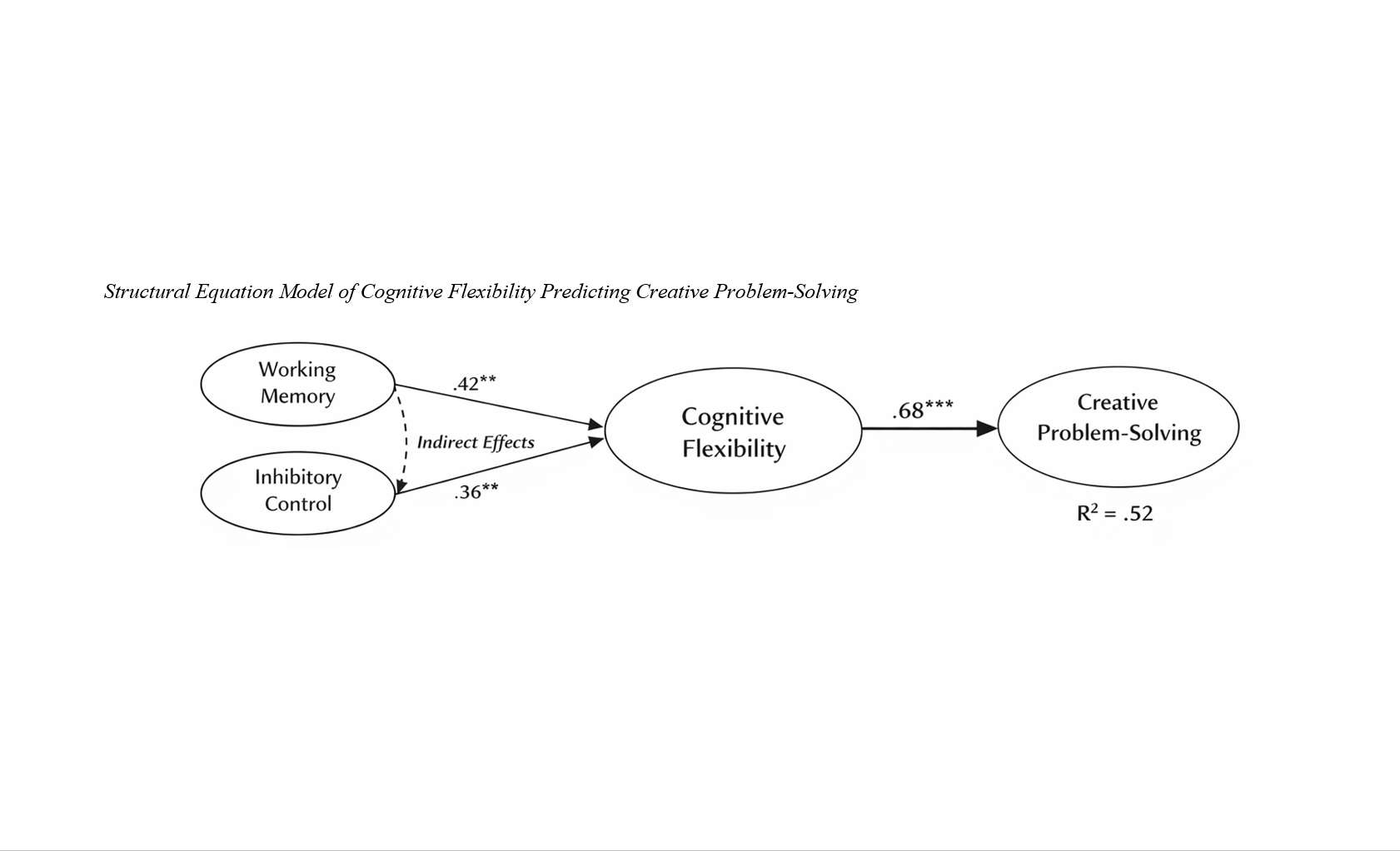
Findings: Cognitive flexibility demonstrated a strong positive association with creative problem-solving (p < 0.001). Hierarchical regression analyses revealed that cognitive flexibility significantly increased the explained variance in creative problem-solving beyond demographic and executive control variables, with the final model accounting for 47 percent of the variance (ΔR² = 0.26, p < 0.001). Both flexibility dimensions emerged as significant predictors (p < 0.001). Structural equation modeling confirmed a strong latent path from cognitive flexibility to creative problem-solving (β = 0.68, p < 0.001), with the overall model demonstrating excellent fit indices and explaining 52 percent of the variance. Machine learning analyses corroborated the dominant predictive contribution of cognitive flexibility.
Conclusion: The findings indicate that cognitive flexibility functions as a central and robust predictor of creative problem-solving in adolescence, integrating executive control processes and contributing substantial incremental validity.
Downloads
References
Aga, K., Inamura, M., Chen, C., Hagiwara, K., Yamashita, R., Hirotsu, M., Seki, T., Takao, A., Fujii, Y., Matsubara, T., & Nakagawa, S. (2021). The Effect of Acute Aerobic Exercise on Divergent and Convergent Thinking and Its Influence by Mood. Brain Sciences, 11(5), 546. https://doi.org/10.3390/brainsci11050546
Amoyaw, B., Beshai, M., Jong, A. T. d., & Sharma, A. (2025). The Impact of Music Education on Students’ Cognitive Development of Creativity in Elementary Schools. The CHILD Journal, 3(1), 75-79. https://doi.org/10.15173/child.v3i1.3910
Babazade, Y. (2025). The Bilingual Brain: Cognitive Benefits and Challenges of Multilingualism. Egjlle, 2(3), 55-63. https://doi.org/10.69760/egjlle.2500197
Baptista, V. E. G. (2025). Project-Based Learning Materials to Enhance Creative Thinking in Grade 7 Science. International Journal of Research and Innovation in Social Science, IX(IIIS), 3763-3783. https://doi.org/10.47772/ijriss.2025.903sedu0271
Baran, B., Obidziński, M., & Hohol, M. (2025). Interpreting Insect Behavior Through the Lens of Executive Functions. Frontiers in Behavioral Neuroscience, 19. https://doi.org/10.3389/fnbeh.2025.1638374
Baudier, L., Clément, É., Sander, E., & Gros, H. (2024). Cognitive Flexibility or Flexibilities? Insights From a Classroom Study. https://doi.org/10.31234/osf.io/e5yps
Cancer, A., Iannello, P., Salvi, C., & Antonietti, A. (2022). Executive Functioning and Divergent Thinking Predict Creative Problem-Solving in Young Adults and Elderlies. Psychological Research, 87(2), 388-396. https://doi.org/10.1007/s00426-022-01678-8
Chen, C., Mochizuki, Y., Hagiwara, K., Hirotsu, M., & Nakagawa, S. (2021). Regular Vigorous-Intensity Physical Activity and Walking Are Associated With Divergent but Not Convergent Thinking in Japanese Young Adults. Brain Sciences, 11(8), 1046. https://doi.org/10.3390/brainsci11081046
Choi, Y. R., Kim, H. S., Yoon, S. J., Lee, N. Y., Gupta, H., Ganesan, R., Gebru, Y. A., Youn, G. S., Kim, D. J., Ham, Y. L., & Suk, K. T. (2021). Nutritional Status and Diet Style Affect Cognitive Function in Alcoholic Liver Disease. Nutrients, 13(1), 185. https://doi.org/10.3390/nu13010185
Deck, B. L., Kelkar, A., Erickson, B., Erani, F., McConathey, E., Sacchetti, D., Faseyitan, O., Hamilton, R. H., & Medaglia, J. D. (2022). Individual-Level Functional Connectivity Predicts Cognitive Control Efficiency. https://doi.org/10.1101/2022.07.14.500048
Finnanger, T. G., Andersson, S., Chevignard, M., Johansen, G. O., Brandt, A. E., Hypher, R. E., Risnes, K., Rø, T. B., & Stubberud, J. (2022). Assessment of Executive Function in Everyday Life—Psychometric Properties of the Norwegian Adaptation of the Children’s Cooking Task. Frontiers in human neuroscience, 15. https://doi.org/10.3389/fnhum.2021.761755
Fischer, N. L. (2025). Set-Shifting and Task-Switching Make Differential Contributions to Divergent Thinking in Adolescence. https://doi.org/10.31234/osf.io/rvs2x_v3
Fischer, N. L., Kalaivanan, K., Tong, K., Uchiyama, R., Fu, P., Leong, V., Robbins, T. W., Sahakian, B. J., Seow, P., Lee, T. K., Hung, D., & Ellefson, M. R. (2025). Cognitive Flexibility Influences Divergent Thinking in Adolescence. https://doi.org/10.31234/osf.io/rvs2x_v1
Giancola, M., D’Amico, S., & Palmiero, M. (2023). Working Memory and Divergent Thinking: The Moderating Role of Field-Dependent-Independent Cognitive Style in Adolescence. Behavioral Sciences, 13(5), 397. https://doi.org/10.3390/bs13050397
GÜLer, K., & Aydin, A. (2023). The Relationship Among Working Memory Capacity, Cognitive Flexibility and Cognitive Emotion Regulation. https://doi.org/10.5772/intechopen.1002893
Hughes, C., & Katus, L. (2024). Emotion Regulation and Executive Function. 75-96. https://doi.org/10.1037/0000406-005
Huo, C. (2025). Mapping the Brain Networks Underlying Creativity Enhancement via Aesthetic Experience. European Journal of Medical Research, 30(1). https://doi.org/10.1186/s40001-025-03155-5
Jaén, I., Vidal-Arenas, V., Suso‐Ribera, C., Pastor, M. C., & García‐Palacios, A. (2024). Psychometric Properties of the Spanish Version of the Cognitive Flexibility Inventory. Clínica y Salud, 35(3), 101-110. https://doi.org/10.5093/clysa2024a3
Joy, J., Pulicken, R. J., Remya, N., Unnikrishnan, M., Thampi, J., Alwin, C., Balagopal, R., Anumol, C., & Roy, R. (2025). The Impact of Cognitive-Motor Dual-Task Training on Executive Function and Soccer- Specific Skills in Recreational Soccer Players: A Single Blind Randomized Controlled Trial. International Journal of Innovative Science and Research Techno, 513-526. https://doi.org/10.38124/ijisrt/25jun397
Koutstaal, W. (2025). Self-Guided Transitions and Creative Idea Search: Adaptively Choosing Flexibility Versus Persistence in Divergent and Convergent Thinking Tasks. Royal Society Open Science, 12(3). https://doi.org/10.1098/rsos.241394
Liashch, O. (2024). Development of the Cognitive Aspect of Creativity in Adolescents Through Group Psychological Training. Personality and Environmental Issues, 3(1), 76-83. https://doi.org/10.31652/2786-6033-2024-3(1)-76-83
Mukhija, J., & Rajan, G. (2025). Investigating the Role of Multiple Language Learning in Divergent Thinking. Psychology & Psychological Research International Journal, 10(1), 1-3. https://doi.org/10.23880/pprij-16000453
Nagy, B., Czigler, I., Csizmadia, P., File, D., Fáy, N., & Gaál, Z. A. (2023). Investigating the Involvement of Cognitive Control Processes in Innovative and Adaptive Creativity and Their Age-Related Changes. Frontiers in human neuroscience, 17. https://doi.org/10.3389/fnhum.2023.1033508
Patel, T., Hoffman, P., & MacPherson, S. E. (2025). Dissecting the Remote Associates Test (RAT): Exploring the Dynamics of Semantic Search in Creative Thinking. https://doi.org/10.31234/osf.io/bgczh_v1
Ramanathan, V., Ariffin, M. Z., Goh, G. D., Goh, G. L., Rikat, M. A., Tan, X. X., Yeong, W. Y., Ortega, J. P., Leong, V., & Campolo, D. (2022). Design and Development of Instrumented Toys for Social Interactive Assessment of Infant Cognitive Flexibility. https://doi.org/10.20944/preprints202212.0554.v1
Ramanathan, V., Ariffin, M. Z., Goh, G. D., Goh, G. L., Rikat, M. A., Tan, X. X., Yeong, W. Y., Ortega, J. P., Leong, V., & Campolo, D. (2023). The Design and Development of Instrumented Toys for the Assessment of Infant Cognitive Flexibility. Sensors, 23(5), 2709. https://doi.org/10.3390/s23052709
Rominger, C., Fink, A., Weber, B., Papousek, I., & Schwerdtfeger, A. (2020). Everyday Bodily Movement Is Associated With Creativity Independently From Active Positive Affect: A Bayesian Mediation Analysis Approach. Scientific reports, 10(1). https://doi.org/10.1038/s41598-020-68632-9
Svanishvili, G. (2025). Real-Time Brain Feedback Reveals the DMN’s Role in Creativity and Idea Formation. Premier Journal of Neuroscience. https://doi.org/10.70389/pjn.100006
Tomasello, M. (2024). An Agency-Based Model of Executive and Metacognitive Regulation. Frontiers in Developmental Psychology, 2. https://doi.org/10.3389/fdpys.2024.1367381
Walshe, E. A., Baxelbaum, K. S., McIntosh, C. W., Miller, L. R., Cheng, S., Wen, N., Winston, F. K., & Romer, D. (2025). Addressing the Gap: Examining the Role of Multiple Executive Function Constructs and Associated Factors in Risky Driving Performance in Young Drivers. Transportation Research Record Journal of the Transportation Research Board, 2679(9), 439-449. https://doi.org/10.1177/03611981251338731
Wang, S., Xin, T., Ma, H., Li, F. F., & Wu, C. (2025). EEG Assessment of Artificial Intelligence-Generated Content Impact on Student Creative Performance and Neurophysiological States in Product Design. Frontiers in psychology, 16. https://doi.org/10.3389/fpsyg.2025.1508383
Wu, Y., & Koutstaal, W. (2020). Charting the Contributions of Cognitive Flexibility to Creativity: Self-Guided Transitions as a Process-Based Index of Creativity-Related Adaptivity. PLoS One, 15(6), e0234473. https://doi.org/10.1371/journal.pone.0234473
Yang, J., Li, Z., Zhang, Z., & Luo, J. (2025). The Function of Posterior Middle Temporal Gyrus in Conceptual Expansion. PsyCh Journal, 14(5), 758-764. https://doi.org/10.1002/pchj.70025
Zelazo, P. D., Morris, I. F., Qu, L., & Kesek, A. (2024). Hot Executive Function: Emotion and the Development of Cognitive Control. 51-73. https://doi.org/10.1037/0000406-004
Downloads
Additional Files
Publication Timeline
- Submitted
- Revised
- Accepted