Effectiveness of an Academic Motivation Training Model on Cognitive Flexibility, Academic Resilience, and Academic Motivation among Female Lower Secondary School Students in Tehran
DOI:
https://doi.org/10.61838/kman.jayps.5222Keywords:
Academic motivation training model, cognitive flexibility, academic resilience, academic motivation, female students, lower secondary educationAbstract
Objective: The present study aimed to examine the effectiveness of an academic motivation training model on cognitive flexibility, academic resilience, and academic motivation among female students in lower secondary schools in Tehran.
Methods and Materials: This applied study employed a quasi-experimental design with a pretest–posttest format and a control group. The statistical population consisted of all female lower secondary school students in Tehran during the 2025–2026 academic year. Based on sample size estimation using G*Power software and Cohen’s criteria, 42 participants were selected through convenience sampling and randomly assigned to an experimental group (n = 21) and a control group (n = 21). The experimental group received training based on the academic motivation model over eight sessions, while the control group received no intervention. Research instruments included the Cognitive Flexibility Inventory developed by Dennis and Vander Wal (2010), the Academic Motivation Scale by Vallerand et al. (1992), and the Academic Resilience Scale by Cassidy (2016). Data were analyzed using analysis of covariance (ANCOVA) in SPSS at a significance level of 0.05.
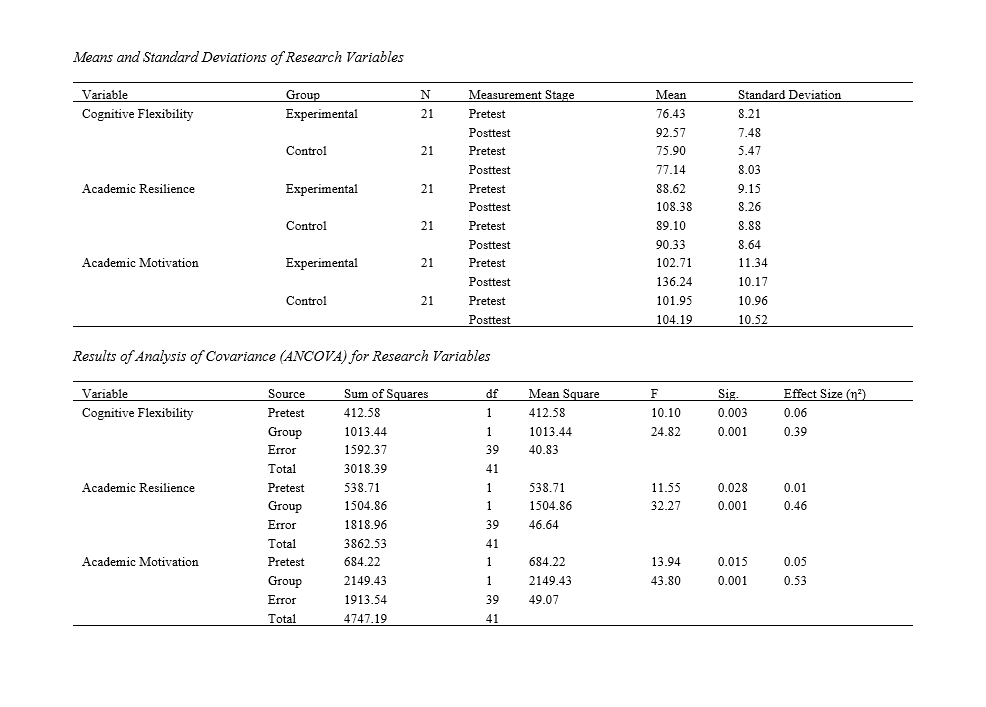
Findings: The results indicated that, after controlling for pretest effects, the academic motivation training model had a positive and statistically significant effect on cognitive flexibility, academic resilience, and academic motivation (p < 0.001). Specifically, significant differences were observed between the two groups in posttest scores for cognitive flexibility (F = 24.82, η² = 0.39), academic resilience (F = 32.27, η² = 0.46), and academic motivation (F = 43.80, η² = 0.53).
Conclusion: Based on the findings, the academic motivation training model can be considered an effective educational intervention that enhances academic motivation, increases cognitive flexibility, and strengthens academic resilience among students. Therefore, implementing this model in educational settings and school counseling programs may improve learning quality, increase academic engagement, and facilitate better student adaptation to educational challenges.
Downloads
References
Aghabagheri, H., Mohammadkhani, P., Omrani, S., & Farahmand, V. (2012). The effectiveness of mindfulness-based cognitive group therapy on increasing subjective well-being and hope in patients with MS. Journal of Clinical Psychology, 4(1), 21-31.
Bakos, D. S., Gallo, A. E., & Wainer, R. (2015). Systematic review of the clinical effectiveness of schema therapy. Contemporary Behavioral Health Care, 1, 1-7. https://doi.org/10.15761/CBHC.1000104
Bamelis, L. L. M., Evers, S. M. A. A., Spinhoven, P., & Arntz, A. (2014). Results of a multicenter randomized controlled trial of the clinical effectiveness of schema therapy for personality disorders. American Journal of Psychiatry, 171(3), 305-322. https://doi.org/10.1176/appi.ajp.2013.12040518
Farrell, J. M., Shaw, I. A., & Webber, M. A. (2009). A pilot study of group schema therapy for borderline personality disorder: A randomized controlled trial. Journal of Behavior Therapy and Experimental Psychiatry, 40(2), 317-328. https://doi.org/10.1016/j.jbtep.2008.07.001
Faustino, B., Vasco, A. B., Silva, A. N., & Marques, T. (2020). Relationships between emotional schemas, mindfulness, self-compassion and unconditional self-acceptance on the regulation of psychological needs. Research in Psychotherapy: Psychopathology, Process and Outcome, 23(2). https://doi.org/10.4081/ripppo.2020.442
Gilbert, P. (2009). Introducing compassion-focused therapy. Advances in psychiatric treatment, 15(3), 199-208. https://doi.org/10.1192/apt.bp.107.005264
Hayes, S. C., Strosahl, K. D., & Wilson, K. G. (1999). Acceptance and commitment therapy: An experiential approach to behavior change. Guilford Press.
Isazadeh, F., Heydari, S., Aghajanbaglou, S., & Saffarinia, M. (2020). The effectiveness of schema therapy on stress, social adjustment, and psychological coherence of women with cancer. Journal of Modern Psychology, 14(2), 85-102.
Jamali, S., Najafi, M., Ghoreishi, F., & Rahimian, E. (2021). The effectiveness of acceptance and commitment therapy on suicidal thoughts and psychological flexibility of patients with bipolar disorder. Psychological studies, 17(1), 7-22.
Karami Mohajeri, Z., Karbalaei Harfeteh, F., Khalatbari, J., & Fardin, M. (2025). The effectiveness of integrating schema therapy and acceptance and commitment therapy on subjective well-being and body image concern of women with breast cancer. Journal of Psychological Science, 24(145), 197-220.
Karimi Mohajeri, Z., Karbalaee Harfteh, F., Khalatbari, J., & Fardin, M. (2025). The effectiveness of integrating schema therapy and acceptance and commitment therapy on subjective well-being and body image concerns in women with breast cancer. Journal of Psychological Sciences, 24(145), 197-220. https://psychologicalscience.ir/browse.php?a_id=2564&sid=1&slc_lang=en
Kelly, A. C., Zuroff, D. C., & Shapira, L. B. (2009). Soothing oneself and resisting self-attacks: The treatment of two intrapersonal deficits in depression vulnerability. Cognitive therapy and research, 33(3), 301-313. https://doi.org/10.1007/s10608-008-9202-1
Khanjani, M., Shahidi, S., Fathabadi, J., Mazaheri, M., & Shokri, O. (2014). Factor structure and psychometric properties of the short form (18 items) of Ryff's cognitive emotion regulation scale in male and female students. Thought and Behavior in Clinical Psychology, 9(32), 27-36.
Körük, S., & Özabacı, N. S. (2018). Effectiveness of schema therapy on the treatment of depressive disorders: A meta-analysis. Current Approaches in Psychiatry, 10(4), 452-470.
MacBeth, A., & Gumley, A. (2012). Exploring compassion: A meta-analysis of the association between self-compassion and psychopathology. Clinical psychology review, 32(6), 545-552. https://doi.org/10.1016/j.cpr.2012.06.003
Mamdouhi, Z., Safargholi, H., Houshmandi, S., Damirchi, S., & Tabakhzadeh, N. (2023). The effectiveness of compassion therapy on cognitive emotion regulation of female students of Islamic Azad University, Islamshahr branch. Journal of Applied Psychology, 12(3), 45-58.
Mansouri Karyani, R., Bassak Nejad, S., Mehrabizadeh Honarmand, M., & Majdi Nasab, N. (2022). The effectiveness of compassion-focused acceptance and commitment therapy on psychological flexibility and psychological distress of patients with multiple sclerosis. Iranian Journal of Psychiatry and Clinical Psychology, 28(2), 222-235.
Neff, K. D. (2003). Self-compassion: An alternative conceptualization of a healthy attitude toward oneself. Self and identity, 2(2), 85-101. https://doi.org/10.1080/15298860309032
Nikan, A., Torabi, A., Mohseni Nasab, Z., Bahadori, A., Javanmard, Z., & Hosseini Rad, M. (2023). Comparison of the effectiveness of schema therapy and mindfulness-based cognitive therapy on stress, resilience, emotion regulation, and cognitive emotion regulation of cardiovascular patients. Research in Psychological Health, 17(1), 46-60.
Rafiei, F., Soleimani, M., & Seyedfatemi, N. (2011). Providing a model for the participation of patients with chronic diseases in nursing care. Koomesh journal, 12(3), 293-304.
Renner, F., Arntz, A., Peeters, F., & Huibers, M. (2016). Schema therapy for chronic depression: Results of a multiple single case series. Cognitive therapy and research, 40(4), 482-496. https://doi.org/10.1007/s10608-016-9750-3
Thimm, J. C. (2017). Relationships between early maladaptive schemas, mindfulness, self-compassion and psychological distress. International Journal of Psychology & Psychological Therapy, 17(1), 1-15.
Tirch, D. D., Leahy, R. L., Silberstein, L. R., & Melwani, P. S. (2012). Emotional schemas, psychological flexibility, and anxiety: The role of flexible response patterns to anxious arousal. International Journal of Cognitive Therapy, 5(4), 380-391. https://doi.org/10.1521/ijct.2012.5.4.380
Young, J. E., Klosko, J. S., & Weishaar, M. E. (2003). Schema therapy: A practitioner's guide. Guilford Press.
Downloads
Additional Files
Publication Timeline
- Submitted
- Revised
- Accepted