Predicting Cyberbullying Perpetration from Moral Disengagement, Online Disinhibition, Trait Aggression, and Social Network Density Using Random Forests
DOI:
https://doi.org/10.61838/kman.jayps.5227Keywords:
Cyberbullying, Random Forest, Moral Disengagement, Trait Aggression, Online Disinhibition, Machine LearningAbstract
Objective: The aim of this study was to predict cyberbullying perpetration from moral disengagement, online disinhibition, trait aggression, and social network density using a Random Forest machine learning algorithm among a sample of South African adolescents and young adults.
Methods and Materials: The study employed a quantitative, cross-sectional predictive research design with a sample of participants from three South African provinces. Data were collected using the Cyberbullying Offending Scale, Cyberbullying Moral Disengagement Scale, Online Disinhibition Scale, Buss-Perry Aggression Questionnaire, and a structural proxy questionnaire for social network density. A Random Forest model was trained on of the data and tested on the remaining , utilizing -fold cross-validation for hyperparameter tuning.
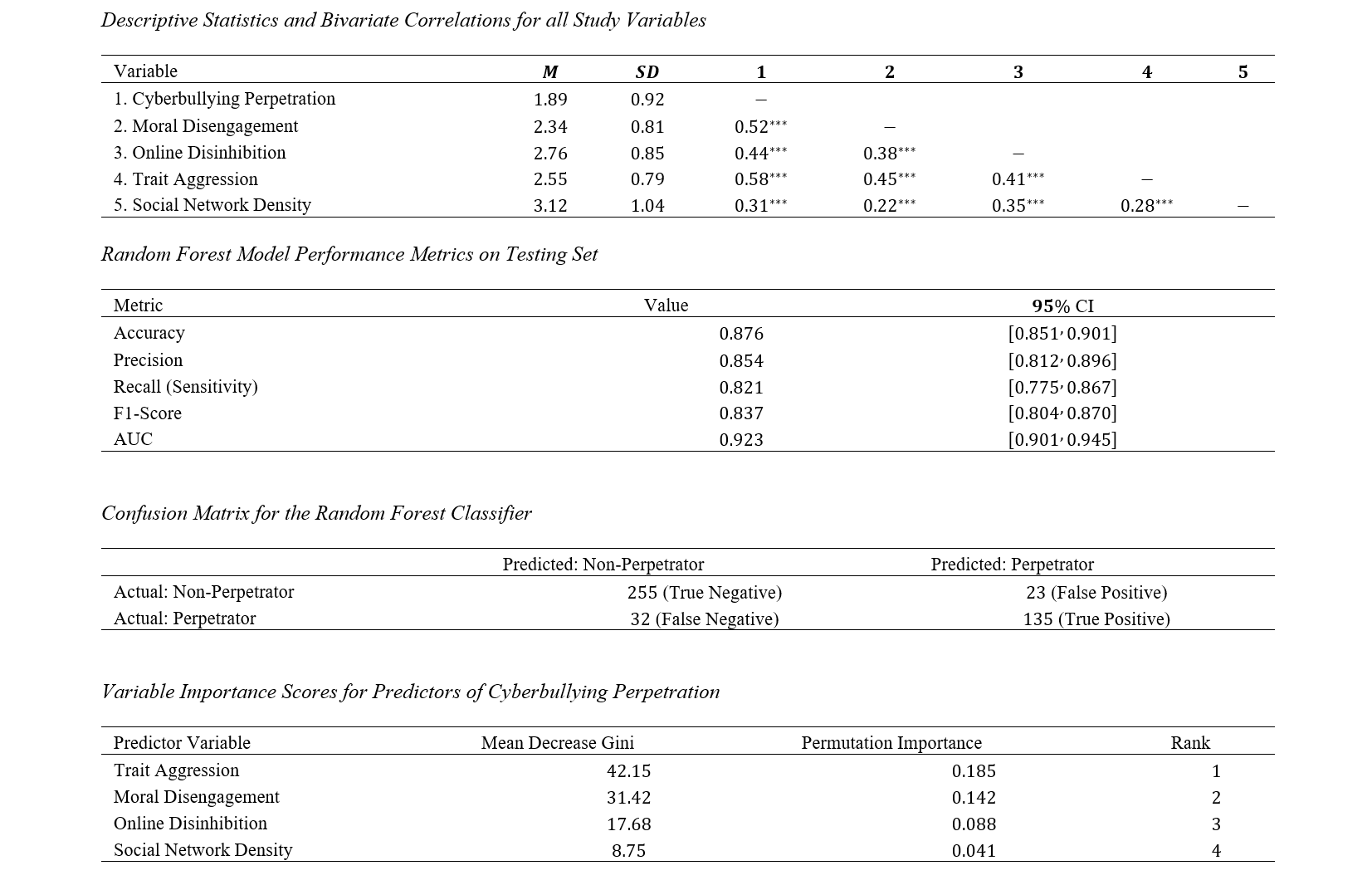
Findings: The Random Forest model demonstrated high predictive performance on the testing set ( ), achieving an Accuracy of , Precision of , Recall of , F1-score of , and . Variable importance metrics revealed that trait aggression was the strongest predictor of cyberbullying perpetration (Mean Decrease Gini ), followed by moral disengagement (Mean Decrease Gini ) and online disinhibition. Social network density was the weakest predictor in the model (Mean Decrease Gini ).
Conclusion: Individual psychological factors, specifically trait aggression and moral disengagement, overwhelmingly drive cyberbullying perpetration compared to digital structural environments, emphasizing the need for interventions focused on anger management and cognitive restructuring.
Downloads
References
Abdelaliem, A. (2024). Cyberbullying Motivations and Moral Disengagement Among Adolescent Cyberbullies: Exploring the Mediating Roles. Cyprus Turkish Journal of Psychiatry and Psychology, 6(1), 3. https://doi.org/10.35365/ctjpp.24.1.01
Bakioğlu, F., Çapan, B. E., Kırteke, S., & Pakpour, A. H. (2024). Adaptation of the Online Moral Disengagement Scale in Turkish: Its Association With Empathetic Tendency and Cyberbullying. https://doi.org/10.21203/rs.3.rs-4359069/v1
Cheng, C. (2024). Moral Disengagement and the Effect on Cyberbullying Among Adolescents and Young Adults. Journal of Education Humanities and Social Sciences, 40, 60-63. https://doi.org/10.54097/zttypd29
Eden, S., & Landau, O. (2025). Cyberbullying, Moral Disengagement, and Empathy: Exploring Relationship in Children With Behavioral Disorder. Psychology of violence. https://doi.org/10.1037/vio0000631
Falla, D., Ruiz, R. O., Ferreira, P. C., Simão, A. M. V., & Romera, E. M. (2023). The Effect of Cyberbullying Perpetration on Empathy and Moral Disengagement: Testing a Mediation Model in a Three-Wave Longitudinal Study. Psychology of violence, 13(5), 436-446. https://doi.org/10.1037/vio0000472
Fissel, E. R., Bryson, S. L., & Lee, J. R. (2024). Minimizing Responsibility: The Impact of Moral Disengagement on Cyberbullying Perpetration Among Adults. Crime & Delinquency, 71(10), 3244-3268. https://doi.org/10.1177/00111287241237979
Francisco, S., Ferreira, P. C., Simão, A. M. V., & Pereira, N. (2023). Measuring Empathy Online and Moral Disengagement in Cyberbullying. Frontiers in psychology, 14. https://doi.org/10.3389/fpsyg.2023.1061482
Francisco, S., Ferreira, P. C., Simão, A. M. V., & Pereira, N. (2024). Moral Disengagement and Empathy in Cyberbullying: How They Are Related in Reflection Activities About a Serious Game. BMC psychology, 12(1). https://doi.org/10.1186/s40359-024-01582-3
Gajda, A., Moroń, M., Królik, M., Małuch, M., & Mraczek, M. (2022). The Dark Tetrad, Cybervictimization, and Cyberbullying: The Role of Moral Disengagement. Current Psychology, 42(27), 23413-23421. https://doi.org/10.1007/s12144-022-03456-6
Liang, H., Jiang, H., Zhang, C., Zhou, H., Zhang, B., & Tuo, A. (2022). How Does Parent-Adolescent Conflict and Deviant Peer Affiliation Affect Cyberbullying: Examining the Roles of Moral Disengagement and Gender. Psychology research and behavior management, Volume 15, 2259-2269. https://doi.org/10.2147/prbm.s371254
Ling, G., Li, X., & Wang, X. (2023). Agreeableness and Adolescents' Cyberbullying Perpetration: A Longitudinal Moderated Mediation Model of Moral Disengagement and Empathy. Journal of personality, 91(6), 1461-1477. https://doi.org/10.1111/jopy.12823
Lubis, A. Y., Mikarsa, H. L., & Andriani, I. (2022). Mediation of Moral Disengagement on Cyberbullying Perpetration Influenced by Emotional Intelligence and Anonymity of Indonesian Adolescents on Social Media. Российский Психологический Журнал, 19(4), 231-242. https://doi.org/10.21702/rpj.2022.4.15
Luo, A., & Bussey, K. (2022). Mediating Role of Moral Disengagement in the Perpetration of Cyberbullying by Victims and Bystanders. Journal of adolescence, 94(8), 1142-1149. https://doi.org/10.1002/jad.12092
Luo, Y. F., Zhang, S., Yang, S. C., & Huang, C. L. (2022). Students’ Judgments on Different Cyberbullying Incidents: The Relationship Between Moral Philosophy and Intention to Engage. European Journal of Psychology of Education. https://doi.org/10.1007/s10212-022-00636-7
Ma, X., He, L., Yu, M., Li, S., Liu, Y., XuYou, & Yu, L. (2026). Relationship between cyberbullying victimization and nonsuicidal self-injury behavior in vocational college students in China: a cross-sectional study. Current Psychology, 45(3), 280. https://doi.org/10.1007/s12144-025-08671-5
Manzoor, Z., Sadiq, U., & Baig, K. B. (2026). Cyberbullying and emotional vulnerabilities: role of coping styles. BMC psychology. https://doi.org/10.1186/s40359-026-04021-7
Octavia, D., Sari, R. M., Merdekawati, D., Marisdayana, R., & Yuliyana, R. (2022). The Correlation Between Parental Communication Pattern, Self-Esteem, and Moral Disengagement With Cyberbullying Behavior in Early Adolescents: A Cross-Sectional Study. Jurnal Ners, 17(1). https://doi.org/10.20473/jn.v17i1.24539
Rahmawati, N. P., & Virlia, S. (2023). The Role of Moral Disengagement and Authoritarian Parenting Style Towards Cyberbullying Attitude Among Social Media Users. Jurnal Ilmiah Psikologi Terapan, 11(2), 105-111. https://doi.org/10.22219/jipt.v11i2.25550
Rodríguez‐Hidalgo, A. J., Camargo, V. S., & Hurtado‐Mellado, A. (2025). Cyberbullying Based on Social Stigmas and Social, Emotional and Moral Competencies. Behavioral Sciences, 15(5), 646. https://doi.org/10.3390/bs15050646
Wang, X., Wang, S., & Zeng, X. (2023). Does Deviant Peer Affiliation Accelerate Adolescents' Cyberbullying Perpetration? Roles of Moral Disengagement and Self‐control. Psychology in the Schools, 60(12), 5025-5040. https://doi.org/10.1002/pits.23037
Xu, J. (2025). Parental Psychological Control and Cyberbullying Among Adolescents: The Mediating Roles of Sleep Quality and Moral Disengagement and the Moderating Role of Grade. Frontiers in psychology, 16. https://doi.org/10.3389/fpsyg.2025.1664970
Yang, H., Zhang, T., Shi, H.-f., & Fan, C. (2023). Empathy and Bystander Helping Behavior in Cyberbullying Among Adolescents: The Mediating Role of Internet Moral Judgment and the Moderating Role of Internet Self-Efficacy. Frontiers in psychology, 14. https://doi.org/10.3389/fpsyg.2023.1196571
Zhang, M., & Konishi, C. (2024). Cyberbullying Among Emerging Adults: The Role of Parental Practices and Morality. Journal of Education and Development, 8(1), 27. https://doi.org/10.20849/jed.v8i1.1396
Downloads
Additional Files
Publication Timeline
- Submitted
- Revised
- Accepted