A Deep Neural Network Analysis of Youth Psychological Distress Based on Cybervictimization, Loneliness, Academic Pressure, Screen-Time Fragmentation, and Family Emotional Climate
DOI:
https://doi.org/10.61838/kman.jayps.5410Keywords:
Psychological distress, deep neural network, cybervictimization, loneliness, academic pressure, screen-time fragmentation, family emotional climate, adolescents, emerging adults, machine learningAbstract
Objective: The present study aimed to investigate youth psychological distress through a deep neural network framework based on cybervictimization, loneliness, academic pressure, screen-time fragmentation, and family emotional climate among adolescents and emerging adults in Georgia.
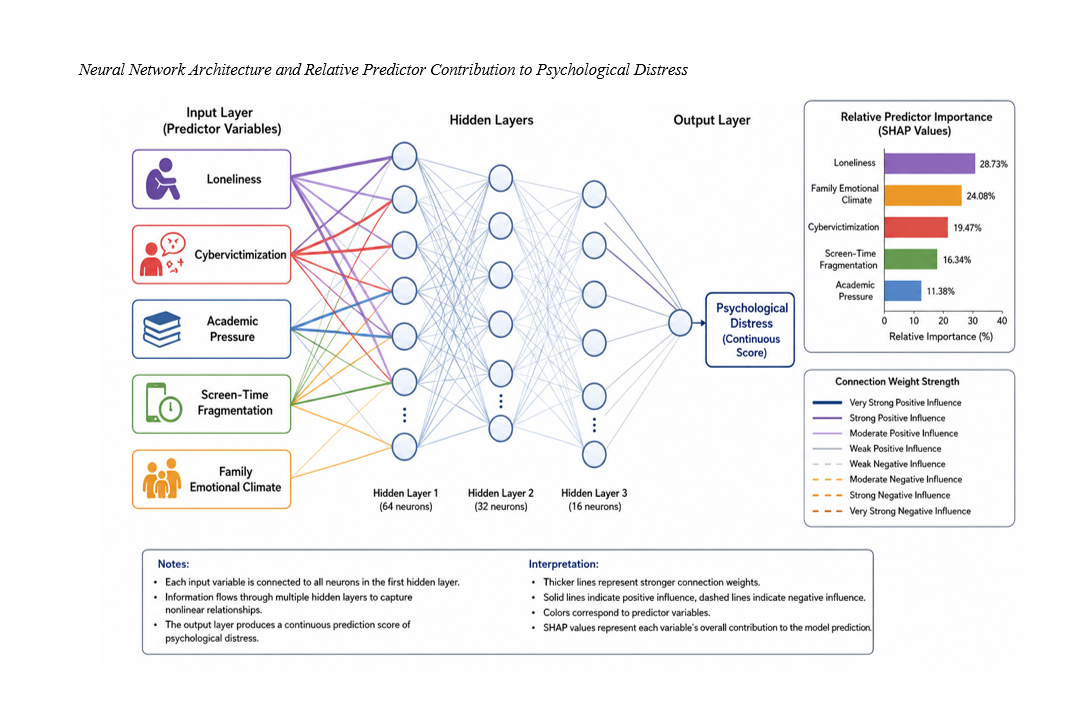
Methods and Materials: This study employed a quantitative cross-sectional predictive design using deep learning methodologies. The statistical population consisted of adolescents and emerging adults aged 16 to 24 years enrolled in secondary schools and universities in Georgia during the 2025–2026 academic year. Using multistage cluster sampling, 842 participants were initially recruited, and after data screening, 814 cases were retained for final analysis. Data were collected using standardized instruments including the Kessler Psychological Distress Scale, Cyberbullying Victimization Scale, UCLA Loneliness Scale, Educational Stress Scale for Adolescents, a screen-time fragmentation measure, and the Family Environment Scale. Data analysis involved descriptive statistics, Pearson correlation coefficients, and deep neural network modeling using Python, TensorFlow, and Keras libraries. Model performance was evaluated using mean squared error, root mean squared error, mean absolute error, coefficient of determination, and cross-validation procedures. SHAP analysis was additionally employed to examine relative predictor importance.
Findings: The findings demonstrated significant positive relationships between psychological distress and cybervictimization, loneliness, academic pressure, and screen-time fragmentation, while family emotional climate showed a significant negative relationship with psychological distress. Loneliness emerged as the strongest predictor within the deep neural network model, followed by family emotional climate and cybervictimization.
Conclusion: Comparative analyses indicated that the deep neural network outperformed traditional machine learning approaches including random forest, support vector machine, and multiple linear regression models in predicting psychological distress outcomes.
Downloads
References
Burgess, K. (2025). The Decline in Adolescents’ Mental Health With the Rise of Social Media: A Narrative Review. Creative Nursing, 31(2), 119-126. https://doi.org/10.1177/10784535251328925
Bussu, A., Pulina, M., Ashton, S. A., Mangiarulo, M., & Molloy, E. (2024). Cyberbullying and Cyberstalking Victimisation Among University Students: A Narrative Systematic Review. International Review of Victimology, 31(1), 59-90. https://doi.org/10.1177/02697580241257217
Chiappini, S., Sampogna, G., Ventriglio, A., Menculini, G., Ricci, V., Pettorruso, M., Volpe, U., & Martinotti, G. (2025). Exploring Emerging Psychopathological Characteristics and Challenges of Novel Depression Subtypes: Insights From the Literature. Frontiers in Psychiatry, 16. https://doi.org/10.3389/fpsyt.2025.1613251
Ehrenreich, S. E., George, M. J., Burnell, K., & Underwood, M. K. (2021). Importance of Digital Communication in Adolescents’ Development: Theoretical and Empirical Advancements in the Last Decade. Journal of Research on Adolescence, 31(4), 928-943. https://doi.org/10.1111/jora.12643
Espino, E., Guarini, A., & Rey, R. D. (2023). Effective Coping With Cyberbullying in Boys and Girls: The Mediating Role of Self-Awareness, Responsible Decision-Making, and Social Support. Current Psychology, 42(36), 32134-32146. https://doi.org/10.1007/s12144-022-04213-5
Evangelio, C., Saiz-González, P., Fernández‐Río, J., & González‐Víllora, S. (2022). Cyberbullying in Elementary and Middle School Students: A Systematic Review. Computers & Education, 176, 104356. https://doi.org/10.1016/j.compedu.2021.104356
Fredrick, S. S., Ettekal, I., Domoff, S. E., & Nickerson, A. B. (2025). Patterns of Child and Adolescent Digital Media Use: Associations With School Support, Engagement, and Cybervictimization. Psychology of Popular Media, 14(1), 54-65. https://doi.org/10.1037/ppm0000570
Garaigordobil, M. (2025). Cyberbullying, Problematic Use of the Internet and Social Media: The Dark Side of the Technological Era / Ciberacoso, Uso Problemático De Internet Y Las Redes Sociales: El Lado Oscuro De La Era Tecnológica. Journal for the Study of Education and Development Infancia Y Aprendizaje, 48(3), 504-545. https://doi.org/10.1177/02103702251352765
Giannakopoulos, G., & Prassou, A. (2025). Mediating and Moderating Mechanisms in the Relationship Between Social Media Use and Adolescent Aggression: A Scoping Review of Quantitative Evidence. European Journal of Investigation in Health Psychology and Education, 15(6), 98. https://doi.org/10.3390/ejihpe15060098
Heiman, T., & Olenik‐Shemesh, D. (2022). Cyber-Victimization Experience Among Higher Education Students: Effects of Social Support, Loneliness, and Self-Efficacy. International journal of environmental research and public health, 19(12), 7395. https://doi.org/10.3390/ijerph19127395
Iorga, M., Pop, L., Croitoru, I., Hanganu, E., & Anton-Păduraru, D.-T. (2022). Exploring the Importance of Gender, Family Affluence, Parenting Style and Loneliness in Cyberbullying Victimization and Aggression Among Romanian Adolescents. Behavioral Sciences, 12(11), 457. https://doi.org/10.3390/bs12110457
Karaköse, T., Yıldırım, B., Tülübaş, T., & Kardas, A. (2023). A Comprehensive Review on Emerging Trends in the Dynamic Evolution of Digital Addiction and Depression. Frontiers in psychology, 14. https://doi.org/10.3389/fpsyg.2023.1126815
Kasturiratna, K. T. A. S., Hartanto, A., Chen, C. H. Y., Tong, E. M. W., & Majeed, N. M. (2024). Umbrella Review of Meta-Analyses on the Risk Factors, Protective Factors, Consequences and Interventions of Cyberbullying Victimization. Nature Human Behaviour, 9(1), 101-132. https://doi.org/10.1038/s41562-024-02011-6
Kudlová, K., & Sleziakova, A. (2023). A Review of Research on Cybervictimization and Cyberaggression in Individuals With Neurodevelopmental Disorders With a Focus on Adhd. Slavonic Pedagogical Studies Journal, 12(2), 73-85. https://doi.org/10.18355/pg.2023.12.2.1
Lee, J., Kim, J., & Lee, J.-E. (2025). Cybervictimization and Eating Disorders in University Sample in Singapore: A Moderated Mediation Model of Deviant Peer Association and Self-Esteem. BMC public health, 25(1). https://doi.org/10.1186/s12889-025-24493-3
Lise, F. D., Bacaro, V., & Crocetti, E. (2023). The Social Side of Sleep: A Systematic Review of the Longitudinal Associations Between Peer Relationships and Sleep Quality. International journal of environmental research and public health, 20(3), 2017. https://doi.org/10.3390/ijerph20032017
López-Martínez, P., Montero-Montero, D., Ruiz, D. M., & Martínez–Ferrer, B. (2021). Child-to-Parent Violence, Peer Victimization and Cybervictimization in Spanish Adolescents. International journal of environmental research and public health, 18(17), 9360. https://doi.org/10.3390/ijerph18179360
Lozano-Blasco, R., Barreiro-Collazo, A., Romero‐Gonzalez, B., & Soto, A. (2023). The Family Context in Cybervictimization: A Systematic Review and Meta-Analysis. Trauma Violence & Abuse, 25(3), 2143-2157. https://doi.org/10.1177/15248380231207894
Makarova, E. A., & Makarova, E. L. (2023). Cyber-Victimization and Its Impact on Victim’s Psychosomatic Status. International Journal of Cognitive Research in Science Engineering and Education, 11(2), 231-245. https://doi.org/10.23947/2334-8496-2023-11-2-231-245
Marano, G., Lisci, F. M., Rossi, S., Marzo, E. M., Boggio, G., Brisi, C., Traversi, G., Mazza, O., Pola, R., Gaetani, E., & Mazza, M. (2025). Connected but at Risk: Social Media Exposure and Psychiatric and Psychological Outcomes in Youth. Children, 12(10), 1322. https://doi.org/10.3390/children12101322
María del Mar Molero, J., Martínez, Á. M., María del Carmen Pérez, F., Rosa María del Pino, S., & Linares, J. J. G. (2025). Cybervictimization and Emotional Symptoms in Adolescents: Mediating Role of Psychological Flexibility Versus Inflexibility. Frontiers in psychology, 15. https://doi.org/10.3389/fpsyg.2024.1505422
Martínez-Monteagudo, M. C., Delgado, B., García-Fernández, J. M., & Esteban, C. R. (2020). Cyberbullying in the University Setting. Relationship With Emotional Problems and Adaptation to the University. Frontiers in psychology, 10. https://doi.org/10.3389/fpsyg.2019.03074
Mascia, M. L., Agus, M., Zanetti, M. A., Perrone, S., Rollo, D., & Penna, M. P. (2021). Who Are the Victims of Cyberbullying? Preliminary Data Towards Validation of "Cyberbullying Victim Questionnaire”. Contemporary Educational Technology, 13(3), ep310. https://doi.org/10.30935/cedtech/10888
Matthews, T., Arseneault, L., Bryan, B. T., Fisher, H. L., Gray, R., Henchy, J., Moffitt, T. E., & Odgers, C. L. (2025). Social Media Use, Online Experiences, and Loneliness Among Young Adults: A Cohort Study. Annals of the New York Academy of Sciences, 1548(1), 194-205. https://doi.org/10.1111/nyas.15370
Menabò, L., Skrzypiec, G., Slee, P. T., & Guarini, A. (2023). Victimization and Cybervictimization: The Role of School Factors. Journal of adolescence, 96(3), 598-611. https://doi.org/10.1002/jad.12284
Mohamed, E., Hassan, E. E., Hassan, Z., Abouzeid, O. N., & Mohammed, M. (2023). Adolescents Cyberbullying and Its Consequences on Self-Esteem and Suicidal Thoughts at Minia Governorate, Egypt. Minia Scientific Nursing Journal, 013(3), 35-46. https://doi.org/10.21608/msnj.2023.233705.1077
Oriol, X., Varela, J. J., & Miranda, R. (2021). Gratitude as a Protective Factor for Cyberbullying Victims: Conditional Effects on School and Life Satisfaction. International journal of environmental research and public health, 18(5), 2666. https://doi.org/10.3390/ijerph18052666
Predescu, E., Calugar, I., & Șipoș, R. (2024). Cyberbullying and Non-Suicidal Self-Injury (NSSI) in Adolescence: Exploring Moderators and Mediators Through a Systematic Review. Children, 11(4), 410. https://doi.org/10.3390/children11040410
Quintana‐Orts, C., Mérida‐López, S., Rey, L., Chamizo‐Nieto, M. T., & Extremera, N. (2023). Understanding the Role of Emotion Regulation Strategies in Cybervictimization and Cyberaggression Over Time: It Is Basically Your Fault! Cyberpsychology Journal of Psychosocial Research on Cyberspace, 17(2). https://doi.org/10.5817/cp2023-2-1
Quintana‐Orts, C., Rey, L., Chamizo‐Nieto, M. T., & Worthington, E. L. (2020). A Serial Mediation Model of the Relationship Between Cybervictimization and Cyberaggression: The Role of Stress and Unforgiveness Motivations. International journal of environmental research and public health, 17(21), 7966. https://doi.org/10.3390/ijerph17217966
Ruan Víctor dos Santos, S., Moura, H. S. D., Araujo, P. N. d., Santos, F. L. d., & Fortuna, C. M. (2025). Virtual Violence as a Contributing Factor to the Mental Health of Young People: A Scoping Review. Canadian Journal of Nursing Research. https://doi.org/10.1177/08445621251364528
Tozzo, P., Cuman, O., Moratto, E., & Caenazzo, L. (2022). Family and Educational Strategies for Cyberbullying Prevention: A Systematic Review. International journal of environmental research and public health, 19(16), 10452. https://doi.org/10.3390/ijerph191610452
Wang, Y., Chen, A., & Ni, H. (2021). The Relationship Between Cybervictimization and Non-Suicidal Self-Injury in Chinese Adolescents: A Moderated-Mediation Model. Frontiers in psychology, 11. https://doi.org/10.3389/fpsyg.2020.572100
Xie, Y., Wu, J., Zhang, C., & Zhu, L. (2022). Cumulative Childhood Trauma and Cybervictimization Among Chinese College Students: Internet Addiction as a Mediator and Roommate Relationships as a Moderator. Frontiers in psychology, 13. https://doi.org/10.3389/fpsyg.2022.791291
Zhou, L., & Li, C. (2021). Factors Associated With Cyberbullying Among Vocational Students Based on the Ecological System Model in an Ethnic Minority Area. Medicine, 100(40), e27226. https://doi.org/10.1097/md.0000000000027226
Downloads
Additional Files
Publication Timeline
- Submitted
- Revised
- Accepted