Ensemble Learning Approaches to Predicting Youth Suicidal Ideation Using Emotional Numbing, Cyberbullying Exposure, AI Chatbot Attachment, Hopelessness, and Social Withdrawal
DOI:
https://doi.org/10.61838/kman.jayps.5429Keywords:
Youth suicidal ideation, ensemble learning, emotional numbing, cyberbullying, AI chatbot attachment, hopelessness, social withdrawal, machine learning, adolescent mental health, suicide predictionAbstract
Objective: The present study aimed to investigate the predictive role of emotional numbing, cyberbullying exposure, AI chatbot attachment, hopelessness, and social withdrawal in youth suicidal ideation using advanced ensemble learning approaches among Canadian adolescents and emerging adults.
Methods and Materials: This cross-sectional predictive study was conducted among 742 adolescents and emerging adults aged 16 to 24 years recruited from educational institutions and youth communities across Canada. Data were collected using standardized instruments assessing suicidal ideation, emotional numbing, cyberbullying exposure, hopelessness, social withdrawal, and attachment to AI chatbot systems. After preprocessing procedures including missing data imputation and feature normalization, several ensemble machine learning algorithms including Random Forest, Gradient Boosting Machine, AdaBoost, XGBoost, LightGBM, and a stacked ensemble classifier were implemented using Python-based analytical frameworks. Model performance was evaluated through accuracy, precision, recall, F1-score, specificity, and area under the receiver operating characteristic curve (AUC-ROC). Feature importance and SHAP analyses were additionally performed to examine the relative contribution of predictors within the final classification model.
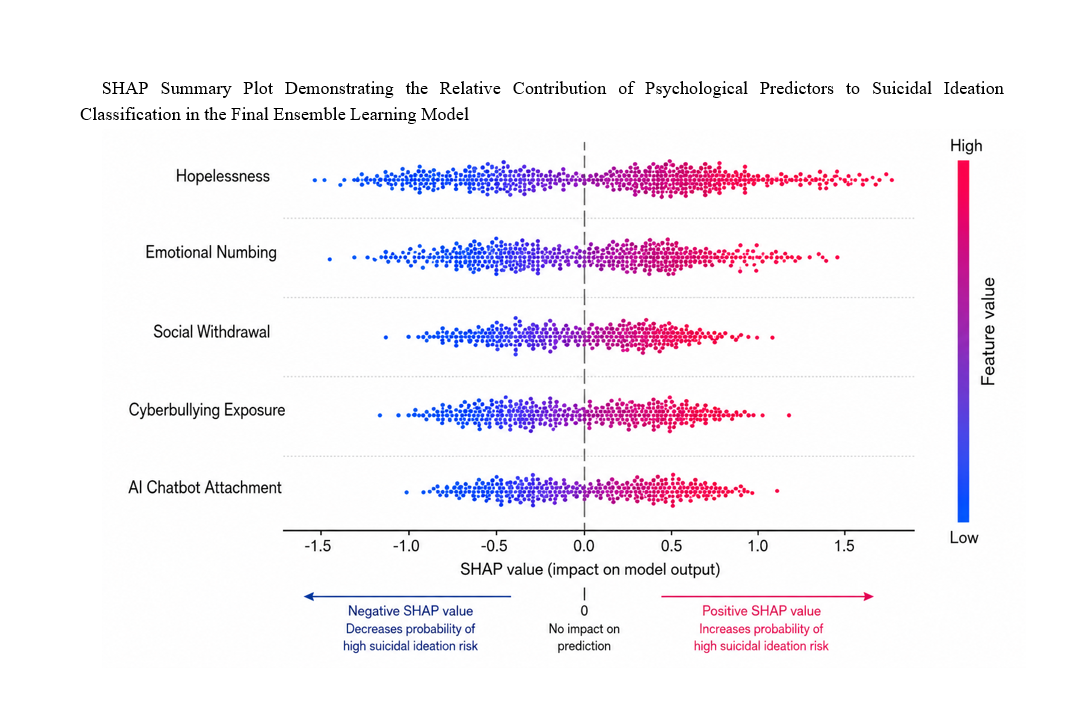
Findings: The findings demonstrated significant positive relationships between suicidal ideation and all predictor variables, including emotional numbing, cyberbullying exposure, AI chatbot attachment, hopelessness, and social withdrawal (p < .01). Hopelessness emerged as the strongest predictor within the final ensemble model, followed by emotional numbing and social withdrawal. The stacked ensemble classifier demonstrated the highest predictive performance with an accuracy of 94%, precision of 92%, recall of 91%, F1-score of 91%, specificity of 95%, and an AUC-ROC value of 0.97. XGBoost and LightGBM also demonstrated strong classification capability. SHAP analysis confirmed that higher levels of hopelessness, emotional numbing, cyberbullying exposure, social withdrawal, and AI chatbot attachment significantly increased the probability of high-risk suicidal ideation classification.
Conclusion: The findings suggest that youth suicidal ideation is shaped by multidimensional interactions among emotional dysregulation, interpersonal isolation, cybervictimization, hopelessness, and emerging forms of technological attachment. Ensemble learning approaches demonstrated exceptional effectiveness in identifying adolescents at elevated suicide risk and may provide valuable computational tools for early psychological screening and suicide prevention programs. The study further highlights the growing psychological significance of AI chatbot attachment within contemporary youth mental health contexts.
Downloads
References
Baldini, V. (2025). A Comprehensive Approach to Adolescent Suicide Prevention: Insights From a Narrative Review Perspective. Frontiers in psychology, 16. https://doi.org/10.3389/fpsyg.2025.1612067
Bezie, A. E., Yohannes, L., Yirdaw, A. A., Sergindo, M. T., Begena, B. B., & Keleb, A. (2025). The Association Between Bullying Victimization and Suicidal Ideation Among Students in Africa: A Systematic Review and Meta-Analysis. Frontiers in Public Health, 13. https://doi.org/10.3389/fpubh.2025.1556211
Campbell, L. O., Babb, K., Lambie, G. W., & Hayes, B. (2025). An Examination of Generative AI Response to Suicide Inquires: Content Analysis. Jmir Mental Health, 12, e73623-e73623. https://doi.org/10.2196/73623
Cao, Z., Lu, L., Li, Z., Lai, S., Zhou, Z., Shen, Q., & Liu, S. (2025). A Cross-Sectional Study of Individual- And Poly-Bullying Victimization and Suicidal Ideation Among Chinese University and High School Students: The Roles of Hopelessness and Interpersonal Relationships. International Journal for Equity in Health, 24(1). https://doi.org/10.1186/s12939-025-02472-9
Cassell, S., & Diamond, G. (2023). Therapist–adolescent Therapeutic Ruptures in Attachment-Based Family Therapy. 95-118. https://doi.org/10.1037/0000306-005
Chiappini, S., Sampogna, G., Ventriglio, A., Menculini, G., Ricci, V., Pettorruso, M., Volpe, U., & Martinotti, G. (2025). Exploring Emerging Psychopathological Characteristics and Challenges of Novel Depression Subtypes: Insights From the Literature. Frontiers in Psychiatry, 16. https://doi.org/10.3389/fpsyt.2025.1613251
Dadras, O., & Takashi, N. (2024). Traditional, Cyberbullying, and Suicidal Behaviors in Argentinian Adolescents: The Protective Role of School, Parental, and Peer Connectedness. Frontiers in Psychiatry, 15. https://doi.org/10.3389/fpsyt.2024.1351629
Ferreira, D. B. B., Santos, R. M. S., Machado, M. C. L., Rezende, V. H. M., Marco, P. D., Romano‐Silva, M. A., & Miranda, D. M. d. (2025). Suicidality and Self-Harm in Adolescents Before and After the COVID-19 Pandemic: A Systematic Review. Frontiers in Psychiatry, 16. https://doi.org/10.3389/fpsyt.2025.1643145
Garaigordobil, M. (2025). Cyberbullying, Problematic Use of the Internet and Social Media: The Dark Side of the Technological Era / Ciberacoso, Uso Problemático De Internet Y Las Redes Sociales: El Lado Oscuro De La Era Tecnológica. Journal for the Study of Education and Development Infancia Y Aprendizaje, 48(3), 504-545. https://doi.org/10.1177/02103702251352765
Gath, M. (2026). Social Media Use and Experiences of Cybervictimization: Links to Six Domains of Youth Well-Being. Journal of Psychologists and Counsellors in Schools. https://doi.org/10.1177/20556365261421831
Humboldt, S. v., Low, G., & Leal, I. (2025). From Words to Wounds: Cyberbullying and Its Influence on Mental Health Across the Lifespan. Behavioral Sciences, 15(5), 619. https://doi.org/10.3390/bs15050619
Imataka, G., & Shiraishi, H. (2024). Youth Suicide in Japan: Exploring the Role of Subcultures, Internet Addiction, and Societal Pressures. Diseases, 13(1), 2. https://doi.org/10.3390/diseases13010002
Kiing, J. S. H., Ragen, E. S., Sulaiman, M., Goh, W. S., Tan, N. J. H., Ng, S. H., Luo, Y., Samuel, M., Young, D., & Loh, V. W. K. (2025). Bullying and Depression Among Adolescents in East Asia: A Scoping Review on Prevalence Rates, Risk and Protective Factors. Frontiers in Psychiatry, 16. https://doi.org/10.3389/fpsyt.2025.1497866
Liu, X., & Liu, X. (2025). Cyberbullying Victimization and Suicidal Ideation Among College Students: The Mediating Role of Psychological Pain and the Moderating Role of School Bonding. BMC psychiatry, 25(1). https://doi.org/10.1186/s12888-025-07007-8
Lu, J., Li, S., Fan, T., Ni, X., Zhang, L., Chen, H., Chen, X., Tang, H., Ye, Y., Zhou, J., & Shen, Y. (2025). Childhood Maltreatment, Bullying, and Internet Addiction in Relation to Suicidal Ideation Among Adolescents: Cross-Sectional Mediation and Network Analysis. Journal of medical Internet research, 27, e79858-e79858. https://doi.org/10.2196/79858
Marano, G., Lisci, F. M., Rossi, S., Marzo, E. M., Boggio, G., Brisi, C., Traversi, G., Mazza, O., Pola, R., Gaetani, E., & Mazza, M. (2025). Connected but at Risk: Social Media Exposure and Psychiatric and Psychological Outcomes in Youth. Children, 12(10), 1322. https://doi.org/10.3390/children12101322
Ohu, F. C. (2025). Public Health Risk Management, Policy, and Ethical Imperatives in the Use of AI Tools for Mental Health Therapy. Healthcare, 13(21), 2721. https://doi.org/10.3390/healthcare13212721
Park, J., Singh, V. K., & Wiśniewski, P. (2024). Current Landscape and Future Directions for Mental Health Conversational Agents for Youth: Scoping Review (Preprint). https://doi.org/10.2196/preprints.62758
Rizk-Hildbrand, M., Semple, T. J., Preisig, M., Haeberling, I., Smigielski, L., Pauli, D., Walitza, S., Kleim, B., & Berger, G. (2025). The Body as a Battleground: A Qualitative Study of the Impact of Violence, Body Shaming, and Self-Harm in Adolescents With a History of Suicide Attempts. International journal of environmental research and public health, 22(6), 859. https://doi.org/10.3390/ijerph22060859
Rodríguez, F. M. M., Martínez-Ramón, J. P., Giménez-Lozano, J. M., & Rodríguez, A. M. M. (2023). Suicide Risk Analysis and Psycho-Emotional Risk Factors Using an Artificial Neural Network System. Healthcare, 11(16), 2337. https://doi.org/10.3390/healthcare11162337
Sun, F. K., Long, A., Lu, M. J., Lin, P. C., & Chiang, C. Y. (2025). Exploring the Perceptions of Young Persons at Risk of Suicide Regarding Suicide and Suicide Prevention: A Phenomenological Study. Journal of Psychiatric and Mental Health Nursing, 32(6), 1275-1285. https://doi.org/10.1111/jpm.70022
Tekeba, B., Tamir, T. T., Gebrehana, D. A., Abich, Y., Baykemagn, N. D., Mengstie, M. A., & Zegeye, A. F. (2025). The Lifetime Prevalence and Associated Factors of Suicidal Ideation and Suicide Attempts Among High School Adolescents in Ethiopia: A Systematic Review and Meta-Analysis. Child and adolescent psychiatry and mental health, 19(1). https://doi.org/10.1186/s13034-025-00927-z
Varley, D., Fenton, C., Gargan, G., Taylor, O., Taylor, A., Kirby, N., Morton, M., Barrow, J., Hatton, C., & Wright, B. (2022). A Systematic Review of Systematic Reviews Exploring the Factors Related to Child and Adolescent Self-Harm. Adolescent Psychiatry, 12(2), 79-114. https://doi.org/10.2174/2210676612666220721101210
Villodas, M. L. (2024). Suicidality and Non-Suicidal Self-Injury: A Narrative Review of Measurement, Risk, and Disparities Among Minoritized and System-Involved Youth in the USA. Children, 11(4), 466. https://doi.org/10.3390/children11040466
Yu, Y. (2025). Principles of Safe AI Companions for Youth: Parent and Expert Perspectives. https://doi.org/10.48550/arxiv.2510.11185
Downloads
Additional Files
Publication Timeline
- Submitted
- Revised
- Accepted