Deep Learning Prediction of Emotional Dysregulation in Adolescents Based on Social Media Use Patterns, Sleep Quality, and Parental Attachment Styles
DOI:
https://doi.org/10.61838/kman.jayps.4988Keywords:
adolescent mental health, emotional dysregulation, deep learning, social media use, sleep quality, parental attachment, predictive modelingAbstract
Objective: The objective of this study was to develop and validate a deep learning model for predicting emotional dysregulation in Colombian adolescents using social media use patterns, sleep quality, and parental attachment styles.
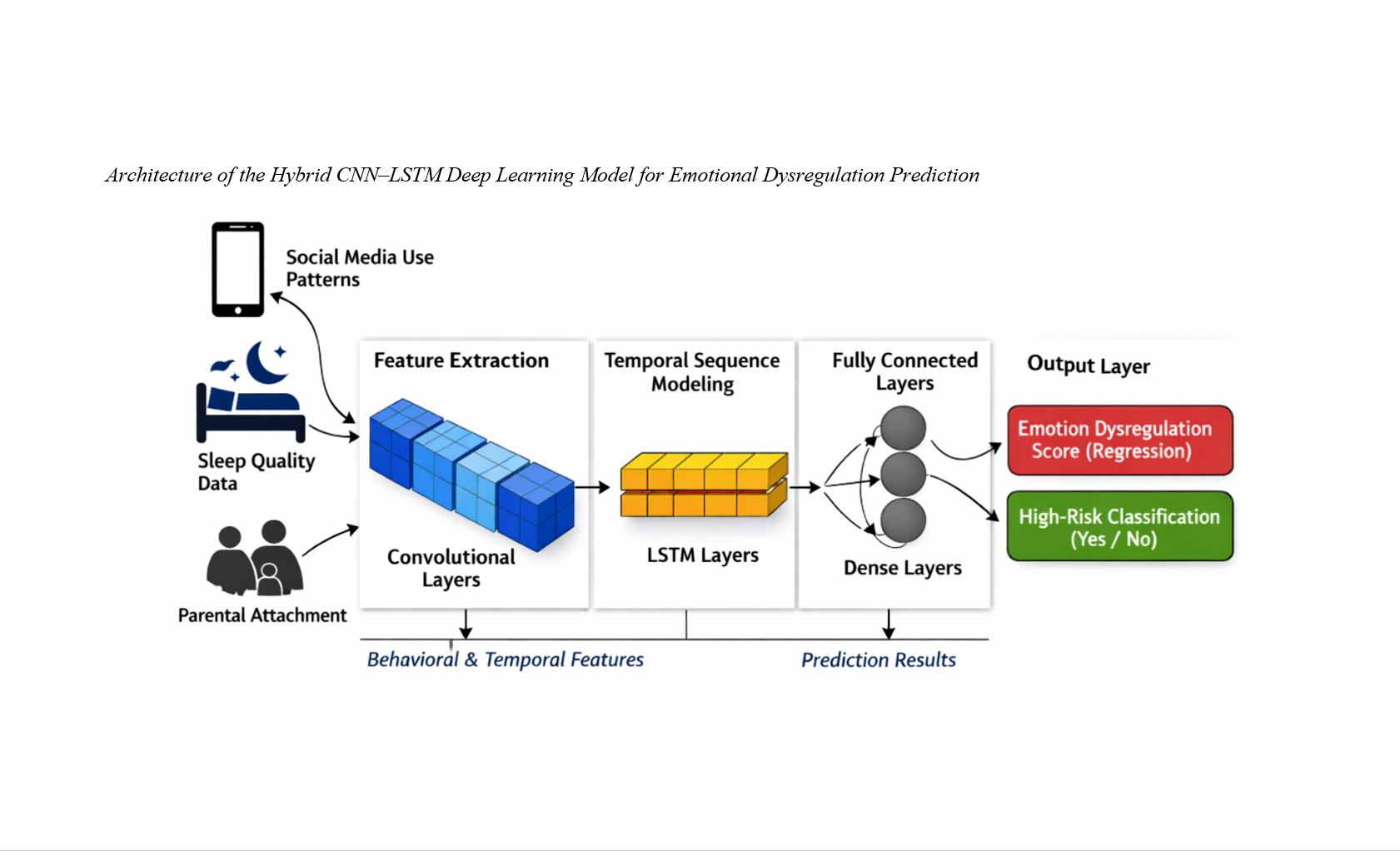
Methods and Materials: This quantitative, cross-sectional predictive study was conducted among 842 adolescents aged 13–18 years from secondary schools in Bogotá, Medellín, and Cali, Colombia. Participants completed standardized measures of emotional dysregulation, sleep quality, and parental attachment, and objective social media usage metadata were collected via smartphone monitoring over a 14-day period. Data were preprocessed and analyzed using a hybrid convolutional neural network–long short-term memory (CNN–LSTM) architecture. Model performance was evaluated using mean absolute error, root mean square error, coefficient of determination, area under the receiver operating characteristic curve, and classification accuracy. Explainable artificial intelligence techniques were applied to determine the relative importance of predictors.
Findings: The deep learning model demonstrated high predictive performance (R² = .79; RMSE = 5.37; AUC = .91; classification accuracy = 87.6%). Emotional dysregulation was significantly associated with social media use (r = .58, p < .001), sleep quality (r = .62, p < .001), and parental attachment (r = −.55, p < .001). Feature importance analysis identified sleep quality (32.4%), nocturnal screen exposure (21.8%), emotional dependency on social media (18.6%), parental attachment security (15.3%), and daily social media duration (11.9%) as the most influential predictors.
Conclusion: The findings indicate that emotional dysregulation in adolescence is strongly shaped by the interaction of digital behavior, sleep processes, and attachment relationships, and that deep learning models offer a powerful tool for early identification of adolescents at elevated emotional risk.
Downloads
References
Alvarado, G., & Palmer, C. A. (2025). 0163 Sleep Quality and Social Interaction: The Moderating Role of Attachment Style. Sleep, 48(Supplement_1), A74-A74. https://doi.org/10.1093/sleep/zsaf090.0163
Asniah, E. (2025). The Emotional Dependency of Adolescent Girls in Romantic Relationships: The Role of Father Nurturant. Kne Social Sciences, 10(25), 258-271. https://doi.org/10.18502/kss.v10i25.19906
Berlianza, A., & Pramono, R. B. (2025). Kelekatan Orang Tua Dan Kecemasan Sosial Sebagai Faktor Penentu Kesepian Remaja Pengguna Media Sosial. Riwayat Educational Journal of History and Humanities, 8(3), 3039-3050. https://doi.org/10.24815/jr.v8i3.47534
Bhau, S., Mahajan, V., Choudhary, S., & Tung, S. (2025). Exploring the Association Between Attachment and Bullying Among Adolescents Through Bowlbian Perspective. International Journal of Innovative Science and Research Techno, 2243-2252. https://doi.org/10.38124/ijisrt/25jul1500
Carvalho, C. B., Arroz, A. M. M., Martins, R., Costa, R., Cordeiro, F., & Cabral, J. (2023). “Help Me Control My Impulses!”: Adolescent Impulsivity and Its Negative Individual, Family, Peer, and Community Explanatory Factors. Journal of youth and adolescence, 52(12), 2545-2558. https://doi.org/10.1007/s10964-023-01837-z
Chen, Y. (2023). Impact of Attachment History on Development of Social Relationships Through Emotion Regulation. 209-217. https://doi.org/10.2991/978-2-494069-97-8_27
Ginalska, K., & Cichopek, A. (2024). Exploring Links Between Attachment and Mental Health. Kwartalnik Naukowy Fides et Ratio, 59(3), 73-83. https://doi.org/10.34766/fer.v59i3.1299
Herdaetha, A., Matius Dimas Reza Dana, I., & Suwito, J. (2025). Factors Influence Non-Suicidal Self-Injury Behavior Among Young Adults. Iseth, 909-915. https://doi.org/10.23917/iseth.5481
Hong, S. L. T., Asatsa, S., & Mutisya, S. (2024). Parental Attachment and Emotional Regulation Among High School Students in Kikuyu Sub County, Kenya. International Journal of Research and Innovation in Social Science, VIII(IX), 450-458. https://doi.org/10.47772/ijriss.2024.809040
Huang, K. H. (2025). Attachment Style Interactions and Their Influence on Adolescent Relationship Information. Interdisciplinary Humanities and Communication Studies, 1(5). https://doi.org/10.61173/1nvcc125
Khalaf, A. M., Alubied, A. A., Khalaf, A., & Rifaey, A. A. (2023). The Impact of Social Media on the Mental Health of Adolescents and Young Adults: A Systematic Review. Cureus. https://doi.org/10.7759/cureus.42990
Kinsella, J. E., & Chin, B. (2024). Mechanisms Linking Social Media Use and Sleep in Emerging Adults in the United States. Behavioral Sciences, 14(9), 794. https://doi.org/10.3390/bs14090794
Leal, M., Adan, M., Heilman, K. J., & Cockcroft, K. (2023). Cardiac Regulation, Attachment Style, and Frustration Tolerance in Children With Disruptive Mood Dysregulation Disorder. https://doi.org/10.31234/osf.io/5j3g2
Leal, M., Adan, M., Heilman, K. J., & Cockcroft, K. (2024a). Autonomic Response and Attachment Style in Disruptive Mood Dysregulation Disorder. South African Journal of Psychiatry, 30. https://doi.org/10.4102/sajpsychiatry.v30i0.2293
Leal, M., Adan, M., Heilman, K. J., & Cockcroft, K. (2024b). Autonomic Response and Attachment Style in Disruptive Mood Dysregulation Disorder. https://doi.org/10.22541/au.169056904.41867362/v2
Liao, J. M. (2025). Attachment Styles and Coping Efficiency: Navigating Academic Stress. Lecture Notes in Education Psychology and Public Media, 92(1), 107-112. https://doi.org/10.54254/2753-7048/2025.22968
Marano, G., Lisci, F. M., Rossi, S., Marzo, E. M., Boggio, G., Brisi, C., Traversi, G., Mazza, O., Pola, R., Gaetani, E., & Mazza, M. (2025). Connected but at Risk: Social Media Exposure and Psychiatric and Psychological Outcomes in Youth. Children, 12(10), 1322. https://doi.org/10.3390/children12101322
Maya, J., Arcos-Romero, A. I., & García, M. V. H. (2023). Psychometric Properties of the Inventory of Parents-Peer Attachment (IPPA) in Adolescents With Behavioural Problems. Clínica y Salud, 34(3), 131-137. https://doi.org/10.5093/clysa2023a13
Ricciardone, S. M., Koehler, V. B., & Rutherford, M. D. (2025). Linguistic Markers of Faster Life History Strategies Among Teen Parents on Reddit: A Comparative Analysis. https://doi.org/10.21203/rs.3.rs-6306298/v1
Rogers, C. R., Chen, X., Kwon, S. J., McElwain, N. L., & Telzer, E. H. (2022). The Role of Early Attachment and Parental Presence in Adolescent Behavioral and Neurobiological Regulation. Developmental Cognitive Neuroscience, 53, 101046. https://doi.org/10.1016/j.dcn.2021.101046
Rosharudin, N. A., Hoesni, S. M., Ali, M. M., & Khairuddin, K. F. (2023). Parenting Factors and Emotion Regulation Among Asian Adolescents: A Systematic Review. International Journal of Academic Research in Business and Social Sciences, 13(11). https://doi.org/10.6007/ijarbss/v13-i11/19492
Salavou, V., & Giannakopoulos, G. (2024). Attachment in Adolescence: Old Patterns and New Challenges. https://doi.org/10.20944/preprints202409.1181.v1
Tan, C. N., & Fauzi, M. A. (2024). Unravelling Late Adolescents’ Addiction to Social Media: A Unified Theory Perspective. Global Knowledge Memory and Communication. https://doi.org/10.1108/gkmc-02-2024-0099
Tuazzara, V. F. (2025). Peran Lingkungan Keluarga Dalam Pembentukan Perkembangan Sosioemosional. Imajinasi Jurnal Ilmu Pengetahuan Seni Dan Teknologi, 2(4), 40-51. https://doi.org/10.62383/imajinasi.v2i4.1001
Valenta, S. T., Ventura, S., Garelli, S., Vicennati, V., Beneventi, M., Agostini, A., Pagotto, U., & Filippini, N. (2025). Exploring Attachment Dimensions in Individuals With Overweight or Obesity. Behavioral Sciences, 15(3), 305. https://doi.org/10.3390/bs15030305
Xie, Y., & Feeney, B. C. (2024). A Narrative Review of Mechanisms Linking Romantic Relationship Experiences to Sleep Quality. Sleep Advances, 5(1). https://doi.org/10.1093/sleepadvances/zpae049
Yuan, D. (2025). The Impact of Social Media on the Adolescent Brain: Cognitive, Emotional, and Societal Implications. Journal of Education and Educational Research, 16(3), 51-57. https://doi.org/10.54097/03c3y333
Zhen, Z., & Tang, F. (2024). Impact of Mattering on Parental Attachment: Social Support Mediation and Self-Efficacy Moderation in Rural Chinese Children. Evolutionary Studies in Imaginative Culture, 1570-1579. https://doi.org/10.70082/esiculture.vi.1482
Zhou, Z. (2025). The Impact of Family of Origin on Romantic Relationships: A Psychological Perspective. Lecture Notes in Education Psychology and Public Media, 81(1), 70-78. https://doi.org/10.54254/2753-7048/2025.20444
Downloads
Additional Files
Publication Timeline
- Submitted
- Revised
- Accepted