Explainable AI Modeling of Academic Burnout in High School Students Using Cognitive Flexibility, School Climate, and Online Learning Engagement
DOI:
https://doi.org/10.61838/kman.jayps.4989Keywords:
academic burnout, cognitive flexibility, school climate, online learning engagement, explainable artificial intelligence, high school studentsAbstract
Objective: The objective of this study was to develop and validate an explainable artificial intelligence model for predicting academic burnout among Chinese high school students based on cognitive flexibility, perceived school climate, and online learning engagement.
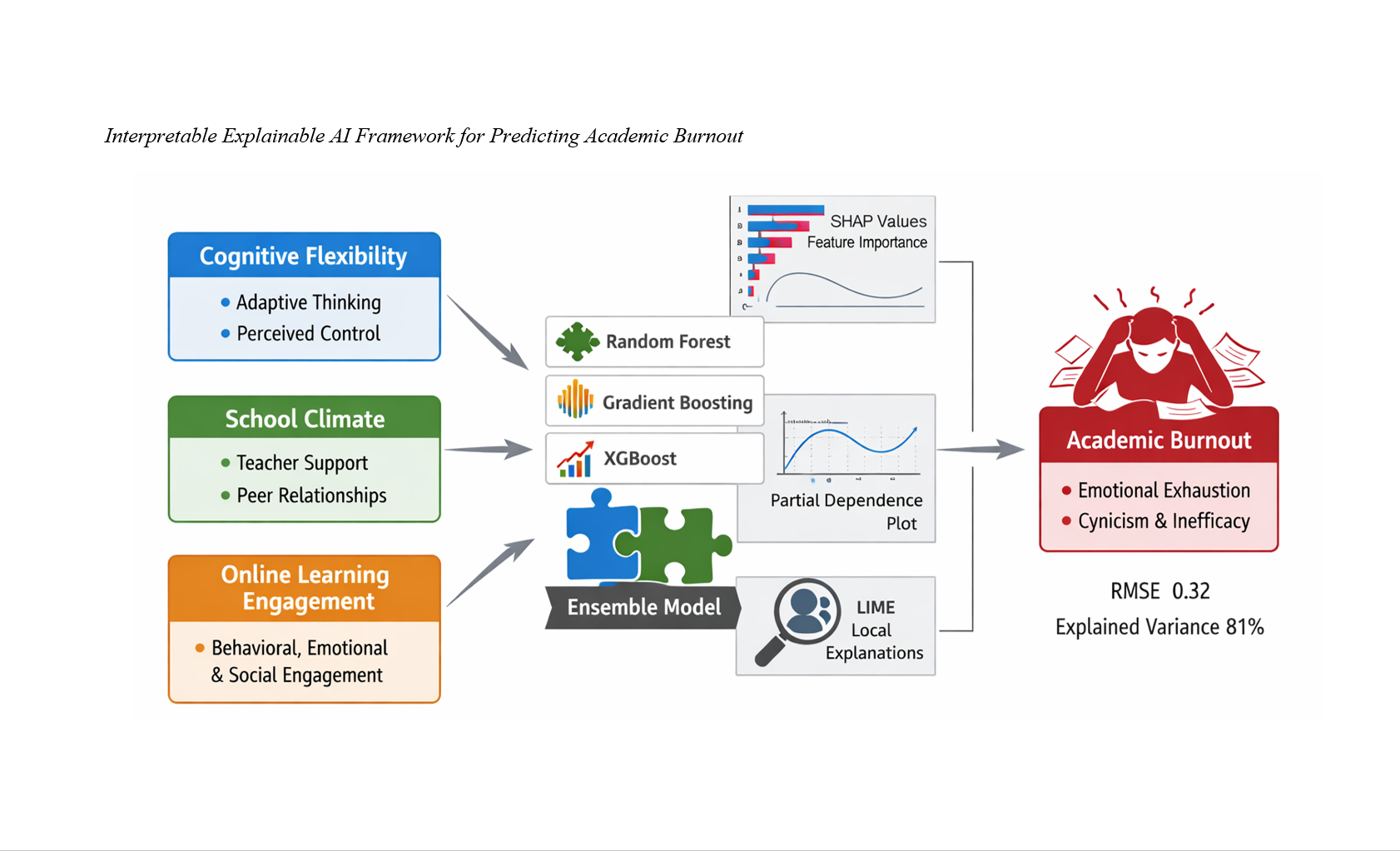
Methods and Materials: This quantitative cross-sectional study was conducted with 1,042 high school students from public schools in three major urban regions of eastern China using multi-stage cluster sampling. Participants completed standardized measures of academic burnout, cognitive flexibility, school climate, and online learning engagement. Data were analyzed using an ensemble machine learning framework combining Random Forest, Gradient Boosting, and XGBoost algorithms. Model performance was evaluated via nested cross-validation. Explainable AI techniques including SHapley Additive exPlanations and Local Interpretable Model-agnostic Explanations were applied to ensure transparency and interpretability of predictions.
Findings: The ensemble model demonstrated strong predictive performance (RMSE = 0.32, MAE = 0.24) and explained 81% of the variance in academic burnout. Cognitive flexibility emerged as the most influential predictor (38.7% relative importance), followed by school climate (31.2%) and online learning engagement (22.5%). The model exhibited high stability across gender and grade-level subgroups, with explained variance ranging from 78% to 83%.
Conclusion: Academic burnout among Chinese high school students is best explained through a dynamic interaction of cognitive, environmental, and behavioral factors, and the proposed explainable AI framework provides a powerful and transparent tool for early identification and targeted prevention of burnout risk in educational settings.
Downloads
References
Arı, A. E. (2025). Sport Burnout in Student-Athletes: The Role of Cognitive Flexibility, Task and Ego Orientation in Sport and Sport Anxiety. Spor Bilimleri Dergisi, 36(2), 86-104. https://doi.org/10.17644/sbd.1625390
Du, Y. (2023). Online Learning During the Pandemic: A Qualitative Investigation of L2 CLIL Students Perceptions and Learning Challenges in China. Lecture Notes in Education Psychology and Public Media, 2(1), 585-598. https://doi.org/10.54254/2753-7048/2/2022392
Dyatlov, A. V., Kovalev, V. V., & Diana, N. C. D. N. C. (2023). Motivation, Intensity and Quality of Educational Activity of Russian Schoolchildren in Online Learning. International Journal of Cognitive Research in Science Engineering and Education, 11(3), 461-473. https://doi.org/10.23947/2334-8496-2023-11-3-461-473
Garcia, R. E., Macaballug, M. E. R., & Pérez, E. (2024). Remote Assessment of Learning During the Pandemic: Junior High School Teachers’ Experiences. International Journal of Evaluation and Research in Education (Ijere), 13(2), 731. https://doi.org/10.11591/ijere.v13i2.25973
Hunt, S. C., Simpson, J., Letwin, L., & MacLeod, B. (2023). Is Online Learning During the COVID-19 Pandemic Associated With Increased Burnout in Medical Learners?: A Medical School’s Experience. PLoS One, 18(5), e0285402. https://doi.org/10.1371/journal.pone.0285402
Kuluşaklı, E. (2025). Student Engagement and Flexibility in Distance Learning in Higher Education. Sage Open, 15(1). https://doi.org/10.1177/21582440251329979
Li, J., Roihan, N., & McGravey, M. (2025). High School Students' Perspectives on Their Online Learning Experiences: A Systematic Literature Review. Journal of Computer Assisted Learning, 41(4). https://doi.org/10.1111/jcal.70064
Liu, X. (2023). Examining Student Burnout Causes Among English as a Foreign Language Students: Focus on School Climate and Student Growth Mindset. Frontiers in psychology, 14. https://doi.org/10.3389/fpsyg.2023.1166408
Mafratoğlu, R., Altınay, F., Köç, A., Dağlı, G., & Altınay, Z. (2023). Developing a School Improvement Scale to Transform Education Into Being Sustainable and Quality Driven. Sage Open, 13(1). https://doi.org/10.1177/21582440231157584
Mendl, J., Fröber, K., & Dreisbach, G. (2024). Flexibility by Association? No Evidence for an Influence of Cue–transition Associations on Voluntary Task Switching. Journal of Experimental Psychology Human Perception & Performance, 50(3), 313-328. https://doi.org/10.1037/xhp0001186
Nidhom, A. M., Andika Bagus Nur Rahma, P., Smaragdina, A. A., Ningrum, G. D. K., & Yunos, J. M. (2022). Integration of Augmented Reality Into MOOC’s in Vocational Education to Support Education 3.0. International Journal of Interactive Mobile Technologies (Ijim), 16(03), 20-31. https://doi.org/10.3991/ijim.v16i03.28961
Nitiasih, P. K., Putra, I. N. A. J., Budiarta, L. G. R., Ni Luh Putu Era, A., & Suastika, G. S. (2022). A Narrative Inquiry on the Implementation of Online Learning During Covid-19 at Junior High Schools. 134-148. https://doi.org/10.2991/978-2-494069-29-9_15
Nursulistyo, E., Indratno, T. K., Dwiastuti, E., Arifiyanti, F., Puspitasari, A. D., Abdullah, N. S. Y., & Sukarelawan, M. I. (2022). Perception Scale of Online Learning in the Indonesian Context During the Covid-19 Pandemic: Psychometric Properties Based on the Rasch Model. Indonesian Review of Physics, 5(2), 49-56. https://doi.org/10.12928/irip.v5i2.6544
Oliveira, S., Roberto, M. S., Simão, A. M. V., & Marques‐Pinto, A. (2022). Effects of the A+ Intervention on Elementary-School Teachers’ Social and Emotional Competence and Occupational Health. Frontiers in psychology, 13. https://doi.org/10.3389/fpsyg.2022.957249
Park, C. H., Kwon, J., Lee, J.-T., & Ahn, S. (2023). Impact of Criterion Versus Norm-Referenced Assessment on the Quality of Life in Korean Medical Students. Journal of Korean medical science, 38(17). https://doi.org/10.3346/jkms.2023.38.e133
Rocha, R. S., Castro, S. L., & Limpo, T. (2022). The Role of Transcription and Executive Functions in Writing: A Longitudinal Study in the Transition From Primary to Intermediate Grades. Reading and Writing, 35(8), 1911-1932. https://doi.org/10.1007/s11145-022-10256-8
Vita‐Barrull, N., Estrada‐Plana, V., March‐Llanes, J., Guzmán, N., Mayoral, M., & Moya, J. (2023). Cognitive Teleintervention With Board Games During the Pandemic Lockdown in School-Age Children. International Journal of Games and Social Impact, 1(2), 8-37. https://doi.org/10.24140/ijgsi.v1.n2.01
Wang, X., Zhang, L., & He, T. (2022). Learning Performance Prediction-Based Personalized Feedback in Online Learning via Machine Learning. Sustainability, 14(13), 7654. https://doi.org/10.3390/su14137654
Wijaya, R. G., Rizkyanto, W. I., Gani, I., & Iswanto, A. (2023). Analysis of the Impact of Synchronous Physical Education Online Learning on the Character, Psychology, and Physiology of High School Students in Yogyakarta. 37-47. https://doi.org/10.2991/978-94-6463-356-6_5
Ye, S., Wang, R., Pan, H., Zhao, F., Li, W., Xing, J., & Wu, J. (2023). Development and Validation of a Prediction Nomogram for Academic Burnout Among Chinese Adolescents: A Cross-Sectional Study. BMJ open, 13(5), e068370. https://doi.org/10.1136/bmjopen-2022-068370
Yu, H.-H., Hu, R.-P., & Chen, M.-L. (2022). Global Pandemic Prevention Continual Learning—Taking Online Learning as an Example: The Relevance of Self-Regulation, Mind-Unwandered, and Online Learning Ineffectiveness. Sustainability, 14(11), 6571. https://doi.org/10.3390/su14116571
Yu, W., Yang, S., Chen, M., Zhu, Y., Meng, Q., Yao, W., & Bu, J. (2022). School Psychological Environment and Learning Burnout in Medical Students: Mediating Roles of School Identity and Collective Self-Esteem. Frontiers in psychology, 13. https://doi.org/10.3389/fpsyg.2022.851912
Yu, W., Yao, W., Chen, M., Zhu, H., & Yan, J. (2023). School Climate and Academic Burnout in Medical Students: A Moderated Mediation Model of Collective Self-Esteem and Psychological Capital. BMC psychology, 11(1). https://doi.org/10.1186/s40359-023-01121-6
Yu, X., Sun, C., Sun, B., Yuan, X., Ding, F., & Zhang, M. (2022). The Cost of Caring: Compassion Fatigue Is a Special Form of Teacher Burnout. Sustainability, 14(10), 6071. https://doi.org/10.3390/su14106071
Downloads
Additional Files
Publication Timeline
- Submitted
- Revised
- Accepted