Predicting Employee Turnover Using Explainable Machine Learning Models: A Comparative Study of XGBoost, LightGBM, CatBoost, and Deep Neural Networks
DOI:
https://doi.org/10.61838/kman.ijimob.5454Keywords:
Employee Turnover Prediction, Explainable Artificial Intelligence, Human Resource Analytics, Machine LearningAbstract
Objective: This study aimed to develop and compare explainable machine learning models for employee turnover prediction using XGBoost, LightGBM, CatBoost, and Deep Neural Networks and to identify the most influential predictors of turnover risk through explainable artificial intelligence techniques.
Methods and Materials: This quantitative predictive analytics study was conducted using a dataset of 4,862 employees from 37 organizations across multiple industries in Canada. Employee demographic, organizational, behavioral, performance-related, and psychological variables were collected from human resource information systems and validated survey instruments. The dataset was preprocessed through normalization, feature engineering, categorical encoding, and missing-value imputation procedures. Four machine learning algorithms, including XGBoost, LightGBM, CatBoost, and Deep Neural Networks, were developed and optimized using grid search and Bayesian hyperparameter tuning. The dataset was divided into training, validation, and testing subsets using stratified sampling. Model performance was evaluated using accuracy, precision, recall, F1-score, area under the receiver operating characteristic curve (AUC-ROC), area under the precision-recall curve (AUC-PR), Matthews correlation coefficient, and balanced accuracy. Explainability was achieved through SHapley Additive exPlanations (SHAP), Local Interpretable Model-Agnostic Explanations (LIME), and partial dependence analyses.
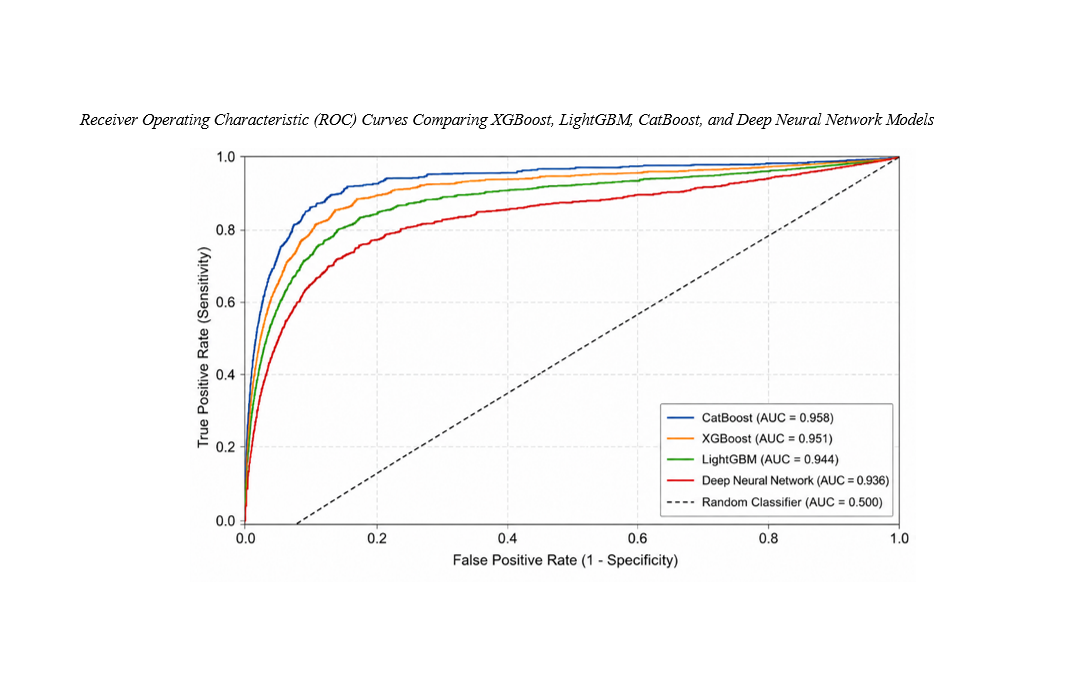
Findings: The comparative analysis revealed that all machine learning models achieved strong predictive performance; however, CatBoost outperformed the other algorithms, achieving an accuracy of 91.9%, an F1-score of 0.878, and an AUC-ROC value of 0.958. XGBoost demonstrated the second-highest performance with an accuracy of 91.3% and an AUC-ROC of 0.951, followed by LightGBM (accuracy = 90.6%, AUC-ROC = 0.944) and the Deep Neural Network (accuracy = 89.7%, AUC-ROC = 0.936). ROC curve analyses confirmed the superior discriminative ability of CatBoost. SHAP-based explainability analyses identified job satisfaction, employee engagement, organizational commitment, perceived organizational support, promotion frequency, salary growth, performance ratings, overtime hours, absenteeism, and training participation as the most influential predictors of employee turnover. The confusion matrix of the CatBoost model further demonstrated strong classification capability with high true positive and true negative rates and minimal classification errors.
Conclusion: The findings demonstrate that explainable machine learning models can accurately predict employee turnover and provide meaningful insights into the organizational, behavioral, and psychological factors associated with employee departure. Among the evaluated algorithms, CatBoost offered the optimal balance between predictive accuracy and interpretability. The integration of explainable artificial intelligence techniques enhanced transparency and practical applicability, enabling organizations to identify high-risk employees and implement proactive retention strategies. These results support the adoption of explainable machine learning as an effective decision-support tool for workforce analytics, talent management, and organizational sustainability.
Downloads
References
Akasheh, M. A., Hujran, O., Malik, E. F., & Zaki, N. (2024). Enhancing the Prediction of Employee Turnover With Knowledge Graphs and Explainable AI. IEEE Access, 12, 77041-77053. https://doi.org/10.1109/access.2024.3404829
Alqahtani, H., Almagrabi, H., & Alharbi, A. (2024). Employee Attrition Prediction Using Machine Learning Models: A Review Paper. International Journal of Artificial Intelligence & Applications, 15(2), 23-49. https://doi.org/10.5121/ijaia.2024.15202
Chandgadkar, V., Pathak, P., Solanki, A., Shrivastava, A., Maktum, T., & Pulgam, N. (2024). ETPSR: Employee Turnover Prediction With Security Recommendations. https://doi.org/10.21203/rs.3.rs-4261760/v1
Dhamija, S. (2023). Analysing Theoretical Models for Predicting Employee Attrition: A Comparative Study in the FMCG Sector. Journal of Advanced Zoology, 44(S-3), 1179-1191. https://doi.org/10.17762/jaz.v44is-3.1295
Gazi, M. S., Nasiruddin, M., Dutta, S., Sikder, R., Huda, C. B., & Islam, M. Z. (2024). Employee Attrition Prediction in the USA: A Machine Learning Approach for HR Analytics and Talent Retention Strategies. Journal of Business and Management Studies, 6(3), 47-59. https://doi.org/10.32996/jbms.2024.6.3.6
Gurung, N., Gazi, M. S., & Islam, M. Z. (2024). Strategic Employee Performance Analysis in the USA: Deploying Machine Learning Algorithms Intelligently. Journal of Business and Management Studies, 6(3), 01-14. https://doi.org/10.32996/jbms.2024.6.3.1
Hadiyanto, H., & Anggoro, Y. (2025). A Skill Matrix Chart Case Study in Global Manufacturing. Systems Research and Behavioral Science, 42(6), 1902-1916. https://doi.org/10.1002/sres.3128
Kiran, P. R., Chaubey, A., & Shastri, R. K. (2023). Role of HR Analytics and Attrition on Organisational Performance: A literature Review Leveraging The SCM-Tbfo Framework. Benchmarking an International Journal, 31(9), 3102-3129. https://doi.org/10.1108/bij-06-2023-0412
Kumar, P., Gaikwad, S. B., Ramya, S. T., Tiwari, T., Tiwari, M., & Kumar, B. (2023). Predicting Employee Turnover: A Systematic Machine Learning Approach for Resource Conservation and Workforce Stability. 117. https://doi.org/10.3390/engproc2023059117
Kundu, B., Shyam, R., & Mondal, B. (2024). The Role of Predictive Analytics in Enhancing Employee Retention in India’s Start-Up Ecosystem. Interantional Journal of Scientific Research in Engineering and Management, 08(11), 1-6. https://doi.org/10.55041/ijsrem39218
Lalitha, V., Prithiv, R. S., & Lokesh, P. (2023). A Novel Analysis of Employee Attrition Rate by Maneuvering Machine Learning. Advances in Science and Technology. https://doi.org/10.4028/p-sw6mmb
Márquez, B. Y., Realyvásquez-Vargas, A., Lopez-Esparza, N., & Ramos, C. E. (2023). Application of Ordinary Least Squares Regression and Neural Networks in Predicting Employee Turnover in the Industry. Archives of Advanced Engineering Science, 2(1), 30-36. https://doi.org/10.47852/bonviewaaes32021326
Nandal, M., Grover, V., Sahu, D., & Dogra, M. (2024). Employee Attrition: Analysis of Data Driven Models. Eai Endorsed Transactions on Internet of Things, 10. https://doi.org/10.4108/eetiot.4762
Patnaik, T. (2024). The Incorporation of HR Metrics in HR Management: A Theoretical Framework With a Specific Focus on Indian Corporates. Ajbr, 5409-5417. https://doi.org/10.53555/ajbr.v27i3s.3115
Preena, R. E. (2024). Techniques to Predict Employee Attrition Using Optimized Levy Fruit Fly Optimization Algorithm. https://doi.org/10.21203/rs.3.rs-4127736/v1
Qin, R., Qi, X., Yuan, Y., & Alataş, B. (2026). Employee Turnover Prediction Research of Human Resource Management on Machine Learning Algorithms and Big Data Analysis. Journal of Organizational and End User Computing, 38(1), 1-27. https://doi.org/10.4018/joeuc.399146
Ravesangar, K., & Narayanan, S. (2024). Adoption of HR Analytics to Enhance Employee Retention in the Workplace: A Review. Hum. Resour. Manag. Serv., 6(3), 3481. https://doi.org/10.18282/hrms.v6i3.3481
Reddy, J. S. (2023). Big Data-Based Framework for Prediction of Employee Attrition by Using Deep Data People Analytics. https://doi.org/10.52783/jier.v3i2.432
Swetha, M., Mahalakshmi, S., Pushpa, S., Madihalli, A. T., Ananya, A., & Bhardwaj, A. (2022). Machine Learning Approach for Forecasting Job Appeasement and Employee Corrosion. https://doi.org/10.15439/2023r17
Talebi, H., Bardsiri, A. K., & Bardsiri, V. K. (2025). Machine Learning Approaches for Predicting Employee Turnover: A Systematic Review. Engineering Reports, 7(8). https://doi.org/10.1002/eng2.70298
Tang, M., Zhao, T., Hu, Z., & Li, Q. (2023). Research on Risk Prediction and Early Warning of Human Resource Management Based on Machine Learning and Ontology Reasoning. Tehnicki Vjesnik - Technical Gazette, 30(6). https://doi.org/10.17559/tv-20230810000869
Tripathi, A. K., Kumari, P., Katiyar, P., Chaudhary, V. S., & Sharma, M. (2024). Workforce Attrition and Engagement Analysis Using Machine Learning. https://doi.org/10.55524/csistw.2024.12.1.26
Xu, Y. (2026). Improving Employee Retention With Machine Learning for Proactive Turnover Risk Detection and Strategic Interventions. https://doi.org/10.21203/rs.3.rs-8378596/v1
Zheng, X. (2025). Construction of a Big Data-Driven Predictive Analysis Platform for Hospital Talent Attrition. Blockchain in Healthcare Today, 8(3). https://doi.org/10.30953/bhty.v8.433
Downloads
Additional Files
Publication Timeline
- Submitted
- Revised
- Accepted